
To the Realm of the Dead
Reflections on the Creation of the Monster in Mary Shelley's Frankenstein

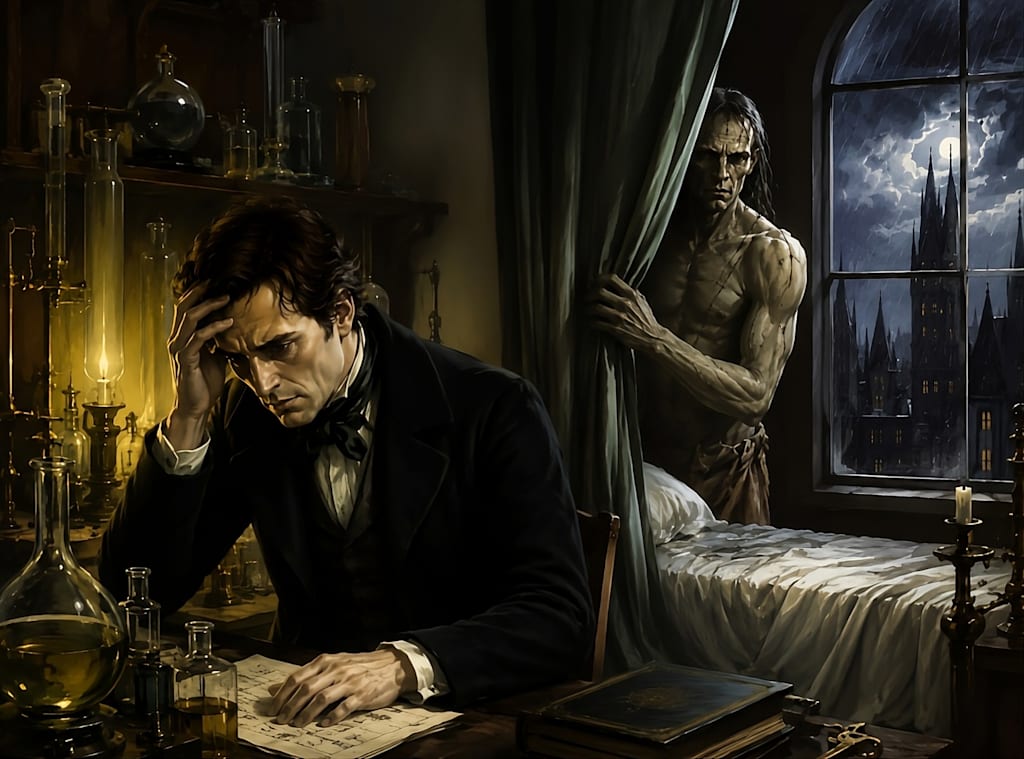
Victor Frankenstein walks the streets of Ingolstadt in a state of confusion, exaltation, and despair. He has brought to life the hideous result of his labors; his endless plumbing of the charnel houses in search of the decaying bits and pieces of bodies, the raw material, the noxious stuff from which he has formed his ersatz "man." God-like, he has been emotionally ascendant, selecting the features as beautiful, before recoiling in horror at the death-like ugliness, the hideous stupor of yellowed, abysmal carnality that marks the features of one who possesses a body, yet lacks a soul.
The streets of Ingolstadt offer no respite. We can imagine them as a dark, dank eighteenth-century swirl of animal droppings and gutter offal, rain-soaked cobbled alleys and dark, eyeless windows looking outward as an exteriorization of the oppression that grips his soul. From this atmosphere arises a vision of death, a prefiguration of the fate awaiting his beloved cousin Elizabeth.
Asleep, still ensconced in the agony of exhaustion beneath the canopied curtains of his laboratory bed, Frankenstein sees Elizabeth in the dismal streets of Ingolstadt, arrived in the beatific bounty of a wedding gown. Rushing to greet her, he embraces her warmly before feeling the stiff, crushing, cold, and emaciated embrace of a living ghost, fancying he can see "the hue of death upon her lips."
Envisioning grave worms burrowing through her clothing, he imagines that he is holding the corpse of his mother in his arms.
This necro-incestuous dream image is a precursor to what will happen later. Victor awakens and, with horror, sees the eyes—if they can be called eyes—of the Creature staring at its father in rapt, clueless wonder. Victor flees from the abomination to which he has given birth, the thing lurking within that has now been exteriorized, manifested as assuredly as a medium of the period was said to manufacture the living embodiment of the dead, the ectoplasmic incarnation of departed men and women.
Yet this dumb-show monster, this hideous mummery, this mockery of all that is natural and sanctified, is no spiritual guide. Except, perhaps, to Hades. To the Lower Circle. An emissary of the lower order of fallen angels. Paradise lost.
To the Realm of the Dead
Victor's laboratory apartment, upon which rain beat ceaselessly against the panes on that fatal night, is the expositor of his consciousness, a representation of the mercurial and primal forge from which he has smitten an image in the darkness of his subconscious, giving full-blown birth to something that emerged from the darkest and most primitive recesses of a guilt-besotted self.
Does Elizabeth represent the corpse of Victor's mother? Is she the substitute sacrifice he is unconsciously offering to his Beast, the outgrowth and physical manifestation of his perverse spiritual disease? Frankenstein is infused with sexual guilt. Generation, absolution, and death are intertwined in the mind of a man whose hands betray him into releasing the ogre that lies within.
Stitched together, the Creature—the Monster, by later Hollywood parlance—is soulless. Like Dracula, who seeks a grotesque parody of absolution in the blood of captive victims, the Creature is a being without spirit. Born from decayed flesh, from a lavatorial swamp of putrescence stitched together and reordered, perhaps with galvanic force, though Shelley remains deliberately vague, he is animated by whatever "instruments of life" Victor has assembled around him. One is left to wonder precisely what those instruments were.
Brought into accursed awareness, the Creature wanders the darkened apartment overlooking the court below like a lost child suddenly awakened to a new, pressing, and terrifying fate. Pulling back the curtain and revealing the sleeping Frankenstein, he becomes the Dreamed Demon watching the tormented Dreamer.
Like an ogre from a fairy tale, he inspires horror not merely because of what he is, but because of what he reveals. Frankenstein flees from him in disgust, yet he is fleeing from his own tragic genius.
Later, arriving by Swiss conveyance, Henry Clerval will spend months nursing Victor back to health. He brings news from Elizabeth and helps restore his shattered mind while the memory of Victor's accursed sin slips gradually into the background. Yet Victor may already be standing on the threshold of madness, if he has not crossed it entirely.
Below him yawns the abyss of Selfhood.
Can he live with what he has done?
He has traversed the Realm of Death and returned carrying a charnel ogre from the Pit. He has brought forth a nightmare and released it into the conscious world of living men.
And so, here upon the precipice of spiritual ruin, Victor trembles for his own soul.
Read my book: Theater of the Worm: Essays on Poe, Lovecraft, Bierce, and the Machinery of Dread by Tom Baker
Read my book: Silent Scream! Nosferatu, The Cabinet of Dr. Caligari, Metropolis, and Edison's Frankenstein--Four novels by C. Augustine
Ebook
Print book
Author's website
Author's YouTube
About the Creator
Tom Baker
Author of Haunted Indianapolis, Indiana Ghost Folklore, Midwest Maniacs, Midwest UFOs and Beyond, Scary Urban Legends, 50 Famous Fables and Folk Tales, and Notorious Crimes of the Upper Midwest.: http://tombakerbooks.weebly.com
Enjoyed the story? Support the Creator.
Subscribe for free to receive all their stories in your feed. You could also become a paid subscriber, letting them know you appreciate their work.
Comments
There are no comments for this story
Be the first to respond and start the conversation.