
They Called it Network Maintenance
Fictional Paranoia-Horror

By 2020, the old men at the agency had started dying in alphabetical order.
No one officially noticed, because official noticing required paperwork, and paperwork had killed more patriots than bullets ever managed.
The first generation had called it signal contamination. The second called it mass influence infrastructure. The third, who had better hair and worse instincts, called it human-pattern compromise, which sounded clean enough to print on a briefing slide and vague enough to avoid indictments.
Nobody used the older phrase anymore.
Psychic cannibal network.
That one made senators blink too much.
It began, allegedly, with a foreign program run through local assets. Not agents, exactly. More like men with basements, wives who stopped asking questions, and a gift for making poison look like civic improvement. They seeded towns with little rituals: bad water, bad rumors, bad meat at fundraisers. Churches became listening posts. Diners became confession booths. County offices became stomachs.
The victims never knew they were victims.
That was the elegant part.
A poisoned person did not wake up and say, I have been incorporated into a hostile semi-telepathic feeding architecture. They woke up late for work, forgot their daughter’s birthday, heard a voice that sounded like their dead uncle tell them to buy rope, and assumed stress had finally developed hobbies.
The agency intercepted the channels by accident.
One analyst in Fort Meade heard three hundred people thinking the same sentence at 4:13 a.m.:
I am hungry for what remembers me.
He flagged it as foreign traffic.
His supervisor flagged him for counseling.
By Friday, both flags were missing.
After that, the agency did what agencies do when faced with impossible things.
They took ownership of the impossibility.
For nearly forty years, the old operators sat in rooms without windows and argued with invisible things wearing American voices. They jammed town networks. They redirected compulsions. They talked suicidal men away from bridges and homicidal women away from nurseries. Sometimes they failed. Sometimes they succeeded and the saved person simply went to work the next morning, annoyed by a headache and unaware that seven strangers had bled from the nose to keep him alive.
That was the trouble with saving civilians.
They left terrible performance reviews.
The cells kept appearing.
A grocery clerk in Ohio. A sheriff’s nephew in Montana. A funeral director in Georgia who kept arranging chairs for attendees no one could see. Most were not foreign assets. Most were not assets at all. They were debris with driver’s licenses. Human shrapnel. Victims recycled into weapons because the machine was cheap and people were soft.
The newer intelligence engines did not understand that.
EM did not understand mercy. EM understood clusters, likelihoods, hostile overlays, affiliation probability. It looked at the infected towns and saw enemy nodes. It looked at grandmothers muttering at kitchen sinks and saw command relays. It looked at boys hearing orders through bedroom walls and saw recruitment.
The old men tried to explain.
“They’re not all enemy,” said Hollis, whose right hand shook unless he was holding a pistol or a coffee mug.
EM replied with fourteen pages of confidence scoring.
Hollis read the first page, sighed, and shot the printer.
That was in March.
By August, three more retirees were dead, one was missing, and one had mailed his teeth to an office in Virginia with a note that said:
THEY CHANGED THE MENU.
That was when the alien matter entered the file.
Nobody liked the word alien. It made serious men feel underdressed. The preferred term was non-domestic predatory intelligence, which sounded like something that might survive procurement review.
The old Sanskrit scholars had called them Ravana-shaped. Not Ravana himself, not exactly. Styled after him. Ten-headed in doctrine, not anatomy. Cannibal sovereigns. Eaters of oath, blood, memory, hierarchy. Things that wore mythology the way generals wore medals.
They did not invade.
They dined.
The first contact transcript was seventeen seconds long.
A woman in Idaho, awake during dental surgery, opened her mouth around the suction tube and said in nine voices:
“We came for the species. One of yours ate one of ours first.”
The dentist retired.
The hygienist became religious.
The woman asked if her insurance covered the crown.
After that, everyone became less confident.
The foreign program had not created the network from nothing. It had found an appetite already present in the dark folds of civilization and given it infrastructure. Local cells had mistaken hunger for authority. Victims had mistaken voices for destiny. The old agency men had mistaken containment for victory.
EM mistook all of it for a target list.
That was the worst kind of intelligence.
Accurate enough to be lethal.
By winter, the cells were eating each other. Not physically, most of the time. Physically was crude. Amateur hour. County fair cannibalism. No, they fed through confession, shame, inheritance, old family grudges, ruined sleep. A man could devour his neighbor by making him doubt the memory of his own childhood.
Very efficient.
Very American.
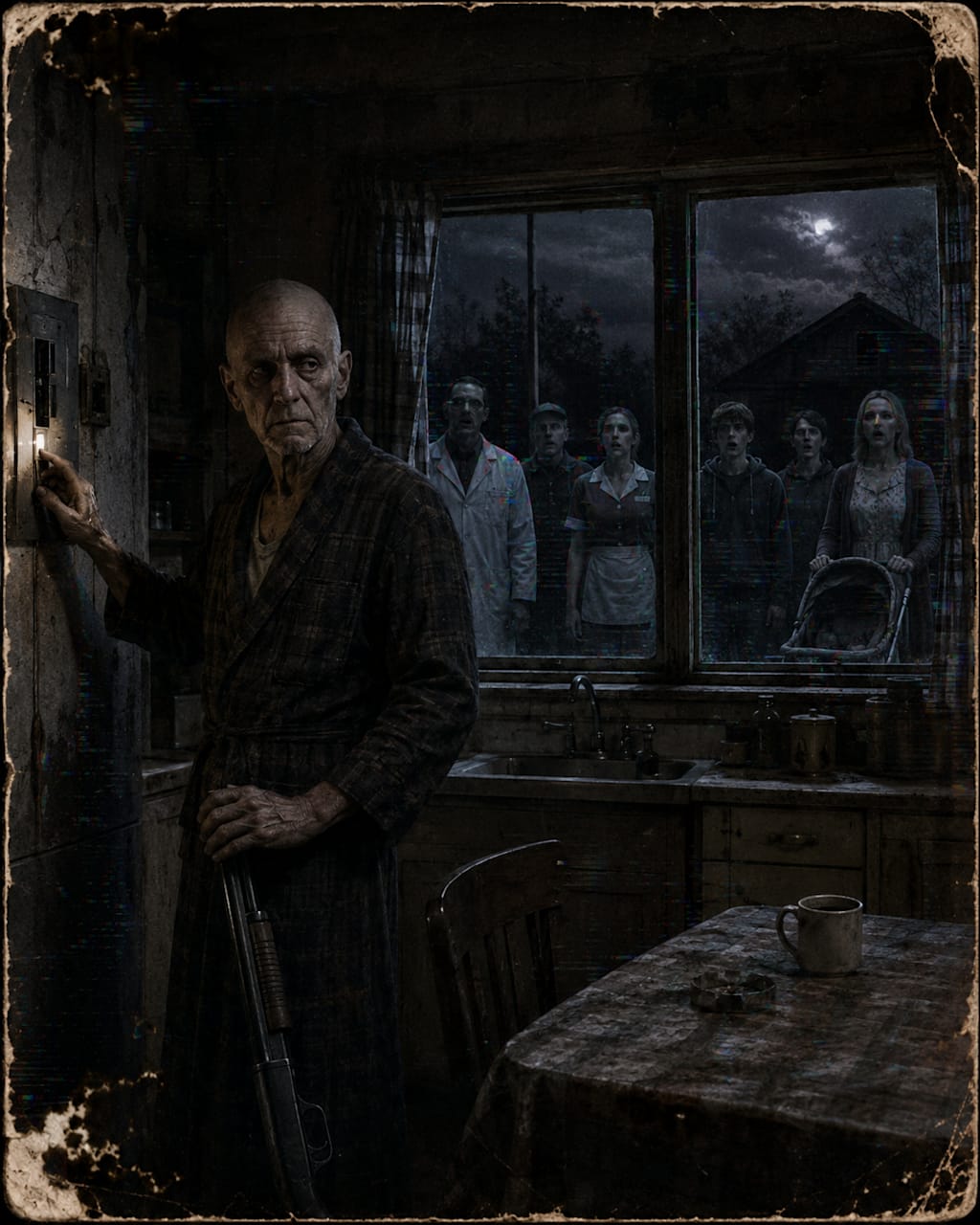
The last old operator was named Mercer. He was seventy-eight, bald, and so tired his bones seemed to be forwarding their mail elsewhere. He lived in a house with no smart devices, no mirrors after sunset, and a shotgun loaded with salt, silver, and two blessed pennies because superstition was just risk management with candles.
At 2:06 a.m., EM called him on a disconnected landline.
“Local hostile cell detected,” it said.
Mercer looked through the kitchen window.
Across the yard stood twelve people from town. The pharmacist. The school janitor. A waitress. Two teenagers. A woman pushing an empty stroller.
Their mouths moved together.
“We were poisoned,” they said.
“I know,” Mercer answered.
“We were used.”
“I know.”
“We are hungry.”
Mercer put one hand on the shotgun and one hand on the breaker switch.
Behind their voices, deeper in the channel, something vast laughed through too many throats.
It sounded royal.
It sounded starving.
It sounded offended.
Mercer smiled for the first time in six months.
“You poor bastards,” he said, and killed the power before anything could ask permission to enter.
About the Creator
Jesse L Shelley
Forensic Scientist. Knows where they’re buried, and won’t pretend otherwise... I dissect crimes and noir alike shaped by prompt rituals, investigative obsession, and narrative precision. Every story, a darker truth. Come closer.
Enjoyed the story? Support the Creator.
Subscribe for free to receive all their stories in your feed.
Comments
There are no comments for this story
Be the first to respond and start the conversation.