
The Zodiac Killer: America’s Most Theatrical Monster - How One Man Terrorized California, Taunted the World, and Vanished Into Legend
From lovers’ lane executions to hooded stabbings and cryptic letters that mocked police for decades, the chilling true story of the Zodiac Killer – a case that still haunts investigators, amateur sleuths, and true crime fans more than 55 years later.

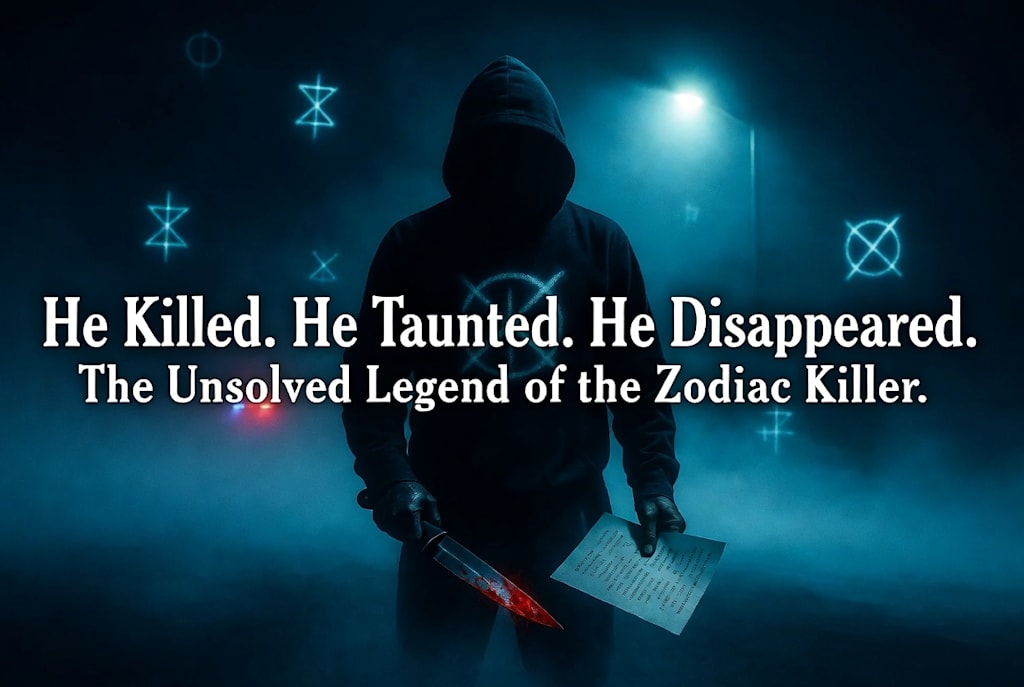
Have you ever been on a quiet date, parked somewhere secluded, and felt that sudden uneasy prickle on the back of your neck? Like someone, somewhere in the shadows, is watching you? For most of us, it’s just paranoia. But for a handful of young people in Northern California at the end of the 1960s, that feeling was brutally, fatally real.
It’s a crisp December night in 1968. Seventeen-year-old David Faraday and his sixteen-year-old girlfriend Betty Lou Jensen are on their first real date. David, nervous and hopeful, has picked out a nice light blue shirt. They’re parked on a quiet stretch of Lake Herman Road near Benicia. Young love, Christmas lights twinkling somewhere in the distance, the kind of night that should become a warm memory. Instead, headlights appear. Another car pulls up. Gunshots rip through the stillness. David is shot in the head at close range. Betty Lou tries to run but is gunned down with five bullets. The killer drives away, leaving two innocent teenagers dead and an entire region on the edge of fear.
But that was only the beginning.
You know, what makes the Zodiac Killer so uniquely disturbing isn’t just the violence. It’s the performance. The showmanship. The way he turned cold-blooded murder into a twisted public spectacle that played out in newspapers across the country. He didn’t just kill. He bragged. He teased. He sent codes promising to reveal his identity. And then he slipped away, leaving behind one of the most famous unsolved cases in American history. Even now, in 2026, people are still obsessed. Still debating. Still wondering if he’s finally been identified or if he died laughing at all of us.
The Summer of Fear - When the Bay Area Changed Forever
Fast forward to July 4th, 1969. The nation is celebrating Independence Day, but in Vallejo, California, another young couple is in the wrong place at the wrong time.
Darlene Ferrin, a lively 22-year-old waitress, is out with 19-year-old Michael Mageau. They’re parked at Blue Rock Springs Golf Course when another car pulls alongside. The driver flashes a bright light, then starts shooting. Michael is hit multiple times but survives long enough to give a description. Darlene is not so lucky. The killer walks over, fires two more point-blank shots into her, then drives off casually.
Just minutes later, a man calls the Vallejo Police Department from a payphone. In a calm, almost bored voice, he takes credit for the shootings - and for the Lake Herman Road murders six months earlier. He gives exact details only the killer would know. Then he hangs up.
This is when the public first hears the name that would haunt them: Zodiac.
A few weeks later, three letters arrive at local newspapers. Each contains part of a cipher - 408 symbols in total. The killer demands they be printed on the front page. Inside the decoded message (solved remarkably fast by a teacher and his wife) are the chilling words:
“I like killing people because it is so much fun. It is more fun than killing wild game in the forest because man is the most dangerous animal of all…”
He talks about collecting slaves for the afterlife. He mocks the police. And he promises more death if they don’t play along.
The Most Cinematic Attack - Lake Berryessa
If there’s one scene from this case that feels ripped straight out of a horror movie, it’s what happened on September 27, 1969, at Lake Berryessa.
Bryan Hartnell and Cecelia Shepard are enjoying a peaceful picnic by the lake on a sunny Saturday afternoon. A man approaches them wearing a bizarre hooded outfit - almost like an executioner’s costume - with the Zodiac’s crossed-circle symbol stitched on the chest. He claims to be an escaped convict from Montana, shows them a gun, and forces them to tie each other up.
Then comes the talking. The slow, deliberate conversation. The psychological torment. Finally, he pulls out a knife and stabs them repeatedly. Bryan survives despite terrible wounds. Cecelia does not. Before leaving, the killer writes his symbol, the date, and the time on the side of Bryan’s car door in black marker. Like an artist signing his work.
You can almost feel the contrast - bright California sunshine, blue water, birds chirping… and pure evil calmly going about its business.
The San Francisco Taxi Murder and Escalating Threats
Just two weeks later, on October 11, 1969, the killer strikes in the city itself. Taxi driver Paul Stine picks up a passenger in Presidio Heights. The man shoots him in the head, takes his wallet, and cuts off a large piece of his bloody shirt. He mails that piece to the San Francisco Chronicle along with another letter.
This time the threats get bigger. He says he’ll blow up a school bus full of children. He demands more of his letters on the front page. The newspapers, trapped between public safety and not wanting to give him exactly what he craves, walk a careful line.
Over the following years, more letters arrive - sometimes with new ciphers, sometimes with boasts, sometimes with complaints about how the press is covering him. He claims responsibility for up to 37 victims. Police can only confirm five murders and two survivors, but the fear he spread went far beyond the body count.
The Cryptic Obsession - Ciphers That Drove the World Crazy
What really set Zodiac apart was his love of codes. He sent four major ciphers. The first 408-symbol one was solved quickly. The famous 340-symbol cipher sent in November 1969 remained unsolved for over 50 years until a team of amateur codebreakers finally cracked it in 2020. Even then, it didn’t reveal his name - just more taunting about fun, paradise, and slaves.
Two other ciphers remain unsolved to this day. People still work on them. Cryptographers, hobbyists, mathematicians - they can’t let it go. Because somewhere in those strange symbols might be the key to finally identifying him.
The Suspects, the Near-Misses, and the Endless Debate
Over the decades, hundreds of names have surfaced. The most famous is Arthur Leigh Allen - a creepy guy with a Zodiac watch, circumstantial connections, and a personality that made investigators suspicious. David Fincher’s 2007 film Zodiac heavily featured him. But DNA and other evidence have never conclusively linked him.
Other theories point to teachers, journalists, police officers, even a cartoonist who worked at one of the papers. Some recent podcasts and books have floated wilder ideas, including connections to the Black Dahlia murder. But as of now, nothing has stuck. The case remains open, though some departments have scaled back active investigation.
And yet… new leads still pop up. New amateur sleuths. New documentaries. The fascination never dies.
Why Does This Case Still Grip Us So Tightly?
I’ve thought about this a lot. Part of it is the mystery, obviously. The unsolved ciphers. The unknown face. But I think there’s something deeper. The Zodiac Killer understood something about human nature and media that feels incredibly modern. He weaponized publicity. He created a persona. He forced newspapers to print his words. In many ways, he was the original troll - only with real bodies instead of online comments.
He turned an entire region paranoid. Couples stopped parking in lovers’ lanes. People looked twice at strangers. And even after he seemed to disappear in the mid-1970s, his shadow lingered.
So here’s my honest reflection: In a world full of solved cold cases thanks to DNA and genetic genealogy, the fact that Zodiac still walks free (or at least his identity does) feels like a slap in the face to justice. But maybe that’s also why we can’t stop talking about him. He represents the terrifying possibility that some monsters are smarter than the systems built to catch them - or at least lucky enough to slip through the cracks of an earlier era.
The next time you hear about a new true crime documentary or podcast breaking down old evidence, think about those foggy California roads in the late 60s. Think about two kids on a first date who never made it home. Think about a hooded man calmly stabbing picnickers on a sunny afternoon.
What do you believe? Will we finally get his name one day, or is the Zodiac destined to remain a ghost - laughing at all of us from whatever afterlife he imagined? Sometimes the scariest stories aren’t the ones with neat endings. They’re the ones that force us to live with the not knowing.
And honestly? That might be his greatest, darkest victory.
About the Creator
KWAO LEARNER WINFRED
History is my passion. Ever since I was a child, I've been fascinated by the stories of the past. I eagerly soaked up tales of ancient civilizations, heroic adventures.
https://waynefredlearner47.wixsite.com/my-site-3
Enjoyed the story? Support the Creator.
Subscribe for free to receive all their stories in your feed.
Comments
There are no comments for this story
Be the first to respond and start the conversation.