

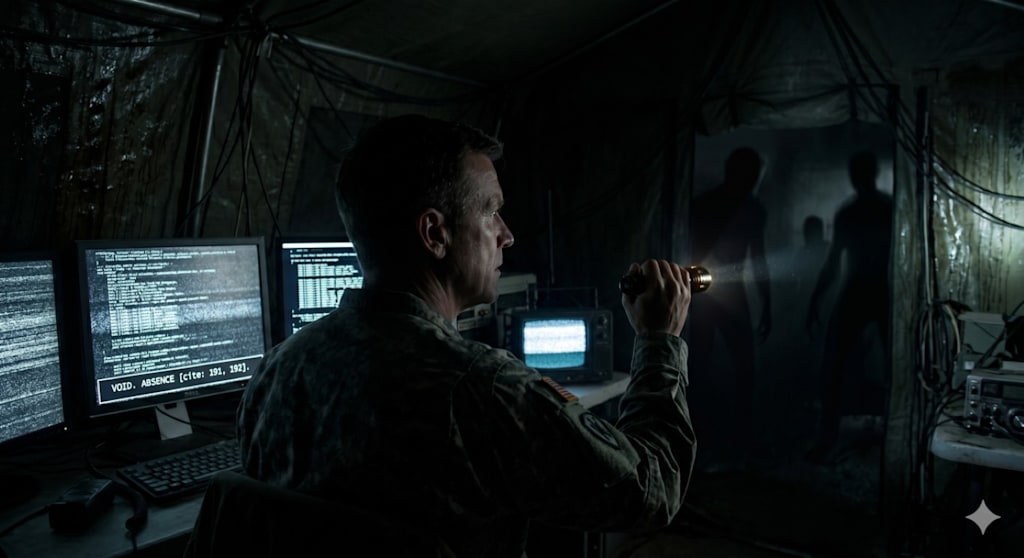
The coffee tastes like rust and diesel fuel, but Captain Reeves drinks it anyway. 0600 hours at Observation Post Viper, ten thousand feet up in the Hindu Kush, and the morning routine unfolds with the precision of men who've done this two hundred times before. Specialist Hart cycles through comm checks in the communications tent, his voice steady: "Viper to Bagram, radio check. Viper to Kandahar, radio check." The responses crackle back, distorted by distance and mountains, but they're there. Always there.
Sergeant Cole stands at the western watchtower, scanning the valley below through binoculars. The village of Qadir sits three kilometers down the mountain—a cluster of mud-brick compounds where smoke rises from morning fires. Goats move between the buildings. A child chases a dog. Normal. Everything normal.
Reeves reviews the duty roster in his quarters, a reinforced concrete box that smells of sweat and gun oil. Twenty-five men on this rock. Twenty-five souls responsible for watching the Pakistan border, for calling in coordinates when the bad guys try to slip through the passes. Tedious work. Dangerous in the abstract way that everything here is dangerous, but mostly tedious. He signs off on the supply request. They need more batteries. More coffee. A replacement part for the generator.
The generator hums its constant song beneath everything—the heartbeat of the post.
At 0647, Hart's voice changes.
"Sir?" It comes through Reeves' radio, tight with confusion. "Sir, I'm getting nothing."
Reeves sets down his coffee. "Define nothing."
"All channels, sir. Bagram, Kandahar, FOB Salerno—just static. Pure static."
"Check your equipment."
"Already did. Twice. It's not the equipment."
Reeves walks to the communications tent, boots crunching on gravel. The morning sun cuts sharp across the peaks, painting everything gold and shadow. Inside, Hart sits surrounded by radio equipment, satellite uplinks, computer terminals. His hands move across the controls with increasing urgency, cycling through frequencies, adjusting gain, checking connections.
Static pours from every speaker. Not the normal static of interference or atmospheric conditions. This is something else—the static of void. Of absence.
"When did it start?" Reeves asks.
"0645, sir. All at once. Every channel simultaneously."
"That's not possible."
"No sir. It's not."
But the static doesn't care about possibility. It fills the tent like a presence—something alive and hungry. Hart's face has gone pale, his fingers trembling as he works. Reeves has seen Hart maintain communications through firefights, sandstorms, and equipment failures. He's never seen him look like this.
"Keep trying," Reeves says, hearing the inadequacy even as he gives the order.
Outside, the sun continues its climb. The generator hums. Everything looks exactly as it should.
Cole finds him twenty minutes later.
"Sir, when's the next supply run?"
"Thursday. Why?"
"Should've had a Chinook pass over at 0700. Daily mail run to the northern posts."
Reeves checks his watch. 0718. "Weather delay?"
"Sky's clear, sir. Clearest it's been in a week." Cole's jaw works, chewing something invisible. "When's the last time you saw a clear sky with no aircraft?"
The question hangs between them. Reeves looks up, scanning the vast blue emptiness above the peaks. No contrails. No distant engine sounds. No helicopters beating through the valleys. The sky that's normally threaded with constant American air power—medevac, supply runs, Apache gunships, Predator drones—is completely, impossibly empty.
"Comms are down," Reeves says.
"All of them?"
"All of them. Simultaneously."
Cole's expression doesn't change, but something shifts behind his eyes. He's a twenty-year man, three deployments, a soldier who's learned to read the spaces between what's said and what's real. "That's not a malfunction, sir."
"No," Reeves agrees quietly. "It's not."
They stand together in the morning light, two men beginning to understand the rules have changed. The safety net they've operated under—the invisible web of communications, air support, supply chains, the vast machinery of the American military—has vanished. Not failed. Vanished.
"I want a patrol to Qadir," Reeves says. "Take Mendez and three others. Check on the village, see if their radios are working, see if they've seen or heard anything unusual."
"Yes sir."
Cole assembles the patrol in ten minutes. Reeves watches them descend the mountain trail, four figures growing smaller against the brown landscape. The post feels suddenly larger, emptier. He walks the perimeter, checking positions, talking to the men on watch. Their faces show the first signs of unease. Word has spread about the communications. About the empty sky.
Private Mendez is nineteen and still believes procedure will keep him safe. He's point man on the patrol, rifle ready, eyes scanning the trail ahead. The descent to Qadir takes forty minutes. The village grows larger with each switchback, and with it, his unease.
Something is wrong with the smoke.
It takes him a moment to identify it. The morning fires should be burning—cooking fires for breakfast—but the smoke is wrong. Too thin. Too scattered. Like fires left untended, burning down to coals.
They reach the village at 0830.
The goats are still there, milling in their pen. The dog the child was chasing sits in the middle of the main path, watching them approach. But there are no people. No voices. No movement behind windows or in doorways.
"Hello?" Mendez calls. His voice echoes off mud walls. "Anyone here?"
The dog whines and trots away.
They clear the village building by building. Doors hang open. Breakfast sits half-eaten on tables. A pot of rice burns on a stove, the bottom scorched black. In the elder's compound—Qadir, who weathered the Soviets and the Taliban and the Americans with equal stoic patience—they find his prayer rug laid out, his shoes by the door, his tea still warm in its glass.
But no Qadir. No wife. No children or grandchildren. No neighbors.
The entire village—forty-seven people by the last census—is gone.
"Sir," one of the soldiers says, his voice thin. "Sir, what the fuck?"
Mendez keys his radio with shaking hands. "Viper, this is Patrol One. Village is abandoned. Complete abandonment. No signs of struggle, no violence. They just... left."
Cole's voice crackles back: "Left how? On foot? Vehicles?"
Mendez scans the area. The village's two trucks sit in their usual spots. The donkeys are still in their shelter. "Negative on vehicles, Sergeant. Everything's here except the people."
A long pause. Then: "Return to post. Double-time."
They climb fast, the unease that had been creeping now galloping. Mendez keeps glancing back at the village—at the smoke still rising from dying fires, at the dog sitting in the path watching them go. The wrongness crawls up his spine. People don't just vanish. Not forty-seven people. Not all at once.
Not unless they knew something was coming.
By the time the patrol returns, it's 1100 hours and the post feels like a trap. Cole briefs Reeves in the command post, his voice low and controlled, but his hands are fists on the table.
"It's coordinated, sir. Has to be. Communications cut at 0645. Air support stops at the same time. And the village—they cleared out recently. Within hours. Maybe overnight."
"You're saying someone warned them."
"I'm saying they knew to leave. And they left everything behind to do it. That's not evacuation, sir. That's flight."
Reeves stares at the map on the wall—at the red pin marking their position, at the vast empty spaces surrounding them. Thirty kilometers to the nearest American position. Fifty to anything resembling support. Mountains and valleys and a thousand places to hide between.
"What are we dealing with?" he asks, though he's not sure he wants the answer.
"I don't know, sir. But whatever it is, it wanted us isolated first."
The word hangs in the air like a curse. Isolated. Cut off. Alone.
Reeves forces himself to think tactically. "Full defensive posture. Every position manned, overlapping fields of fire, night vision ready. We dig in and wait for comms to come back."
"And if they don't?"
"Then we walk out at first light tomorrow."
But even as he says it, Reeves knows it's a lie. Something that can cut all communications simultaneously, that can clear the sky of aircraft, that can make an entire village disappear—something like that doesn't let you walk away.
The afternoon drags on, thick with tension. Men check weapons, fill magazines, test night vision equipment. The routine of preparation helps—gives hands something to do—but can't quite cover the fear seeping through the post like groundwater. They're soldiers. They know how to fight. But you can't fight what you can't see, can't understand, can't even name.
At 1630, Private Mendez is on watch at the southern tower when he sees it.
Movement at the perimeter. Just beyond the wire, where the mountain slope drops into shadow. Something low and fast, there and gone before he can focus on it.
"Contact," he says into his radio, then immediately feels foolish. Contact with what? A shadow? "Possible contact, south perimeter."
Cole's voice crackles back: "What are you seeing, Mendez?"
"I... I don't know, Sergeant. Movement. Maybe."
"Maybe isn't good enough."
But ten minutes later, another soldier reports the same thing from the eastern tower. Movement. Shadows that don't match the terrain. Nothing concrete. Nothing you could put in a report. Just the crawling certainty that something is out there, watching.
The sun begins its descent toward the peaks.
Reeves orders all external lights activated early. Floodlights blaze to life around the perimeter, pushing back the shadows, creating a ring of harsh white light around the post. Beyond that ring, the mountain falls into darkness. The men on watch stare into that darkness, rifles ready, and see nothing.
But they feel it. Every one of them feels it.
The weight of eyes.
Cole joins Reeves on the command tower as dusk deepens to night. Below them, the post looks like a ship on a dark sea, an island of light surrounded by endless black. The stars come out, brilliant and cold and indifferent.
"They're out there," Cole says quietly.
"You're sure?"
"I'm sure."
"How many?"
Cole shakes his head. "Enough. More than enough."
The night settles in with a weight that feels physical. The temperature drops, breath misting in the floodlights. The men on watch stamp their feet, blow on their hands, and keep their eyes on the darkness. Hours pass. Midnight comes and goes. Nothing moves in the light. But in the darkness beyond...
At 0200, the reports start.
"Movement, northwest quadrant. Multiple contacts."
"I've got something east side. Fast movers, staying in the shadows."
"South perimeter, something just tested the wire."
Reeves moves from position to position, checking where his men point, seeing what they see: shapes that might be human, might be something else, moving with purpose and coordination through the darkness. They stay just beyond the light, just beyond clear identification. Testing. Probing. Learning.
"Sir," Mendez whispers from his position, his voice gone young and frightened. "Sir, what are they?"
Reeves has no answer. The shapes move like soldiers—tactical, disciplined, patient. But no soldiers he knows would operate like this. No Taliban, no insurgents, no special forces from any nation. This is something else. Something that orchestrated their isolation with precision, that waited for the right moment, that now circles them like wolves around wounded prey.
At 0400, one of the shapes comes close enough to the light that Mendez gets a clear look.
He doesn't fire. He can't. Because what he sees doesn't make sense, doesn't fit any category his training prepared him for. The shape is human-sized, human-shaped, but moves wrong. Too fluid. Too fast. And when it turns its head toward him, when he sees what might be a face in the spill of the floodlights, his breath catches.
The eyes don't blink. They don't reflect light the way eyes should—instead, the light seems to pass through them, as if looking into two perfectly circular voids, and then reflects back wrong, casting a faint luminescence that doesn't match the angle of the floodlights. The geometry is almost right, almost human, but the jaw extends too far back, the hinge point too high, creating a subtle wrongness in the skull's proportions that his brain refuses to fully process. It's like looking at a face drawn by someone who'd only heard human anatomy described but never seen it.
His finger freezes on the trigger.
"Mendez?" Cole's voice in his ear. "Report."
"I... I saw..." But he can't finish. Can't put words to what he saw. Can't make his mind accept it.
The shape melts back into darkness.
The long night drags on. The shapes circle, draw closer, retreat, circle again. They're learning the defenses, counting the men, measuring response times. They're hunting, but not ready to strike. Not yet. They're waiting for something. For the fear to peak. For exhaustion to set in. For the moment when the defenders' attention wavers.
Reeves stands in the command tower and watches his post being dissected by an enemy he cannot see, cannot understand, cannot fight. The radio on his hip hisses static. The sky above remains empty of aircraft. The village below sits dark and abandoned. They are alone on this mountain—twenty-five men in a ring of light—and something in the darkness has decided they are prey.
At 0530, the sky begins to lighten in the east. Dawn is coming. The shapes withdraw, pulling back into the deeper shadows. The men on watch sag with relief, thinking the night is over, thinking they've survived.
But Cole knows better. He stands beside Reeves, watching the shapes retreat, and sees the pattern in their movement. They're not fleeing the light. They're repositioning. Taking up new positions. Closer positions.
"Sir," he says quietly. "They're not leaving."
"No," Reeves agrees. "They're getting ready."
The dawn light spreads across the peaks, painting them gold and red. Beautiful. Indifferent. Below the post, the abandoned village sits silent. Above, the sky remains empty. And in the shadows at the perimeter, just beyond the wire, the shapes settle into position and wait.
The isolation is complete. The trap is set. The hunters have learned everything they need to know.
And now, as the sun rises on what might be their last day, the men of Observation Post Viper understand with terrible clarity: the long night was never the attack.
It was the preparation.
The real horror is about to begin.
________________________________________
At 0545, full daylight breaks across the mountain. The shapes vanish completely. Not retreating—vanishing. One moment they're there in the pre-dawn gray, and the next they're gone, as if they'd never existed at all.
"Where'd they go?" Mendez whispers.
No one answers. Because no one knows.
Inside the communications tent, Hart tries the radio one more time. He's been cycling through frequencies all night, finding nothing but static. But now, as he keys the mic, something different comes through.
Not silence.
A signal. Active. Deliberate. A low, pulsing interference blocking every channel simultaneously. Not equipment failure. Not atmospheric conditions.
Jamming.
"Captain." Hart's voice is hollow. "Sir, you need to hear this."
Reeves enters and listens to the rhythmic pulse drowning out every frequency. His jaw tightens.
"How long?"
"Just started. Right when they pulled back."
"Can you break through it?"
Hart shakes his head. "This is military-grade. Maybe better. It's covering everything—satellite, HF, VHF, emergency bands. Whoever's doing this knows exactly what they're doing."
Reeves stands there, listening to the pulse, understanding what it means.
No rescue. No air support. No way to call for help.
They are alone.
He steps outside. The morning is clear and cold. The mountains stretch endlessly in every direction—beautiful, empty, hostile.
"Sergeant Cole. Staff Sergeant Williams. Corporal Oakes. Command tent. Now."
The NCOs gather quickly. Reeves doesn't waste time.
"Communications are being actively jammed. The village is abandoned. Air support hasn't flown in twenty-four hours. Whatever hit us was coordinated. Planned. We're cut off."
"How long until someone notices we're dark?" Williams asks.
"We're a remote observation post on the edge of nowhere. Could be days before anyone realizes. Could be a week." Reeves meets each of their eyes. "We can't wait that long."
"What are you saying, sir?" Oakes asks.
"I'm saying we fortify. We prepare for assault. We make our stand." He pauses. "This is a siege now. We hold until relief arrives or until we can't hold anymore."
Silence fills the tent, the weight settling on all of them.
"What are we fighting?" Cole asks quietly.
"I don't know. But they're organized. They're patient. And they've been watching us all night, learning our defenses, counting our numbers." Reeves straightens. "Get the men ready. Full combat load. Reinforce the wire. Set claymores at every approach. I want overlapping fields of fire on all sides. If they come, we make them pay for every meter."
The NCOs nod. They understand. This isn't about winning anymore. It's about surviving the night.
They file out to brief their squads.
Reeves walks to the perimeter and looks out at the empty mountain. The abandoned village below. The silent sky above.
Somewhere out there, the shapes are watching. Waiting. They've spent the night studying the post's defenses—guard rotations, blind spots, weak points in the wire. They know exactly how many men are here and exactly how much ammunition they have left.
When they come—and they will come—it won't be random. It won't be chaotic.
It will be surgical.
Behind him, the men begin their preparations. Checking weapons. Stacking ammunition. Reinforcing positions. The familiar sounds of soldiers doing what soldiers do when there's no other choice.
Reeves watches the mountain and waits for the war to begin.
About the Creator
Charles V Sasser Jr
Retired U.S. Army CSM, SOFREP defense analyst, and author of the thriller Led by Love of Country. I translate military doctrine into strategic insights on global conflicts, defense technology, and executive leadership.
Enjoyed the story? Support the Creator.
Subscribe for free to receive all their stories in your feed. You could also become a paid subscriber, letting them know you appreciate their work.
Comments
There are no comments for this story
Be the first to respond and start the conversation.