

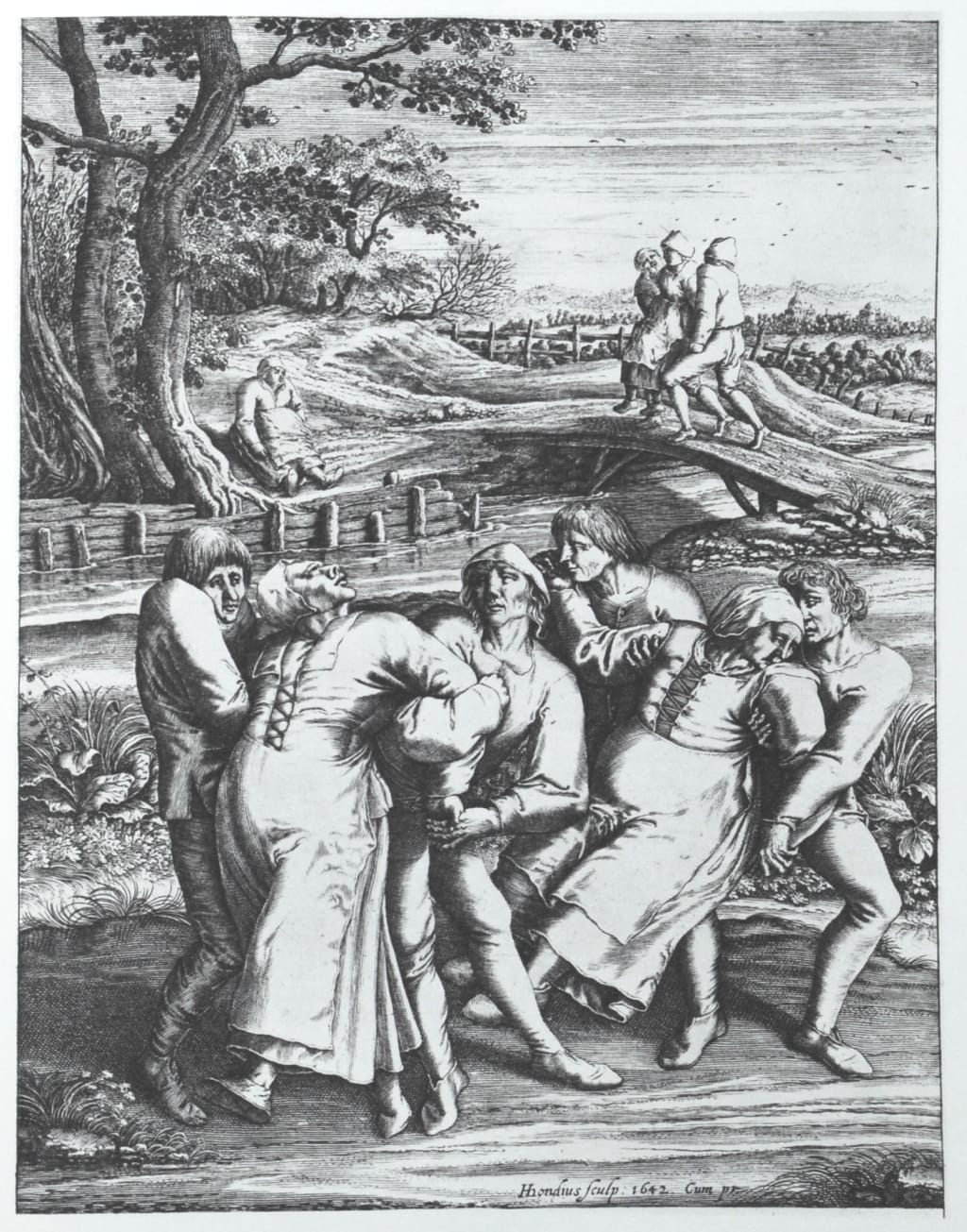
In the summer of 1518, the streets of Strasbourg were alive with an eerie rhythm. It began with a single woman, Frau Troffea, who stepped into the square one sweltering July evening and began to dance. Her movements were frantic, her feet pounding against the cobblestones as if driven by some unseen force. At first, the townsfolk watched in amusement, clapping and cheering as her skirts swirled around her. But as the hours turned into days, their amusement turned to unease. Frau Troffea did not stop. She danced until her feet bled, until her body collapsed from exhaustion, only to rise again and continue.
By the end of the week, dozens had joined her. They came in twos and threes, then in droves, their faces blank, their eyes glazed, as if possessed by the same invisible puppeteer. The city council, desperate to restore order, declared the dancing a curse sent by Saint Vitus, the patron saint of dancers. They hired musicians and built a wooden stage in the square, hoping that by encouraging the afflicted to dance themselves free of the madness, the plague would pass. But the music only fueled the frenzy. The dancers writhed and twirled, their bodies moving in perfect, unnatural unison, as if guided by a force beyond their control.
Among the onlookers was a young apothecary named Elias. He had returned to Strasbourg after years of studying in distant lands, bringing with him knowledge of herbs and remedies unknown to most in the city. Elias watched the dancers with a mixture of fascination and dread. He had seen strange illnesses before—fevers that made men see demons, plagues that turned skin black—but this was something else. This was no mere sickness of the body. It was as if the very air of Strasbourg had been infected, as if the city itself had begun to move.
Elias began to investigate. He visited the homes of the afflicted, searching for clues. He found none. The dancers came from all walks of life—rich and poor, young and old, pious and profane. There was no pattern, no common thread. But as he delved deeper, he began to notice something strange. The dancers all spoke of the same dream. They spoke of a figure in the shadows, a man with no face, who beckoned them to dance. They spoke of music that no one else could hear, a melody that pulsed in their veins and pulled them to the square.
One night, Elias himself dreamed of the faceless man. He stood at the edge of a dark forest, his body swaying to an unheard rhythm. When Elias awoke, his legs ached as if he had been dancing for hours. He knew then that the plague was not of this world. It was something older, something darker, something that had slumbered beneath the streets of Strasbourg for centuries and had now awoken.
Determined to uncover the truth, Elias sought out the city's oldest records. In the dusty archives of the cathedral, he found a manuscript written in a language he barely understood. It spoke of an ancient ritual, a pact made by the founders of Strasbourg to ensure the city's prosperity. They had summoned a spirit, a being of music and movement, and bound it to the land. But the spirit was not content to remain a passive guardian. It demanded tribute, and if it was not appeased, it would take control of the living, forcing them to dance until they dropped dead.
Elias realized that the plague was not a curse but a warning. The spirit was restless, its hunger growing with each passing year. The city had forgotten its pact, and now the spirit was reclaiming what was owed. Armed with this knowledge, Elias went to the city council. He told them of the ritual, of the need to appease the spirit. But the council scoffed. They called him a madman, a charlatan seeking to profit from the city's suffering.
With no other options, Elias took matters into his own hands. He gathered the ingredients for the ritual—herbs, candles, and a vial of his own blood—and went to the square. The dancers were still there, their movements growing slower, their bodies weaker. Elias lit the candles and began to chant, his voice rising above the sound of their labored breaths. He called to the spirit, offering himself as a vessel, a conduit for its power.
For a moment, nothing happened. Then the air grew cold, and the candles flickered. The dancers stopped, their bodies frozen in place. Elias felt a presence, a weight pressing down on him. He closed his eyes and let the spirit in. It filled him, its music coursing through his veins, its movements guiding his limbs. He danced, not with the frantic desperation of the afflicted, but with a grace and power that seemed to transcend human limits. The spirit was satisfied. It had its tribute.
When Elias awoke, the square was empty. The dancers had collapsed, their bodies spent but alive. The plague was over. But Elias knew that the spirit was still there, lurking beneath the streets, waiting for the next time it would need to be fed. He left Strasbourg soon after, carrying the knowledge of what he had done and the burden of the city's secret.
To this day, the people of Strasbourg tell stories of the Dancing Plague, of the summer when their city was consumed by an invisible force. But few know the truth, and fewer still dare to speak of it. For the spirit still sleeps, and its hunger is eternal.
About the Creator
Enjoyed the story? Support the Creator.
Subscribe for free to receive all their stories in your feed.
Comments
There are no comments for this story
Be the first to respond and start the conversation.