
The Wendigo: The Hunger That Never Ends
The Cannibal Spirit Said to Turn Humans Into Monsters

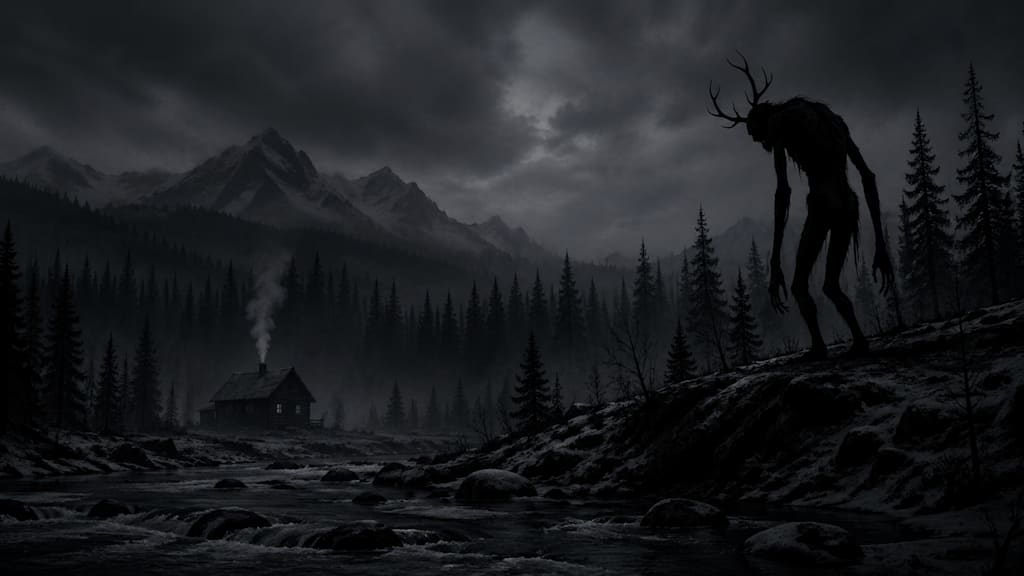
There are horrors that stalk the dark.
And then there are horrors that were once human.
Deep within the frozen forests of North America, among the endless pines and silent snowfall, Indigenous tribes whispered of something far worse than death. Not a beast. Not a demon. But a curse. A sickness of the soul born from starvation, greed, and cannibalism.
They called it the Wendigo.
And according to legend, once the hunger begins… it never stops.
A Monster Born From Winter
The Wendigo originates from the oral traditions of Algonquian-speaking peoples, including the Ojibwe, Cree, and Innu tribes of Canada and the northern United States. The creature is tied closely to brutal winters, famine, and isolation.
Descriptions vary depending on the tribe, but one detail remains horrifyingly consistent:
The Wendigo is always starving.
Witness accounts and folklore describe it as impossibly thin, its skin stretched tightly over protruding bones. Some say its lips are chewed away from endless feeding. Others describe yellowed fangs slick with blood and eyes glowing deep within hollow sockets. Its body grows taller with every victim it consumes, yet it never gains weight.
It only becomes hungrier.
Imagine seeing something towering between the trees during a blizzard.
Too thin to be alive.
Too fast to be human.
And smiling.
The Sound In The Woods
The old stories warn that the Wendigo does not hunt like an animal.
It stalks.
It watches.
Hunters spoke of hearing footsteps circling camps at night without seeing anything in the snow. Others described distant cries for help echoing through the forest — voices sounding exactly like lost loved ones.
Some legends claim the creature can mimic human voices to lure people deeper into the wilderness.
Others say you smell it before you see it.
Rotting meat.
Wet fur.
Decay.
And then the silence begins.
A silence so complete that even the surroundings seems afraid.
The Real Horror: Becoming One
What makes the Wendigo terrifying is not simply its appearance.
It’s the transformation.
In many Indigenous traditions, the Wendigo is not born a monster.
It becomes one.
A person driven to cannibalism — whether through greed, desperation, or madness — risks becoming possessed by the spirit of the Wendigo. The curse twists the mind first. Victims develop violent cravings for human flesh and become consumed by paranoia and hunger.
The body follows afterward.
Legends describe bones cracking and stretching. Teeth sharpening. Skin paling from frost and decay. Humanity slowly dissolves beneath an endless appetite.
The more it eats, the more it starves.
An eternal punishment.
The Swift Runner Case
Most paranormal legends survive only through stories.
The Wendigo has something worse.
Real cases.
One of the most infamous incidents occurred during the winter of 1878 in Alberta, Canada. A Cree trapper named Swift Runner was discovered living alone after his entire family vanished. Authorities initially believed starvation had claimed them during the brutal winter.
Then they found the remains.
His wife.
His children.
Butchered.
Consumed.
The horror became even more disturbing when investigators realized emergency food supplies existed less than 25 miles away at a nearby Hudson’s Bay Company post. Swift Runner had not been trapped beyond hope.
When confronted, he confessed.
But according to reports, Swift Runner insisted he had not acted alone.
He claimed the Wendigo spirit had entered his dreams and taken hold of him.
That the hunger became unbearable.
That something inside him wanted flesh.
He was executed in 1879.
Yet his story spread through Canada like wildfire, becoming one of the most chilling “Wendigo psychosis” cases ever documented.
Imagine the terror of realizing the monster wasn’t lurking outside the cabin.
It was already sitting at the dinner table.
Jack Fiddler And The Wendigo Killings
Another infamous case emerged in the early 1900s.
A respected Oji-Cree shaman named Jack Fiddler claimed he had killed multiple people infected by the Wendigo spirit before they could transform fully. To him, it was mercy.
To Canadian authorities, it was murder.
Fiddler and his brother were arrested after allegedly killing a woman believed to be close to becoming possessed. Before standing trial, Jack Fiddler escaped custody and took his own life.
The case remains controversial to this day.
Was it superstition?
Mental illness?
Or genuine terror rooted so deeply in the community that people believed death was preferable to becoming the thing in the woods?
The Psychology Of The Wendigo
Historians and psychologists later coined the term “Wendigo psychosis.”
The condition allegedly caused overwhelming urges toward cannibalism alongside fears of transforming into a monster. Some researchers documented dozens of cases tied to starvation, isolation, and extreme winter trauma.
But many Indigenous communities reject the purely psychological explanation.
To them, the Wendigo was never just metaphor.
It was spiritual corruption.
The embodiment of greed consuming the human soul.
And perhaps that is why the legend survives.
Because the Wendigo represents something terrifyingly real.
Not antlers.
Not claws.
Not glowing eyes.
But the idea that under enough hunger… enough cold… enough desperation…
Human beings can become monsters.
The Endless Hunger
Modern horror films often portray the Wendigo as a deer-headed creature stalking forests.
But traditional stories paint something far more disturbing: a once-human predator stripped of empathy, driven only by appetite.
A starving thing with human memories.
Human thoughts.
Human eyes.
Still aware enough to know exactly what it’s doing.
And perhaps that is the cruelest part of all.
The Wendigo does not merely kill.
It devours identity itself.
Every bite strips away another piece of humanity until nothing remains except hunger wrapped in skin.
An emptiness that can never be filled.
Final Thoughts
The Wendigo has endured for centuries because it preys on one universal fear:
That civilization is fragile.
That morality can collapse in the cold.
That somewhere deep beneath survival instincts lies something ancient and ravenous waiting to emerge.
And maybe, on the quietest winter nights, when the forest outside your window goes completely still…
You’ll hear footsteps crunching slowly through the snow.
Not hunting for food.
Hunting for you.
Author's Note
various news sources and articles were used to write this article. what do the readers think? Does the wendigo exist??
About the Creator
E. hasan
An aspiring engineer who once wanted to be a writer .
Enjoyed the story? Support the Creator.
Subscribe for free to receive all their stories in your feed.
Comments
There are no comments for this story
Be the first to respond and start the conversation.