

The Wendigo: When Hunger Becomes a Monster
Miss Lil's Spooky Files | Ancient Folklore, Legendary Monsters & Things That Go Bump in the Woods
There are monsters that hunt you because they are hungry. There are monsters that hunt you because they enjoy the taste of fear. And then there are monsters that are never, ever satisfied.
Imagine walking through a frozen forest in the dead of winter. Snow crunches beneath your boots. The trees stand like skeletal fingers against a moonless sky. Your breath hangs in the air, and somewhere in the distance, something moves.
You stop.
The forest goes quiet.
Then you hear it. A sound that might be the wind slipping between the trees. Maybe a branch snapping. Perhaps the faintest whisper of someone calling your name.
You tell yourself it's nothing. You're miles from home, tired, cold, and probably imagining things.
But what if you're not alone?
What if something out there has been watching you for hours? Something that knows the woods better than you ever will. Something that once might have been human, but has become something else entirely.
And what if it is hungry?
Not ordinary hungry. Not the kind of hunger that can be satisfied with a meal, a full stomach, or even an entire herd of deer.
I'm talking about a hunger that grows with every bite. A hunger that consumes the body, the mind, and eventually the soul.
Tonight, we're sitting down with one of the most terrifying figures in Indigenous North American folklore: the Wendigo.
And trust me, this is one monster whose appetite you do not want to attract.
Before We Meet the Monster, We Need to Understand Its Roots
The Wendigo, also spelled Windigo, Wiindigoo, Witiko, and several other variations, comes from the traditional belief systems and oral histories of Algonquian-speaking Indigenous peoples of North America.
The stories are particularly associated with Anishinaabe (Ojibwe), Cree, and other northern Algonquian communities throughout the Great Lakes region and the forests of Canada.
Unlike the monsters we encounter in European folklore, the Wendigo is not simply a creature lurking in the wilderness waiting for an unfortunate traveler.
Its meaning runs much deeper.
The Wendigo is associated with winter, starvation, cannibalism, greed, selfishness, and the destruction of the bonds that hold a community together. It represents something far more frightening than a predator with sharp teeth.
It represents what happens when hunger, desperation, and selfishness consume everything that makes someone human.
There are variations in the stories between communities, and there is no single universal description or version of the Wendigo. These are living cultural traditions, not one neatly packaged monster mythology.
And that distinction matters.
Because while Hollywood has given us a recognizable monster, the traditional stories are considerably more complicated.
What Exactly Is a Wendigo?
Here's where things get interesting.
In many traditional accounts, the Wendigo is described as a malevolent spirit associated with an insatiable craving for human flesh. It may appear as a supernatural being, but some stories also describe human beings who become Wendigos.
Think about that for a moment.
The monster isn't necessarily born a monster.
Sometimes, it was once a person.
A person who became consumed by hunger, greed, or a supernatural force until there was little left of their former humanity.
The physical descriptions vary, but many accounts portray the Wendigo as frighteningly thin, almost skeletal. Its body may be enormous, yet it appears perpetually starved. Its appetite is so great that no amount of food can restore it.
Some traditions describe a heart of ice, while others associate the creature with an unnatural coldness that follows wherever it goes.
There is something particularly disturbing about that image: a creature that can consume an entire human being and still remain desperately hungry.
It is a walking contradiction. Its body may grow, its strength may increase, and its appetite may become more powerful, but satisfaction remains forever out of reach.
The Wendigo doesn't eat to survive.
It consumes because consumption has become its entire existence.
The Hunger of Winter
To understand why the Wendigo became such a powerful figure in northern folklore, we need to talk about winter.
Not the pretty winter advertised on Christmas cards. Not the gentle snowfall, cozy fireplaces, and mugs of hot chocolate.
I'm talking about the kind of winter that can kill you.
The kind where temperatures plunge, food becomes scarce, hunting becomes dangerous, and a journey through the wilderness can turn deadly in a matter of hours.
For communities living in the northern forests, survival depended on cooperation. Food had to be shared. People depended on one another. A successful hunt could mean the difference between a family surviving until spring or starving before the snow melted.
Now imagine what happens when someone puts their own survival above everyone else's.
What happens when greed replaces generosity? When someone takes more than their share? When desperation becomes an excuse to abandon every rule that keeps a community alive?
This is where the Wendigo becomes more than a frightening creature.
It becomes a warning.
The Wiindigo has been examined by scholars as a figure connected to hunger, food systems, social relationships, and the consequences of abandoning communal responsibility. Its meaning is not simply that cannibalism is frightening. It also speaks to the dangers of selfishness and excess.
And perhaps that is why this particular monster has survived in storytelling for generations.
Because starvation is terrifying, but so is the possibility that a person might become so consumed by their own needs that they no longer recognize the people around them.
How Does Someone Become a Wendigo?
One of the most unsettling aspects of Wendigo lore is the possibility of transformation.
In some traditional accounts, a human being could become a Wendigo after resorting to cannibalism during extreme starvation. Other stories describe possession or the influence of a supernatural Wendigo spirit.
There are also accounts connecting the transformation to overwhelming greed and an inability to control destructive appetites.
The details differ between traditions, but the underlying horror is remarkably consistent.
A person crosses a boundary that should never be crossed.
They stop seeing other human beings as family, neighbors, or fellow travelers. Instead, people become something to consume.
And once that transformation takes hold, there is no ordinary meal that can bring them back.
Historical accounts collected by outsiders describe people feared as potential Wendigos, including individuals believed to have become dangerous after consuming human flesh. These records need to be read carefully: they were written through outside observers' perspectives and sometimes reflect colonial misunderstandings, fear, and sensationalism. They nevertheless demonstrate how seriously the concept was treated in some communities.
There is a particularly chilling idea buried in these stories.
The Wendigo doesn't necessarily lose its humanity because it is physically transformed.
It loses its humanity because it has abandoned the things that make human life worth protecting.
The Appearance: A Monster That Can Never Fill Its Own Stomach
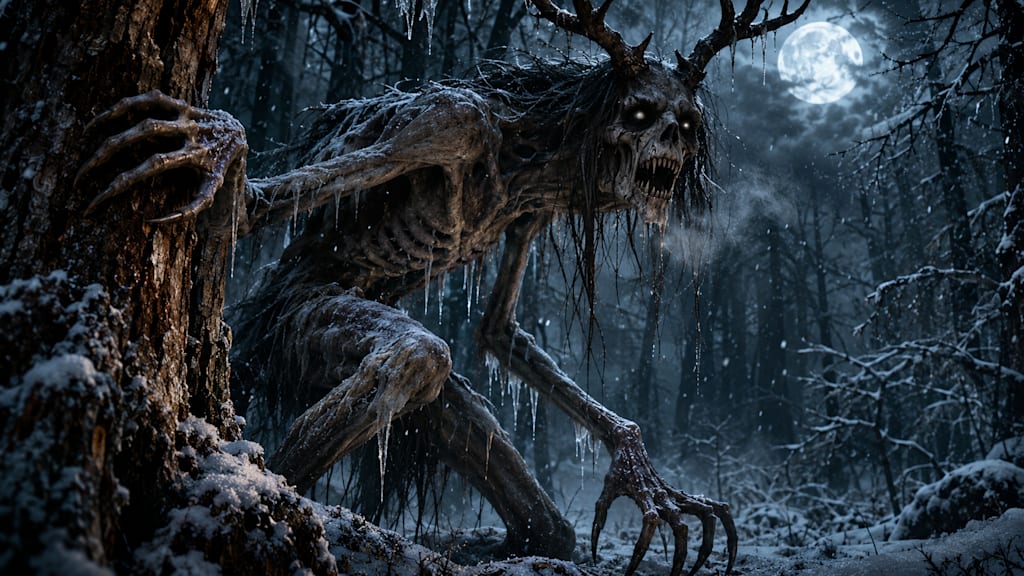
If you ask someone today what a Wendigo looks like, chances are they'll describe a towering creature with elongated limbs, sunken eyes, sharp teeth, and a deer skull crowned with enormous antlers.
That image has become enormously popular in modern horror.
But here's something worth knowing: the famous deer-skull-headed Wendigo is largely a modern popular-culture interpretation. It should not be treated as the definitive appearance found in traditional Anishinaabe or Cree accounts.
Older descriptions vary considerably. Some portray the creature as an enormous supernatural being. Others describe something frighteningly human in appearance, except for its unnatural hunger, its terrible coldness, and its monstrous behavior.
One recurring image is that of an emaciated figure.
Imagine something so desperately hungry that its bones seem ready to tear through its skin. Its limbs are unnaturally long, its face hollow, and its eyes carry the emptiness of something that has forgotten what satisfaction feels like.
Some accounts describe an icy heart, sometimes understood literally within the story and sometimes as a reflection of the creature's spiritual condition.
And that brings us to one of the most fascinating details.
The Wendigo can become larger through consumption, yet its hunger remains.
It grows, but never becomes full.
Its appetite expands alongside its body, creating an endless cycle of eating and starvation.
Think about the cruelty of that existence. Every meal makes the creature more powerful, but none brings it relief.
It is not merely starving.
It is hunger made permanent.
The Heart of Ice
There is something wonderfully dreadful about the idea of a monster with a heart made of ice.
In many modern retellings, the Wendigo's icy heart becomes its defining weakness. Some stories claim that the creature can only be destroyed by melting or destroying that heart.
However, we should be careful not to present one particular method of killing a Wendigo as a universal piece of Indigenous folklore. The traditions are varied, and popular retellings frequently combine different stories into a single monster mythology.
Still, the symbolism of the frozen heart is difficult to ignore.
The heart is supposed to represent warmth, compassion, love, and humanity.
The Wendigo has none of those things left.
It has become cold in every possible sense of the word.
And perhaps the most frightening part is that the cold doesn't simply surround it. In the stories, the cold is part of what it has become.
The Wendigo and the People Who Never Came Home
Imagine a hunting party leaving their settlement before dawn.
They pack their supplies, gather their weapons, and disappear into the forest.
Hours pass.
Then a day.
Then another.
Eventually, someone realizes that one of the hunters is missing.
Perhaps they became lost. Perhaps an accident happened. Perhaps an animal attacked.
Or perhaps something else found them first.
In some historical accounts, unexplained disappearances in remote northern regions were associated with Wendigos. The creature became part of the explanation for the dangers of traveling through wilderness, particularly when people were isolated, hungry, and vulnerable.
But there is another frightening possibility in the lore.
What if the person who disappeared eventually returned?
What if they came home looking almost exactly as they had when they left, but something about them was wrong?
What if they no longer recognized their family?
What if they looked at the people who welcomed them home and saw dinner?
The transformation from human to monster is one of the most disturbing elements of these stories because it turns the familiar into the threatening.
The monster might not be standing outside your cabin.
It might already be sitting at your table.
Wendigo Psychosis: When Folklore Meets History
Now, this is where the history gets particularly fascinating.
You may have come across the term Wendigo psychosis while researching this creature.
During the nineteenth and twentieth centuries, European and North American explorers, missionaries, traders, physicians, and anthropologists recorded accounts of individuals among northern Algonquian communities who were believed to be experiencing a condition associated with becoming a Wendigo.
Some historical reports described individuals expressing an intense fear of becoming cannibals, experiencing disturbing thoughts about eating human flesh, or behaving in ways their communities interpreted as signs of transformation.
There were also accounts of people who had reportedly resorted to cannibalism during periods of extreme starvation.
Western researchers eventually began treating these reports as a possible culture-bound psychiatric condition, and the term Wendigo psychosis entered anthropological and psychiatric literature.
But there is an important distinction here.
Wendigo psychosis is not an established modern psychiatric diagnosis. Scholars have disagreed over the reliability of historical accounts, how the phenomenon should be interpreted, and whether the cases grouped under that label represented one identifiable condition at all.
Some researchers have argued that the phenomenon cannot be properly understood without examining the Indigenous cultural and spiritual frameworks in which the accounts originated.
In other words, we cannot simply take centuries of Indigenous beliefs, translate them into Western medical terminology, and assume we've explained them.
The debate itself is an important part of the Wendigo's history.
And personally, I find the historical dimension every bit as fascinating as the supernatural stories.
The Wendigo wasn't simply a monster invented to frighten children around a campfire. It was part of a much larger cultural understanding of hunger, survival, responsibility, and the consequences of destructive behavior.
The Wendigo in Modern Horror
If you've watched horror movies, played survival video games, or spent any time exploring internet folklore, you've probably encountered a Wendigo-inspired creature.
Modern horror has embraced the legend wholeheartedly.
The creature has appeared in literature, television, films, comic books, and video games. Sometimes it is portrayed as a supernatural predator. Other times it is a former human transformed into a cannibalistic monster.
The antlered creature with a deer skull has become especially recognizable, although that particular design owes much of its popularity to modern creative interpretations rather than a single traditional account.
One interesting example is Algernon Blackwood's 1910 supernatural horror story, The Wendigo. Blackwood helped introduce the creature to a wider English-speaking literary audience, portraying it as an overwhelming supernatural presence associated with the wilderness.
Later popular portrayals have continued to change the creature, sometimes emphasizing its physical appearance while overlooking the cultural significance of the original traditions.
And that's something worth remembering when we enjoy these stories.
The Wendigo is not simply a convenient monster for a horror movie. It comes from living Indigenous traditions with meanings that extend far beyond entertainment.
We can appreciate the frightening folklore while respecting the people whose stories gave it life.
Why the Wendigo Still Terrifies Us
Let's step away from the frozen forests for a moment.
What makes the Wendigo so frightening?
Is it the possibility of encountering something enormous and hungry in the wilderness?
Is it the idea of being hunted by something that can survive the coldest winters?
Or is it the thought that a person could become something unrecognizable through desperation, greed, or an insatiable desire for more?
I think the last possibility is what gives this legend its staying power.
We live in a world that constantly tells us to want more.
More money. More possessions. More power. More attention. More of everything.
But the Wendigo represents the nightmare of wanting without limits.
It is the ultimate example of appetite without satisfaction.
And unlike a monster that can be defeated by outrunning it, the Wendigo represents something much more difficult to escape: the possibility of losing ourselves to the very thing we desire.
Its hunger is never satisfied because satisfaction is no longer possible.
There is no feast waiting at the end of its journey. No warm hearth. No peaceful return home.
Only another meal. Another winter. Another empty stomach.
And another victim.
A Final Thought From Miss Lil
I have always found the oldest monsters particularly interesting. Not necessarily because they have the sharpest claws or the most frightening faces, but because of what they tell us about the people who first told their stories.
The Wendigo is a particularly unsettling example.
It comes from a world where winter could be merciless, food could disappear, and survival depended on people looking after one another.
It reminds us that there are things more dangerous than hunger itself.
There is greed. There is selfishness. There is the willingness to consume everything around us without ever considering what happens when nothing is left.
And perhaps that's why I find this particular legend so disturbing.
A wolf hunts because it needs to eat. A bear searches for food because its body demands it. These are creatures following the natural order of things.
The Wendigo is different.
It is the nightmare of hunger without an end.
So, the next time you're walking through the woods on a bitterly cold evening and hear something moving between the trees, remember this little piece of folklore.
Don't assume every sound is a monster. Don't let your imagination run away with you.
But if something out there starts calling your name, and you know perfectly well that nobody else is supposed to be in those woods...
Well, perhaps it's time to head home.
And maybe, just maybe, leave the hunting for another day.
Until next time, keep your fires burning, your loved ones close, and your eyes on the tree line.
Miss Lil has finished her tea. ☕
A Little More Reading for the Curious
For anyone who wants to dig deeper than the campfire stories, these are some worthwhile scholarly starting points:
Dangerous Spirits: The Windigo in Myth and History by Shawn Smallman (2014). A broad historical examination of Windigo beliefs and their documentation.
The Cannibal Talking Head: The Portrayal of the Windigo Monster in Popular Culture and Ojibwe Traditions by Brady DeSanti (2015). Examines the differences between popular representations and Ojibwe understandings.
Cannibalizing the Wiindigo by Agnieszka Pawłowska-Mainville (2022). Explores Anishinaabeg and Oji-Cree perspectives, landscapes, food systems, and popular representations.
Reviving Witiko (Windigo) by Nathan D. Carlson (2009). Examines historical accounts and the controversy surrounding Windigo psychosis.
One final note: Spellings, beliefs, and descriptions vary between Indigenous nations and communities. These sources are starting points, not a substitute for Indigenous storytellers and knowledge-holders.
About the Creator
Lilithea Adasia
I dig where others look away. 🖤 True crime, paranormal mysteries, uncomfortable truths, and the beautifully broken human experience. I chase the stories others bury and ask the questions others avoid. Come curious. Leave questioning.
Enjoyed the story? Support the Creator.
Subscribe for free to receive all their stories in your feed. You could also become a paid subscriber, letting them know you appreciate their work.
Comments
There are no comments for this story
Be the first to respond and start the conversation.