
The Voice That Lived in the Walls
Valence-en-Brie, 1896: The French Household Haunting

The House That Answered
In June 1896, a police commissioner investigating a supposedly haunted house in the French village of Valence-en-Brie encountered an unexpected problem: the thing he was called to investigate apparently had an opinion about his dirty boots. As the officers entered, a mysterious voice told them to leave, specifically mentioning their footwear. It was hardly the solemn pronouncement one expects from a ghost, just an unseen speaker expressing dissatisfaction with housekeeping. Yet that humor concealed something far more disturbing.
For nearly three weeks, the family living in the house had reported noises, broken windows, overturned furniture, and a voice that seemed to move from room to room without a visible owner. Physicians, journalists, neighbors, and police became involved. Some suspected a practical joke. Others believed they were witnessing unexplained forces. One ambitious investigator would even claim to have defeated the presence using a theory of invisible energy. Unlike countless ghost stories constructed long after the fact, this one was documented while it happened.
The house belonged to M. Lebègue, a prosperous resident of Valence-en-Brie. He often traveled to Paris, leaving his wife, children, and servants at home. Madame Lebègue, in poor health, was attended by Dr. Pate. The first disturbance occurred on June 10, 1896, when a young servant, Isabelle Pelletier, went to the cellar for firewood. Her candle went out, and a violent noise erupted. In the darkness, she reportedly glimpsed something red floating in the air, then heard a terrifying roar. She fled upstairs. At first, the family suggested an animal or a trapped owl, but soon the noises changed; something began to speak.
The voice was initially faint but grew louder, described as deep, coarse, and conversational. They heard it in the kitchen, hallways, and bedrooms, sometimes from the floor or a chimney, sometimes beneath dishes on the dining table. Its remarks were undignified; it insulted visitors, mocked the police, and commented on household routines. Once, when Madame Lebègue asked for water in bed, the voice called out to her daughter Charlotte to inform her of the request. The presence seemed more interested in joining household conversation than delivering supernatural proclamations. Charlotte became accustomed to it; Isabelle, meanwhile, grew irritated by the mess she had to clean after each disturbance.
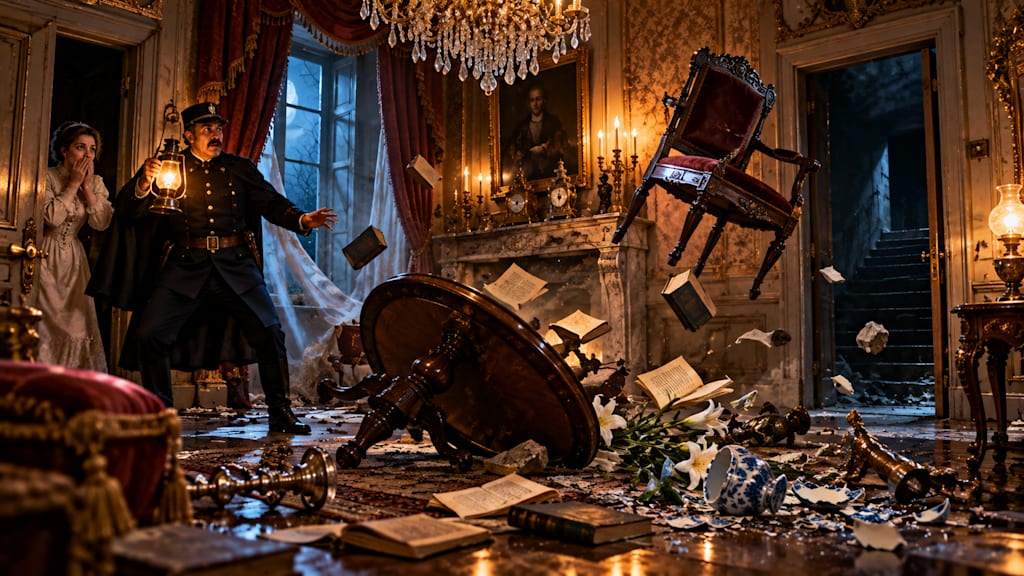
Physical disturbances soon escalated. Chairs and tables were overturned, decorative objects fell or were thrown, and windows shattered. In one notable case, several windowpanes broke, glass falling outside as if the force originated from within. Furniture was found disturbed in locked rooms. Stones appeared or were thrown under mysterious circumstances. These are witness descriptions, not independently verified proof, but the persistence of the reports drew official attention. M. Lebègue kept watch with a revolver, and "Gendarmes"- a branch of the French Armed Forces that acts as a national police force- searched the property, but no culprit was identified. The family insisted the disturbances continued.
Dr. Pate, the family physician, told a reporter he had heard the voice on several occasions. He searched for cracks or openings, hoping to catch someone projecting sound, but found nothing. He was also troubled by the broken windows and overturned furniture and could offer no explanation. Still, uncertainty is not proof of a ghost. The police commissioner remained skeptical, suspecting a practical joker. Notably, when he and his officers spent a night in the house, the voice was silent. A fact that complicated claims of supernatural independence. Neighbor Delorme suggested a ventriloquist might be responsible and that someone was disturbing the furniture while playing an elaborate trick. Neither theory was proven, but both were plausible.
At some stage, the unseen voice acquired a name. When the family’s teenage son questioned it, it claimed to be a Russian aristocrat: Prince Visky. The supposed prince offered little about himself; when asked where he was, he replied Marseille, hundreds of miles away, which he insisted was not a contradiction. No evidence suggested a Russian prince, living or dead, was involved, but the name gave the story character and the press a hook. The voice now had a personality: unseen, rude, boastful, and apparently unconcerned with geography.
Investigators arrived. Journalist Henry Desormeaux of Le Gaulois interviewed household members and local witnesses, including Dr. Pate, a former mayor, and the schoolmaster. Desormeaux reported hearing the voice himself and became convinced that ordinary trickery did not explain everything. He speculated that Isabelle Pelletier might be connected to the disturbances through unknown human forces, noting similar disturbances at her previous jobs. He drew upon speculative theories of the era: invisible energies, electrical-like influences, and powers beyond the body, the legacy of a period fascinated by hypnotism and spiritualism. These ideas were not scientifically established, and another investigator would soon take them even further.
Abbé Schnebelin, a clergyman interested in occult phenomena, proposed that the disturbances might result from a person projecting their will at a distance, using forces like electricity. He did not see the events as supernatural but as involving unknown natural powers. Schnebelin advised the family to thrust a pointed object toward the source of the voice. The family’s son reportedly went further, firing several shots into the cellar when the voice was heard there. A groan was heard, and the disturbances reportedly faded or stopped. There is no evidence the gunfire struck anyone or anything, but Schnebelin claimed success, offering elaborate explanations about measuring mysterious energies in stones thrown during the disturbances. Contemporary newspapers treated this with skepticism and humor. The physician and occultist Papus (Gérard Encausse) also examined the case and published an account, turning the affair into a public debate about science's limits.
A century later, the central question remains unresolved. The records show that a series of disturbances was reported at the Lebègue home in June 1896, with named witnesses describing a strange voice and physical damage. Journalists, police, physicians, and occultists examined the claims. But the evidence does not prove a supernatural presence. Nor does it prove every witness was accurate, that every event happened as described, or that all ordinary explanations were eliminated. Human prank, ventriloquism, exaggeration, misinterpretation, or some combination remains possible. Investigators themselves disagreed, and sensational newspaper coverage complicates the picture. Many accounts repeated information from the same journalists and witnesses; multiple papers do not necessarily mean multiple independent investigations.
What remains is not proof of a ghost, but a record of people confronting something they could not explain. Eventually, the disturbances ceased, journalists left, occultists drew their conclusions, and the police made no supernatural arrests. The Lebègue family was left with a house the newspapers said was finally quiet. Today, the affair survives in period journalism, collections, and the writings of those convinced they had encountered something extraordinary. Its most fascinating feature may not be the broken furniture or shattered glass, but the voice. A voice that seemed to know the family, that answered questions, that claimed to be a prince, that could be rude, boastful, and absurd. If it was an elaborate deception, the performance was memorable. If it was a misunderstanding, it became one of the strangest sensations of that summer. And if something else happened, the evidence doesn't let us say what.
That is where the historical record leaves us: not with a confirmed ghost or a solved hoax, but with a house in a quiet French village, bewildered witnesses, and a mystery that captured the nation’s attention. For several weeks in the summer of 1896, the residents of Valence-en-Brie were confronted with a question that remains wonderfully unsettling: What do you do when an empty room starts talking back?
About the Creator
Veil of Shadows
Ghost towns, lost agents, unsolved vanishings, and whispers from the dark. New anomalies every Monday and Friday. The veil is thinner than you think....
Enjoyed the story? Support the Creator.
Subscribe for free to receive all their stories in your feed.
Comments
There are no comments for this story
Be the first to respond and start the conversation.