
The Voice in the Farmhouse: The Terrifying Dagg Poltergeist of 1889
Freak-Out Friday Edition

Editor’s note: This article examines a documented nineteenth-century haunting controversy through contemporary reporting and later historical analysis. The disturbances, voices, and apparitions described below are allegations recorded by witnesses, not established supernatural facts. No dialogue or eyewitness experiences have been invented.
In the autumn of 1889, a farmhouse in rural Quebec became the setting for one of Canada’s strangest reported hauntings.
It began with missing money and household disturbances. Then came broken windows, flying objects, and fires that seemed to ignite for no apparent reason. Eventually, witnesses claimed a deep, gravelly voice began speaking from empty rooms, insulting visitors, threatening members of the household, and identifying itself as the Devil. When they organized a prayer meeting, a Bible reportedly disappeared from a chair and turned up inside the kitchen oven. And somehow, the story only became stranger.
Before the disturbances ended, seventeen men signed a declaration supporting the extraordinary reports. An investigator would attempt to communicate with the unseen speaker. A young orphan girl would become the focus of growing attention. And the supposedly demonic voice? According to witnesses, it eventually apologized, claimed to be an angel, and began singing hymns.
Nearly 140 years later, the surviving accounts present a mystery with three distinct layers. What did the people inside that farmhouse believe they witnessed? Why did the events seem to revolve around one particular child? And how much confidence should we place in an investigation conducted by someone already sympathetic to the possibility of communicating with spirits?
To understand how these questions became entangled, we must return to September 1889.
ACT I - THE TERROR
George Dagg was a farmer living in Clarendon Township, Pontiac County, Quebec, approximately seven miles from Shawville. His household included his wife, Susan, their young children, and an eleven-year-old Scottish orphan named Dinah Burden McLean. Their home was modest: a one-story log farmhouse with an attic and an attached shed. Daily life revolved around chores, livestock, meals, and the demands of farm life.
According to the account later collected by investigator Percy Woodcock, the trouble began on September 15. George had given his wife seven dollars, consisting of a five-dollar bill and a two-dollar bill. She placed the money in a drawer. The following morning, a young hired chore boy named Dean discovered the five-dollar bill near the stove and brought it to George. The remaining money was missing from the drawer. The two-dollar bill was subsequently discovered in the boy’s bed. Suspicion fell upon him. When another unpleasant incident occurred in the house, Susan ordered Dean to leave. He maintained his innocence.
That detail deserves attention because the haunting did not begin with an apparition or a mysterious voice. It began with an accusation against a child. The household’s troubles continued after he left.
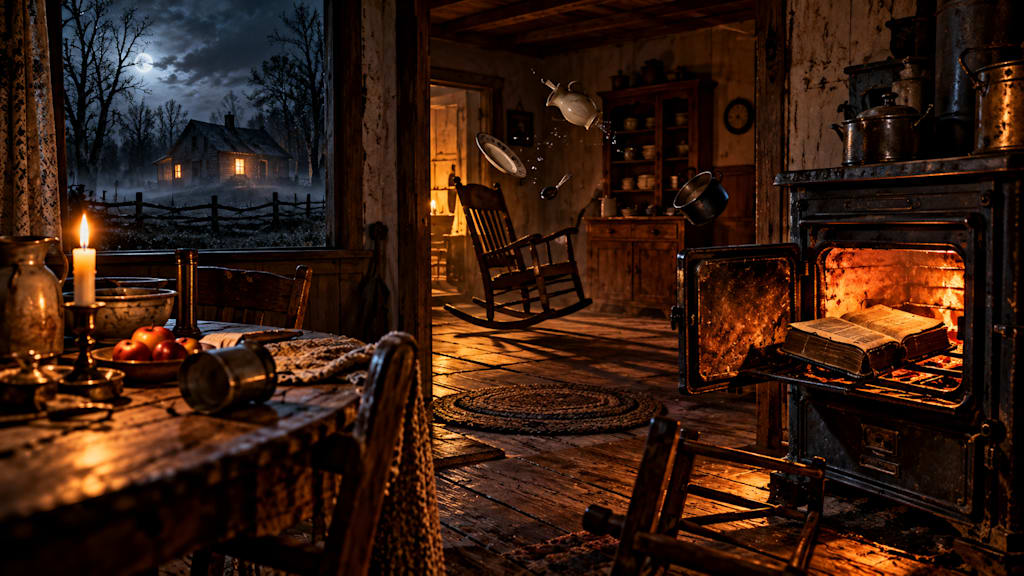
Soon, reports say stones began striking the farmhouse. Eight windowpanes reportedly broke. Inside, ordinary household objects allegedly behaved in extraordinary ways. A washboard reportedly flew down from the attic. A mouth organ was heard playing and then appeared to move from its resting place. A rocking chair began moving without anyone sitting in it. A jug of water was said to have struck Susan Dagg in the face.
The most alarming reports involved fire. Curtains allegedly caught fire while hanging in the windows. Clothing and household objects were found burning or placed in the stove. One later declaration claimed that as many as eight separate fires occurred in a single day. No one ever conclusively established whether these incidents were caused deliberately, accidentally, or by some other mechanism. But to the people who believed they were witnessing them, the farmhouse had become a place where ordinary objects could no longer be trusted.
Then came the voice. Witnesses described it as deep, rough, and like an elderly man's. It reportedly spoke from locations where no visible person could be found. It answered questions. It used obscene language. It also seemed to have a particular talent for insulting the people who investigated. In some accounts, the unseen speaker claimed to be the Devil.
Children in the household also described frightening figures, including a tall, thin being with the head and horns of a cow, a tail, and a cloven foot. Another report concerned an enormous black dog. These were accounts of alleged appearances, not independently verified sightings. The children were young, and adults shared their descriptions with the public, who were already trying to make sense of the disturbances. Nevertheless, the stories spread...
Neighbors visited. Curious strangers arrived. Religious concerns intensified. Eventually, they organized a prayer meeting to confront the supposed presence. During this gathering, one of the case’s most memorable incidents allegedly occurred. A man named Horner, identified in the contemporary account as the brother of a Reverend Horner, was leading the meeting. A Bible resting on a chair in front of him reportedly vanished while he prayed. It was later found in the oven. The detail has sometimes been retold as a minister having the Bible snatched directly from his hands. That is not what the principal historical account says. But even in its less embellished form, the allegation was extraordinary.
By November, the Dagg farmhouse had become a regional sensation. Yet amid accounts of invisible hands and frightening apparitions, witnesses noticed something that would change the direction of the entire investigation. When one particular child was absent, the disturbances reportedly stopped. And that child was Dinah McLean.
ACT II - THE HUMAN MYSTERY
Dinah Burden McLean was eleven years old. She had been sent from Scotland to Canada through an organized child-emigration arrangement and had come to live with the Daggs after passing through an institution in Belleville, Ontario. She was not George and Susan Dagg’s biological daughter. She was a child who had crossed the Atlantic and entered a household far from her birthplace. That background matters.
Nineteenth-century child migration often placed vulnerable children in situations where they depended heavily on adults for housing, security, and acceptance. We cannot know precisely how Dinah experienced life in the Dagg household. But we should remember that she was a child before she became a central figure in a famous haunting.
Woodcock’s account described her as having become visibly unwell during the weeks of disturbances. Her cheeks were said to have grown sunken, with dark circles beneath her eyes. Those descriptions may reflect illness, exhaustion, emotional strain, or the perceptions of concerned adults. The record does not establish a medical explanation. It does establish that witnesses repeatedly connected Dinah’s presence with the reported phenomena. When she was sent to another household, the disturbances reportedly ceased. When she returned, they allegedly resumed. The mysterious voice was particularly associated with her. She was also among the children who claimed to have seen the frightening figures.
At first, local suspicions had fallen on the chore boy Dean. Later, according to Woodcock’s account, some residents suspected a neighboring woman named Wallace and her children of practicing harmful magic. Neither accusation was demonstrated. The progression is revealing. Faced with events they could not explain, people looked for someone responsible. First a boy, then a neighboring family, and then attention settled increasingly on Dinah.
But what did her involvement mean? One possibility is that someone was deliberately creating the disturbances. Another is that ordinary events, misunderstood or exaggerated, became part of a shared expectation that something extraordinary was occurring. A third possibility, favored by some investigators at the time, was that Dinah somehow served as a medium through whom an unseen intelligence operated. That last interpretation belonged to the spiritualist worldview of the period. It was not a scientifically established explanation. The central problem is that the surviving evidence cannot decisively distinguish among these possibilities. No reliable basis exists to accuse Dinah of orchestrating the events. Nor does her apparent association with them demonstrate supernatural powers.
What makes her role especially troubling is how quickly an entire community's attention could become concentrated on one eleven-year-old girl. Adults questioned her. Visitors watched her. Investigators evaluated her behavior. And whatever she understood about the events, her life was being transformed by them.
Then an investigator arrived who believed he could determine what was happening. His name was Percy Woodcock. His involvement produced the document that still makes this case so remarkable.
ACT III - THE EVIDENCE
Percy Woodcock was a Canadian artist associated with the Royal Canadian Academy. He had also spent years studying phenomena attributed to spiritual or occult causes. When reports from the Dagg farmhouse reached him, he traveled to Clarendon to investigate.
He arrived in the area on November 14, 1889, and visited the farmhouse the following day. At first, he found that Dinah had been sent away. George Dagg reportedly explained that the family expected a quiet day because the disturbances generally ceased in her absence. Woodcock persuaded the family to bring her back.
Over the next several days, he interviewed residents, examined the premises, and recorded what he believed he had witnessed. He reported hearing the mysterious voice himself. According to his account, it engaged him in a lengthy conversation, resisted his attempts to correct its behavior, and eventually agreed to stop insulting people. Woodcock considered the possibility of ventriloquism. He examined the farmhouse and shed for concealed speakers or accomplices. He also reported a test in which Dinah filled her mouth with water while the voice continued speaking. He regarded this as evidence that she could not be producing the sound. But the test, as described, was neither independently controlled nor sufficient to rule out every ordinary explanation.
Woodcock’s confidence was stronger than the surviving evidence can justify. His spiritualist interests also deserve consideration. He did not approach the farmhouse as a modern investigator testing competing explanations under controlled conditions. He was already familiar with claims of spirit communication and regarded such phenomena as possible. That does not prove he was dishonest. It does mean his conclusions require careful scrutiny.
On November 17, Woodcock prepared a formal declaration summarizing the alleged disturbances. Seventeen men signed it. The statement described fires, flying objects, broken windows, a moving mouth organ, a rocking chair, and a disembodied voice. It also included the children’s descriptions of the strange apparitions. The names were published. Signatories included George Dagg and several other members of the Dagg family, along with local residents and visitors.
This detail gives the case unusual historical weight. Seventeen people publicly attached their names to an extraordinary account. But what exactly did their signatures establish? Not that seventeen independent observers had witnessed every event. Some incidents occurred before Woodcock arrived. Others were reported by family members or neighbors. Certain episodes allegedly happened when only one person was present. The declaration brought these claims together into a single statement. That distinction matters enormously. A document can prove that people endorsed an account without proving that every detail happened exactly as described.
And there is another complication. A later examination of the declaration noted that its description of a white-haired, crowned apparition appears to refer to an event reported after the document’s stated signing date. If that chronology is correct, the declaration may have been amended after its initial preparation. We cannot determine from the surviving material exactly how or when the wording was finalized. But the inconsistency cautions against treating the document as an untouched, precisely dated record.
Then came the final and perhaps strangest development. The alleged voice changed. After previously threatening and insulting visitors, it reportedly began apologizing. It claimed a more benevolent identity. Witnesses said it sang hymns in a beautiful voice. Some accounts describe a radiant or crowned figure and an apparent departure from the farmhouse. Woodcock himself reportedly questioned the voice’s new claims, pointing out that the supposedly angelic speaker had previously presented itself very differently. The people gathered at the farmhouse did not all interpret the change in the same way. For some, the apparent transformation offered reassurance. For others, it introduced yet another reason for doubt. Was the voice an independent intelligence capable of deception? Was someone performing for an increasingly fascinated audience? Were witnesses interpreting ambiguous experiences through the religious and spiritual expectations of their time? Or had the story grown beyond the ability of anyone present to separate observation from belief?
The surviving record cannot provide a definitive answer. It does show, however, that the reported disturbances eventually ended. Dinah was removed from the Dagg household and returned to institutional care. In later correspondence, Woodcock continued defending his interpretation and criticized those who questioned his account. The farmhouse itself returned to relative obscurity. But the story did not disappear. Newspapers, spiritualist publications, and later examinations of historical poltergeist cases preserved its most extraordinary claims. And more than a century later, the seventeen signatures remain part of the mystery.
The Silence After the Voice
There is an understandable temptation to treat the Dagg farmhouse as a simple contest between believers and skeptics. Either a supernatural entity terrorized a family, or someone invented the entire affair. But the historical record does not force us into either conclusion. It establishes that extraordinary claims circulated widely in 1889. It establishes that witnesses and visitors reported disturbing incidents. It establishes that Percy Woodcock investigated, published his conclusions, and obtained seventeen signatures. It also reveals weaknesses in the evidence, conflicting interpretations, and a young girl whose circumstances deserve more compassion than sensational retellings often provide.
The unexplained does not automatically become supernatural. And the possibility of an ordinary explanation does not mean every witness lied on purpose. Human memory, fear, suggestion, expectation, and sincere belief can interact in complicated ways. So can deception. The difficulty is determining which factors were actually present in a particular case. At the Dagg farmhouse, the evidence is too limited to settle that question.
But perhaps the most haunting aspect of the story is not the Bible allegedly found in the oven. Nor the voice that claimed to be the Devil before singing hymns. Nor even the declaration signed by seventeen men. It is the image of an eleven-year-old orphan standing at the center of an escalating spectacle, surrounded by adults who believed something extraordinary was happening. We know far more about what those adults said than what Dinah herself experienced. And that imbalance may be the most revealing feature of the entire affair.
In the end, the voices stopped. The crowds dispersed. No one reported fires or flying objects anymore. Whatever happened in that farmhouse, it became part of the past. But the questions remained.
Did the witnesses encounter events they genuinely could not explain? Did an elaborate deception unfold before a community already primed to believe? Or did an ordinary series of incidents become something extraordinary through the combined force of fear, expectation, and testimony? We cannot say. We can only return to the surviving documents and examine what they actually tell us.
And perhaps that is why the Dagg farmhouse continues to fascinate. Because beneath the alleged haunting lies another mystery entirely. Not simply what happened inside that house. But how seventeen people came to put their names to a story that history still cannot fully explain.
Where the historical record ends, the questions begin. - Veil of Shadows
About the Creator
Veil of Shadows
Ghost towns, lost agents, unsolved vanishings, and whispers from the dark. New anomalies every Monday and Friday. The veil is thinner than you think....
Enjoyed the story? Support the Creator.
Subscribe for free to receive all their stories in your feed.
Comments
There are no comments for this story
Be the first to respond and start the conversation.