
The Vanishing of Louis Le Prince: The Man Who Disappeared Before He Could Change History
Maniacal Monday Edition

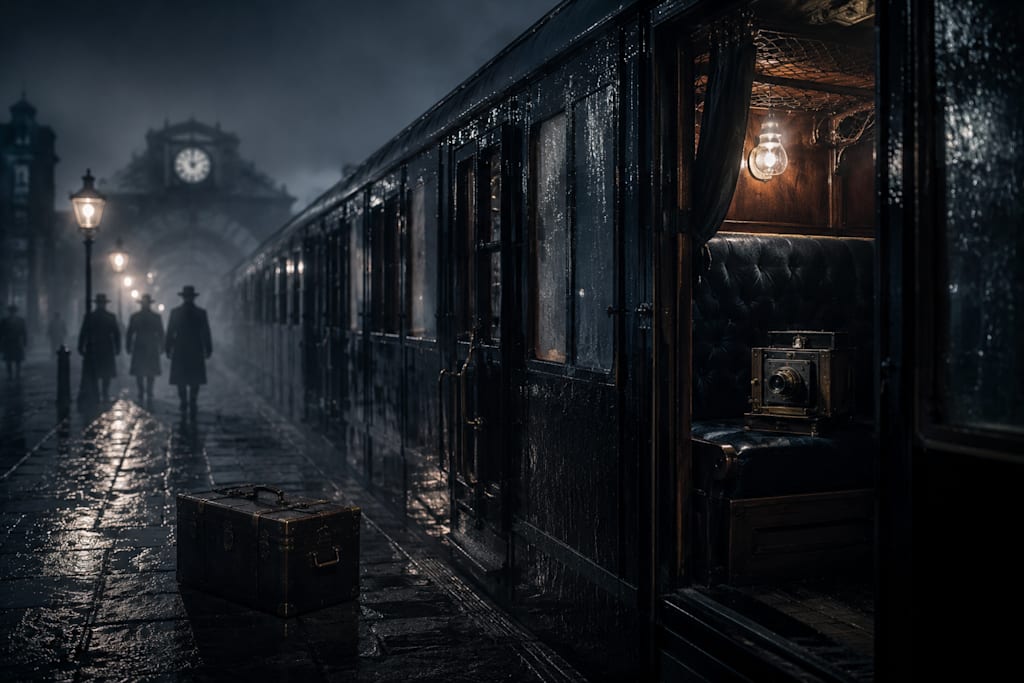
On a warm September evening in 1890, a man boarded a train in France carrying plans that might have changed the course of history. His name was Louis Le Prince. Few people today recognize the name, yet many historians believe he was the true inventor of motion pictures. A man who captured moving images years before cinema officially began. Le Prince had already filmed people walking in a garden, photographed motion, and developed revolutionary camera technology. Most importantly, he was preparing to travel to America, where he intended to demonstrate his invention to the world.
Then, somewhere between two stations in France, he vanished. When the train arrived in Paris, Louis Le Prince was gone. His luggage and his body were missing. Despite one of the largest investigations of the era, nobody could explain what happened. More than a century later, the mystery remains unsolved, standing as one of history's strangest and perhaps most consequential disappearances.
Louis Aimé Augustin Le Prince was born in 1841 in the French city of Metz. From an early age, he displayed a fascination with art, science, and technology. He lived during a period of astonishing innovation: the Industrial Revolution was transforming society, photography was becoming increasingly sophisticated, and inventors across Europe and America were searching for ways to capture not just still images, but motion itself. The challenge was immense. A single photograph could freeze a moment in time, but creating the illusion of movement required capturing many images in rapid succession and then displaying them at the correct speed. Dozens of inventors pursued the goal, and most failed. Le Prince, however, appeared to succeed.
In 1888, Le Prince created what many historians consider the earliest surviving motion picture: the Roundhay Garden Scene. The film lasts only a few seconds, and four people walk through a garden in Leeds, England. The footage is grainy and brief, yet it moves; the people are alive. For the first time in history, ordinary human activity had been captured on film and preserved. Today it looks primitive, but in 1888, it was nothing short of miraculous.
Le Prince continued refining his cameras and projection systems. His ultimate goal was not simply to create moving pictures but to present them publicly. He believed he stood on the threshold of a technological revolution, and history suggests he was right.
By 1890, Le Prince was preparing for what should have been the most important journey of his life. After visiting family in Dijon, France, he intended to travel to Paris before continuing to England and ultimately to the United States. America was critical; a successful demonstration there could secure patents, investors, and international recognition. The future of cinema may have depended on that trip.
On September 16, 1890, Le Prince boarded a train departing Dijon. Witnesses saw him enter his compartment, and nothing seemed unusual. The journey to Paris should have been routine, but when the train arrived, Louis Le Prince never stepped onto the platform.
Railway staff quickly realized something was wrong. The inventor could not be located, his compartment was empty, and his luggage was missing. No one had seen him leave, no one remembered speaking with him, and no one could explain where he had gone. The mystery deepened almost immediately: the train had not stopped at any station where he could have casually disappeared, and reports indicated that the compartment windows were secured, making an accidental fall unlikely. There was no evidence of a struggle, no blood, no signs of violence, and no body was discovered along the route. It was as though the inventor had simply ceased to exist.
Authorities launched an investigation, but nothing emerged. Days turned into weeks, weeks into months, and the search expanded, still nothing. There were no confirmed sightings, no ransom demands, no remains, and no explanation. Just silence.
As often happens with unsolved mysteries, theories began multiplying almost immediately. One possibility was suicide; perhaps Le Prince had become overwhelmed by financial difficulties, professional pressures, or personal troubles. Yet evidence supporting this theory was surprisingly thin. Friends and family described him as optimistic about the future, actively planning demonstrations and business ventures, and appearing excited rather than despairing. For many researchers, suicide simply does not fit the known facts.
Another theory suggested an accident. Could he somehow have fallen from the train? The problem is that extensive searches along the route failed to locate any trace of him. No body was recovered, no personal effects were found, and no witness reported an accident. The theory remains possible, but ultimately unsatisfying.
Then there is the theory of murder, a possibility that has fascinated investigators for generations. Le Prince was carrying valuable intellectual property, and if his inventions succeeded, enormous profits could follow. Some historians have speculated that rivals may have viewed him as a threat, which naturally leads to the most controversial theory of all: a conspiracy involving one of the most famous inventors in history, Thomas Edison. Edison would later receive widespread credit for pioneering motion-picture technology in the United States, and Le Prince's disappearance occurred just before he was expected to publicly demonstrate systems that may have challenged those claims. The timing has fueled speculation for decades. Did powerful business interests eliminate a competitor? Was industrial espionage involved? Could Le Prince have been silenced before unveiling his invention? There is no evidence directly linking Edison to the disappearance, none, but the coincidence remains irresistible to mystery enthusiasts. The theory survives because the case itself provides so few answers; when evidence is absent, speculation rushes in to fill the void.
Another intriguing possibility emerged from within Le Prince's own family: some researchers have suggested he may have disappeared voluntarily. Perhaps he wished to escape debts or obligations, perhaps family conflicts played a role, or perhaps he simply started a new life elsewhere. Again, the evidence is frustratingly limited. No convincing record of a new identity has ever surfaced, and no confirmed sighting appeared in later years. For a man of his intelligence and ambition, abandoning everything without a trace seems difficult to explain, yet it cannot be completely ruled out.
Then, decades later, a curious clue appeared. In 2003, researchers uncovered a photograph taken in Paris in 1890. The image depicted the body of an unidentified drowning victim, and some observers noticed a resemblance to Louis Le Prince. The similarities were striking enough to attract attention; had the mystery finally been solved? Unfortunately, no. The photograph raised more questions than answers, as the identity of the victim could not be conclusively established. Without modern DNA evidence, certainty remains impossible. The image became yet another tantalizing thread in a mystery woven from loose ends.
Today, historians continue debating what happened aboard that train. The disappearance remains officially unsolved, no definitive explanation has emerged, no confession has surfaced, and no hidden documents have revealed the truth. Perhaps the most haunting aspect of the story is what came afterward. Motion pictures transformed civilization: cinema became one of humanity's most influential art forms, entire industries emerged, fortunes were made, and legends were born. Yet the man who may have started it all never saw any of it. If Louis Le Prince had reached America, history books might look very different. His name might stand alongside, or even above, the giants of early cinema. Instead, he became a ghost story: a vanished inventor, a missing pioneer, a man who stepped onto a train carrying the future and somehow disappeared before it reached its destination.
More than 135 years later, the question remains exactly where it was in September of 1890: what happened to Louis Le Prince? No witness knows. No document explains it. And perhaps most unsettling of all, the train reached Paris without him, and nobody has ever convincingly explained how.
About the Creator
Veil of Shadows
Ghost towns, lost agents, unsolved vanishings, and whispers from the dark. New anomalies every Monday and Friday. The veil is thinner than you think....
Enjoyed the story? Support the Creator.
Subscribe for free to receive all their stories in your feed.
Comments
There are no comments for this story
Be the first to respond and start the conversation.