
The Vanishing of Benjamin Bathurst: The Diplomat Who Walked Out of Reality
Foreboding Friday Edition

Intro
Most disappearances leave behind fragments, a dropped handkerchief, a muddy footprint, the echo of a desperate cry. These relics are the breadcrumbs that investigators hungrily follow: a trail, a struggle, a final clue waiting to be discovered. But sometimes, reality unravels in ways that leave no such comfort. Some vanishings are different, as if the world itself has blinked and, in that brief darkness, a person is simply erased.
A trail… A struggle… A final clue waiting to be discovered. But some vanishings are different. Some occur so suddenly, so completely, that they feel less like crimes and more like glitches in reality itself. A rift opening, swallowing a soul, and sealing without a trace.
In 1809, as the Napoleonic Wars cast long shadows across Europe, British diplomat Benjamin Bathurst found himself traveling under mounting political tension. On a cold November night, he stopped at an inn in Germany, unaware that his name was about to become a riddle whispered for centuries.
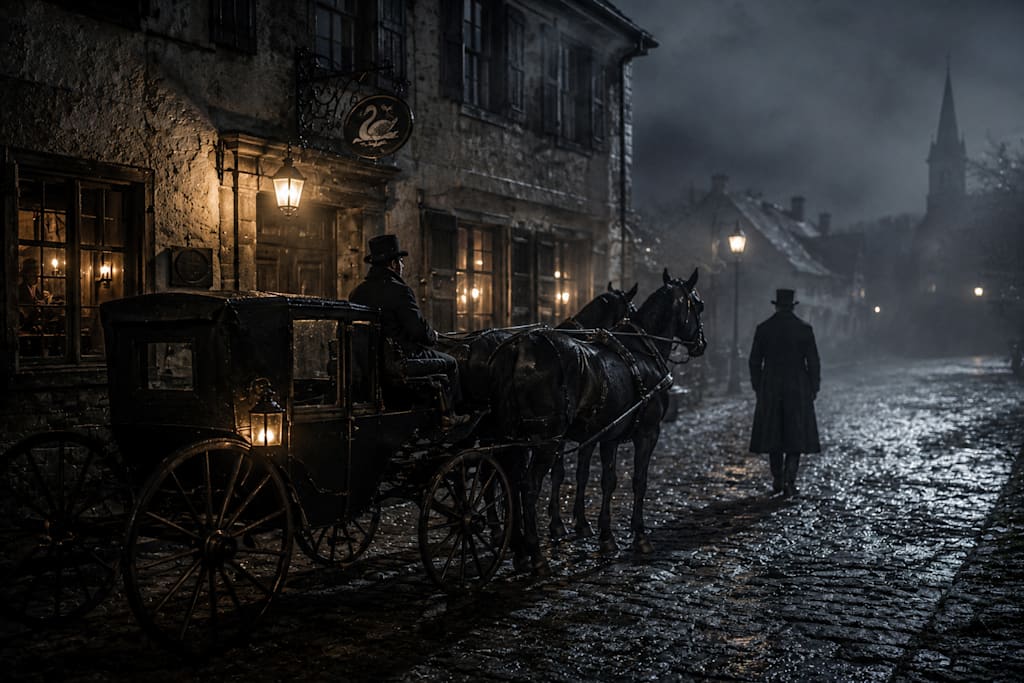
Moments later, he stepped around the front of a waiting carriage, his footsteps muffled by the wet cobblestones. And was never seen again. No scream. No witness to an attack. No body. Just an empty space where a man should have been. And more than two centuries later, the mystery remains unsolved.
No scream or witness to an attack… nothing! Just an empty space where a man should have been. And more than two centuries later, the mystery remains unsolved.
Act I – Europe in Chaos
The year was 1809. Europe was burning beneath the shadow of Napoleon Bonaparte and the sweeping conflict of the Napoleonic Wars. Borders shifted like sand. Armies marched across entire nations. Diplomats such as Benjamin Bathurst moved carefully through a continent thick with spies, suspicion, and sudden violence. Every unfamiliar face was a possible threat, every whisper a coded warning.
Europe was burning beneath the shadow of Napoleon Bonaparte and the sweeping conflict of the Napoleonic Wars. Borders shifted constantly. Armies marched across entire nations. Diplomats moved carefully through a continent thick with spies, suspicion, and political violence. Among them was Benjamin Bathurst.
Bathurst was no ordinary traveler. A respected British diplomat and rising political figure, he had been stationed in Vienna during one of the most unstable periods in European history. As French influence spread relentlessly, Bathurst found himself in increasingly dangerous territory, forced to rely on both caution and luck.
As French influence spread across the continent, Bathurst found himself in increasingly dangerous territory.
By late 1809, Bathurst decided to leave Austria and make the perilous journey back toward Britain. Traveling with his companion and servant, Johann Krause, Bathurst disguised himself under an assumed name, hoping to slip through the net of spies and highwaymen that prowled every crossroads.
It would be a journey he would never complete. The roads were dangerous. Robbery was common. Political agents operated in secrecy. Every night, Bathurst’s anxieties grew, and every unfamiliar knock at the door brought a fresh wave of dread.
Traveling with his companion and servant, Johann Krause, Bathurst moved through Germany disguised under an assumed name to avoid attracting attention. Even so, tensions remained high. Roads were dangerous. Robbery was common. Political agents operated in secrecy. Every unfamiliar face carried uncertainty.
Still, the evening of November 25 in the town of Perleberg, Prussia, seemed, at first glance, unremarkable. The travelers arrived exhausted at the White Swan Inn, a haven of warmth in the biting cold. Bathurst, however, was restless. Witnesses later described him as anxious and distracted, his eyes flitting nervously to the windows as if he sensed danger lurking just beyond the lantern light. At least not at first.
Act II – The White Swan Inn
The travelers arrived in the town of Perleberg, Prussia, exhausted from the road. There, they stopped at a local establishment known as the White Swan Inn.
Witnesses later described Bathurst as anxious and distracted that evening. Some claimed he appeared deeply uneasy, frequently glancing out the window as though expecting trouble.
Whether it was mere wartime paranoia or the premonition of something more sinister, no one can say. After a hasty meal, Bathurst and Krause prepared to depart once more into the shadowed night. The carriage was brought forward, horses stamping in the gloom. Lanterns flickered on the wet stones, casting long, wavering shadows. There was nothing to hint at the extraordinary event about to unfold.
After dining, Bathurst and Krause prepared to continue their journey through the cold November night. The carriage was brought forward. The horses waited impatiently in the darkness. Lantern light flickered against wet cobblestones as travelers and townspeople moved nearby. Nothing about the setting suggested the impossible was about to occur.
Bathurst exited the inn ahead of his companion, his breath curling in the cold. He approached the carriage, and in that instant, the familiar dissolved into the inexplicable. He vanished. One moment, he was there. The next, the air where he had stood was empty, as if he had been plucked from the world by unseen hands.
He approached the carriage. And then… He vanished.
Act III – The Last Moments
Johann Krause, the only witness, recounted that Bathurst walked around the front of the horses toward the opposite side of the carriage. It should have taken only seconds, enough time for the mist to swirl, for a hoof to clatter. But Bathurst never emerged. At first, Krause assumed the diplomat had simply stepped away, perhaps back inside the inn or toward the street. Yet as seconds stretched into minutes, confusion curdled into alarm.
It should have taken only seconds, but Bathurst never emerged. At first, Krause assumed his employer had stepped away briefly. Perhaps he had returned inside the inn. Perhaps he had wandered toward the street. But moments passed, and then minutes. And confusion quickly became alarm.
Searches began immediately. The inn was combed room by room, the streets scoured, and locals questioned. Yet Bathurst had vanished as utterly as a coin tossed into deep water. No sign of him, no trace, as if he had been swallowed by the night itself.
The inn was checked room by room. Nearby streets were examined. Locals were questioned. With no sign of Bathurst anywhere.
The situation made no sense. This was not an isolated road or a dense forest, but a busy inn with witnesses nearby and lanterns burning. Yet no one saw what became of Bathurst. No one could explain how a man could step from the light into utter oblivion.
This had not occurred on an isolated road or deep within a forest. The disappearance took place outside a busy inn, near witnesses, beneath lantern light, in an area where movement should have been obvious. And yet no one could explain where Benjamin Bathurst had gone.
Act IV – The Search
Panic spread quickly. Bathurst was not simply a missing traveler. He was a British diplomat during wartime. His disappearance immediately triggered fears of espionage, assassination, or kidnapping. Authorities launched extensive searches throughout the region. Nearby woods were combed. Rivers examined. Travelers interrogated. But the deeper investigators looked, the stranger the mystery became.
No evidence of violence was found at the scene. No blood. No signs of a struggle. No witnesses reported cries for help. And perhaps most unsettling of all… the horses reportedly remained calm. Anyone violently abducted beside a carriage would likely have caused noise or commotion. Horses are easily startled creatures. Yet there were no reports of panic. It was as though Bathurst had simply ceased to exist between one step and the next.
Act V – Theories in the Darkness
Over the next two centuries, countless theories emerged attempting to explain the disappearance. Some grounded. Others are far stranger. But none fully solved the mystery.
Theory One: Murder
The most accepted theory is that Bathurst fell victim to foul play. The roads of early 19th-century Europe were dangerous, and Bathurst’s nervous demeanor may have indicated he feared pursuit. Perhaps criminals or enemy agents intercepted him the moment he rounded the carriage. Perhaps he was silenced quickly and secretly removed. This explanation fits the political climate. But it struggles against the logistics.
How does a man disappear instantly in a populated area without drawing attention? How does a violent abduction occur without noise? Without witnesses of any kind? Without even disturbing the horses? The unexplained gaps remain seriously troubling.
Theory Two: Espionage and Assassination
Some historians believe Bathurst may have been targeted by French operatives. As a diplomat carrying sensitive information, he represented a valuable target during wartime. This theory adds intrigue but faces the same problems. An organized kidnapping in such a visible location would have required extraordinary precision. And still… No evidence ever surfaced proving enemy involvement. No ransom. No confirmed sighting. No confession. Nothing.
Theory Three: Psychological Breakdown
Others argue Bathurst may have suffered emotional collapse. The stress of wartime travel, political instability, and paranoia may have driven him to flee voluntarily. But this too raises questions. Why leave behind possessions? Why vanish without preparation? And why disappear in such an abrupt and bizarre manner? A man suffering fear may run. But he does not usually evaporate into thin air beside a carriage.
Theory Four: Something Stranger
And then there is the theory that lingers quietly at the edge of the story. The possibility that Bathurst’s disappearance belongs to that rare category of mysteries that seem to defy ordinary explanation altogether.
Not a haunting. Not a ghost story. But a moment where reality itself appeared to fail. Because the most unsettling aspect of the Bathurst case is not the disappearance itself but the timing. One second he was visible and the next… poof! No transition. No evidence and no resolution.
Act VI – Echoes Through History
Years later, scattered pieces of evidence surfaced. A coat believed to belong to Bathurst was discovered. Rumors circulated of murder. Human remains were eventually found in the region, though nothing conclusively tied them to the diplomat. The uncertainty only deepened the legend.
Over time, the story transformed from historical mystery into something almost mythic. Because it touches a fear older than ghost stories themselves: The fear of sudden disappearance. The idea that a human life can simply slip beyond the reach of explanation. No farewell. No answers. No trace.
In Closing…
The disappearance of Benjamin Bathurst remains one of history’s strangest unsolved mysteries. Perhaps he was murdered. Perhaps he fell victim to spies operating in the shadows of war. Or perhaps the truth is something far more unsettling.
Because every so often, history leaves behind a story that refuses to behave logically. A moment where reality seems to bend… and a person steps briefly into the unknown.
Benjamin Bathurst walked around a carriage in 1809. And somehow… he never came back.
About the Creator
Veil of Shadows
Ghost towns, lost agents, unsolved vanishings, and whispers from the dark. New anomalies every Monday and Friday. The veil is thinner than you think....
Enjoyed the story? Support the Creator.
Subscribe for free to receive all their stories in your feed.
Comments
There are no comments for this story
Be the first to respond and start the conversation.