
The Vampire: Why We're Still Fascinated by the Undead
A short exploration of why this Undead entity remains so entrenched in our subconscious human mind, Society, and pop culture.

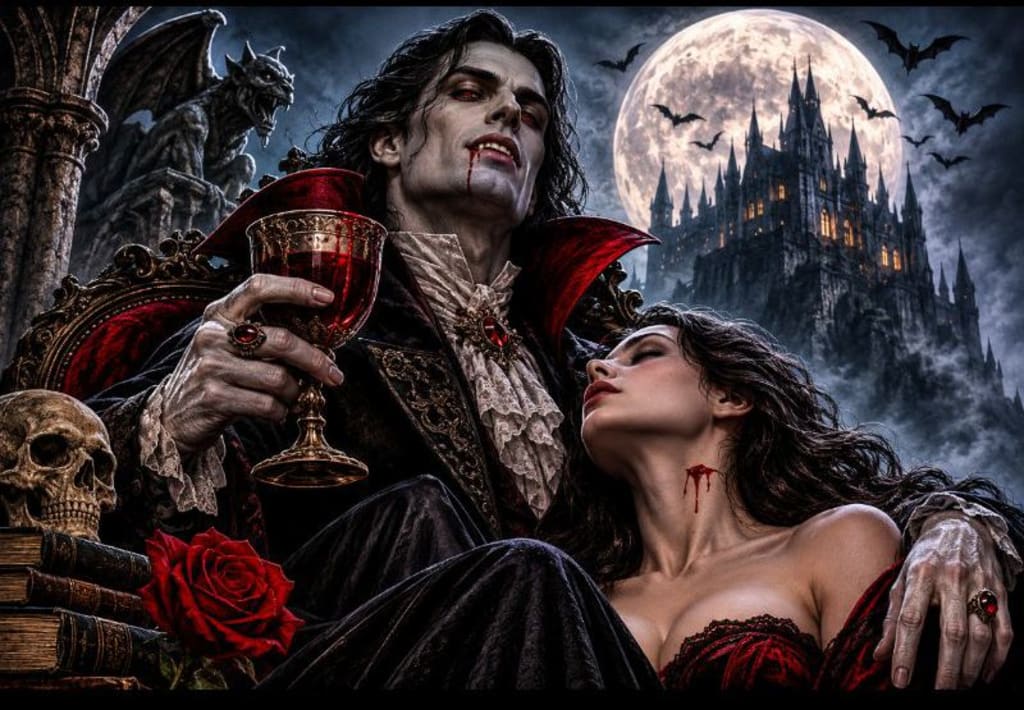
The Vampire: Why We're Still Fascinated by the Undead
The vampire is arguably one of the most enduring supernatural creatures in fiction and folklore. But what is it about this undead blood drinker that has maintained such a powerful grip on the collective human imagination? Nearly every civilization seems to have its own variation of the vampire, and the creature has undergone quite an evolution over the centuries. Interestingly, the modern vampire has very little in common with some of its more disturbing ancient predecessors.
The origins of vampire mythology can be traced back thousands of years. Ancient Mesopotamian mythology featured bloodthirsty female spirits such as Lilitu and Lamashtu, who were associated with attacks on pregnant women and children. Ancient Greek and Roman folklore included the Lamia and Empusa, demonic entities believed to attack people in their sleep and drain their bodily fluids.
Even the mythology of ancient Greece included stories of reanimated corpses, while Slavic folklore eventually gave us some of the more recognizable vampire traditions associated with Serbian and Bulgarian mythology. In some of these early accounts, vampires were little more than bloated, foul-smelling corpses that emerged from their graves to spread disease and terror among the living.
In other words, the original vampire wasn't necessarily the seductive, aristocratic gentleman in a black cape that we've come to associate with the character today. It was more likely something you wouldn't willingly allow within ten feet of your neck unless you were a particularly adventurous individual with questionable survival instincts.
Over time, however, the vampire evolved, much like its human food source.
The Vampire as a Symbol of Wealth and Power
One of the more interesting aspects of vampire mythology is how frequently the creature has been associated with wealth, aristocracy, and social privilege.
Consider the image of the wealthy vampire living in an enormous castle, surrounded by servants, while ordinary people struggle to survive outside its walls. There is something rather symbolic about this arrangement.
Imagine being a poor peasant in medieval Europe, barely managing to feed your family, while some wealthy aristocrat lives comfortably behind the walls of his estate. He has everything you don't, including the power to take whatever he wants. You work, he benefits. You struggle, he prospers.
Now imagine that this wealthy individual is also literally drinking the blood of the living to sustain himself.
It's not difficult to see how the vampire could become a metaphor for an exploitative ruling class.
The vampire represents an entity that feeds upon others while maintaining its own privileged existence. It takes the vitality, labor, and resources of those beneath it, often without giving anything meaningful in return.
There is also an interesting historical connection between aristocratic bloodlines and the obsession with maintaining family status. Wealthy families sometimes went to extraordinary lengths to preserve their fortunes and social standing through marriages within their own circles. The resulting inbreeding could produce devastating consequences, yet the pursuit of maintaining a supposedly superior bloodline continued.
The idea of pure blood, inherited privilege, and superiority over ordinary people fits rather neatly into vampire mythology.
Perhaps this is one reason the aristocratic vampire became such an enduring figure in literature. It represents the fear that those who possess the most power are often the very people most willing to exploit everyone else.
The Vampire and Our Fear of Losing Control
Of course, the vampire represents much more than social inequality. It also taps into some of our most fundamental psychological fears.
At its core, the vampire myth is one of the oldest expressions of the human desire to cheat death.
Wealth, beauty, physical strength, and influence are all temporary. Eventually, regardless of how rich, powerful, or attractive we might be, our bodies deteriorate and our lives come to an end.
The vampire offers an escape from that reality.
Imagine possessing extraordinary strength, the ability to heal, immortality, and centuries in which to accumulate wealth and experience. You could potentially become enormously powerful, regardless of where you started in life.
But there is a catch.
Your existence depends upon consuming the vitality of other human beings. You can have all the power in the world, but you are still dependent upon the very creatures you consider inferior.
There is something rather ironic about that arrangement.
The vampire also represents the darker aspects of human nature: predatory behavior, narcissism, and the willingness to consume others to satisfy personal desires. It is a creature that takes without remorse, often viewing human beings as resources rather than individuals.
This brings us to another reason the vampire has remained so popular: our fascination with forbidden desires.
Sex, Desire, and the Forbidden
The vampire has always had a complicated relationship with human sexuality.
Modern vampire fiction frequently portrays the creature as seductive, mysterious, and sexually dangerous. There is an obvious appeal to the idea of an immortal being who possesses extraordinary physical abilities, wealth, and an almost hypnotic influence over others.
But beneath that seductive exterior is something considerably darker.
The vampire represents unchecked desire, the willingness to pursue gratification without regard for morality, consequences, or the well-being of others.
It is also worth considering the vampire's relationship with blood itself. Blood has long been associated with life, passion, vitality, and reproduction. The act of consuming another person's blood can therefore be interpreted as an expression of taking something far more fundamental than physical nourishment.
The vampire doesn't simply want to possess another person. It wants to consume what makes that person alive.
There is also a power fantasy associated with the vampire archetype, particularly in stories involving older men and younger women. The immortal vampire is often portrayed as a wealthy, powerful, and physically desirable individual who can pursue virtually anyone he wants.
For some audiences, this represents an escape from the limitations and frustrations of ordinary life. The vampire becomes a fantasy of absolute freedom, where age, mortality, social restrictions, and conventional expectations no longer apply.
Of course, there is another side to that fantasy. The same creature that appears attractive and powerful can also be manipulative, possessive, and terrifyingly dangerous.
That contradiction is precisely what makes the vampire so fascinating.
The Vampire Is Also a Reflection of Us
Perhaps the greatest reason the vampire has endured for so long is that it reflects aspects of human nature that we don't particularly enjoy acknowledging.
We fear becoming powerless. We fear aging, losing our attractiveness, and eventually dying. We envy those who possess wealth and influence, and sometimes we fantasize about having the freedom to do whatever we want without worrying about the consequences.
The vampire embodies all these desires while simultaneously representing their darkest possible expression.
It is immortal but dependent. Powerful but vulnerable to certain weaknesses. Seductive but predatory. Wealthy but incapable of enjoying the ordinary pleasures of human existence without placing someone else at risk.
Think about it. You could spend centuries accumulating wealth, developing extraordinary physical abilities, and living in a magnificent castle. But you still can't walk outside during the day without turning yourself into a very expensive barbecue.
And even if you manage to avoid sunlight, you have to contend with garlic, religious symbols, wooden stakes, and the inconvenience of not being able to enter someone's home without an invitation.
Imagine being one of the most powerful supernatural beings on Earth and having to stand on someone's porch for three hours because the homeowner refuses to let you inside.
Meanwhile, the ordinary human being you're trying to seduce can enjoy a slice of pizza, take a walk in the sunshine, and go to bed whenever they damn well please.
There is something wonderfully absurd about that.
Ultimately, the vampire is much more than an undead creature that drinks blood. It is a reflection of our fears, desires, insecurities, and fascination with power. It represents our longing to escape mortality, our resentment toward those who exploit others, and our curiosity about what might happen if we abandoned the restrictions that make us human.
Perhaps that's why the vampire continues to evolve with every generation.
The monsters may change, the mythology may become more sophisticated, and the bloodsucking aristocrat may eventually be replaced by a brooding supernatural heartthrob.
But the underlying fascination remains the same.
Because sometimes the most frightening thing about a monster isn't how different it is from us.
It's how much it has in common with us.
About the Creator
mark bradley (mark45xxx)
I'm a published Comic Book Creator & freelance illustrator specializing in dark,surreal, & cinematic artwork. I help authors, indie creators, and collectors, bring intense ideas to life
Enjoyed the story? Support the Creator.
Subscribe for free to receive all their stories in your feed.
Comments
There are no comments for this story
Be the first to respond and start the conversation.