
The Vampire of Kisiljevo
The Corpse That Terrified Europe...

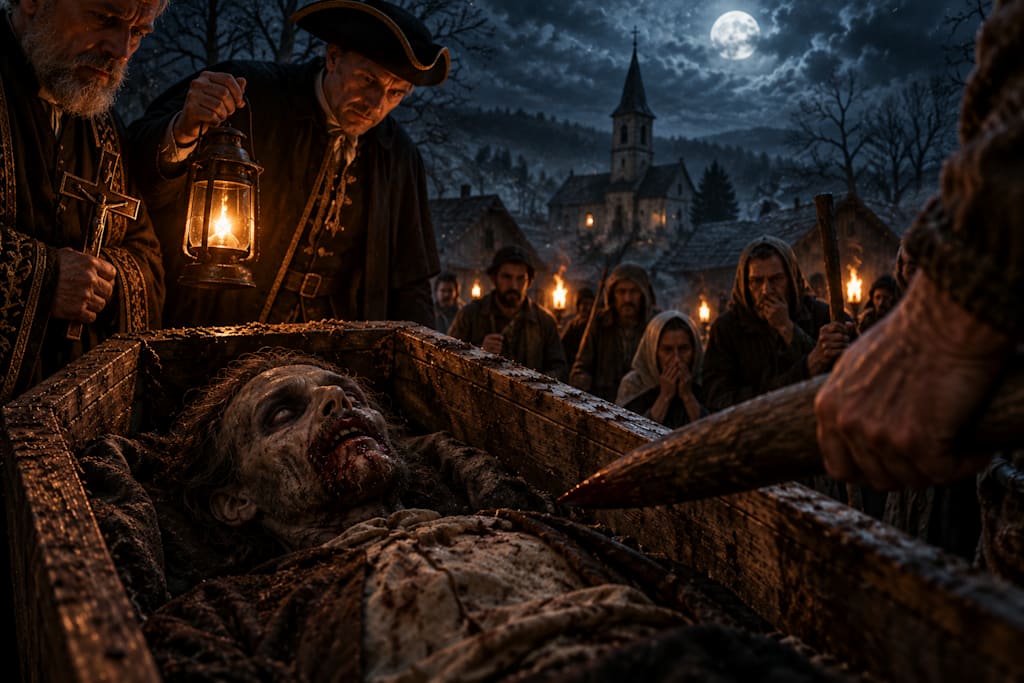
The villagers already knew what was inside the grave.
Or at least they believed they did.
It was 1725 in the small Serbian village of Kisiljevo. Nine people had died within approximately eight days. Their illnesses had been sudden. Their deaths had been frightening. But illness was not what terrified the village.
The dead had apparently been saying the same thing. Petar Blagojević had come back. They said the recently deceased villager had appeared to them during the night. He had entered their rooms, lain upon them, tormented them, attacked them while they slept. Then they became ill. Within roughly twenty-four hours, they died. There was only one problem. Petar Blagojević had been buried for approximately ten weeks.
The people of Kisiljevo became convinced that something was leaving his grave after dark. They even had a name for it: Vampyr. And soon an imperial official would stand beside Petar’s opened coffin and see something disturbing enough that the story would travel far beyond this frightened Serbian village. More than 170 years before Bram Stoker published Dracula, Europe was about to meet the vampire, and it would not arrive wearing a cape.
Nine Dead in Eight Days
Kisiljevo... rendered in contemporary German records as Kisilova, lay in territory that had recently come under Habsburg administration following wars between the Habsburg and Ottoman empires. This was a world where two very different systems overlapped. Imperial administrators wanted taxes, records, and order. Villagers carried traditions and beliefs far older than the bureaucracy attempting to govern them. Then Petar Blagojević died.
For approximately ten weeks, apparently nothing extraordinary happened. Then people began dying. Nine deaths in approximately eight days would have been alarming in any small community. But according to the report subsequently written by the imperial official involved, the victims made a disturbing accusation during their final illnesses. Petar had visited them.
The dead man had supposedly come during the night and lain upon them or attacked them. Afterward, they weakened and died. To modern readers, there are obvious possibilities: disease, fever, delirium, sleep paralysis, respiratory illness causing sensations of pressure or suffocation, fear spreading through a small community already confronting an unexplained cluster of deaths. But Kisiljevo lacked modern epidemiology. It possessed something else... a cultural explanation for a corpse that refused to remain peacefully dead.
Then Petar’s widow reportedly added another piece to the nightmare. Her dead husband had returned to her as well. He wanted his shoes. She subsequently left the village. Whatever uncertainty remained among Petar’s neighbors was rapidly disappearing. Something had to be done.
Call the Government
The villagers approached an imperial administrator commonly identified as Frombald. They wanted Petar’s grave opened. Frombald was understandably reluctant. Exhuming a corpse because villagers believed it was wandering around at night was not exactly routine Habsburg administration. He preferred to obtain authorization from higher authorities. The villagers had no intention of waiting.
According to the contemporary account, they feared that if Petar were not stopped, he might destroy the entire community. They threatened to abandon their homes rather than remain while more people died.
Frombald was therefore placed in an extraordinary position. He could insist upon procedure while a terrified village fled. Or he could accompany them to the grave. He chose the grave. A local priest was present. The villagers gathered. The earth was opened. After approximately ten weeks underground, the body of Petar Blagojević was exposed. And according to Frombald... something looked... wrong.
The Body in the Grave
Frombald’s report is the reason this case refuses to disappear into ordinary folklore. We are not merely dealing with a legend written down generations afterward. The administrator claimed to have personally observed the corpse.
He described Petar’s body as displaying surprisingly little decomposition, aside from deterioration around the nose. The hair and beard appeared to have grown. The nails appeared renewed. The skin seemed changed. And around the mouth was what appeared to be fresh blood.
To the villagers, there was nothing ambiguous about this. Petar had been feeding. Imagine the scene without three centuries of medical knowledge separating us from it.
Nine people have died. They supposedly accused the same dead man. His widow claims he returned. You dig him up expecting a decomposing corpse. Instead, the body appears strangely preserved. The hair and nails seem longer. The skin looks unusual. And there is reddish fluid around the mouth.
You have spent your entire life hearing that the restless dead can return. What conclusion do you reach? For the villagers of Kisiljevo, the evidence was lying directly in front of them. Petar Blagojević was a vampire.
What They Were Actually Seeing
Modern knowledge of decomposition provides a far less supernatural explanation. Dead bodies do strange things. After death, skin loses moisture and retracts. As it pulls away from hair follicles and nail beds, hair and fingernails can appear to have continued growing. They haven't. The surrounding tissue has changed. Skin can loosen and slough away, revealing layers beneath that may look unexpectedly fresh. Temperature, soil, moisture, coffin conditions, and numerous environmental factors can dramatically alter the rate at which a corpse decomposes.
Then there is the blood. As bacteria break down tissues, gases accumulate inside the body. Pressure can force dark fluid from the mouth and nose. To someone unfamiliar with decomposition, that fluid can look horrifyingly like evidence that the deceased has recently consumed blood.
These processes helped create some of the classic signs historically associated with vampires: the swollen corpse, the apparently growing nails, the fresh-looking skin, blood at the mouth. The people examining such bodies were not necessarily lying about what they saw. They were interpreting real physical changes without understanding their causes.
And in Kisiljevo, those changes were discovered at precisely the worst possible moment. People were already dying. The villagers already had a suspect. Now the suspect’s corpse appeared to confirm the accusation. There would be no trial. There would be no further investigation. Petar was already dead. So they killed him again.
The Stake
The villagers prepared a sharpened stake. Frombald watched. It was driven into Petar’s body. According to the official’s report, more apparently fresh blood emerged from the corpse, including from the mouth and ears.
For frightened witnesses in 1725, this was not evidence of decomposition. It was confirmation. The vampire had been caught. But the stake was not enough. Petar’s body was burned. Whatever remained of the man disappeared into fire.
Frombald then faced a considerably more mundane horror: he had to explain this to his superiors. His surviving report carries an almost timeless bureaucratic anxiety. Frombald made it clear that he had been pressured by villagers who were effectively beside themselves with fear and asked that responsibility not be placed upon him if authorities considered the proceedings improper.
In other words: Yes, a corpse was exhumed, staked, and burned while I was present. Please understand that this was absolutely not my idea.
Three hundred years later, it is difficult not to sympathize with him. But his report accomplished something far greater than protecting an administrator’s career. It allowed Petar Blagojević to escape Kisiljevo one final time.
The Vampire Travels West
In July 1725, an account of the extraordinary affair appeared in Vienna's Wienerisches Diarium. Readers far from the Serbian frontier encountered reports of villagers dying after attacks by a dead man. They read about the exhumation, the strange corpse, the blood, the stake. And they encountered the Balkan term being used to describe the creature: Vampyr.
The Kisiljevo case was part of a much larger transformation. Beliefs concerning the dangerous return of the dead existed across numerous cultures long before 1725. The vampire was not invented in Petar's grave. But during the eighteenth century, reports from Habsburg-controlled Balkan territories began carrying local vampire traditions into Central and Western European intellectual life.
Then came another famous Serbian case involving Arnold Paole in the late 1720s and early 1730s. Again there were deaths. Again, bodies were exhumed. Again, authorities became involved. Doctors examined corpses. Reports circulated. European scholars, physicians, and theologians began arguing about vampires. Were they possible? Was Satan involved? Were the reports frauds? Could decomposition explain the supposedly preserved bodies? What had begun as local attempts to protect communities from dangerous dead people became an international controversy.
The vampire had escaped folklore. It had entered print. And once a monster enters print, it becomes remarkably difficult to kill.
Before Dracula
The vampire that frightened Kisiljevo would barely be recognizable to a modern audience. There was no castle. No aristocratic count. No seductive stranger. No elegant evening clothes. No supernatural gentleman offering eternal life. Those characteristics came later as folklore passed through literature and transformed. Writers gradually remodeled the corpse from the grave into something sophisticated.
John Polidori’s The Vampyre appeared in 1819. Sheridan Le Fanu’s Carmilla followed later in the nineteenth century. Then, in 1897, Bram Stoker published Dracula. By then, the vampire had become one of literature’s great monsters.
But remove the romance. Remove the aristocracy. Remove Hollywood. Remove the cape. Go back. The original creature is much uglier. It is your neighbor. He dies. You help bury him. Ten weeks later, people begin dying. And before they die, they tell you your neighbor came back.
That is the vampire of Kisiljevo. And perhaps that is why Petar’s story remains so disturbing.
What Killed the Villagers?
We do not know why nine people died. An infectious disease is an obvious possibility. Contaminated food or water could devastate a small community. Numerous illnesses poorly understood in the eighteenth century could kill rapidly. Once several people became sick, fear may have supplied an explanation.
Human beings are extraordinarily good at finding patterns during crises. We need causes. We need suspects. We need stories that turn chaos into something understandable. And once a community agrees on the explanation, new experiences can begin to fit into it. A fever dream becomes a visitation. Sleep paralysis becomes a dead man sitting upon the chest. Difficulty breathing becomes strangulation. Another death becomes another victim. Soon everyone knows what is happening: there is a vampire in the village.
None of that requires Petar Blagojević to have risen from his grave. But dismissing the villagers as simply ignorant misses something important. They were frightened people confronting unexplained deaths using the knowledge available to them. And then they opened a grave. What they saw appeared to confirm everything they feared.
We know today that a corpse can mimic many of the signs they associated with vampirism. They did not. They saw Petar. They saw the blood. And someone reached for a stake.
The Man Who Stayed Dead
Eventually the panic ended. Petar Blagojević disappeared from history almost as abruptly as he entered it. There is no reliable evidence that he ever physically climbed from his grave. There is no proof that he attacked anyone. There is no scientific reason to conclude that the corpse examined in 1725 was anything other than a dead human body undergoing decomposition. But that does not make the story fictional.
That is the disturbing part. The villagers were real. The deaths were real. Their fear was real. The exhumation was real. An imperial official really reported what he believed he had witnessed. The body really was staked and burned. And the story traveled.
Nearly two centuries later, readers would open Dracula and meet Count Dracula in his Transylvanian castle. They would encounter one of the most famous monsters ever created.
But long before Dracula became immortal, an administrator stood beside an open grave in a Serbian village. Around him were terrified people. Inside the grave lay their neighbor. Nine villagers were dead. The corpse appeared strangely preserved. There was blood around its mouth. And everyone surrounding Frombald already knew what had to happen next.
The stake was raised. The body was pierced. The corpse was burned. Petar Blagojević never left Kisiljevo again. But something else did.
A report traveled toward Vienna. The story spread. The word survived. And almost three hundred years later, when darkness falls and someone whispers that there is a vampire outside... we still know exactly what they mean.
Perhaps Petar never rose from his grave. But in the summer of 1725... the vampire did. And it has been walking beside us ever since... behind the Veil.
About the Creator
Veil of Shadows
Ghost towns, lost agents, unsolved vanishings, and whispers from the dark. New anomalies every Monday and Friday. The veil is thinner than you think....
Enjoyed the story? Support the Creator.
Subscribe for free to receive all their stories in your feed.
Comments
There are no comments for this story
Be the first to respond and start the conversation.