
The Vallecas Poltergeist: What Four Police Officers Witnessed in a Madrid Apartment.
Veil of Shadows | Investigative Feature

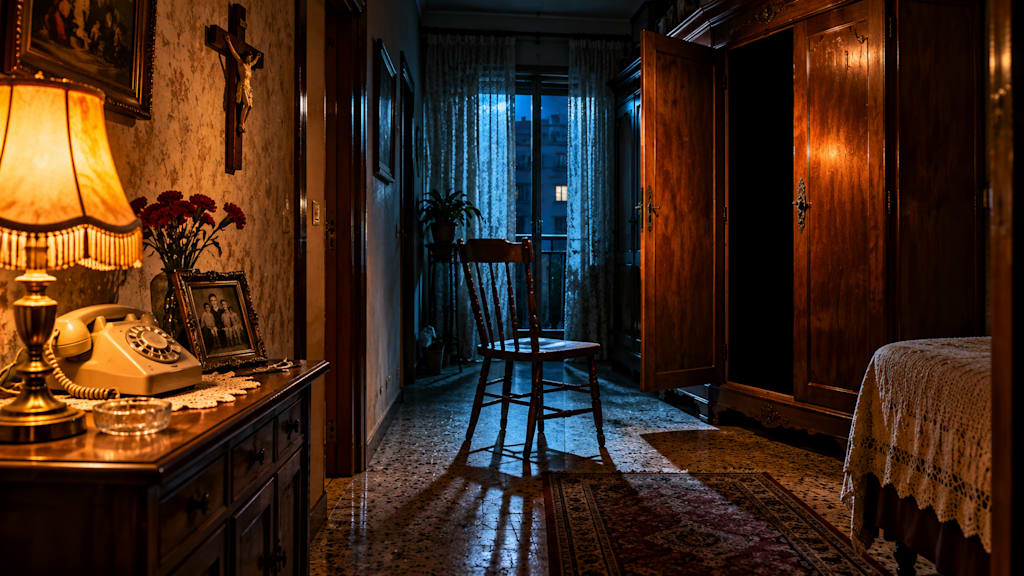
Editor’s note: This article examines a documented police response, contemporary reporting, medical findings described in published investigations, and conflicting eyewitness testimony. Paranormal claims are identified as claims, not established facts. Atmospheric descriptions serve the story; no dialogue, physical evidence, or supernatural events were invented.
The Apartment on Luis Marín Street
Madrid, November 1992. Somewhere in the working-class neighborhood of Vallecas, a family had reached the point where remaining inside their own home seemed more frightening than standing outside in the cold. The address was number 8, Calle Luis Marín. It was an ordinary apartment building. Nothing about its exterior suggested that it would become the setting for one of Spain’s most enduring paranormal controversies. Yet during the early hours of a November morning, police officers were called to investigate disturbances at the home of the Gutiérrez-Lázaro family.
The family described terrifying occurrences: unexplained noises, moving objects, and a presence they believed was tormenting them. When responding officers entered the apartment, they encountered circumstances unusual enough to record in an official police incident log. A cupboard door reportedly opened unexpectedly. A loud noise came from the terrace. Officers observed a strange brown substance on a small cloth. A crucifix and a damaged poster added to the family’s account of disturbances. None of those observations established that a ghost existed. But the officers’ report ensured that the story would not remain confined to a frightened family’s recollections. And behind the disturbances lay a tragedy that had occurred more than a year earlier. The death of a seventeen-year-old girl named Estefanía.
The Girl at the Center of the Legend
Estefanía Gutiérrez Lázaro was the eldest daughter in a large family. Her brothers would later remember her as cheerful, affectionate, and deeply involved in caring for her younger siblings. Long before the apartment became famous, Estefanía had participated in a Ouija-style session at school. According to accounts repeated by family members, the session involved an attempt to contact someone who had died. A teacher reportedly interrupted the activity. Over the years, the story acquired increasingly dramatic details. A broken board, smoke rising from a glass, an unseen presence supposedly attaching itself to Estefanía. But those details come from recollections and later retellings, not independently verified evidence of a supernatural occurrence.
What is established is that Estefanía subsequently experienced serious health problems. Family members described episodes involving altered awareness, unusual behavior, and physical distress. She received medical attention and medication. On July 13, 1991, she suffered a medical emergency and was taken to Madrid’s Gregorio Marañón Hospital. She died during the early hours of July 14. She was seventeen. Her death was sudden, devastating, and destined to become the central tragedy around which the Vallecas legend developed.
The preliminary autopsy documentation described a suspicious death because of its sudden occurrence. Later forensic findings, as reported by investigators who examined the records, classified the death as natural, involving cardiorespiratory arrest and pulmonary edema. Subsequent family interviews have disputed the precise underlying medical circumstances. What the evidence does not establish is any causal connection between the Ouija session and her death. Nevertheless, for a grieving family struggling to understand what had happened, the idea that something unseen might have followed Estefanía home became part of the explanation for what came next.
The House That Would Not Settle
Following Estefanía’s death, relatives began describing increasingly disturbing incidents inside the apartment. Doors reportedly opened and closed without explanation. Objects seemed to move. Strange sounds interrupted the household. A photograph of Estefanía was said to have been found damaged by fire. Some family members described shadowy figures or an unsettling presence in particular rooms. The accounts were not uniform, and they grew less consistent over the years. But the family’s distress was real enough to attract attention.
By the autumn of 1992, journalists and paranormal investigators had already visited the home. In fact, a Spanish television news report about the apartment aired in October 1992, before the famous police intervention. That detail is important. The media didn't suddenly discover the family because police officers witnessed something extraordinary. The story was already circulating. And the explanation offered in early coverage was not always the familiar narrative of an Ouija session and Estefanía’s death. Some accounts focused instead on the family’s deceased grandfather. The origin of the alleged haunting was already changing. Then came the night that transformed a local paranormal story into a national legend.
The Police Enter the Apartment
The police response is usually dated November 1992, although published reconstructions disagree over the exact day. Some identify November 19 as the incident date and November 27 as the date of a printed record; many later accounts place the visit on November 27.
What matters most is that police responded and created an official incident entry. Inspector José Pedro Negri and other officers became associated with the investigation. The family was visibly frightened. Inside the apartment, officers were told about the disturbances and examined the rooms. Then came the event that would become the defining image of the entire case. A cupboard door opened. According to published excerpts of the incident log, the opening appeared sudden and unnatural to the officers. The wording was striking… not because it proved the supernatural, but because it captured the officers’ immediate interpretation of an unexpected event.
The difference is crucial. A police officer can accurately report that a door opened unexpectedly without establishing what caused it. The account continued. Officers heard a loud noise from the terrace. Officers investigated but found no obvious source. Later, officers observed a brown substance on a cloth near the telephone. It was described as resembling saliva. Elsewhere in the apartment, officers observed a disturbed crucifix and a scratched poster. The resulting incident record became the most frequently cited document in the Vallecas case. For believers, it represented official confirmation that something extraordinary had occurred. For skeptics, it represented something much narrower: a record of observations made during a brief response to a distressed household. Both sides would return to that document repeatedly. And neither could make it answer every question.
What the Officers Did, and Did Not, See
This is where the story becomes more complicated than its reputation suggests. Popular versions sometimes describe police officers watching a crucifix rotate on the wall or witnessing scratches appear before their eyes. The available record does not securely establish those events. It records the condition of objects and reports the family’s explanations for how they became damaged. Likewise, the brown substance was not demonstrated to be ectoplasm or anything else supernatural. No published laboratory finding establishes its composition. The cupboard door remains the clearest example of something the responding officers reportedly observed happening unexpectedly. But even that event has competing interpretations. In a 1993 television appearance, Inspector Negri discussed the door opening and acknowledged that ordinary physical explanations, including temperature changes, might be possible. He did not claim to have scientifically demonstrated a ghost's existence. Later appearances presented a more dramatic recollection of the incident, contributing to the impression that the officers had experienced something overwhelming. Yet recollections made years afterward cannot simply replace the earliest available testimony.
There is another complication. A later account attributed to an unnamed responding officer disputed elements of Negri’s version, including whether the cupboard had visibly opened on its own. Because that account was anonymous, it cannot be treated as definitive either. What remains is an official record of unusual observations, accompanied by testimony that does not entirely agree. And the disagreements were only beginning.
The Confession That Threatened to End the Mystery
In September 2018, two of Estefanía’s brothers, Ricardo and Maximiliano, gave an interview to the Spanish newspaper El Mundo. Their account challenged much of the accepted paranormal narrative. They suggested that the family’s grief, fear, and expectations had contributed to the atmosphere inside the apartment. The cupboard, they explained, contained photo albums that could fall against its doors. The mysterious brown substance might have been food left by a younger sibling. The damaged religious objects and poster, they argued, had not been witnessed undergoing supernatural changes.
Then Ricardo made a particularly consequential statement. He said he had thrown a stone that produced the noise heard on the terrace during the police visit. According to his 2018 account, he had done so at his mother’s request. If true, that explanation would remove one of the most dramatic incidents from the list of unexplained events. It was a remarkable development. A witness who had lived through the alleged haunting was now suggesting that an important part of the police encounter had been deliberately staged. For some investigators, the case seemed to be collapsing.
But not every family member accepted that interpretation. Estefanía’s sister Marianela continued to defend the reality of the frightening experiences she remembered. The family that had once shared a home now seemed unable to agree about what had happened inside it. And then, in 2026, the story changed again.
The Witness Who Took It Back
On October 1, 2026, Ricardo Gutiérrez appeared with his sister Querubina on The Wild Project, a Spanish podcast hosted by Jordi Wild. Nearly eight years after his widely publicized statements, Ricardo withdrew his account of throwing the stone. He said that his earlier explanation had not been truthful. He alleged that he had been encouraged to give the stone story during the production of earlier media coverage, partly because he wanted the controversy surrounding his family to end. That allegation remains disputed and is not independently established by the material available. But the reversal itself is documented. The same man had now publicly offered two incompatible accounts of a central incident. In 2018, he said he caused the noise. In 2026, he said he did not.
Which version should be believed? That question cannot be settled simply by choosing whichever account makes the story more exciting. A confession can be false. A retraction can be false. A memory can change. And a witness may be entirely sincere while mistaken about events that occurred decades earlier. The reversal does not prove the noise was paranormal. But it does prevent Ricardo’s earlier statement from being treated as an uncontested explanation. The Vallecas case had once again become a story about the limits of testimony.
What Grief Can Do to a House
When examining alleged hauntings, people are tempted to divide everyone involved into two convenient categories: those who witnessed something supernatural and those who invented it. Real life is rarely that simple.
A family had lost a daughter and sister. Some relatives believed frightening events followed her death. Others later questioned those interpretations. The media arrived. Paranormal investigators offered explanations. Skeptics offered different ones. And over time, the story became larger than the people who had originally lived through it.
Fear can alter how people interpret ordinary events. Grief can make coincidences feel deeply significant. Others' suggestions can influence what witnesses remember. None of those possibilities requires anyone to be consciously dishonest. Nor do they automatically explain every reported incident. A cupboard door might open because its contents shift. A noise might travel from another apartment or the street. A mark might have an ordinary source that nobody noticed at the time. But without controlled examination, preserved physical evidence, and consistent firsthand testimony, those possibilities remain explanations to evaluate, not conclusions established beyond a doubt.
The same standard applies to supernatural claims. An unexplained event is not automatically evidence of a ghost. It is an event whose cause has not been satisfactorily established.
The Apartment After the Haunting
The Gutiérrez-Lázaro family eventually left the apartment. Later occupants reportedly did not experience the same extraordinary disturbances. That does not prove the original accounts were fabricated. But it raises a question worth considering. Was the source of the reported phenomena something inherent to the building? Or was the experience inseparable from the particular family, its circumstances, and the tragedy that had occurred?
The case continued to inspire television programs, books, documentaries, and eventually the 2017 Spanish horror film Verónica, which drew on the legend but dramatized its events. The story survived every attempted explanation. It survived contradictory interviews. It survived more than three decades. And it survived the simple fact that the police never established a supernatural cause.
Perhaps that is why Vallecas remains so compelling. It contains just enough documentation to distinguish it from an entirely invented ghost story. And just enough uncertainty to resist the tidy ending that both believers and skeptics might prefer.
The Last Door
Imagine returning to the apartment after everyone has gone. The police have left. The reporters have packed their equipment. The family is finally asleep. Nothing moves. Nothing whispers. There is no shadow waiting in the hallway. Only an ordinary cupboard standing against an ordinary wall.
You could examine its hinges. Check whether the latch catches properly. Look inside for anything that might press against the door. Perhaps you would find an explanation. Perhaps you would discover nothing unusual at all.
That imagined inspection is not evidence of what happened in 1992. But it illustrates the problem at the heart of the case. The investigators who arrived that night could describe what they encountered. They could not reconstruct every event that had preceded their arrival. They could not know everything the family had experienced. And they could not determine whether the strange occurrences were connected to the death of a seventeen-year-old girl.
More than thirty years later, even family members disagree about what happened. The police record remains. The explanations continue to change. And the most unsettling question may not be whether something supernatural entered the apartment on Luis Marín Street. It may be whether anyone who entered that apartment, family member, police officer, investigator, or journalist, ever possessed enough information to know what was really happening.
Sometimes the most disturbing mysteries aren't the ones without witnesses. They’re the ones with witnesses who cannot agree on what they saw. And somewhere between those conflicting memories, the door remains open.
Veil of Shadows examines documented mysteries, historical accounts, and reported paranormal phenomena. Unverified claims are identified as such. Nothing in this article should be interpreted as establishing a supernatural cause for Estefanía Gutiérrez Lázaro’s death or the reported disturbances.
About the Creator
Veil of Shadows
Ghost towns, lost agents, unsolved vanishings, and whispers from the dark. New anomalies every Monday and Friday. The veil is thinner than you think....
Enjoyed the story? Support the Creator.
Subscribe for free to receive all their stories in your feed.
Comments
There are no comments for this story
Be the first to respond and start the conversation.