
The Valensole Incident: Something Landed in the Lavender
Frigid Friday Edition

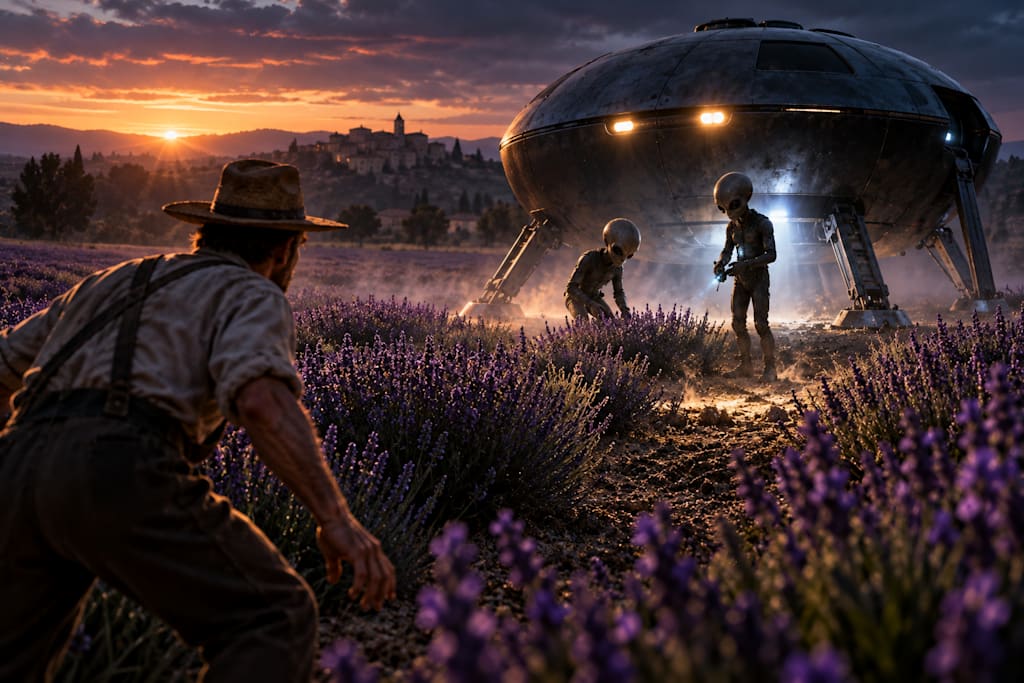
Maurice Massé thought it was a helicopter. That was irritating enough. It was early on the morning of July 1, 1965, near the small town of Valensole in southeastern France. The sun had risen over Provence, illuminating agricultural fields that stretched beneath the summer sky. Massé was working alone.
At approximately 5:45 a.m., he heard a strange whistling sound. Helicopters were not unknown in the region, and military exercises were taking place in Provence. Massé’s first thought was therefore remarkably ordinary: someone was landing near his crops. He went to investigate.
Then he saw something beyond the rise. It was not, according to Maurice Massé, a helicopter. Something was sitting in his field. And beside it stood two small figures. Within minutes they would be gone. Within two days, French gendarmes (military police) would be standing in the same spot. More than sixty years later, the official French government archive responsible for unexplained aerospace phenomena still lists the Valensole incident as unidentified.
Whatever happened that morning began with one annoyed farmer walking toward a whistle...
Something in the Field
Massé later described a dark, unusual object resting on the ground. Contemporary accounts compared its overall size to a small automobile. Its shape was difficult to classify, sometimes described as resembling a capsule or elongated structure, with supports extending toward the earth.
Massé watched it. Then he noticed the figures. There were two. They were small; one contemporary description compared their height to that of an eight-year-old child. Later accounts supplied much more elaborate descriptions: unusually large heads, strange eyes, small mouths, and features that appeared decidedly nonhuman to Massé. Some versions claim the figures were examining or gathering lavender. That detail has become part of UFO folklore, but it is safer to say what the documentary record establishes: Massé claimed two unusual beings were standing near the object. That is strange enough.
He moved closer. The figures apparently noticed him. Then one of them raised something. Massé described a small tube-like device being directed toward him. And suddenly... he couldn’t move.
Fifteen Minutes
The paralysis is one of the most extraordinary parts of Massé’s story. Later retellings sometimes claim that he remained immobilized for hours. He did not. The core account places the period at approximately fifteen minutes.
Massé remained conscious. He could observe. But he claimed he could not move normally. Meanwhile, the two figures hurried back toward the object. They entered it. The craft began to rise. Massé described it departing obliquely, rapidly accelerating and disappearing into the distance.
Then there was nothing. The strange object was gone. The little figures were gone. The field was quiet. And eventually Massé could move again.
This is the point at which countless UFO stories become impossible to investigate. A witness sees something. It disappears. Years pass. Someone eventually writes the story down. By then there is nothing to examine except memory.
Valensole was different. Because Maurice Massé walked over to where the object had supposedly been. And something was there.
The Marks
Approximately ten minutes after the object disappeared, Massé approached the alleged landing site. The ground had been disturbed. He described a strange impression resembling a star or radiating pattern surrounding a central hole. Later that evening, around 8:30, Massé returned with his daughter. Something about the soil struck him as peculiar. Ground that had been wet earlier had reportedly become extremely hard. Massé compared it to cement.
Now, none of this establishes that a spacecraft had landed there. A hole in the ground is not an extraterrestrial calling card. Agricultural equipment can disturb soil. Vehicles can leave marks. Human beings can manufacture evidence. Military activity was also occurring in the region. But the marks would soon become considerably more important for one reason. Other people saw them.
Enter the Gendarmes
Massé began discussing his experience the following day. Word spread. Unfortunately, so did the curious. People descended upon the location, walking around the alleged landing site and compromising whatever pristine physical evidence might originally have existed.
It was perhaps the most predictable development imaginable. A farmer announces that something extraordinary has landed in his field. Authorities need the area preserved. The public responds: Let’s all go stand on it.
Nevertheless, local gendarmes learned of the incident on July 2. Massé was formally interviewed. Later that evening, he accompanied officers to the site. They examined the location. Massé was questioned again. The investigation continued the following day. The gendarmerie documented physical traces, took measurements, and photographed the scene. Contemporary reporting described a central hole approximately twenty centimeters across and roughly eighty centimeters deep.
That fact changes Valensole's character. It does not prove Massé’s story. It does not prove that the marks were produced by the object he described. It certainly does not prove that extraterrestrial visitors landed in Provence. But it establishes something much more modest and useful: when investigators went where Maurice Massé told them to go, they found physical disturbances to investigate. The mystery had escaped his testimony. It was now sitting in the dirt.
But What Made Them?
The obvious question was whether something conventional could explain the encounter. One possibility emerged almost immediately: a helicopter. Military exercises were underway in Provence, and helicopters had reportedly been operating in the wider region. This was not a skeptical explanation invented decades later by someone determined to debunk an old UFO case. It was discussed at the time. And remember: Massé himself initially thought the whistling sound belonged to a helicopter.
Could he have encountered military activity and misinterpreted it? A helicopter could certainly produce unusual sounds. It could disturb the ground. Personnel associated with military exercises could account for figures nearby. An unexpected encounter with unfamiliar equipment might look very strange to a civilian who wasn't expecting to see it.
There is just one problem. It doesn’t comfortably reproduce the story Massé told. He claimed he observed the object for several minutes at relatively close range. He described its shape. He described two unusually small occupants. He described their strange appearance. He described the tube-like device. He described paralysis. And he described an object departing in a manner he did not recognize as a conventional aircraft.
Of course, testimony can be wrong. People misjudge distance and size. Fear changes perception. Memory alters details. A person can sincerely describe something inaccurately. Massé could also have invented the entire extraordinary portion of the story. The physical marks prove only that marks existed. They do not tell us who, or what, made them.
And Maurice Massé was the sole witness to the actual encounter. No second farmer watched from another field. No pilot reported the object. No photograph captured the beings. No instrument recorded Massé’s paralysis. No piece of machinery was recovered. No extraterrestrial material was discovered and scientifically authenticated.
This was one man’s extraordinary story. But authorities took it seriously enough to investigate.
What the Internet Added
Over the decades, Valensole accumulated embellishments. One of the most dramatic claims is that investigators discovered some mysterious rocky residue at the landing site that prevented crops from growing normally for years. That version is considerably stronger than the contemporary evidence allows.
There were physical ground traces. Those are documented. Later investigators and UFO researchers discussed alleged changes to vegetation and soil. But the site had already been contaminated by visitors, and claims about long-lasting biological effects cannot simply be transformed into: The French government discovered alien residue. It didn’t.
This distinction matters. Because mysteries become weaker when we exaggerate them. If a story requires us to add evidence that wasn’t there, perhaps the original story isn’t very good. Valensole doesn’t require that. Strip away the alien residue. Strip away claims that Massé was paralyzed for hours. Strip away every later embellishment we cannot confidently trace back to the earliest documentation. Something strange remains.
The Government File
France eventually created an official organization under CNES, the French national space agency, to investigate unidentified aerospace phenomena. Today that organization is known as GEIPAN. Its archives contain thousands of reports ranging from cases eventually explained by ordinary phenomena to incidents that remain unresolved.
Valensole is among them. GEIPAN did not investigate Massé in 1965; it did not yet exist. The gendarmes handled the original work, but the historical documentation eventually entered the official French system. And the current classification of the Valensole case is D. Unidentified.
That does not mean extraterrestrial. It does not mean paranormal. It does not mean French authorities secretly know aliens landed in a lavender field. It means the available information has not produced a satisfactory identification.
There is an enormous difference between “We don’t know” and “Therefore, aliens.” The first is an admission. The second is a conclusion. Valensole gives us the first. And perhaps that is why the case remains interesting.
Maurice Massé Goes Back to Work
Eventually the crowds left. The investigators left. The newspapers moved on. The summer continued. The fields remained. Maurice Massé went back to being Maurice Massé. Whatever descended, or didn’t descend, into his field never returned to provide an explanation.
No delegation from another world landed in Paris. No alien visitors introduced themselves. No missing spacecraft was recovered from a nearby mountain. Nothing happened that transformed Massé’s extraordinary claim into proof. All that remained was his testimony. And a patch of disturbed earth.
Perhaps that is exactly what a hoax would leave. Perhaps it is exactly what a misunderstanding would leave. Or perhaps something genuinely unusual happened in Valensole on July 1, 1965, and everyone arrived just slightly too late to discover what it was.
We cannot go back. That field no longer contains pristine evidence. The witnesses and investigators belonged to another era. The physical traces have long since disappeared. All we can do is reconstruct the morning from the surviving documentation.
So return to 5:45 a.m. Forget UFO mythology. Forget aliens. Forget everything that came later.
A farmer works alone in Provence. He hears a whistle. He thinks somebody has landed a helicopter near his crops. He walks toward the sound. Beyond the rise is something he doesn’t recognize. Two small figures are standing beside it. One turns toward him. Something is raised. And Maurice Massé stops moving.
Minutes later, the figures are gone. The object rises into the morning sky. Massé eventually walks to where it had been. He looks down. Something has disturbed the ground.
The following night, French gendarmes stand in the same field. They can question Maurice. They can inspect the site. They can measure the hole. They can photograph the traces. They can write their reports. But there is one thing they cannot do: tell us what happened.
More than sixty years later, neither can we. Maybe Maurice Massé encountered something entirely ordinary and misunderstood it. Maybe someone played an elaborate trick. Maybe military activity provided the ingredients for an extraordinary misidentification. Maybe Massé simply lied. Every one of those possibilities belongs on the table.
But somewhere among them lies the truth. And until someone can identify it, Valensole leaves us with an uncomfortable little scene frozen in the summer of 1965:
1) A farmer.
2) A whistle.
3) Two figures.
4) Something sitting among the crops.
5) And marks in the earth after it was gone.
The lavender grew beneath the Provençal sun. The hole eventually disappeared. The field returned to normal. But the question Maurice Massé carried out of it never did.
What landed at Valensole? Whatever the answer was... it disappeared over the horizon... and once again... slipped quietly, behind the Veil of Shadows.
About the Creator
Veil of Shadows
Ghost towns, lost agents, unsolved vanishings, and whispers from the dark. New anomalies every Monday and Friday. The veil is thinner than you think....
Enjoyed the story? Support the Creator.
Subscribe for free to receive all their stories in your feed.
Comments
There are no comments for this story
Be the first to respond and start the conversation.