
The Tylenol Terrorist: The Killer Who Turned Medicine Into Murder
Veil of Shadows

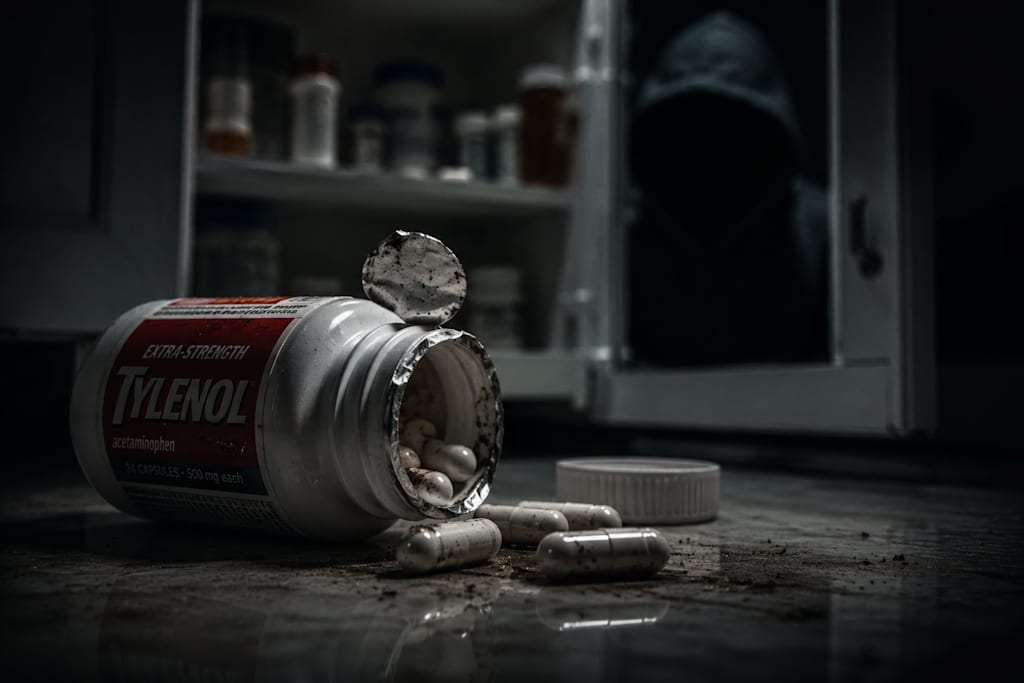
On the morning of September 29, 1982, an ordinary day unfolded across the suburbs of Chicago. A twelve-year-old girl wasn't feeling well. A young mother reached for a bottle of pain reliever. A flight attendant hoped to ease a headache before beginning her day. An elderly man swallowed a capsule without a second thought. None of them knew they had just made the final decision of their lives. Within hours, they were dead...
At first, no one suspected a connection. Doctors treated what appeared to be isolated medical emergencies. Families struggled to understand how healthy loved ones could collapse so suddenly. Police investigated deaths that seemed unrelated, separated by different neighborhoods, different ages, and different lives. Then investigators noticed something impossible: every victim had recently taken Extra-Strength Tylenol.
In the days that followed, America would discover that one unknown individual had quietly transformed one of the nation's most trusted household products into a weapon. More than forty years later, the killer has never been identified. The crime remains one of the most disturbing unsolved mysteries in American history, not simply because seven innocent people died, but because it permanently changed the way the world thinks about trust.
The first victim was twelve-year-old Mary Kellerman of Elk Grove Village, Illinois. She complained of a sore throat, and her parents gave her an Extra-Strength Tylenol capsule. Shortly afterward, she collapsed. Doctors could do nothing to save her. At the time, no one imagined that a common over-the-counter medication could be responsible.
Just hours later, another tragedy unfolded. Twenty-seven-year-old postal worker Adam Janus returned home feeling ill. Hoping to relieve his discomfort, he swallowed Tylenol and died soon afterward. Still unaware of the danger, grieving family members gathered at the Janus home. His brother Stanley and Stanley's wife, Theresa, each took Tylenol from the same bottle. Within hours, both were dead. Three members of one family had vanished in a single day.
Elsewhere across the Chicago area, similar tragedies unfolded: flight attendant Paula Prince, Mary Reiner, Mary McFarland, and Helen Jensen. One by one, ordinary people unknowingly crossed paths with bottles that had been turned into instruments of death. The realization struck investigators like lightning: this was not an accident.
Someone had taken bottles of Extra-Strength Tylenol from store shelves, opened the capsules, replaced the medication with potassium cyanide, carefully resealed the containers, and quietly returned them to retail stores. The victims had not been chosen personally; they had been chosen by chance. That single fact terrified the nation. Serial killers typically select victims; this murderer selected products. Anyone could have been next.
The response was immediate. Hospitals warned patients not to take Tylenol. Television stations interrupted regular programming with emergency bulletins. Radio broadcasts repeated the same urgent message. Families rushed into bathrooms and medicine cabinets, throwing away bottles that had seemed perfectly harmless only hours earlier. Store shelves were emptied. Fear spread faster than the investigation itself. For perhaps the first time in modern American history, millions of people questioned whether an everyday consumer product could be trusted.
Johnson & Johnson, the manufacturer of Tylenol, faced an unimaginable crisis. Within days, the company ordered a nationwide recall of approximately 31 million bottles of Tylenol capsules. The financial cost was staggering, yet the company chose to act quickly, placing public safety ahead of immediate profit. Business schools still study the response as one of the defining examples of crisis management. Parents hesitated before giving children medicine. Consumers examined bottles with suspicion. Something fundamental had changed; the medicine cabinet no longer felt safe.
Meanwhile, investigators launched one of the largest criminal investigations in the history of the United States. The Chicago Police Department, Illinois State Police, FBI, and Food and Drug Administration all joined the search. Detectives interviewed thousands of people, questioned retailers, inspected factories, and laboratories examined capsules one by one. Every possible lead received attention. The central question seemed deceptively simple: who had poisoned the Tylenol? Yet every answer dissolved under scrutiny.
One early theory suggested the tampering had occurred inside the manufacturing process, but investigators quickly ruled this out. The contamination had taken place after the bottles left the factory. Someone had purchased, or otherwise obtained, the products, altered them individually, and secretly placed them back on store shelves. It was a painstaking process, one that suggested planning rather than impulse.
Soon, another development complicated the case. A man named James Lewis mailed a letter demanding one million dollars in exchange for ending the poisonings. For a brief time, investigators believed they had found their suspect. Lewis was arrested, yet despite his extortion attempt, authorities concluded there was insufficient evidence linking him directly to the murders themselves. He was convicted for the extortion scheme, not the poisonings. The murders remained unsolved.
As years passed, additional suspects emerged. Some investigators examined disgruntled individuals, others considered personal vendettas against Johnson & Johnson, and still others proposed that the poisonings were simply the work of someone who wished to spread panic without any larger motive. Every theory answered certain questions, none answered all of them.
Perhaps the most frightening possibility was also the simplest: what if the killer never cared who died? What if the only objective was fear itself? In that scenario, the seven victims were not targets; they were statistics chosen entirely by random chance. That realization remains deeply unsettling.
Human beings find comfort in patterns. We believe danger can be avoided if we make the right decisions, lock the doors, avoid dangerous neighborhoods, stay alert. The Tylenol murders shattered that illusion. These victims had done nothing unusual. They purchased medicine from ordinary stores, followed the directions, and trusted a product used safely by millions. That trust became the weapon.
History often remembers the crimes, but sometimes it forgets the consequences. The Tylenol murders transformed the consumer landscape almost overnight. Before 1982, most medicine bottles could be opened with little effort; there were no foil seals beneath the caps, no shrink-wrapped necks, no tamper-evident rings, and no warning labels announcing, "Do not use if seal is broken." Those protections became standard because of seven ordinary people who unknowingly exposed a terrifying vulnerability. Eventually, the changes spread far beyond medicine: food products, cosmetics, household goods, and manufacturers across countless industries adopted tamper-evident packaging. An unsolved crime reshaped modern commerce. Today, it is almost impossible to imagine buying medication without multiple layers of protection. Yet millions of younger consumers have no idea why those barriers exist. The answer lies in a single week during the autumn of 1982.
The investigation remains officially open. From time to time, advances in forensic science have prompted renewed examinations of evidence. Detectives have revisited suspects, journalists have explored forgotten leads, and documentaries continue asking the same haunting question: who did it? Perhaps someone alive today knows the answer. Perhaps the truth disappeared with the killer decades ago. History offers no certainty, only silence. That silence is what has allowed the Tylenol Terrorist to remain one of America's great unsolved mysteries, not because the crime itself is difficult to understand (sadly, human cruelty rarely is), but because someone committed one of the most consequential acts of product tampering in history and simply vanished. No confession, no definitive arrest, no courtroom revelation. Just seven innocent victims and a nation forever changed.
Tonight, before you take a pain reliever, a vitamin, or cold medicine, you'll probably twist off a cap, break a plastic ring, and peel away a foil seal. You may not think twice about any of it; most of us don't. But those simple barriers exist for a reason. They are quiet reminders of a week when trust itself became the target. A week when an ordinary bottle on an ordinary shelf concealed extraordinary evil. And somewhere, perhaps known only to history itself, the person responsible carried the secret away, leaving behind not only an unsolved crime, but a permanent change in the way the world protects the things we trust most.
About the Creator
Veil of Shadows
Ghost towns, lost agents, unsolved vanishings, and whispers from the dark. New anomalies every Monday and Friday. The veil is thinner than you think....
Enjoyed the story? Support the Creator.
Subscribe for free to receive all their stories in your feed.
Comments
There are no comments for this story
Be the first to respond and start the conversation.