
The Travis Walton Incident: Five Days That Changed Everything
Mystery Monday Edition

Last Friday, we explored one of Britain's strangest unexplained deaths… the baffling case of Zigmund Adamski, a Yorkshire coal miner who vanished for five days before being discovered atop a towering coal pile under circumstances that remain unexplained to this day. As our team reflected on that extraordinary mystery over the weekend, one question kept resurfacing.
Has history ever recorded another case in which someone disappeared for several days... only to return with a story so extraordinary that it continues to divide opinion nearly half a century later? The answer takes us from the coalfields of northern England to the pine forests of northeastern Arizona.
Unlike Zigmund Adamski, this man came back alive. And he spent the rest of his life telling the world what he believed happened during those missing five days. Whether you believe him or not, the Travis Walton case remains one of the most investigated, debated, and enduring mysteries in the history of alleged UFO encounters.
The date was November 5, 1975. A crew of seven loggers spent the day working in the Apache–Sitgreaves National Forest near Snowflake, Arizona. As dusk settled over the towering ponderosa pines, they piled into their pickup truck and headed home along a winding forest road, expecting nothing more exciting than dinner and a good night’s sleep.
A crew of seven loggers had spent the day working in the Apache–Sitgreaves National Forest near Snowflake, Arizona. It had been a long shift, and as dusk settled over the towering ponderosa pines, they piled into their pickup truck and headed home along a winding forest road.
They expected nothing more exciting than dinner and a good night's sleep.
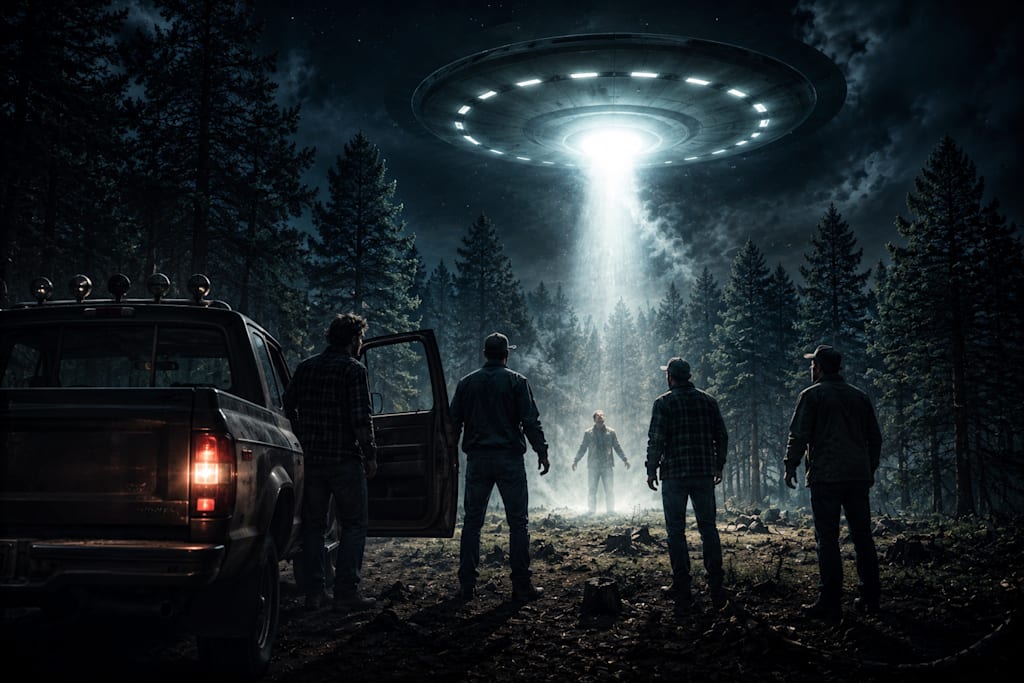
Instead, they would become part of one of the most controversial stories in modern history. As the truck rounded a bend, the men noticed an unusual glow filtering through the trees. At first, they assumed it might be a forest fire. Then they saw the source: resting in a clearing was an object unlike anything they had ever seen. Accounts differ slightly in describing its exact appearance, but the witnesses consistently described a metallic, disc-shaped craft hovering above the ground and emitting a brilliant light. The truck slowed to a stop. No one spoke for a moment. Curiosity overcame caution. Twenty-two-year-old Travis Walton climbed out of the truck, despite his friends’ shouts to stay back. Instead, Walton walked toward the object, saying he wanted a closer look. The others watched in stunned silence as he approached within a short distance of the hovering craft. Then everything changed. According to the witnesses, a brilliant beam or flash of light suddenly erupted from the object, throwing Walton violently backward.
The sight was so shocking that panic took over. Believing their friend had been killed, the terrified loggers sped away from the clearing. It was a decision they would later regret almost immediately. Within moments, fear gave way to guilt and they turned the truck around. But when they returned, Travis Walton was gone. The clearing was empty. The object had vanished. So had their friend.
Most people imagine that the witnesses immediately claimed aliens had abducted Walton. That is not what happened. Instead, they faced a much more immediate problem. How do you explain to police that your friend disappeared after approaching a strange object in the forest?
Investigators were understandably skeptical. To law enforcement, the simplest explanation was that Walton had been murdered. The seven loggers suddenly found themselves under intense scrutiny. Their truck was examined, their statements compared, and investigators searched for inconsistencies. The men insisted they were telling the truth, but authorities remained unconvinced.
Search teams combed the forest. Helicopters flew overhead. Volunteers searched ravines and trails. Nothing… No body… No clothing… No evidence of a struggle. No, Travis Walton.
As the days passed, public suspicion intensified. Rumors spread that the logging crew had fabricated the story to conceal a crime. The pressure became immense. Then investigators turned to one of the era's most controversial investigative tools. Several members of the logging crew underwent polygraph examinations. While polygraph tests are not considered reliable proof of truthfulness and are generally not admissible as evidence because they measure physiological responses rather than factual accuracy, the reported results nevertheless attracted enormous public attention. Most of the crew were reported to have passed examinations indicating they appeared truthful when describing the unusual object and Walton's disappearance. For supporters of the case, this strengthened the witnesses' credibility. For skeptics, it changed very little. The debate had already begun.
Five days after disappearing, Travis Walton reappeared. He later recalled regaining awareness in what he believed was a medical-like room. Confused and frightened, he said he fled the strange environment before eventually finding himself back on Earth. The next thing he clearly remembered was waking near a highway and making his way to a telephone. Weak, exhausted, and badly dehydrated, Walton contacted his family. He was alive. But his story was only beginning.
Doctors examined him. Investigators questioned him repeatedly. Journalists descended upon Arizona in droves. Television programs soon followed.
Walton consistently described an experience unlike anything he had ever imagined. His account would eventually become one of the best-known alleged abduction narratives ever recorded and be the basis for the movie “Fire in the Sky”.
Predictably, reactions split almost immediately. Some believed Walton had genuinely experienced something beyond conventional explanation. Others argued that stress, confusion, drunkenness, or fabrication offered more likely answers. Still others suggested the entire event had been orchestrated for publicity. Each theory developed passionate defenders. Yet every explanation encountered stubborn questions.
If it had been a hoax, why involve so many witnesses? Why invite years of scrutiny? Why endure ridicule that would follow the participants for decades? Conversely, if the account represented an actual encounter with something extraordinary, why was there no definitive physical evidence capable of convincing the broader scientific community? The case seemed permanently suspended between possibility and doubt. Perhaps that is why it has endured.
Unlike many stories of alleged UFO encounters involving only one observer, the Walton incident began with multiple independent witnesses describing an unusual event before Walton's own account entered the picture. That distinction has made the case especially significant within UFO research. It has also made it especially controversial.
Researchers have revisited the evidence countless times. Books have been written. Television documentaries have examined every available detail. Supporters point to the consistency of the witnesses' accounts over many years. Skeptics examine alternative explanations. Neither side has managed to settle the matter conclusively.
The Arizona forest where it happened remains as quiet today as it was on that November evening. Towering pines still line the roads. Sunlight still filters through the branches. Visitors drive the same routes once traveled by the logging crew. Most see nothing unusual. Yet the location has become a destination for those fascinated by one of history's most persistent mysteries.
Perhaps what makes the Travis Walton case so compelling is not the alleged craft itself but the human story. Seven ordinary working men suddenly found themselves at the center of international attention. Families were drawn into the controversy. Friendships were tested, and careers were affected. Whether they had witnessed something extraordinary or simply found themselves trapped inside an impossible misunderstanding, their lives were never the same again.
History is filled with stories that ask us to choose between certainty and imagination. The Walton case refuses to offer that luxury. Instead, it presents a series of documented events that everyone agrees occurred: a logging crew entered the forest, Travis Walton disappeared for five days, extensive searches failed to locate him, and he eventually returned alive with an extraordinary account of what he believed had happened. Everything beyond those points becomes a matter of interpretation.
Some readers will conclude the answer lies somewhere in ordinary human experience, still waiting to be uncovered. Others will believe the case points toward something far stranger. The evidence has never persuaded everyone. Perhaps it never will. And maybe that is precisely why the story has endured for nearly fifty years.
Unfortunately, the forests of Arizona kept their silence. The witnesses kept their story and the world still remains divided. One thing, however, is beyond dispute. On an ordinary November evening in 1975, seven loggers drove into the woods expecting nothing more than another day's work. Five days later, they emerged as participants in one of the most debated mysteries of the modern age.
Whether it was an extraordinary encounter, a profound misunderstanding, or something history has yet to explain, the Travis Walton incident continues to occupy that rare place where documented events and enduring mystery meet.
And that is exactly where the most unforgettable stories behind the Veil of Shadows are often found…
About the Creator
Veil of Shadows
Ghost towns, lost agents, unsolved vanishings, and whispers from the dark. New anomalies every Monday and Friday. The veil is thinner than you think....
Enjoyed the story? Support the Creator.
Subscribe for free to receive all their stories in your feed.
Comments
There are no comments for this story
Be the first to respond and start the conversation.