
The Tale of Hoichi the Earless
The Blind Musician Who Played for the Dead

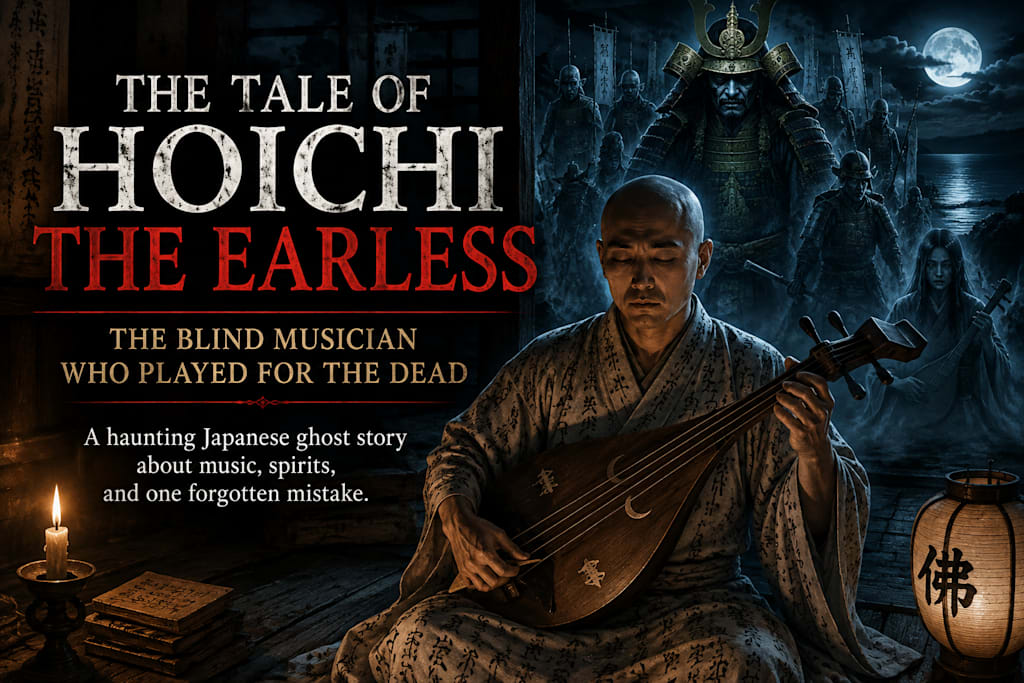
There are many ghost stories in Japan.
Some are about haunted houses.
Some are about spirits hiding in forests.
And some begin with something much simpler:
A man playing music in the dark.
One of the most famous Japanese ghost stories is the tale of Hoichi the Earless, a blind musician whose beautiful playing attracts an audience that is not quite alive.
It is a story about ghosts, loyalty, music, and one very unfortunate pair of ears.
The Musician Who Could Not See
Long ago, Hoichi was a blind musician who lived at a Buddhist temple.
Although he could not see, he had an extraordinary talent for playing the biwa, a traditional Japanese stringed instrument.
He was especially skilled at performing stories about the great battles between the Heike and Genji, two powerful clans whose conflict had shaped Japanese history and legend.
When Hoichi played, people listened.
His music was so emotional that audiences could almost imagine the soldiers fighting, the ships moving across the sea, and the tragedy that followed.
But Hoichi did not know that someone else was listening too.
Someone from the other side.
A Stranger Arrives at Night
One night, Hoichi heard footsteps outside the temple.
A deep voice called his name.
The visitor claimed to be a warrior serving a powerful lord.
He had heard about Hoichi's incredible musical talent and wanted him to perform for his master.
Hoichi was surprised.
But the warrior sounded convincing.
So he followed him.
The journey seemed strangely long.
Eventually, Hoichi entered a magnificent residence.
He could hear people everywhere.
Servants.
Voices.
The sound of a great gathering.
Someone asked him to play the story of the Heike.
Hoichi began.
He played the biwa.
He sang of warriors.
He sang of battle.
He sang of the final confrontation at sea.
And as he continued, his mysterious audience became increasingly silent.
They were completely captivated.
Hoichi believed he had found an extraordinary audience.
He had no idea that he was performing for the dead.
The Temple Begins to Worry
When Hoichi returned to the temple before sunrise, the monks noticed something strange.
He disappeared every night.
He refused to explain where he was going.
The monks became concerned.
They feared that something supernatural had happened.
So they secretly followed him.
What they discovered was terrifying.
Hoichi was sitting alone in a cemetery.
There was no mansion.
No lord.
No servants.
No audience.
Only graves.
And in front of him was the tomb of Emperor Antoku, who had died during the famous Battle of Dan-no-ura.
The monks realized the truth.
Hoichi had been performing for the spirits of the dead Heike warriors.
And the ghosts were not going to let him go easily.
The Plan to Hide Hoichi
The monks knew they had to protect him.
They came up with an unusual plan.
They covered Hoichi's body with Buddhist scriptures.
The idea was that the writing would make him invisible to the spirits.
His entire body was covered.
His arms.
His legs.
His chest.
His face.
Everything.
Or almost everything.
There was just one problem.
They forgot his ears.
Yes.
His ears.
It sounds almost ridiculous.
And yet that tiny mistake becomes the most horrifying part of the story.
The Ghost Returns
That night, the warrior returned.
“Hoichi!”
No answer.
He looked around.
He could see Hoichi's ears.
Nothing else.
The rest of the musician appeared to be invisible.
The ghost could not see Hoichi himself.
But he could see his ears.
So the warrior tore them from Hoichi's head.
Then he disappeared into the night.
The monks eventually returned and found Hoichi alive—but without his ears.
From that night onward, he became known as Hoichi the Earless.
The story sounds gruesome.
But there is something strangely beautiful about it too.
Hoichi survived.
He continued playing his music.
And his story became one of Japan's most famous traditional ghost tales.
Why Is This Story Still Scary?
What makes Hoichi's story effective is not simply the ghosts.
It is the atmosphere.
Imagine being blind.
You are sitting alone in a dark temple.
You hear footsteps approaching.
You cannot see who is there.
A stranger tells you to follow him.
You enter a place filled with voices.
You play music for people you cannot see.
And everyone seems completely silent when you stop.
That is terrifying.
But there is another reason the story remains memorable.
Hoichi's blindness becomes both his weakness and his protection.
He cannot see the ghosts.
But because he cannot see them, he also does not immediately realize how frightening his situation is.
The audience knows more than he does.
And that makes every scene more unsettling.
A Story About More Than Ghosts
At first glance, Hoichi the Earless is simply a horror story.
But underneath the ghosts is another idea.
Hoichi's music is powerful enough to cross the boundary between the living and the dead.
The dead still remember their battles.
They still remember their losses.
They still want someone to tell their story.
And Hoichi becomes the voice that allows them to remember.
Perhaps that is why the story has survived for so long.
The ghosts are frightening.
But their desire to hear the past again feels strangely human.
They are dead, yet they still want to listen.
They still want to remember.
They still want someone to remember them.
And perhaps that is the most haunting part of all.
Because sometimes, the scariest thing about a ghost story isn't the ghost.
It is the possibility that the dead have something they desperately want the living to hear.
About the Creator
Takashi Nagaya
I want everyone to know about Japanese culture, history, food, anime, manga, etc.
Enjoyed the story? Support the Creator.
Subscribe for free to receive all their stories in your feed.
Comments
There are no comments for this story
Be the first to respond and start the conversation.