
The Strasbourg Dancing Plague
The Summer an Entire City Couldn't Stop Dancing!

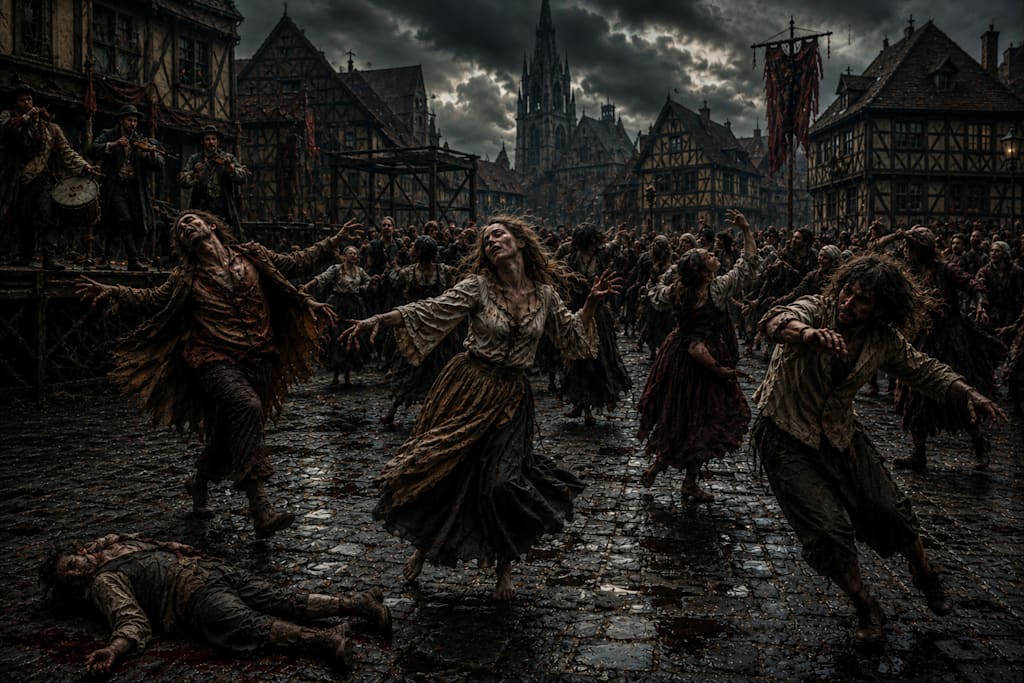
On a warm July morning in 1518, the streets of Strasbourg awoke as they always had. Merchants opened their shops, blacksmiths lit their forges, and church bells echoed across the rooftops as townspeople hurried about another ordinary day in the bustling city. Nothing seemed unusual, and nothing hinted that within weeks, Strasbourg would become the site of one of history's most disturbing medical mysteries.
It began with a single woman. Her name, according to several contemporary accounts, was Frau Troffea. Without warning, she stepped into the street outside her home and began to dance. There was no music, no celebration, no festival… she simply moved, hour after hour, under the summer sun, continuing without pause. Neighbors gathered, expecting exhaustion to bring the strange episode to an end. Instead, the hours became a day, the day became another, and still she danced. She did not appear joyful or entertained. Witnesses described something far more unsettling: it was as though she had surrendered control of her own body.
Then another person joined her, and then another. Within days, the strange affliction spread through the city. Men, women, young, old, one after another stepped into the streets and began dancing with the same relentless determination. Not because they wanted to, but because they seemingly could not stop.
The phenomenon spread with terrifying speed. What had begun as one inexplicable incident transformed into a citywide emergency. By the end of the month, chroniclers claimed that hundreds of people had been affected; some estimates placed the number at more than 400. Imagine standing at your window and watching neighbors stumble through the streets, their clothes soaked with sweat, their breathing ragged, their faces twisted not with happiness but desperation. They danced through daylight and darkness. When they collapsed from exhaustion, many reportedly rose again and continued moving. The streets became an open-air nightmare.
At first, authorities struggled to understand what they were witnessing. The sixteenth century was an age in which medicine and religion often walked hand in hand. Diseases were poorly understood, mental illness was scarcely recognized, and the supernatural frequently filled the gaps left by science. Physicians examined the afflicted and, by modern standards, their conclusion seems almost impossible: they believed the dancers suffered from an excess of "hot blood." According to the prevailing medical theories of the day, the only cure was to allow the condition to run its course. Incredibly, city officials acted on that advice. Rather than stopping the dancing, they encouraged it. Musicians were hired, wooden stages were constructed, and professional dancers were brought in to accompany the afflicted. The reasoning was simple: if the victims needed to dance, then perhaps they should dance until whatever force gripped them finally released its hold.
Instead, the nightmare intensified. The music never brought relief; it merely provided a rhythm for suffering. Day after day, the exhausted figures continued to move. Their shoes wore through, their feet blistered, skin split open against the cobblestones, and blood stained the streets beneath bodies that refused, or were unable to stop. Some reportedly screamed while dancing, others wept, and many begged for help. But help never came because no one knew what they were fighting for.
The human body is remarkably resilient, but it is also unforgiving. Continuous physical exertion eventually overwhelms even the strongest athlete. These were not trained performers; they were ordinary townspeople. As the days passed, the toll became horrific. Contemporary accounts describe dancers collapsing from complete exhaustion, others reportedly succumbing to strokes or fatal heart attacks, and a few simply collapsing where they stood and never rising again. Death did not arrive dramatically; it came quietly, one exhausted heartbeat at a time. The city had become a place where movement itself could kill.
Perhaps the most unsettling aspect of the Dancing Plague is not the deaths, but the question that haunted everyone who witnessed it: Who would begin dancing next? Imagine living in Strasbourg during those weeks. Each morning, you open your shutters and the music has already begun. Outside, familiar faces stagger across the square. The baker, the butcher, your neighbor, people you have known for years. None of them can stop. Then a friend suddenly joins them, not voluntarily but almost instinctively. How long before someone in your own family steps into the street? How long before it is you?
History rarely records fear with perfect clarity, but fear must have saturated Strasbourg that summer. The city was already burdened by hardship. Harvests had failed in previous years, disease lingered, famine stalked the countryside, and religious anxiety permeated everyday life. Many believed divine punishment was never far away. Against that backdrop, the Dancing Plague seemed almost apocalyptic. One explanation quickly gained popularity: the people believed they had fallen under the curse of Saint Vitus. According to medieval tradition, the saint possessed the power to afflict sinners with uncontrollable dancing or convulsions. If the curse had truly descended upon Strasbourg, then medicine alone would never cure it.
Eventually, civic leaders abandoned the disastrous strategy of encouraging the dancers. The afflicted were instead taken to a shrine dedicated to Saint Vitus in the nearby mountains, where priests prayed over them, and special red shoes were reportedly placed upon their feet. Religious ceremonies replaced public performances, and gradually, the dancing subsided. Whether through faith, coincidence, exhaustion, or the natural end of whatever had gripped the city, the epidemic finally faded. But the questions remained… and five centuries later, they still do.
Modern historians and medical researchers have spent decades searching for an explanation. One of the earliest theories blamed “Ergot” poisoning. Ergot is a fungus that can grow on rye and produce powerful hallucinogenic compounds, and contaminated grain has been linked to strange behavior throughout history. At first glance, the theory seemed convincing, yet it quickly encountered serious problems. Ergot poisoning typically causes violent muscle spasms, confusion, and severe pain; victims are often too incapacitated to perform coordinated movements for hours, let alone days. Dancing continuously for weeks simply does not fit the known effects.
Today, many historians favor another explanation: mass psychogenic illness. Sometimes called mass hysteria, it occurs when psychological distress manifests physically within groups of people. Under conditions of intense stress, fear, religious pressure, and social anxiety, symptoms can spread from person to person without any infectious disease being present. It sounds impossible, until history reminds us that it has happened more than once. Even so, the Strasbourg outbreak remains unusually extreme: hundreds of people, weeks of relentless movement, multiple reported deaths. No modern case quite compares, and so the mystery refuses to die.
Perhaps the most chilling possibility is not that Strasbourg was cursed, nor that its citizens were poisoned, nor even that they suffered from a psychological epidemic. Perhaps what unsettles us is something much simpler: we do not fully understand the limits of the human mind. We like to believe our bodies obey us, that when we decide to stop walking, we stop; when we decide to sit, we sit. The Dancing Plague challenges that comforting belief. It suggests there may be circumstances, rare, extraordinary circumstances, in which the mind loses its grip upon the body, where movement becomes compulsion, and where exhaustion cannot overcome whatever invisible force drives a person onward. Whether that force was biological, psychological, cultural, or something history has yet to explain remains one of the great unanswered questions.
As summer eventually gave way to autumn, the music faded from Strasbourg's streets. The stages were dismantled, the crowds dispersed, merchants reopened their businesses, and children once again played in the market squares. Life resumed, but one can only imagine how the survivors must have viewed those familiar streets. Every corner carried memories. Every cobblestone had witnessed impossible scenes, neighbors dancing until their shoes dissolved, until their feet bled, until their hearts simply gave out. Not in celebration, not in madness as they understood it, but in a desperate struggle against something no one could see.
Five hundred years later, the city has changed beyond recognition. The buildings are different, the people are different, the music has long since fallen silent, yet the mystery still lingers. History preserves wars, kings, and great discoveries, but it also preserves moments that defy every neat explanation we try to give them. The Strasbourg Dancing Plague is one of those moments: an entire city watched ordinary people dance themselves to death beneath the summer sun. Doctors examined them, priests prayed over them, officials tried to help them; nothing worked. And perhaps the most terrifying part of all is that we still cannot say with certainty why it happened.
Sometimes history whispers through forgotten documents, sometimes it echoes through abandoned places, and sometimes... it dances. Until there is no one left standing.
About the Creator
Veil of Shadows
Ghost towns, lost agents, unsolved vanishings, and whispers from the dark. New anomalies every Monday and Friday. The veil is thinner than you think....
Enjoyed the story? Support the Creator.
Subscribe for free to receive all their stories in your feed.
Comments
There are no comments for this story
Be the first to respond and start the conversation.