
The Stranger in the Montana Mountains: America's Forgotten UFO Mystery of 1865
A Veil of Shadows Editorial

Editor's note: This investigation draws on a nineteenth-century newspaper account, historical reporting, and later examinations of the story. The reported observations, physical discoveries, and witness statements have not been independently verified. Possible explanations are presented as theories, not established facts. Atmospheric descriptions evoke the period without inventing evidence or eyewitness testimony.
The Trapper, the Meteor, and the Mountain Stone
In October 1865, America was trying to put itself back together. The Civil War had ended only months earlier. Abraham Lincoln was dead. Families mourned, cities rebuilt, and a wounded nation struggled to imagine what came next.
Far beyond the political turmoil of Washington, however, another story was making its way into the newspapers. It concerned a lonely stretch of the Rocky Mountains, a frontier trapper named James Lumley, and something that allegedly fell from the heavens.
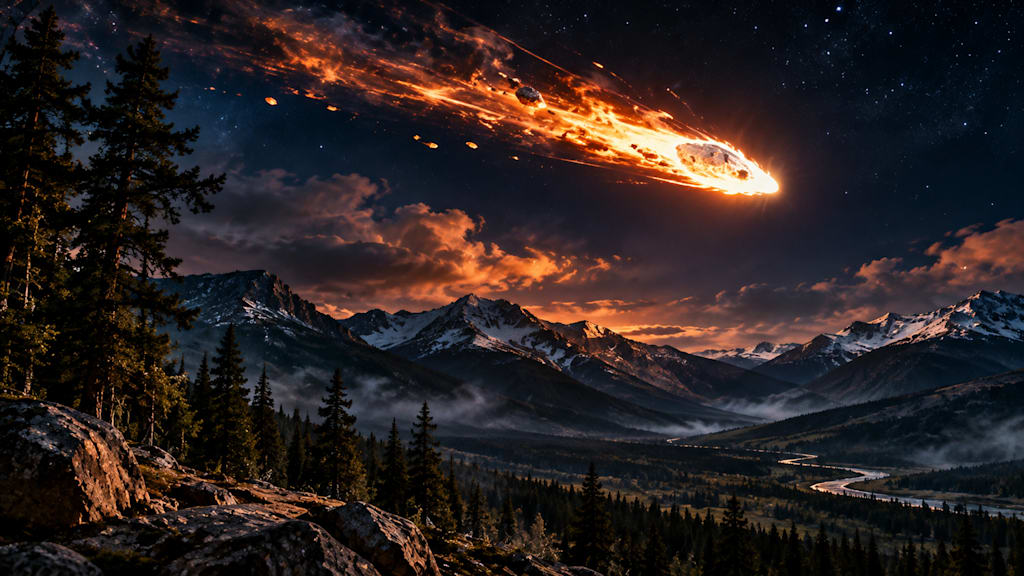
According to the account, the object blazed across the evening sky before exploding with enough force to shake the earth. The following morning, Lumley supposedly discovered a trail of devastation through the forest. At its end lay an enormous stone embedded in a mountainside.
But this was no ordinary stone. It reportedly contained compartments, mysterious markings, and fragments of an unfamiliar glass-like substance. And when the story reached a newspaper office in St. Louis, its editors entertained a possibility that seemed astonishingly modern. Perhaps, they suggested, the object had come from another inhabited world.
Eighty-two years before Roswell, Americans were already wondering whether something, or someone, had arrived from beyond Earth. But what actually happened in those mountains? And how much of the story can history substantiate?
The Trapper at the Everett House
On October 19, 1865, the Missouri Democrat (St. Louis Democrat) published an extraordinary account attributed to a man named James Lumley. The article described him as an experienced Rocky Mountain trapper who had been staying at the Everett House in St. Louis.
Even before the story unfolded, the newspaper acknowledged that its claims required verification. According to the published account, Lumley had been trapping in the mountains near Cadotte Pass, approximately seventy-five to one hundred miles beyond the Great Falls of the Upper Missouri River, in present-day Montana. The account dates the experience to mid-September, year uncertain.
The alleged incident began shortly after sunset. Lumley reportedly observed a brilliant object moving rapidly eastward across the sky, visible for about five seconds, then appearing to break apart with a violent explosion. Several minutes later came a tremendous detonation; the ground shook, a rushing noise followed, and the air, Lumley said, carried a peculiar sulfurous odor.
Had the story ended there, it might have remained an unusual but recognizable meteor report. But the following morning brought a discovery that transformed the account into something far stranger.
The Path Through the Forest
About two miles from his campsite, Lumley allegedly encountered a scene of extraordinary destruction. A broad path was torn through the forest, large trees uprooted or snapped, hillsides damaged, and the ground gouged. Lumley reportedly followed this trail to an immense stone embedded in the mountainside.
Here, the story departed dramatically from an ordinary meteorite report. The exposed portion of the stone supposedly appeared divided into compartments, with unusual markings Lumley interpreted as hieroglyphics. Nearby, he allegedly found glassy fragments and dark stains suggesting some kind of spilled liquid.
Lumley believed the markings were deliberate, and that the object had once served a purpose for intelligent beings. No drawing, measurements, or specimen was provided. If true, the implications were extraordinary.
A Newspaper Looks Toward the Stars
Perhaps the most remarkable part of the account came not from Lumley but from the newspaper’s editors. After recounting his story, they discussed reports of a meteor allegedly seen from Leavenworth, Galena, and St. Louis. They mentioned Colonel Bonneville as associated with the sighting.
These references are intriguing, but they are not equivalent to independent confirmation of Lumley’s discovery.
Nevertheless, the editors took an imaginative leap, speculating that meteors could transport inhabitants of distant planets. They even imagined a future visitor from Mercury or Uranus arriving like a new Columbus, conquering humanity as Europeans had conquered the Americas.
The idea of extraterrestrial life did not begin with flying saucers. Long before modern spacecraft, Americans were contemplating inhabited worlds, cosmic travel, and unsettling new possibilities.
The Problem With the Evidence
This is where the investigation must separate the extraordinary account from the extraordinary event it describes.
The newspaper publication is historical evidence; it establishes that the story circulated in October 1865. It does not establish that a spacecraft, or even an unusual stone, actually crashed in Montana.
Difficulties with the account:
Lumley’s testimony appears only through a newspaper narrative; no verified personal journal or sworn statement survives.
No precise location is given; Cadotte Pass and the surrounding country are vast.
The object was never recovered for examination; no authenticated specimen, inscription, or glass fragment has been established.
No independent inspection of the damaged forest was reported.
The story has changed in later retellings; modern versions sometimes describe a metallic, bullet-shaped craft, but the original newspaper says nothing of the sort.
When we replace a mysterious stone with a futuristic metal craft, we stop repeating the historical account and start rewriting it through modern expectations.
A Meteor, a Misunderstanding, or Something Else?
Could a natural phenomenon explain at least part of Lumley’s report? Possibly... Large meteors (fireballs or bolides) can produce brilliant flashes, fragment in the atmosphere, and generate powerful sonic booms. In rare cases, large cosmic objects produce destructive atmospheric blasts (see: Tunguska, 1908). But no established physical evidence links the Montana story to a comparable explosion.
Even if a meteor or atmospheric blast occurred, it does not explain the reported compartments and hieroglyphic markings, which might represent misinterpretation, embellishment, or invention.
Another possibility is that the account was a product of nineteenth-century newspaper sensationalism. American newspapers frequently published strange anecdotes, remarkable discoveries, humorous fabrications, and speculative stories designed to capture readers’ attention. The frontier, in particular, provided the perfect setting for extraordinary claims that were difficult to investigate.
Yet identifying the possibility of a tall tale is not the same as proving deliberate deception. The surviving evidence supports uncertainty, not a verdict.
Before Roswell, There Was a Question
In July 1947, reports from Roswell, New Mexico, created one of the most enduring controversies in UFO history. But the Lumley story reminds us that the basic fascination is much older.
The account contains nearly everything that would later become familiar in UFO lore: a brilliant object in the sky, an apparent crash, unusual debris, mysterious markings, and the suggestion of extraterrestrial origin, yet it emerged in a world without satellites, airplanes, or science-fiction cinema. That does not make the account more credible. It makes it historically fascinating.
In 1865, the mystery centered on a celestial stone; a century later, it might have been a spacecraft. The object changed with the era. The question remained.
The Mystery That History Left Behind
Somewhere in the surviving pages of an October 1865 newspaper, James Lumley remains suspended between history and legend.
We know that a remarkable story was published.
We know that its authors contemplated visitors from other worlds.
We know that later generations reinterpreted the account through the language of UFO crashes.
But we cannot establish whether Lumley witnessed a meteor, discovered an unusual geological formation, misunderstood something he encountered, or became the central character in a story that was embellished or invented.
Perhaps a brilliant fireball really did cross the Montana sky. Perhaps a natural event inspired an elaborate account. Perhaps the episode began in a newspaper office. Or perhaps the story preserves some genuine observation whose circumstances have disappeared beyond recovery. The evidence does not allow us to choose with confidence.
And that is where the mystery belongs, not in a declaration that extraterrestrials visited the American frontier, nor in an unsupported insistence that nothing unusual could have happened, but in the space between what was reported and what can be demonstrated.
More than 160 years have passed since the story appeared. The forests have changed. The frontier has vanished. Humanity has placed machines on Mars and sent spacecraft beyond the outer planets.
Yet one nineteenth-century newspaper account still invites an extraordinary question. If you had been standing beneath that Montana sky, watching a brilliant object tear through the darkness before hearing an explosion somewhere beyond the mountains, what would you have believed?
A meteor?
A strange coincidence?
Something beyond your understanding?
And if you had found that mysterious stone the following morning, would you have walked away? Or would you have gone closer? The newspaper gave its readers a story. History left us the uncertainty. And now, more than a century and a half later, the question belongs to you...
The Veil of Shadows - Where History Ends and Mystery Begins.
About the Creator
Veil of Shadows
Ghost towns, lost agents, unsolved vanishings, and whispers from the dark. New anomalies every Monday and Friday. The veil is thinner than you think....
Enjoyed the story? Support the Creator.
Subscribe for free to receive all their stories in your feed.
Comments
There are no comments for this story
Be the first to respond and start the conversation.