
The Spectators
There are things that live between one blink and the next.

Daniel Mercer had spent much of his professional life persuading people to look at things they did not care about. At forty-two, he ran the creative department of a Manhattan advertising agency and understood the mechanics of human attention. He knew that curiosity and disgust were not opposing emotions: an unpleasant image could hold a viewer’s attention far longer than a beautiful one, provided it promised to reveal something worse.
That night, he was reviewing photographs for a health insurance campaign when the broadcast appeared.
It was two forty-three in the morning. He had been working for hours, accompanied by a cold cup of coffee and the hum of the refrigerator. He had opened YouTube to listen to music, but the video ended and the screen filled with a row of recommendations. Among them was an image of his bedroom.
He recognized the green lamp on the nightstand, the jacket draped over a chair, and the white wardrobe doors. In the bed, a man lay on his back with his right arm hanging outside the sheets.
It was him.
Daniel stared at the thumbnail, convinced that someone had used a photograph of him to stage a joke. AI-generated videos were now practically indistinguishable from real footage. And yet, on the pillow, there was a small coffee stain—the one he himself had left that morning.
He clicked the thumbnail.
The broadcast showed his bedroom from a high angle, in the greenish tint of a night-vision security camera. The image was so sharp that he could make out the crack in the headboard he had been promising to repair for months.
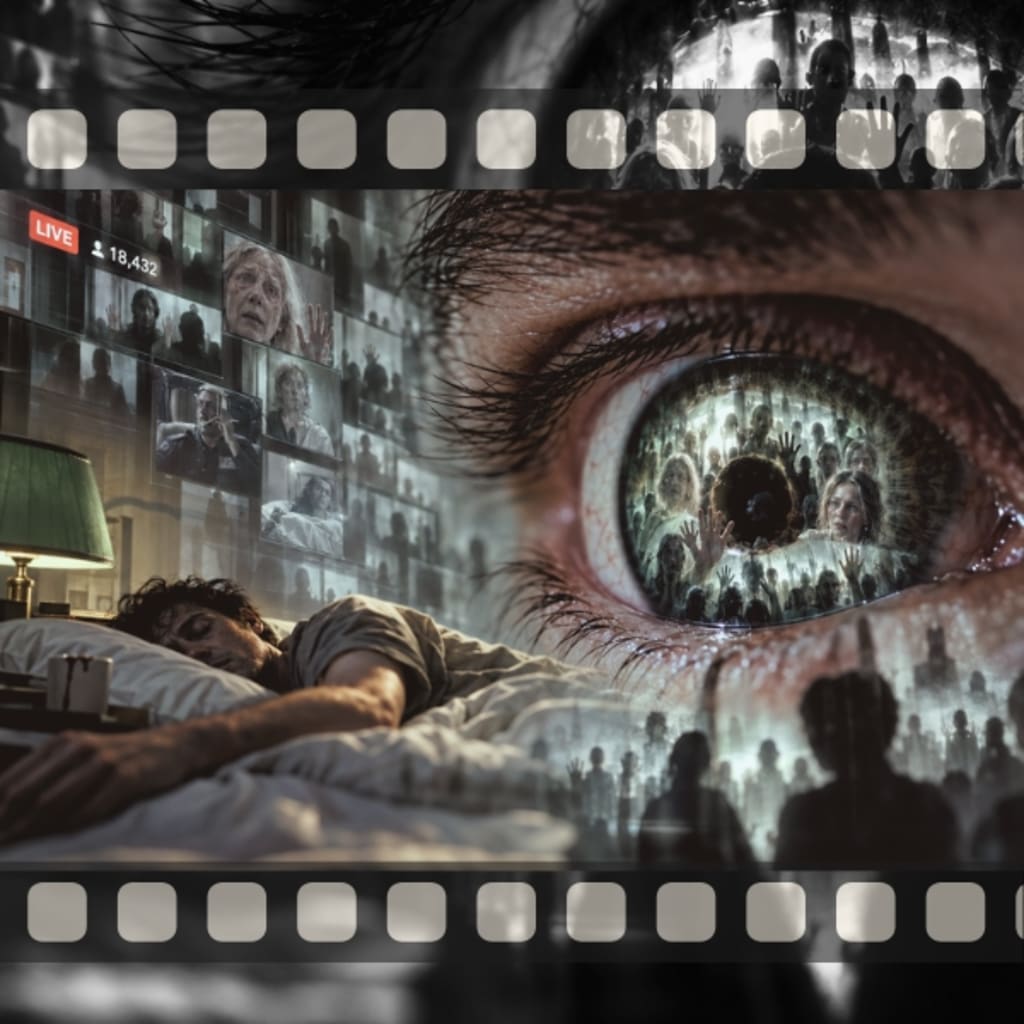
The viewer count read 18,432. There was no username, no playback controls—only a red indicator that said LIVE and a column of comments.
“Looks younger than the last one,” someone wrote.
“How long has he been there?”
“It hasn’t started yet.”
Daniel went to the bedroom. The bed was empty, and there was no sign of a hidden camera. When he returned, the man in the broadcast was still asleep. He tried closing the browser, shutting down the computer, and finally unplugging it from the wall.
The screen stayed on.
Then the man in the bed opened his eyes.
His double stared directly into the camera, his expression of terror one Daniel recognized at once. The man moved his lips several times before Daniel managed to read the words.
Don’t close your eyes.
A pinned message appeared in the chat:
THE SUBJECT HAS BEEN INFORMED.
The viewer count increased by one.
Daniel felt a sharp pain behind his eyes, similar to the one that preceded his migraines. It was 3:07 a.m. He had spent nearly twenty-five minutes watching that absurd broadcast and was beginning to feel ridiculous. He decided to leave the computer on and go to bed, but as he stood up, the image changed.
It now showed Margaret Smith, his neighbor from apartment 4B, sitting in a kitchen. The old woman wore a white nightgown, and a blue cup sat in front of her. Daniel had seen her that very afternoon collecting her mail. She was a kind widow who often stopped him in the elevator to ask about his work.
Margaret stared straight into the camera. Her eyes were red, her eyelids swollen, and there were small crusts around her lashes. Tears ran down her cheeks without changing her expression.
“Please,” she whispered.
“Mrs. Smith?”
The old woman seemed to hear him. She shook her head, terrified.
“Don’t look at me. Don’t look at me.”
The broadcast showed a teenager sitting in front of a computer, in a room decorated with video game posters. His lips were cracked, and he held a spoon against his left eye. Daniel saw that he had taped small strips of adhesive between his eyebrows and forehead to keep his eyelids open. On the desk were several empty bottles and a calendar with six consecutive days crossed out in red.
“What the hell are you doing?” Daniel murmured.
The boy dropped the spoon.
“Six days,” he replied in a hoarse voice. “I’ve been here six days.”
The image changed before Daniel could ask anything else. A man appeared, sitting inside a car, dressed in a private security uniform. Daniel recognized his face immediately: he had read about his disappearance the week before. He searched for the article on his phone and confirmed that it was a security guard from New Jersey whose car had been found abandoned, engine running, all the doors closed.
The man held up three fingers, then pointed to his eyes.
Daniel searched for other recent disappearances. He recognized a college student from Boston and a nurse from Philadelphia among the faces he had glimpsed briefly in the broadcast. All of them had vanished without a trace. All of them had last been seen in front of a screen.
When he looked up, the monitor showed his own living room. The camera seemed to be positioned behind him. Daniel turned to look for it, but found nothing. On the screen, his double repeated the movement a few seconds later.
He raised a hand. The image took three seconds to imitate him. He repeated the gesture and got the same result. For several minutes, he timed the delay with his phone’s stopwatch, relieved to have found at least one anomaly he could measure.
Three seconds. Always three.
He decided to use that delay to leave the apartment. He stood and walked toward the door, watching his double repeat every movement. When he reached the lock, he blinked.
The pain was immediate.
Something closed around his ribs like a hand. He fell to his knees, unable to breathe, and remained on the carpet until the pressure began to ease.
A message appeared on his phone:
TIME WITHOUT VISUAL CONTACT: 0.8 SECONDS.
WARNING LOGGED.
Daniel understood why the teenager had taped his eyelids open.
He tried calling emergency services, but the calls were cut off by an electronic shriek. Messages to his colleagues remained undelivered. He discovered that he could move around the apartment as long as he kept the phone in front of his eyes. Whenever he tried to turn it off, the broadcast appeared on another surface: the glass of a window, the oven door, or the bathroom mirror. He was not required to watch a particular screen—only whatever the broadcast chose to show him.
At dawn, he began to feel sleepy.
He made coffee, took a cold shower, and called the agency to say he was sick. Later, his ex-wife called to discuss some documents related to the sale of his old apartment. Daniel was about to explain what was happening when the broadcast showed a little girl sitting in a hospital bed.
She was about eight years old. She wore a white hospital gown and held a rag doll. Her head was slowly tipping forward, overcome by exhaustion.
“Are you listening to me?” his ex-wife asked.
“Yes.”
The doll fell onto the sheets. The girl tried to steady herself, but her eyelids finally closed.
Daniel watched her body arch across the bed. Something pushed from inside her abdomen, lifting the fabric of the gown. Three bulges appeared beneath her skin, and he heard a sound like several bones breaking at once. The girl opened her mouth, but no scream came.
Then she disappeared.
The doll remained on the sheets.
“Daniel, what’s wrong with you?”
“I just watched a little girl die.”
His ex-wife fell silent.
“Have you been drinking?”
Daniel hung up.
He searched for news about hospitals and missing children, but found no reference to the girl. When he returned to the broadcast, the bed was still empty, and the viewer count had dropped to 18,432.
He understood that the number did not indicate how many people were watching.
It indicated how many were still alive.
That night, Daniel had been awake for nearly twenty hours. He had consumed coffee, energy drinks, and a stimulant he kept from an old prescription, but his eyelids were beginning to close on their own. Each time they did, a new pressure tightened in his chest. He looked up sleep deprivation and learned that hallucinations could begin after forty-eight hours.
The teenager in the broadcast had lasted six days.
At eleven, he called emergency services again. This time he managed to speak to an operator. He explained that he was trapped in his apartment and began giving her his address. Then, in the background of the call, he heard the same tapping he had heard at the beginning of the broadcast.
“Ma’am?”
The operator did not answer.
A man’s voice, very close to the microphone, said:
“You shouldn’t have called.”
The call ended.
During the second night, Daniel began losing small fragments of consciousness. He found coffee spilled across the keyboard without remembering picking up the cup, and discovered a sentence written in a work document:
WE ARE STILL HERE.
Soon afterward, the voices began. They were murmurs that seemed to come from the walls—scattered words and overlapping conversations. Daniel made out children’s voices, men crying, and women repeating unfamiliar names. When he pressed his ear to the monitor, he could hear them more clearly.
“Don’t sleep,” a woman begged.
“Don’t close your eyes.”
“Please, don’t leave us alone.”
He recognized Margaret Smith’s voice and found her among the windows of the broadcast. The old woman was slumped over her kitchen table, her forehead resting on her arms.
“How long have you been here?” Daniel asked.
Margaret lifted her head with difficulty.
“I don’t know.”
“Days?”
She shook her head slowly.
“My husband died eleven years ago. I was watching when it happened.”
“What were you watching?”
Margaret pressed her lips together. For several seconds, she seemed torn between the urge to answer and a fear too great to name.
“Him.”
The broadcast returned to Daniel’s bedroom. A man lay in the bed with his eyes closed. His face was gaunt, marked by deep shadows beneath his eyes, but he seemed to be resting peacefully.
Daniel looked at that sleeping face and understood that he had never wanted so badly to rest. Then he realized the image did not show his current bedroom, but the place where it had all begun.
And that the man was not sleeping.
He was waiting.
On the third day, Daniel tried taping his eyelids open. The skin became irritated, and sweat loosened the strips, but for a few minutes he managed to keep his eyes open without effort. On the fourth day, he began to see insects crawling along the walls and tiny human figures moving among the objects on his desk. Several times, he thought his ex-wife was sitting beside him.
By the sixth day, the broadcast had stopped showing other people.
Daniel watched himself sitting in front of the computer, his face gaunt, small wounds around his eyelids. The camera moved closer to his eyes, and he noticed something moving behind his pupils. At first he thought it was a reflection, but soon he made out tiny human figures pushing against one another.
He went to the bathroom and leaned toward the mirror.
They were there.
Thousands of people moved behind his pupils, packed together like a crowd trapped in a space too small to contain them. One figure approached the surface of his left eye and raised a hand.
It was Margaret Smith.
Daniel stumbled back until he hit the wall.
He understood that the missing people had not ceased to exist. They had been absorbed into his consciousness, condemned to see the world through his eyes. The broadcast transferred perception from one mind to another, gathering human beings inside a body forced to remain awake.
The voices woke all at once.
Thousands of people begged, screamed, and repeated names Daniel did not know. Among them, he recognized the girl from the hospital.
“I’m scared,” she said.
“Shut up!” Daniel shouted.
He beat his head against the wall until blood began to run down his forehead, but the voices did not fade.
Then he heard another voice.
His own.
“You can end it.”
In the mirror, his reflection watched him without moving its lips.
“All you have to do is close your eyes.”
Daniel looked at the figures trapped behind his pupils. If the broadcast needed someone to watch in order to keep them there, perhaps denying it that gaze would be enough. He had no certainty. He did not know what would happen to those people if he managed to interrupt it.
Margaret approached the surface of his eye again. She raised her hands and shook her head, begging him not to do it.
Daniel turned on the faucet, washed the blood from his forehead, and looked at himself once more.
“I’m sorry,” he whispered.
He closed his eyes.
The pain crushed his chest, and he fell to his knees. Thousands of voices began screaming inside his head. Some cursed him; others promised him anything if he would only open his eyes. He heard Margaret calling his name and the little girl crying. He felt an unbearable pressure behind his pupils, as if the crowd inside him were trying to force its way through them.
Daniel held on until something seemed to break inside his skull.
Then came the silence.
He remained on his knees for several minutes before daring to open his eyes. The bathroom was empty. There were no figures behind his pupils, no voices in his head. In the living room, the computer was still off, its power cable still unplugged.
He collapsed onto the sofa and slept for the first time since the broadcast began.
When he woke, sunlight was coming through the windows. His mouth was dry, his muscles ached, and he was so weak that he could barely stand. He walked toward the kitchen for water, but stopped in front of the hallway mirror.
His reflection looked normal. His eyes were red, and the skin around his eyelids was marked with small wounds, but the figures were gone.
Daniel smiled.
His reflection did not.
It remained still, watching him. Daniel slowly raised his right hand.
The reflection took three seconds to imitate him.
Behind the glass, Margaret Smith appeared, wearing her white nightgown, her eyes open in an unnatural way.
“You shouldn’t have done it,” she whispered.
Daniel stepped back.
“What did I do?”
The old woman began to cry.
“You let us out.”
From the living room came the sound of an electronic notification. The computer had turned itself on and was displaying a live broadcast. A young woman was working in front of a screen, a sleeping cat beside her keyboard. Daniel recognized the scene, though he could not remember where he had seen it.
At the bottom of the screen was a counter.
18,432 VIEWERS.
The woman looked up at the camera. Behind her, reflected in a window, were thousands of people.
Daniel tried to scream, but his reflection raised a finger to its lips.
“Now,” it said in his own voice, “we don’t need anyone to stay awake.”
The woman leaned closer to the screen. The figures in the glass began to move.
Daniel looked toward the window of his apartment and found his reflection there, watching him from the other side.
This time, it was the reflection that closed its eyes.
About the Creator
Isidora Luna
Writter & Poet
Enjoyed the story? Support the Creator.
Subscribe for free to receive all their stories in your feed. You could also become a paid subscriber, letting them know you appreciate their work.
Comments
There are no comments for this story
Be the first to respond and start the conversation.