
The Space Between Stations
What disappears does not always cease to exist.

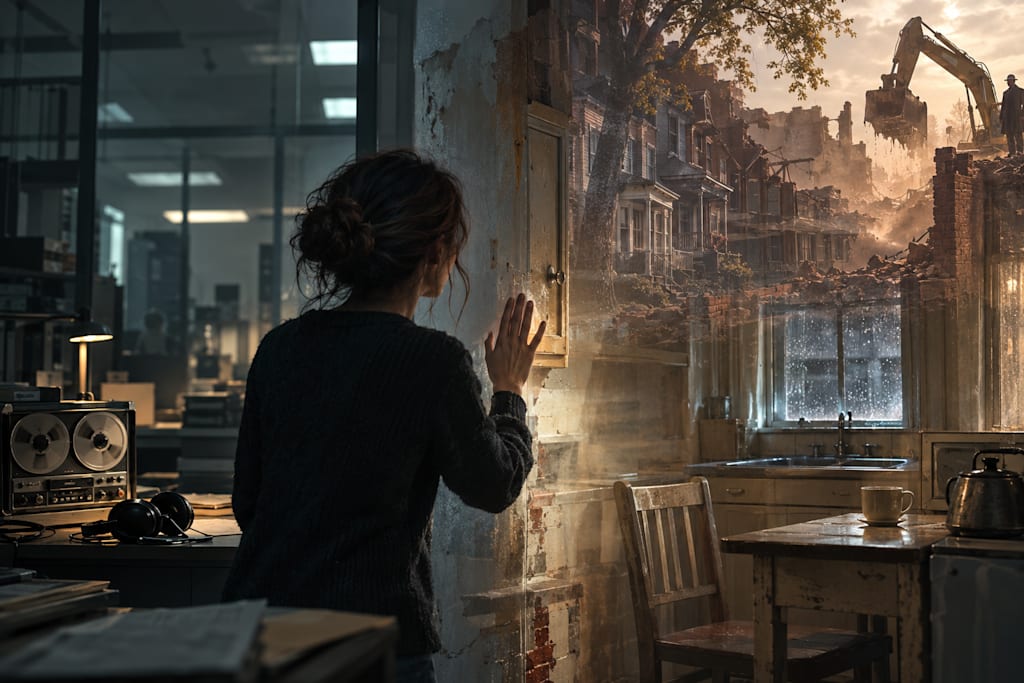
Miriam first noticed the sound of a spoon striking porcelain: three uneven taps, followed by the scrape of a chair across what she thought was linoleum. Beneath these domestic noises ran a mechanical hum. She adjusted the equalizer and leaned toward the monitor, listening as water dripped into a metal sink and someone cleared her throat. The recording ended before the woman spoke, leaving Miriam with the peculiar impression that the silence had been interrupted rather than restored.
After seventeen years restoring damaged recordings, Miriam had learned that history survived most faithfully in its incidental details: a door closing during an interview, traffic passing beneath a speech, the almost inaudible breath someone took before answering a difficult question. What troubled her was the address written on the reel's cardboard sleeve. Bellwether Street, November 18, 1957. The collection had come from a municipal storage facility scheduled for demolition, but neither the street nor its buildings appeared in the city's historical directories. She searched the fire insurance maps, tracing old property boundaries with a finger, then compared them against successive planning surveys. Streets had been renamed, widened, and absorbed into larger developments. Bellwether had simply ceased to exist.
She removed her headphones and reached for the coffee beside her keyboard. The mug was empty except for a dark residue, yet as she swallowed, she tasted warm milk and something faintly scorched. The sensation lingered against the roof of her mouth, followed by the sweetness of bread browning in butter. Miriam looked toward the kitchenette beyond the glass partition. Its lights were off, and the stainless-steel counter held only the electric kettle and a stack of paper cups. She had taken her coffee black for twenty years.
The following morning, the recording contained a voice that had not been present before. Miriam discovered it while comparing the original transfer with the cleaned version. The spoon struck the cup, the chair moved, and the water continued dripping, but after the woman cleared her throat, a man spoke from farther inside the room. His words were muffled, though she could distinguish two syllables with uncomfortable clarity: Not yet.
She checked the digital file against the magnetic reel, then transferred the recording again using a second machine. The voice remained. The scrape of the chair no longer suggested someone preparing to sit. It sounded like someone rising in anticipation of an arrival.
When Miriam replayed the final seconds, she smelled toast. She turned toward the kitchenette, irritated by the persistence of the sensation. The odor had the warm, acrid character of bread left too long beneath a heating element, but the room remained empty. She opened the partition door and stood beneath the ventilation grille, listening to the thin rush of conditioned air.
"Something wrong with the ventilation?" Daniel asked from the corridor.
Miriam looked over her shoulder. He carried two archival boxes against his chest, his glasses slipping down his nose. Daniel had worked with her for nearly twelve years, long enough to recognize when she was concentrating and when something had unsettled her. She asked whether he smelled anything burning. He paused, inhaled, and shook his head before continuing toward storage, leaving her alone with the odor that had already begun to fade.
Three days later, Daniel brought her another reel from the same collection. It had been wedged behind a cabinet whose drawers had swollen shut, its sleeve marked only by a number absent from the inventory. When Miriam threaded the tape through the machine, she heard a street: a bus laboring toward a stop, brakes releasing their metallic complaint, footsteps crossing pavement, a dog barking somewhere behind a fence. A screen door slammed. A child called from a distance, and beneath the ordinary activity, a heavy mechanical vibration rose and fell, briefly overwhelming the surrounding sounds.
She isolated the vibration and listened until her jaw ached from the pressure of the headphones. It resembled excavation machinery operating under strain, though something about its rhythm suggested repeated impacts rather than continuous movement. The bus accelerated, drowning the vibration, and the recording ended in static.
Daniel returned as she was searching the city's transportation archive. She had found the bus route, which had operated through a residential district demolished during midcentury redevelopment. He leaned over her shoulder to examine a photograph of narrow houses lining a tree-shaded street. One house stood behind a bus stop, its front steps descending toward pavement broken by the roots of an enormous elm. On the reverse, someone had written Bellwether, before clearance.
"That's our block," Daniel said, pointing toward the corner. "The old plaza was built over those houses."
Miriam compared the photograph with a contemporary site plan. The road's slight curve survived in the present parking entrance, and the elm's position corresponded to an empty square on the original survey. She placed a transparent floor plan over the photograph, aligning the street corners until the archive's foundations settled across the vanished houses. Her finger stopped above the nearest kitchen, visible through an open doorway behind a woman standing on the steps.
Her restoration desk occupied that room. She knew the kitchen's arrangement before she studied the photograph. The sink stood beneath the window. A refrigerator with a rounded handle occupied the opposite wall, and beside it hung a narrow cupboard whose upper hinge had loosened. She could almost feel the rough edge of its painted door beneath her fingertips.
Daniel asked whether she was all right. Miriam folded the floor plan before he could see her hand shaking.
That evening, while shutting down her equipment, she reached toward the wall beside her desk and stopped with her fingers curved around an invisible handle. A framed evacuation diagram hung above the light switch. There was no cupboard. She stood with her arm extended, embarrassed by the certainty of a movement she had not intended. When she lowered her hand, the faint smell of toast returned.
She avoided the recordings for four days, occupying herself with oral histories and deteriorating interview tapes. Nevertheless, the vanished kitchen followed her home. One morning she opened the wrong cupboard while searching for coffee, even though she had lived in her apartment for eleven years. That night she dreamed of rain tapping against a low kitchen window while a chair scraped behind her. When she turned, the doorway opened into the archive's restoration room, its fluorescent lights reflected in the dark glass above the sink.
She woke with her hand pressed against the bedroom wall.
At work the next morning, the plaster beside her desk was warm. The heat occupied a narrow rectangle precisely where she had expected the cupboard. Miriam pressed her palm against it and felt a faint vibration, as though machinery were operating deep inside the building. When Daniel entered carrying his morning coffee, the warmth vanished.
He found her standing beside the evacuation diagram. She told him about the recordings, the vanished street, and the correspondence between the photograph and her workspace. She did not mention the cupboard or the dream. Daniel listened without interrupting, then suggested they examine the redevelopment files together. His willingness to investigate relieved her more than she cared to admit.
They spent the afternoon among brittle municipal reports that smelled of dust and aging adhesive. The redevelopment authority had ordered Bellwether Street cleared in November 1957 after years of disputed property acquisitions. One report described an orderly clearance. Another referred to an unexpected collapse. A third recorded the deaths of three workers following a machinery failure. Even the date differed.
Danie placed two reports beside one another. Both described the same demolition crew and intersection, but one claimed the street had been cleared before the accident. The other placed several occupied houses directly in the machine's path.
Miriam returned to the photograph. At the far end of Bellwether Street stood an excavator with its bucket raised above a roofline. Beside it, a man in a dark coat held a clipboard. Under magnification, he appeared to be looking toward the photographer.
As Miriam studied his face, a low vibration passed through the table. The photograph shifted beneath her fingers, and dust loosened from the shelving above them. Daniel caught a falling folder, laughing uneasily about the building's aging foundations, but Miriam recognized the rhythm. It was the machinery from the recording.
The next morning, she saw the excavator through the restoration room window. Its long arm crossed the glass, trailing pale dust and fragments of brick, before disappearing behind the parking structure. Miriam hurried outside, expecting maintenance equipment near the loading dock. Instead, delivery vehicles stood beneath the familiar concrete overhang. Near the foundation, she found a fragment of red brick among the ornamental shrubs, warm to the touch, with fresh mortar clinging to one edge. She carried it upstairs in her coat pocket.
By afternoon, the evacuation diagram lay on the floor. Behind it, a narrow cupboard door had emerged from the plaster, its yellowed paint blistered around a loose upper hinge. Miriam could see the handle pressing outward beneath the remaining wall. She touched it, feeling the metal yield beneath her fingers, and heard porcelain strike porcelain from somewhere inside. Three taps, followed by a pause.
The restoration room seemed to lengthen around her. Her breathing returned from a distance that did not correspond to the walls, while rain tapped against a window beyond the fluorescent lights. Then the man's voice spoke from behind the cupboard, close enough that she felt its vibration against her palm.
"Not yet."
Miriam withdrew her hand and hurried into the corridor. She nearly collided with Daniel, who was carrying a box toward the elevator. Before she could explain, the lights dimmed, and a heavy scraping sound passed behind the wall. Daniel stopped, listening. He had heard it too.
A narrow shadow moved along the corridor, shaped like the legs of a chair being dragged across a floor. Daniel set down the box and approached the elevator, but when its doors opened, both stepped backward.
A kitchen occupied the space beyond. Rain streaked the window above a porcelain sink. A kettle stood on the stove, and a chair had been pulled away from a narrow table, leaving pale marks across yellow linoleum. The smell of coffee and scorched toast drifted into the corridor. Miriam noticed that the elevator's steel threshold continued beneath the kitchen floor.
Daniel leaned forward, his shoe crossing the threshold. Miriam caught his sleeve. The fabric tightened between her fingers, and she felt him pulled toward the room by a force originating somewhere beneath his feet. He stumbled backward against her, striking his shoulder against the wall. The elevator doors closed on the kitchen, and when they reopened, the empty lift waited behind them.
Daniel stared at the illuminated buttons, his breathing shallow, a dark patch of sweat spreading beneath his collar. He touched the place where Miriam had gripped his sleeve, then looked at her with an expression she had never seen on his face.
"We need to get everyone out."
They took the stairs. On the fifth floor, voices moved behind the concrete wall, accompanied by footsteps and the clatter of dishes. On the third, the air grew hot and metallic. Miriam felt each step vibrating beneath her shoes, the rhythm of heavy equipment traveling through the building. Daniel moved ahead, calling into offices and urging people toward the exits, but by the second floor a narrow wooden landing appeared beyond the next turn, its banister polished smooth by generations of hands.
Daniel reached it first. Miriam saw his foot settle on the wood. She heard it creak under his weight, and then the landing shifted sideways, exposing darkness where the stairs should have continued. Daniel caught the railing, his body twisting as the floor withdrew beneath him. Miriam seized his wrist, feeling the tendons tighten beneath his skin. For one suspended moment, they held each other across a distance that was not quite visible, his hand warm and solid inside hers while dust filled the stairwell.
Then the railing passed through his body. Daniel's fingers slipped from her grasp, and she heard him strike something below, followed by a cry and shoes scraping against concrete. His voice rose through the darkness, calling her name. Miriam dropped to her knees and reached into the opening, but her fingers encountered only cold plaster. The wooden landing had vanished, replaced by the stairwell wall.
Daniel continued calling. She pressed her ear against the concrete, hearing his breath break between words. He was close enough that she could distinguish the catch in his throat, yet when she struck the wall, the sound returned from a distance far greater than its thickness.
"I'm here," she called.
For a moment he stopped speaking. Then, muffled by something deepening between them, he answered, "I know."
The building shuddered. Miriam stumbled down the stairs, following people running toward the lobby. She intended to find another entrance to the space where Daniel had fallen, but when she reached the ground floor, the street outside had changed.
The municipal plaza remained beneath the afternoon light, though beyond it stood a row of narrow houses. An elm spread its branches above a bus stop, its roots lifting the pavement. A woman stood on the steps of the nearest house, one hand resting against the doorframe. Behind her, the archive's glass facade flickered through brick walls like an image reflected in disturbed water.
At the loading dock, an excavator stood with its engine running. A man in a dark coat watched beside it, a clipboard pressed against his chest. When he raised his hand, the machine's bucket descended.
The impact traveled through the pavement into Miriam's knees. Above her, glass shattered, but the falling fragments became red brick before reaching the ground. She saw the archive's staircases crossing bedrooms, its corridors passing through walls hung with family photographs. A woman carrying a child moved through the revolving entrance without touching the glass.
Miriam looked toward the stairwell where she had left Daniel. Through the overlapping structures, she could see the concrete landing and the strip of fluorescent light above the door. Then brick walls moved through them. She heard Daniel call again and saw his hand appear against the glass of a window that belonged to neither building.
She ran toward him, the pavement changing beneath her feet from smooth concrete to uneven stone. Dust filled her mouth. She reached the window and struck it with both hands, but the glass had begun to lose its reflection. Daniel's face remained visible for an instant, pale and distorted, his mouth moving behind a surface that no longer occupied the same distance from her.
Then the archive disappeared. The houses stood beneath the pale sky. The bus stop occupied the corner, and the elm's leaves stirred in a breeze carrying wet earth and diesel exhaust. Miriam found herself leaning against its trunk, her palms scraped raw by the bark. Across the street, the woman with a child stood motionless on he steps, staring toward the place where the glass building had been.
Miriam could still hear Daniel. His voice came from beneath the pavement, so faint she might have mistaken it for water moving through buried pipes. She knelt and pressed her ear against the ground. Somewhere below, a telephone rang. A chair rolled across a hard floor. The archive's ventilation system continued its familiar mechanical hum.
A spoon struck porcelain inside the nearest house. Miriam rose slowly.
Through the doorway, she could see the kitchen from the recording. The narrow cupboard hung beside the refrigerator, its upper hinge loose. Rain tapped against the window above the sink, although the street remained dry. On the table stood a reel-to-reel recorder, its spools turning with a faint, irregular click.
The woman in the doorway watched Miriam approach. When Miriam reached the steps, she shifted aside without speaking.
Inside, the kitchen smelled of coffee, toast, and warm dust. Miriam felt the uneven linoleum beneath her shoes, but beneath the domestic sounds, another room continued to exist. She heard the archive's ventilation system, the hum of fluorescent lights, and Daniel's uneven breathing somewhere beyond the wall.
She approached the recorder. Its reels turned steadily, though the tape passing between them was nearly transparent. From the speaker came the scrape of an office chair, followed by the click of a keyboard. Then Daniel spoke, his voice thin and distant, asking whether she smelled something burning.
Miriam reached for the stop button. Before her finger touched it, the recording changed. She heard headphones settling over someone's ears, a chair drawn closer to a desk, and the soft intake of breath that preceded careful listening. Her own breath.
She stood motionless, feeling the warm kitchen air against her face while the recorder reproduced the small sounds of a body she could no longer hear herself making.
Beyond the window, the excavator's engine started again. The woman in the doorway turned toward the street, fear gathering slowly in her expression. Miriam looked down at her hand, still suspended above the recorder, and heard the faint rustle of her sleeve emerge from the speaker before she moved.
Then Daniel called her name. This time his voice came from inside the recording, close enough that she heard his breath catch on the final syllable. Miriam pressed the stop button. The reels slowed, but Daniel continued calling from somewhere behind the kitchen wall.
Outside, the excavator's bucket rose above the houses, scattering pale dust against the afternoon light. Miriam reached toward the wall where Daniel's voice seemed nearest and felt, beneath the old plaster, the familiar vibration of the archive's ventilation system.
On the other side, something struck the wall.
She pressed her palm against it, and another hand pressed back.
About the Creator
Rebecca A Hyde Gonzales
I love to write. I have a deep love for words and language; a budding philologist (a late bloomer according to my father). I have been fascinated with the construction of sentences and how meaning is derived from the order of words.
Enjoyed the story? Support the Creator.
Subscribe for free to receive all their stories in your feed. You could also become a paid subscriber, letting them know you appreciate their work.
Comments
There are no comments for this story
Be the first to respond and start the conversation.