
The Smile Room
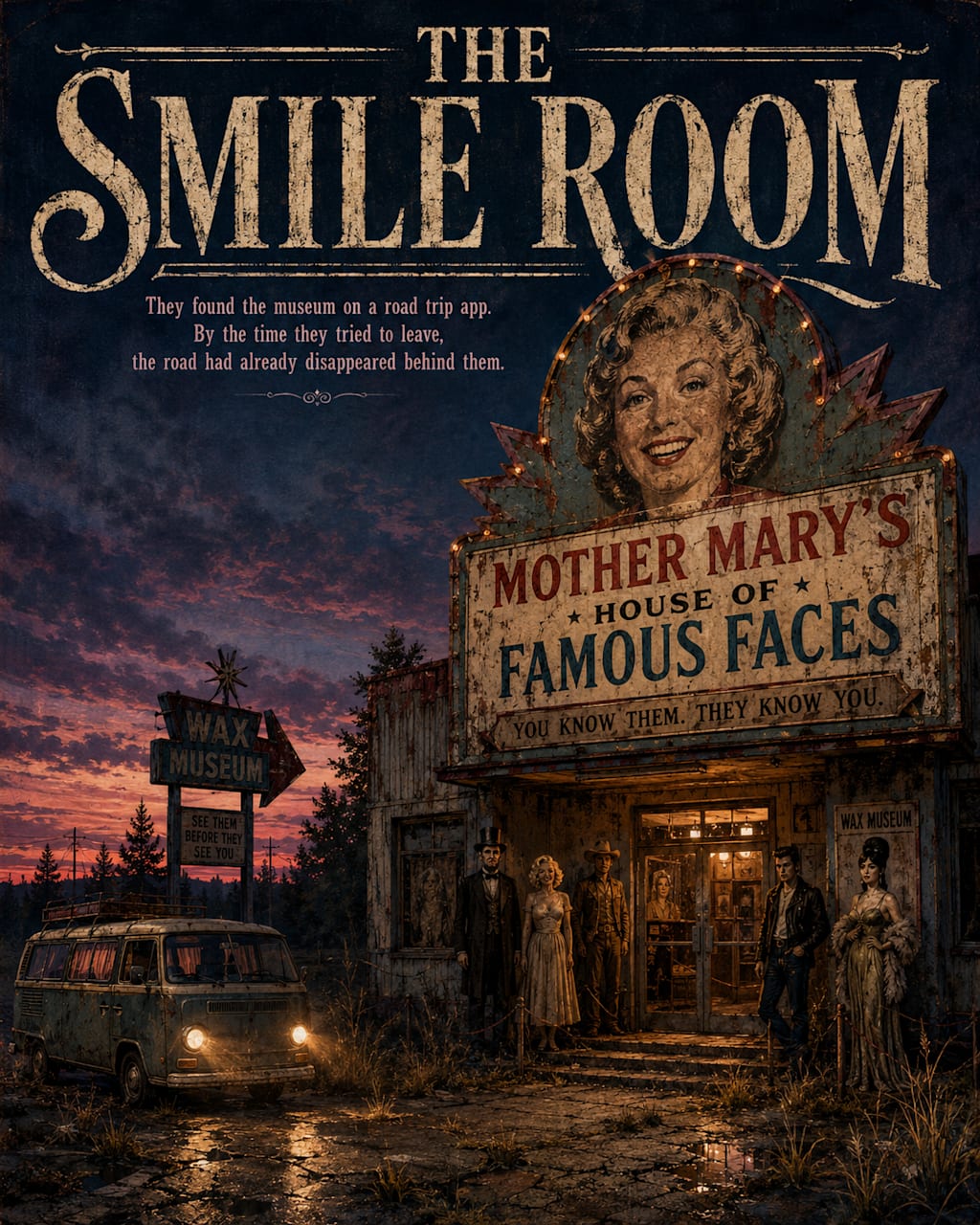
They found the museum on a road trip app. By the time they tried to leave, the road had already disappeared behind them.
Jay planned road trips the way other people planned weddings.
Not casually. Not lazily. Not with vague ideas about “seeing where the road takes us.” Jay believed the road would absolutely take you somewhere, but only if you respected it enough to make a color-coded folder first.
This trip had started as a final destination.
The Museum of American Wonder sat three states away, famous for its two-story fiberglass jackalope, a gift shop shaped like a barn, and a rotating exhibit called America’s Questionable Treasures. Jay found it online at two in the morning and immediately sent the group chat seventeen screenshots with the message:
We have no choice. We are being called.
The road trip grew from there.
Jay built the route around the kind of places he loved most: strange roadside landmarks, family-owned museums, oversized produce, haunted-looking diners that were not technically haunted, and local attractions with websites that had not been updated since 2009.
Everyone had a role.
Ally handled the itinerary because Ally could turn chaos into a spreadsheet and make it look like a personal victory. She tracked reservations, gas stops, emergency contacts, and the shared budget.
Sabrina checked weather, food options, bathroom stops, and whether any attraction had reviews containing words like “unsafe,” “cult,” or “do not go.”
Grace packed the emergency kit, extra snacks, chargers, wipes, bandages, motion sickness pills, and a little pouch of things she called “spiritual insurance.” Grace also had a habit of switching into Greek when she was nervous, which meant everyone had learned to recognize danger by tone even when they did not understand the words.
Mel researched cheap motels, accessibility notes, and whether a place seemed likely to misgender them before they even walked through the door.
Parker handled cameras.
Nia handled the playlist.
Owen handled snacks and morale, which mostly meant buying beef jerky nobody asked for and offering it whenever anyone looked sad.
Jay handled the joy.
That was what Mel called it on the second day, when Jay had convinced all eight of them to pose under a concrete peach wearing matching sunglasses from a gas station.
“You’re the joy department,” Mel said.
Jay bowed. “A sacred office.”
Sabrina, who had anxiety and a stomach that treated uncertainty as a personal attack, pointed at the peach and said, “That thing has teeth.”
“It has texture,” Jay said.
“It has teeth.”
Grace shaded her eyes and stared up at it. “Δεν μου αρέσει αυτό.”
Mel looked over. “Translation?”
“I don’t like this.”
Jay smiled, softer this time. He was always good at noticing when a joke needed to stop being a joke. “We can skip the inside.”
Sabrina exhaled. “Thank you.”
They skipped the inside.
That was Jay too. He pushed people toward adventure, but not past the point where their faces changed.
By the fifth day, they had seen a concrete peach, a singing gas pump, the world’s third-largest ball of bread tags, and a taxidermy squirrel wedding in a town where nobody laughed when Jay asked who officiated.
They were sunburned, overtired, and happy in the fragile way people get when they have been eating from gas stations and sleeping badly but have not yet turned on each other.
Then the app found the wax museum.
It appeared on Jay’s phone while they were leaving an abandoned dinosaur park off a state highway with no shoulder. The app was called OddRoute, a crowdsourced map of “undiscovered roadside gems,” and most of its listings were either outdated, disappointing, or closed forever.
This one had no reviews.
No photos.
Just a red pin about forty miles off their route and the name:
MOTHER MARY’S HOUSE OF FAMOUS FACES
Below that, in gray text:
Last verified: Unknown.
Jay lowered the phone.
Ally saw his face and immediately said, “What did the app do?”
“It found something.”
Sabrina closed her eyes. “I hate when it finds something.”
“It is a wax museum,” Jay said. “A forgotten wax museum. Do you understand how perfect that is?”
“No,” Sabrina said. “I understand the opposite.”
Ally leaned forward from the passenger seat, already opening the itinerary. “How far off route?”
“Forty miles.”
“That is not terrible.”
“It is if we die,” Sabrina said.
Grace looked out the van window at the flat road, the fields on either side, the sun sinking orange behind a row of telephone poles. “Δεν μου αρέσει αυτό.”
Mel glanced at her. “Same translation?”
“Very much same translation.”
Jay looked at Sabrina first, then Grace. His excitement dimmed, but did not disappear. “We can vote. No pressure. If it feels wrong, we do not go.”
“That is suspiciously reasonable,” Nia said.
“I contain multitudes.”
Ally checked the map. “There’s a gas station twelve miles before the turnoff. We stop there first, fill up, use the bathroom, buy water. If the road looks bad, we turn around.”
Jay pointed at her. “This is why you are Operations Director.”
“And why you are not allowed to say ‘one quick stop’ ever again.”
Sabrina hugged her knees in the back seat. “I am formally documenting that I hate this.”
“Duly noted,” Ally said.
They went anyway.
That was the first mistake, though later none of them could agree on the last.
The gas station had one pump, two dead vending machines, and a handwritten sign taped to the door:
CASH ONLY. BATHROOM FOR CUSTOMERS. DO NOT ASK ABOUT THE MUSEUM.
Jay filmed the sign, but did not joke about it.
The cashier watched them from behind the counter with the exhausted contempt of someone who had seen every kind of idiot and ranked them all.
Ally bought water, batteries, and a paper map.
Sabrina bought antacids.
Grace bought a small St. Christopher medal from a dusty rotating rack and did not make eye contact with anyone while paying.
Mel asked the cashier, “Is Mother Mary’s still open?”
The cashier stopped counting change.
“No,” she said.
Jay lowered the camera slightly. “But it exists?”
The cashier looked past them, through the smeared front window, toward the road that led into the fields.
“Lots of things exist.”
“Is it private property?” Ally asked.
“That depends who you ask.”
“We don’t want to trespass,” Mel said.
The cashier slid the receipt across the counter. “Then don’t.”
Outside, Jay was quiet for almost a full minute.
Sabrina noticed. “You’re not going to say that was perfect ominous local warning energy?”
“I was thinking it,” Jay admitted.
“At least we are growing.”
Ally unfolded the paper map on the hood of the van. “We said if the road looks bad, we turn around.”
The road did not look bad.
That was the problem.
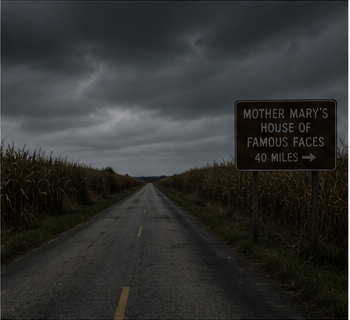
It looked newly paved.
A smooth black ribbon cutting between miles of dry cornfields, too clean for the cracked highway behind them. No houses. No mailboxes. No lights. Just fields and the app’s red pin waiting ahead.
After ten miles, their phones lost signal.
After twenty, the van’s radio turned to static.
After thirty, they passed the same dead deer three times.
It lay on the right shoulder with its legs folded neatly beneath it, head turned toward the road, eyes wet and black.
“The road is looping,” Sabrina whispered.
“It’s not looping,” Ally said, though she was looking at the map too hard.
Grace had gone pale. “Παναγία μου.”
Jay tried to smile, but it failed. “Okay, that one I know.”
“Holy Mother,” Mel said.
Then the museum appeared.
Not all at once.
First, the sign.
A wooden cutout of a woman’s face, twenty feet tall, mounted above an archway of rusted metal roses. Her smile was enormous. Her eyes were painted blue. Her cheeks had faded to the color of old meat.
MOTHER MARY’S HOUSE OF FAMOUS FACES
YOU KNOW THEM. THEY KNOW YOU.
Beyond the sign sat a long white building with a red roof and boarded windows. The parking lot was empty except for weeds, a sun-bleached ticket booth, and six wax figures standing in a row by the entrance.
Waiting.
“Absolutely not,” Sabrina said.
Jay did not argue.
He parked, but left the engine running.
Ally looked at him.
Jay lifted both hands from the wheel. “We can leave.”
No one answered.
The figures were celebrities, or had once been meant to be. Their faces had softened with heat and time until recognition became a private argument. One might have been Elvis. One might have been Marilyn. One looked like three presidents had melted into one another and tried to remain patriotic.
Nia climbed out first. “It smells like crayons and rot.”
Parker lifted his camera. “That’s the wax.”
Ally checked her watch. “Fifteen minutes, dawg. We film exterior only unless the entrance is clearly open to the public.”
Owen pointed at the door.
It was open.
Not wide.
Just enough.
As if someone had been watching for them and had politely stepped away.
Inside, the air was cold.
That made no sense. Outside, the day still held its heat. Inside, every breath fogged faintly. The lobby was paneled in dark wood, with red carpet worn down to threads and velvet ropes guiding visitors toward a ticket counter where no one stood.
Behind the counter was a bell.
Jay looked at it.
Sabrina said, “Don’t.”
Jay nodded and stepped back.
The bell rang by itself.
Sabrina flinched hard enough that Mel touched her shoulder.
A speaker crackled overhead.
Then a woman’s voice said, bright and warped by age:
“Welcome, darlings.”
No one moved.
The voice continued.
“Please keep your hands to yourselves. The figures are delicate, and so are you.”
Parker laughed under his breath. “Okay, that’s actually good.”
Ally turned toward the door. “We’re leaving.”
The door slammed shut.
The sound cracked through the lobby like a gunshot.
Nia grabbed the handle and pulled.
It did not move.
Owen joined her.
Nothing.
Jay stopped filming.
“Oh,” he said quietly.
From somewhere deeper in the building came a soft dragging sound.
Then another.
Wax on carpet.
Ally took control because that was what Ally did when fear made everyone else useless.
“Phones out. Flashlights on. Stay together. We find another exit.”
“There’s no signal,” Sabrina said.
“I didn’t say call. I said light.”
They moved past the ticket counter into the first gallery.
A sign above the entrance read:
THE HALL OF FIRST IMPRESSIONS
Figures lined both sides of the room behind velvet ropes. Movie stars. Politicians. Athletes. Historical figures. All smiling. All slightly wrong. Their skin had cracked around the mouths and eyes. Their hairlines lifted in dry curls. Some had candles placed at their feet, unlit but recently melted.
Mel whispered, “Why does it feel like they’re leaning toward us?”
“Because they are,” Grace said.
Halfway through the hall, they found the first new figure.
It stood under a spotlight that should not have worked, wearing khaki shorts, a dinosaur park T-shirt, and Parker’s stupid orange bucket hat.
Parker lowered his camera.
“That’s mine,” he said.
The figure’s face was blank.
Not unfinished. Erased. A smooth wax oval with no eyes, no nose, no mouth.
Pinned to its chest was a paper label:
THE BOY WHO WANTED PROOF
Parker reached for his hat.
“Don’t touch it,” Ally snapped.
Too late.
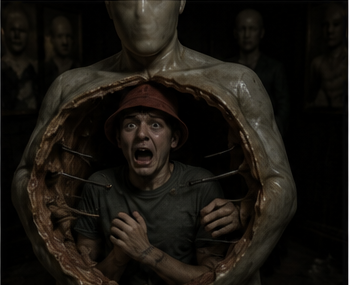
The figure opened.
Not like a door.
Like a flower.
Its chest split down the center, wax peeling back in soft pink flaps, and a pair of arms shot out from inside. They were human arms, slick to the elbow, fingers ending in long metal caps that punched into Parker’s shoulders.
He screamed.
The thing pulled him forward into its hollow body.
Everyone lunged for him.
Jay grabbed Parker’s waist. Mel caught his belt. Nia seized one kicking leg. The wax figure bent around him, closing, swallowing, its soft body taking the shape of his ribs, his open mouth, his thrashing hands.
Then the metal fingers hooked inward.
Parker’s scream became wet.
Hot blood sprayed across Jay’s face.
The figure sealed.
The room went silent except for Parker inside it, making small muffled sounds that stopped one by one.
The label on the chest changed.
Wax letters rose through the paper like bruises.
PARKER VALE, 1997 TO 2026
LOCAL DOCUMENTARIAN
Sabrina screamed until her voice broke.
They ran.
The museum changed while they ran.
The Hall of First Impressions became a corridor of mirrors. The mirrors became display cases. The display cases held wedding scenes, moon landings, talk-show sets, royal balconies. In each one, wax faces turned a fraction too late to watch them pass.
At the end of the corridor, they found emergency exit doors.
Ally hit the push bar.
An alarm began to wail.
The doors opened onto a brick wall.
Not outside.
A brick wall inches beyond the frame, warm and sweating, with something moving behind it.
The wall breathed.
Nia backed away laughing. “No. No, thank you. No.”
A blade came through the brick.
Not breaking it. Sliding between the bricks like the wall was flesh.
It caught Nia across the throat.
For a second, she stood there looking offended.
Then her neck opened.
Blood poured over her hands. Ally caught her as she fell, but there was too much, too fast, bright red pulsing between Ally’s fingers.
Grace began speaking Greek so quickly the words tangled.
“Κράτα την, κράτα την, μη φύγεις, μη φύγεις.”
Hold her. Hold her. Don’t go. Don’t go.
But Nia went.
The alarm stopped.
The museum speaker crackled.
“Please proceed to the Smile Room.”
Jay vomited into a velvet rope stand.
Mel slapped him.
Hard.
“Not now,” they said.
Jay stared at them, shocked back into his body.
Ally’s hands were red to the wrists. She looked down at Nia, then up at the others. Something in her face locked.
“We move,” she said. “We do not split up. We do not touch anything. We find staff areas. Loading dock. Kitchen. Maintenance. Something.”
Owen nodded too many times. “Yes. Yes. Maintenance. Buildings have backs.”
They found a door marked EMPLOYEES ONLY behind a wax figure of a game show host.
Inside was a workshop.
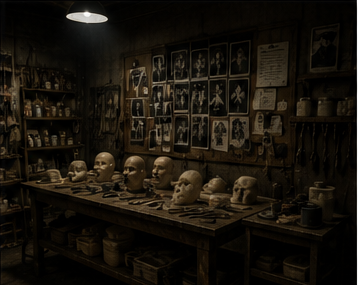
Tables. Molds. Wigs. Buckets of cooling wax. A wall of tools. Sculpting knives. Heat guns. Bone saws. Dental pliers. Jars of glass eyes sorted by color.
And photographs.
Hundreds of them.
Pinned to corkboards.
People at the entrance. People in the lobby. People smiling under the giant Mother Mary sign.
Visitors.
Missing visitors.
There was a photo of them at the gas station, taken from behind the vending machines.
There was a photo of Jay sitting in the driver’s seat before they even reached the turnoff.
There was a photo of Sabrina standing beside the Elvis figure, one hand pressed to her chest, unaware that something behind the ticket counter was leaning out to look at her.
Sabrina made a small sound.
Then the workshop lights went out.
In the dark, something whispered directly into her ear.
“Anxious people last longer.”
When the lights came back, Sabrina was gone.
The door to the freezer stood open.
Mel got there first.
Inside, Sabrina hung from a meat hook by the back of her jacket, alive, kicking weakly, mouth taped shut. Around her were bodies in various stages of becoming exhibits. Some coated in wax to the neck. Some posed in chairs. Some missing faces. Some with faces that had been replaced by others.
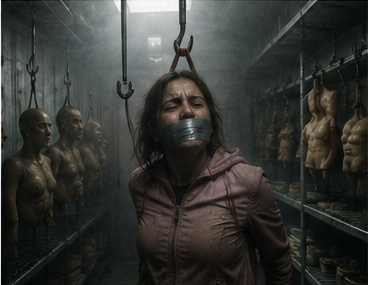
At the back of the freezer, a woman stood at a metal table.
She wore a stained pink apron over a black dress. Her hair was set in perfect gray curls. Her face was wax-smooth except around the eyes, where real skin wrinkled and blinked.
Mother Mary.
She was working a scalpel under the cheek of a dead man, peeling carefully.
“Don’t rush me,” she said without looking up. “Faces tear when people rush.”
Owen charged her.
He was big, kind, uselessly brave.
Mother Mary sighed and pressed a pedal under the table.
A heat lamp burst on overhead.
Owen stopped beneath it, confused.
Then the ceiling nozzles opened.
Boiling wax poured over him.
He screamed and clawed at his face as it coated him, sealing his eyelashes, filling his ears, plastering his shirt to his skin. He stumbled backward, arms windmilling, and fell against a rack of metal molds. They clanged down around him like bells.
Sabrina thrashed on the hook.
Ally grabbed a bone saw from the wall and swung it at the chain.
Once.
Twice.
Grace stood in the freezer doorway, crying, whispering, “I know her.”
Mel turned. “What?”
Grace stared at Mother Mary. “Not her. This. I know this.”
Mother Mary finally looked up.
Her eyes landed on Grace and softened with interest.
“Oh,” she said. “One who has been displayed before.”
Grace went still.
Jay did not understand. Ally did. Mel did.
Sabrina’s anxiety had been warning. Grace’s lived experience was recognition.
There are rooms where people are turned into objects long before anyone uses wax.
Mother Mary smiled. “You’ll make a wonderful witness.”
Grace stepped into the freezer.
“No,” Mel said.
Grace looked back at them, tears shining. “Get Sabrina down.”
Then she began speaking to Mother Mary in Greek.
Softly at first.
Then louder.
Mother Mary tilted her head, delighted by a language she had not prepared for.
Ally struck the chain again.
It snapped.
Sabrina fell into Mel’s arms.
Mother Mary moved fast.
Too fast for someone shaped like an old woman.
She crossed the freezer with the scalpel raised, but Grace grabbed a heat gun from the table and fired it into Mother Mary’s face.
Wax ran.
Not melted makeup.
Wax.
It poured off her cheeks in creamy sheets, revealing patches beneath: old skin, young skin, brown skin, freckled skin, a dozen stolen faces layered over one another like wallpaper.
Mother Mary shrieked.
Grace kept the heat on her.
“Run!” she screamed.
Jay dragged Grace back as Ally slammed the freezer door.
Mother Mary hit it from inside.
Once.
Twice.
The metal dented.
They ran through the workshop and into the final gallery.
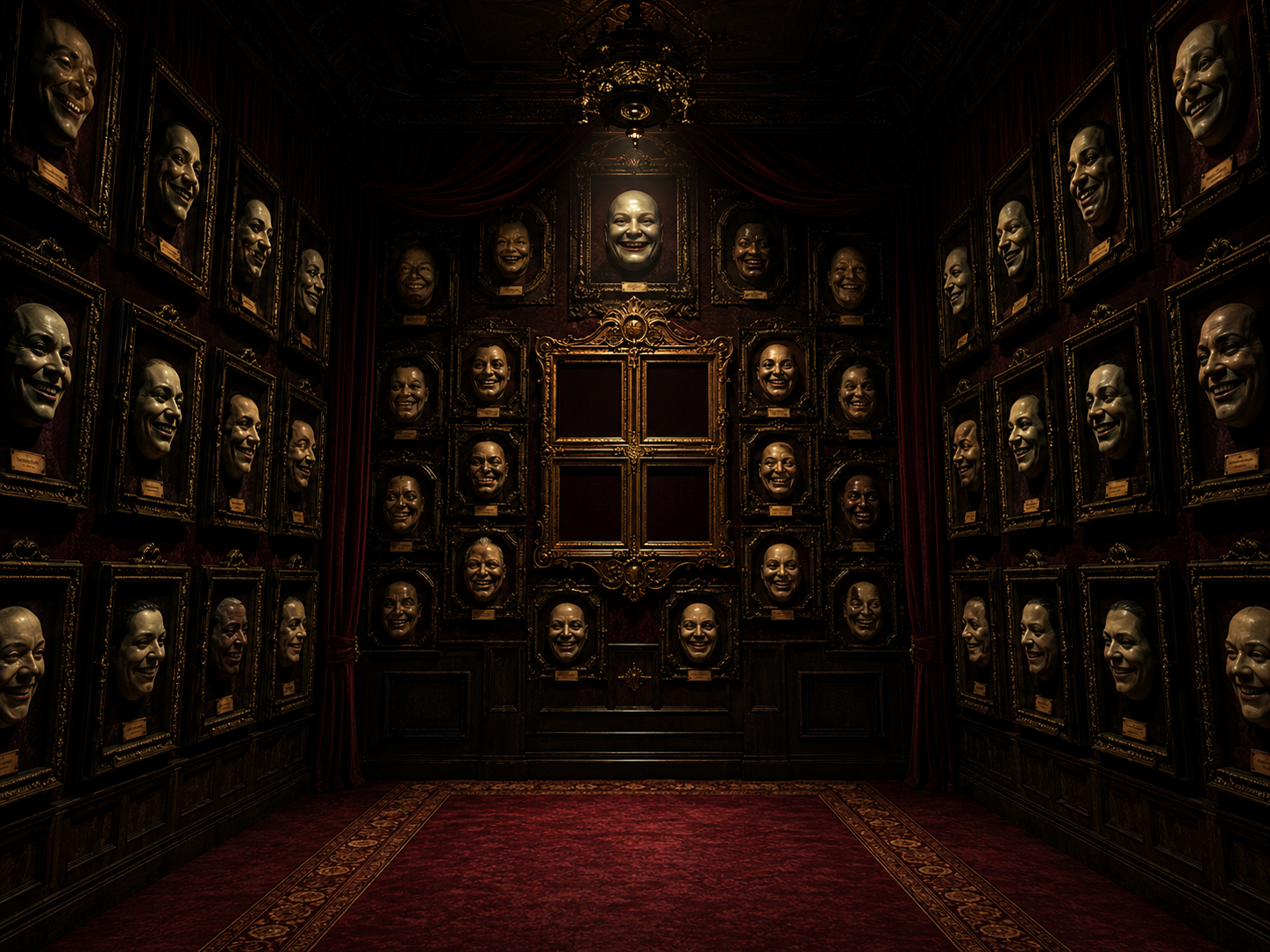
THE SMILE ROOM
Every wall was lined with faces.
Not heads. Faces.
Wax death masks mounted in golden frames, each smiling gently. Under every face was a brass plaque with a name and date. Some were decades old. Some were recent.
At the end of the room was a blank display.
Nine empty frames.
No.
Three had already been filled.
Parker’s frame.
Nia’s.
Owen’s face gleamed wetly in a new gold frame, mouth open in a perfect cheerful grin.
Sabrina made a wounded animal sound.
Jay stopped running.
On the far wall, a frame bore his name.
JAY MARTIN
THE JOY DEPARTMENT
The wax inside the frame was not finished yet. It had no eyes. But it was smiling.
Something broke in him.
“I brought us here,” he whispered.
Ally grabbed his shirt. “Then help get us out.”
A red EXIT sign buzzed at the end of the room.
This time, when Ally pushed the door, it opened to night air.
The parking lot.
The van.
They ran for it.
The tires were gone.
Not flat.
Gone.
The van sat on its rims in a neat circle of rubber scraps.
The road beyond the sign was no longer paved. It was dirt. Then weeds. Then cornfield. The smooth black road that had brought them there had vanished as if it had never existed.
Behind them, the museum doors opened.
Mother Mary stepped out, smoking, half her face sliding from the bone.
In one hand she held Parker’s camera.
Then Nia’s phone.
Then Owen’s.
Every lens blinked red.
“Darlings,” she called. “You forgot the gift shop.”
Ally threw the van keys to Mel. “Check if it starts.”
“It has no tires.”
“Check if it starts.”
Mel obeyed.
The engine coughed, caught, roared.
Ally grabbed a tire iron from the back.
Jay picked up a broken piece of rim.
Grace pulled Sabrina toward the van.
Mother Mary crossed the parking lot slowly now, smiling with three mouths that did not belong to her.
“You can leave,” she said. “Of course you can leave. Everyone leaves something.”
Ally ran at her first.
Not screaming.
Working.
She ducked under the scalpel and drove the tire iron into Mother Mary’s knee. It bent backward with a crack. Jay swung the rim into her head. Grace threw the St. Christopher medal hard enough to strike one exposed eye.
Sabrina, shaking, grabbed the gas can from the van’s emergency kit.
Mel understood instantly.
They splashed the museum doors, the velvet ropes, the ticket booth.
Mother Mary laughed from the ground. “Fire makes faces run.”
“Good,” Sabrina said.
Her voice shook.
Her hands did not.
She lit the match.
The front of Mother Mary’s House of Famous Faces went up fast, flames racing along old curtains and dry wood, climbing the giant painted sign. The woman’s smiling face blackened. Her blue eyes blistered.
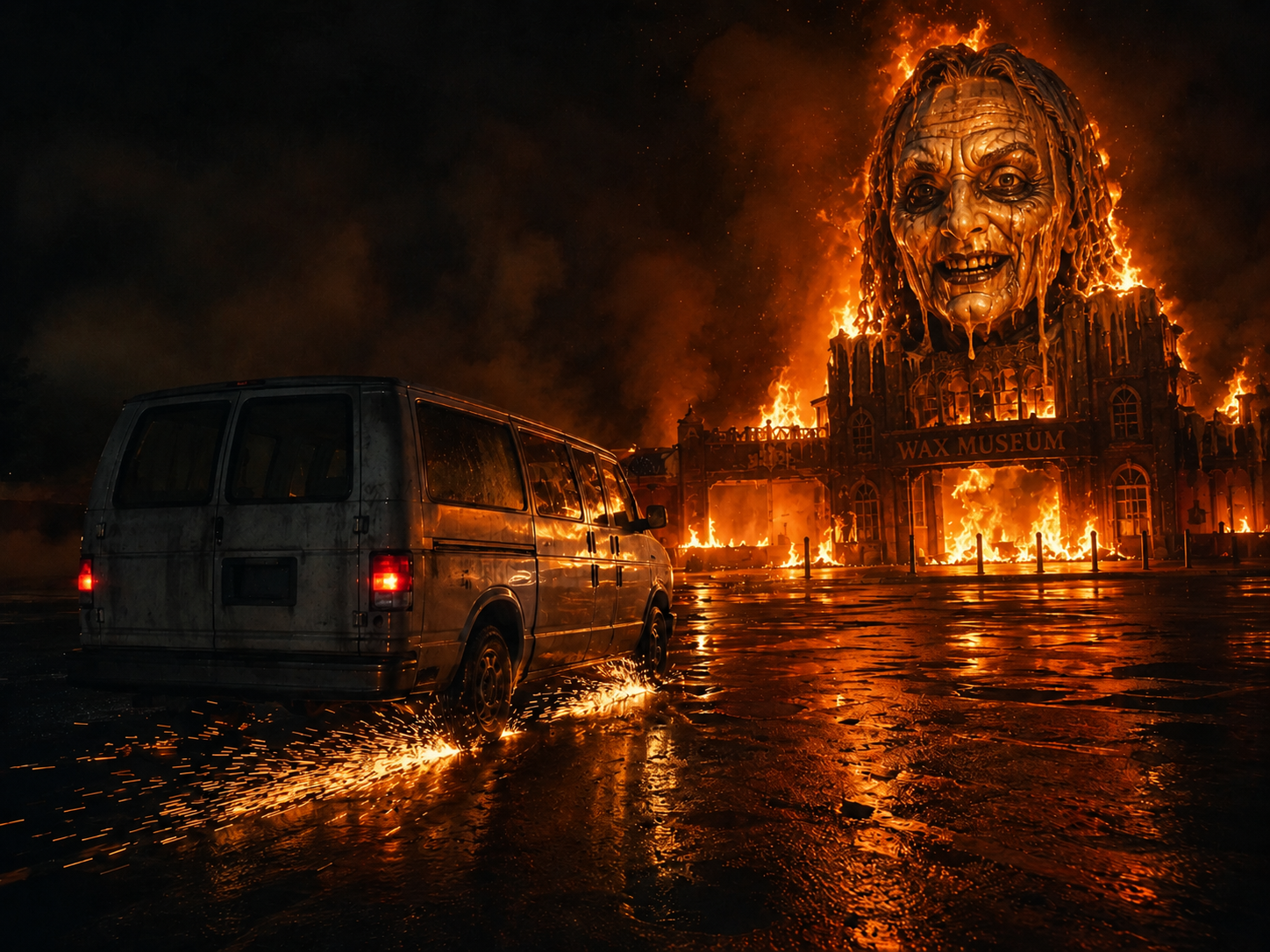
Mother Mary screamed only when the wax figures inside began screaming too.
Mel drove.
The van shrieked across the parking lot on bare rims, sparks flying behind them. Ally held Sabrina in the back. Jay pressed his bleeding forehead to the window. Grace whispered Greek prayers into both hands.
No one cheered when the road reappeared.
No one spoke when their phones found signal ten miles later.
At dawn, they reached the famous Museum of American Wonder.
The giant jackalope gleamed pink in the morning sun.
The parking lot was full of families.
Jay looked at the entrance and began to laugh.
Not because it was funny.
Because there are only so many shapes a sound can take before it becomes a scream.
Mel checked OddRoute.
Mother Mary’s listing was gone.
In its place, a new pin had appeared twenty miles ahead.
No photos.
No reviews.
Just a name.
THE NINE FRIENDS MEMORIAL OVERLOOK
Below it was one comment, posted one minute ago.
You know them. They know you.
About the Creator
Jason Hair-Wynn
Theatre artist, director, choreographer, and arts leader writing on accountability, equity, and culture in the performing arts, with a deep belief in storytelling, truth, and spaces rooted in care. And some travel content along the way
Enjoyed the story? Support the Creator.
Subscribe for free to receive all their stories in your feed. You could also become a paid subscriber, letting them know you appreciate their work.
Comments
There are no comments for this story
Be the first to respond and start the conversation.