
The Silence of the Lambs
Jonathan Demme, 1991.


I was on stage with Metallica, but, damn it, they turned my amp down because I hadn't learned to actually play "Last Caress." "Last Caress" is a Misfits song made famous by Metallica covering it. Great song.
Hanging from the ceiling of the auditorium, which was packed with tens of thousands, was a video monitor cube with screens on each side. Hannibal Lecter was holding forth on the one facing me. Or rather, the actor who portrays him, Sir Anthony Hopkins. I have no idea what he was saying; apparently, they turned down his amp, too.
The Silence of the Lambs is one of those quintessential American blockbuster films, like Star Wars, The Godfather, The Exorcist, or Pulp Fiction. Iconic, it's a film that so much has been written about over the decades, a reader might well wonder what yet another article about it could accomplish.
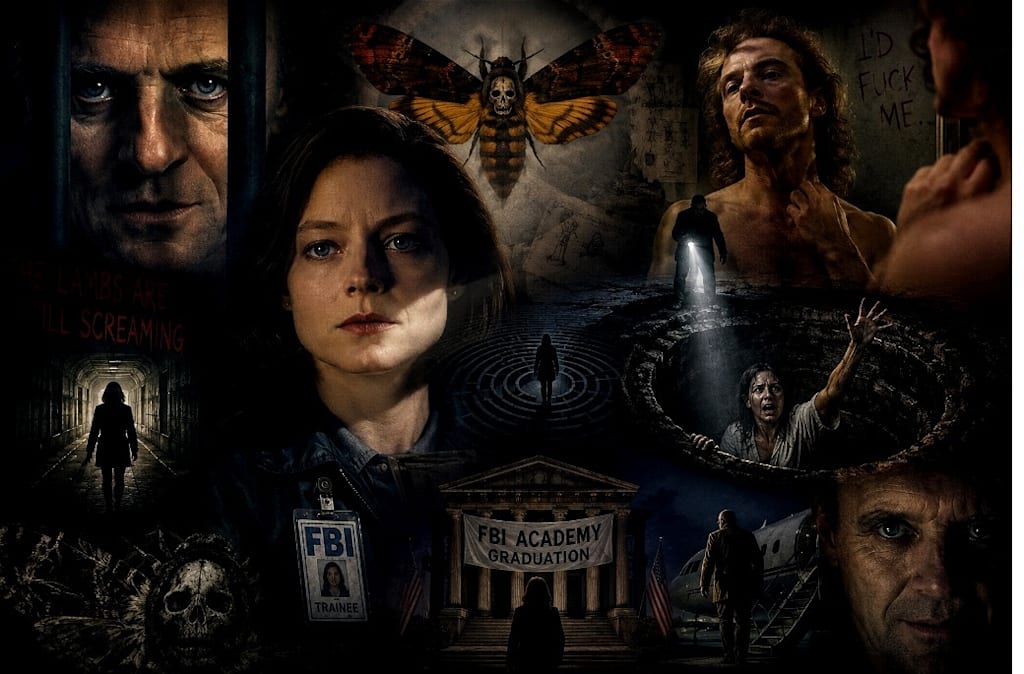
I got up from the aforementioned dream of heavy metal glory to watch Silence once again, having not seen it in years. The film is a transformative journey, just as much as my dream was. Or maybe two pathways heading in opposite directions, for two different protagonists: Clarice Starling (Jodie Foster) and Jame "Buffalo Bill" Gumb (Ted Levine).
The moth-to-flame analogy, the Death's-Head moth, and the transformation from the larval state into some new, bright creature, a feminine ideal (the journey of Jame Gumb), all of these subtexts inform the film, make it a dark, tangled cinematic pathway.
Clarice is exposed to us first as a trainee at the FBI Academy—a young, well-scrubbed, highly motivated, competent young woman—but her noticeable Southern lilt suggests to the viewer, as will be reinforced later by the imprisoned Hannibal Lecter, that she is "just one or two generations removed from poor white trash."
Inside, Clarice feels the weight of her upbringing, living with the ghost of her slain policeman father, whose funeral recurs to her intermittently as she's drawn into a world of recovered bodies, the twisted dead human remains that float in rivers or are stuffed in storage spaces, a testament to the insectile appetites of the mysterious and grotesque Jame Gumb, a transsexual (or at least he believes himself to be so) who is manufacturing an Ed Gein-style "femme suit" out of the skins of his victims. His journey, he believes, ends with him becoming a beautiful, desirable object. Having escaped the cocoon-like imprisonment of his hated former male identity, we see him preen in front of the mirror nude, his genitalia clasped painfully between his legs.
"Would you fck me? I'd fck me."
Clarice, by contrast, is straining to fill the shoes of her male FBI colleagues, accepting Jack Crawford's (portrayed by Scott Glenn) assignment for her to interview the infamous Dr. Hannibal "Hannibal the Cannibal" Lecter, an unlikely supervillain and evil genius with perverse killing and dietary habits.
Hannibal functions as a nightmare boogeyman so vile and bizarre, yet so calm and reserved on the surface, that the dichotomy is almost surreal. Clarice begins visiting him in his subterranean, dungeon-like cell, with the other subconscious bogeys brought to life imprisoned around him like howling monkeys (one, Miggs, he manages to convince into suicide simply, seemingly, through the power of hypnotic suggestion).
This subterranean (read: subconscious) space is guarded by the repellent Dr. Chilton (Anthony Heald), who playfully and slyly sexually suggests himself to Clarice, an attempt to demote her from Special Agent to re-feminized sexual object. Finally descending into "Hell," she is curiously guarded by Barney, a large Black man and kindly orderly who is the polar opposite of the cold, white male-dominated world represented by the belittling Chilton.
Having traversed the barriers, Clarice meets Lecter, a symbol of all that is bestial and unreformed in the male character. The beast in the pit, Lecter/Hopkins, is a sly, mentally manipulative mastermind who alternates praise and derision strategically. Clarice offers him a phony deal as long as he feeds her information, his "profiling" of the mad, unknown serial killer Buffalo Bill, Gumb, who skins his victims.
The unblinking, coolly psychopathic Lecter, an exteriorized evil AI droid, is her own mental daimon, herself, her father, and her sense of loss all combined into an exteriorized internal dialogue, running, often callously, over places she has been wounded—where the "lambs are still screaming," to use Lecter's phraseology.
Little Lambs and the Beast Within
Lecter is one manifestation of her father ideation, her attempt to fill his murdered shoes, her search for his image in alternating frameworks: the all-American, bourgeois force of law and order as represented by Jack Crawford, her surrogate father image, and then the fallen images or reproductions represented by Chilton, and the grotesques Jame Gumb and Lecter himself, the black voice of bestiality that feels nothing, hears no crying lambs, but leads them to silence, to extinguishment, with no remorse.
In between, Starling struggles with her own insecurities, her own sense of fractured identity and buried fears, her Electra complex, and her need to balance perceived female vulnerability with her desire to represent the slain, corrupted forces of "law and order" her dead father represents.
The final scenes, in the labyrinthine maze of Buffalo Bill Gumb's underground lair, are the final passageway from death to rebirth for Clarice, who is left fumbling in the dark while the predatory Gumb, using night-vision goggles, toys with her, playing a game of cat and mouse in the dark. In a pit, the Senator's daughter Catherine (Brooke Smith) cries for help—another representation of little Clarice, vulnerable and afraid, in the deep, womb-like, vaginal abyss of the pit, where she is waiting in fear to be born. Above, big Clarice, Foster, stumbles through the dirty maze until the lights go out. Will one incarnation rescue another, to be born like a butterfly from a cocoon?
Catherine is holding Gumb's dog hostage. Her "lamb" still screaming, one of the lambs Clarice feels eternal guilt for not being able to save, to forestall their pleas, in her remembered childhood incident.
At last, after Gumb, the nightmare version of Daddy (corrupted by a desire to be feminized, to be "Mommy," and violate the values Clarice so desperately yearns for) is eliminated, the lights come on.
Clarice happily graduates from the FBI Academy. Tellingly, Crawford informs her he "cannot stay" for the ceremony. Moments later, she receives a mysterious call. It is from the escaped Lecter. He is in a foreign country, waiting "to have an old friend for dinner." Dr. Chilton is seen getting off a plane, and Lecter follows.
The Beast Within is ever-present, waiting to devour the gatekeepers.
The final twist of Clarice's personal evolutionary understanding. Her final stop on the road. The lambs are still screaming. They will never stop.
The echoes of their screams will be heard forevermore.
The Silence of the Lambs Official Trailer #1 - Anthony Hopkins Movie (1991) HD
Author's website
Author's YouTube
Read my book: Cult Films and Midnight Movies: From High Art to Low Trash Volume 1 by Tom Baker
eBook
Read my book: Silent Scream! Nosferatu, The Cabinet of Dr. Caligari, Metropolis, and Edison's Frankenstein--Four Novels by C. Augustine
eBook
Read my book: Theater of the Worm: Essays on Poe, Lovecraft, Bierce, and the Machinery of Dread by Tom Baker
About the Creator
Tom Baker
Author of Haunted Indianapolis, Indiana Ghost Folklore, Midwest Maniacs, Midwest UFOs and Beyond, Scary Urban Legends, 50 Famous Fables and Folk Tales, and Notorious Crimes of the Upper Midwest.: http://tombakerbooks.weebly.com
Enjoyed the story? Support the Creator.
Subscribe for free to receive all their stories in your feed. You could also become a paid subscriber, letting them know you appreciate their work.
Comments
There are no comments for this story
Be the first to respond and start the conversation.