
The Ringcroft Haunting: What Happened at Andrew Mackie's Farm?
Ferocity Friday Edition

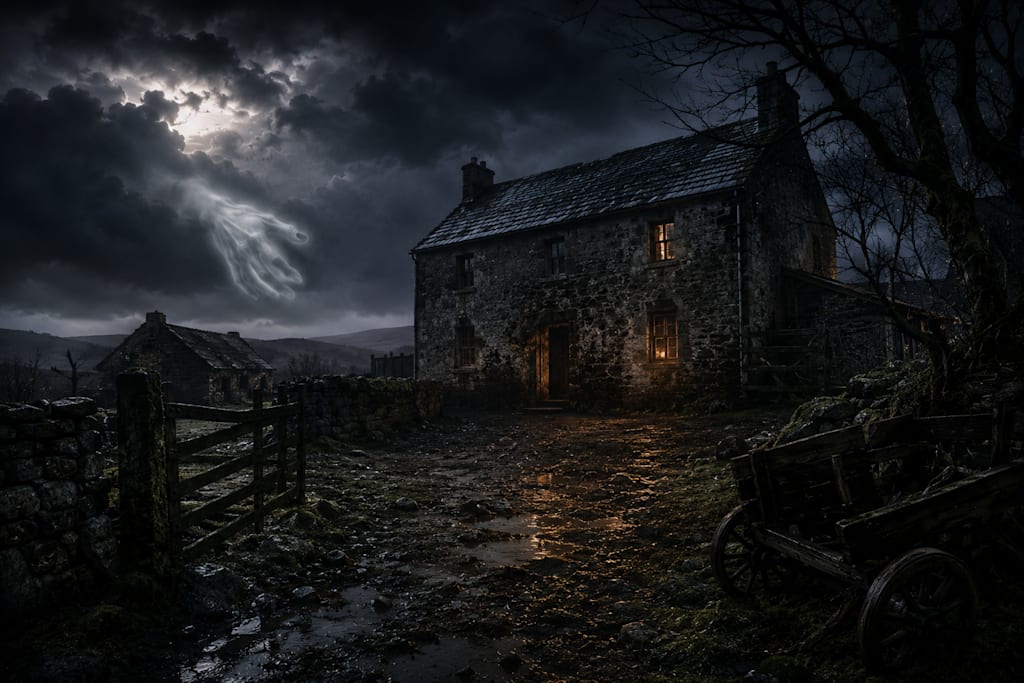
It began with the animals...
In February 1695, on a lonely farm in southwest Scotland, Andrew Mackie discovered that some of his young cattle had somehow gotten loose during the night. There was nothing supernatural about that. Animals break restraints. So Mackie secured them again. The bindings were broken again. He made them stronger. Still they broke. Finally, Mackie began to suspect that something other than unruly livestock was responsible. He moved the animals elsewhere.
Then one of them was discovered tethered tightly against the back of the house, its feet barely touching the ground. The animal was unharmed. But someone, or something, had apparently put it there. And that was only the beginning.
Andrew Mackie was a mason and farmer living with his wife and children at a place called Ring-Croft of Stocking, in the parish of Rerrick in Kirkcudbrightshire, Galloway. We know about the extraordinary events supposedly occurring inside his home because his local minister, Alexander Telfair, wrote them down while the affair was still fresh.
Telfair's account would be published in Edinburgh in 1696 under the formidable title: 'A True Relation of an Apparition, Expressions and Actings, of a Spirit, which Infested the House of Andrew Mackie.' The title leaves little doubt about what Telfair believed was responsible. But before deciding what happened at Ringcroft, we should return to the farmhouse. Because after the animals came the fire.
One night, while the Mackie family slept, a quantity of peat was apparently gathered together in the middle of the floor and ignited. Smoke awakened the family before the house could burn. No intruder was seen.
Soon afterward, on March 7th, stones began flying through the house. No one could determine where they were coming from. The strange attacks continued, and Andrew Mackie finally approached his minister. Alexander Telfair could easily have remained safely outside the story. He didn't. Telfair visited Ringcroft himself.
At first, nothing remarkable happened while he prayed inside the house. Later, however, he saw stones fall outside and learned that the activity indoors had intensified. He went back inside. Stones were thrown. Some struck him. Telfair returned on another occasion and stayed for much of the night.
This time, according to his own account, the disturbances became considerably more personal. Objects were thrown at him. Something he could not see struck him sharply on his sides and shoulders with what felt like a large staff. Telfair claimed the blows were loud enough for others in the room to hear.
Something rapped against chests and boards. Then, while Telfair was praying and leaning against a bedside, he felt pressure moving upward along his arm. The minister looked down. He later claimed that he saw a small white hand and forearm. Nothing above the elbow. Then it disappeared.
This is where the Ringcroft story becomes something considerably more interesting than another old Scottish ghost tale. Telfair wasn't writing centuries later. He wasn't collecting a legend about a ruined castle. He claimed he had been there. And other people began coming to Ringcroft as well. The activity supposedly escalated...
Visitors were pelted with stones. People claimed to have been struck with staffs. Mackie reportedly received a wound to his brow and later felt something grab him by the hair so violently that he thought fingernails scratched his scalp. Others said they were pulled around by their clothing. A miller named John Keige reportedly cried for help when something seized his side.
At night, bedclothes were pulled from the Mackie children. A door bar and other objects allegedly moved through the house without anyone visibly carrying them. Then the thing began making sounds. It rattled against chests and bedsteads, and it whistled. During prayer it reportedly produced repeated noises resembling "wisht, wisht," so distinctly that the household dog barked and ran toward the door.
By early April, the affair had become serious enough that additional ministers were brought into it. Two of them, Andrew Ewart of Kells and John Murdo of Crossmichael, came to Ringcroft and spent the night fasting and praying. Whatever was happening did not politely stop for the clergy.
According to Telfair's account, stones were hurled through the house, some remarkably large. Ewart was reportedly struck in the head twice, hard enough to draw blood. His wig was pulled off during prayer. When he held a napkin between his hands, a stone supposedly landed inside it and knocked it away. Murdo was struck as well. A burning piece of peat was thrown among the people gathered in the house. At dawn, another barrage of stones reportedly descended upon them.
The following day, straw in the barnyard caught fire. Then Mrs. Mackie noticed something peculiar beneath a loose stone near the house. On April 6th, she lifted it. Underneath, according to the account, she discovered seven small bones wrapped in old paper, accompanied by what appeared to be fresh blood and flesh.
Terrified, she put everything back and ran for help. And while she was away, Ringcroft supposedly erupted. Stones were flying this way and that. Balls of fire suddenly appeared. A fiery hot stone landed in the children's bed and burned through the bedclothes. More than an hour later, a local landowner named Charles MacLellan reportedly found the stone still too hot to hold comfortably. A staff was said to have thrust through the wall above the children's bed.
Then MacLellan removed the mysterious bones. And for a time, the disturbances stopped. But then shortly returned. A blacksmith was struck on the head. A plow component was thrown. Another heavy stone reportedly struck him without causing the injuries one might expect. The house was allegedly set alight twice. And yet, somehow, Ringcroft remained standing.
Reading the account more than three centuries later produces a peculiar feeling. Because this does not read like the restrained report of a modern investigator. It reads like utter chaos:
Stones.
Fire.
Whistles.
Invisible blows.
Moving objects.
Mysterious bones.
And one small white hand appearing beside a praying minister.
But the historical setting matters enormously. Scotland in 1695 was a society in which belief in Satan, witchcraft, providence and supernatural intervention was embedded deeply within the religious worldview. The Scottish witch hunts were not some remote medieval memory. People were still being prosecuted for witchcraft during this period.
Alexander Telfair therefore did not approach Ringcroft with the assumptions of a twenty-first-century investigator. He believed evil spirits existed. His interpretation of events reflected that belief.
Rumors also circulated about the Mackie family and possible explanations for the disturbances. One claimed Andrew Mackie had somehow promised his first child to the Devil when learning a mason's secret. Telfair himself rejected that allegation, defending Mackie's character and saying he had been reliably informed the story was false. Other suspicions involved objects associated with previous occupants.
The remarkable thing is that Telfair did not accept every supernatural rumor merely because it was supernatural. He tried, within the limits of his own worldview, to distinguish rumor from what he considered reliable testimony. That does not make his conclusions correct. But it makes the document considerably more interesting. And then there are the witnesses...
Telfair's account was not presented simply as one minister's private recollection. Other named people attested to incidents, including ministers, neighbors and landowners. That fact is frequently invoked in paranormal retellings, as though multiple signatures would transform a supernatural claim into scientific evidence. They do not. People can misinterpret events. Eyewitnesses can be mistaken. Groups can reinforce one another's expectations. People can exaggerate. And people can lie. Fraud must remain a serious possibility.
Perhaps someone within or around the Mackie household engineered at least some of the disturbances. Children have been suggested by later commentators. Practical joking, trickery and escalating community hysteria could potentially explain portions of the story.
And once people expected stones to fly, fires to appear and invisible attackers to strike, ambiguous events may have acquired supernatural meanings almost automatically. But there is a problem within that hypothesis. Simply saying "hoax" does not reconstruct the hoax. If Telfair's account is even broadly accurate, somebody would have needed to create phenomena while visitors were actively watching for deception.
Who?... How?... Were the ministers fooled? Were some witnesses participants? Were later accounts exaggerated? Did several unrelated ordinary events become woven into one supernatural narrative? Did Telfair misunderstand what he saw? Was the little white hand an illusion in poor seventeenth-century lighting?
These are reasonable questions. We simply do not have sufficient evidence to answer them. And that is precisely why Ringcroft remains fascinating. We do not possess proof that a poltergeist terrorized Andrew Mackie's family in 1695. What we possess is something different. A historical record indicating that people reported extraordinary events there. Some attached their names to those claims. A minister claimed that he personally experienced them. And within a year, the story had been committed to print.
More than three centuries later, the little farmhouse is no longer the point. Neither are the stones, or the fires. Or even the pale hand that Alexander Telfair claimed appeared beside him while he prayed. The unsettling thing is the document. Because paper survives long after witnesses can no longer be questioned. The men and women of Ringcroft are gone. We cannot separate them and interview them. We cannot examine the stones. We cannot inspect the farmhouse. We cannot reproduce the lighting. We cannot place cameras in the rooms or test the walls for hidden openings. History has closed the crime scene to us. All that remains is testimony. And that is a very powerful indicator. Given the time, it would have been social suicide to sign one's name to a documented haunting. They must have believed these events occurred with great intensity.
Somewhere in Galloway in 1695, something happened around the household of Andrew Mackie. Perhaps it was an elaborate fraud. Perhaps frightened people interpreted ordinary events through the lens of extraordinary beliefs. Perhaps several explanations were involved. Or perhaps the witnesses encountered something genuinely otherworldly that they could not understand.
Alexander Telfair believed he knew. He called it a spirit. We have the luxury of being less certain. But before dismissing the Ringcroft haunting, there is one uncomfortable fact worth remembering. Telfair and the others lived much closer to those events than we ever will. They knew people would doubt them. They knew how extraordinary their claims sounded. And still... they put their names beneath the story.
More than three hundred years later, those names remain. So does the question: What really happened at Ringcroft of Stocking? We will probably never get an answer, but whatever it was, it disappeared with the people who were there. And somewhere between what they witnessed, what they believed, and what they wrote down... the truth once again, slipped quietly behind the Veil of Shadows...
About the Creator
Veil of Shadows
Ghost towns, lost agents, unsolved vanishings, and whispers from the dark. New anomalies every Monday and Friday. The veil is thinner than you think....
Enjoyed the story? Support the Creator.
Subscribe for free to receive all their stories in your feed.
Comments
There are no comments for this story
Be the first to respond and start the conversation.