
The Photograph That Blinked
The old photograph on her wall had five people in it. This morning, she counted six — and the new one was standing right behind her.

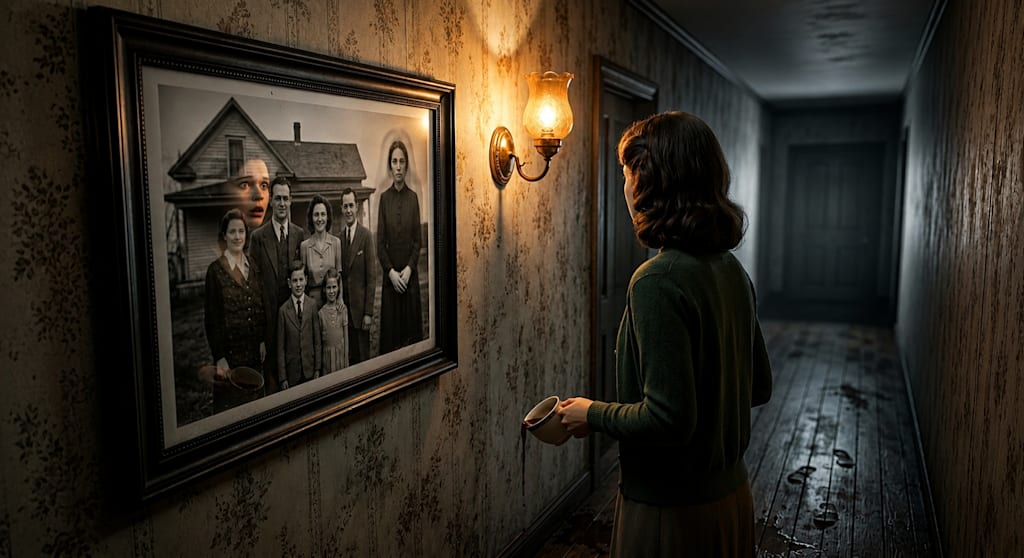
Elena had inherited the house the same way she had inherited everything from her grandmother — without warning and without explanation. The will was simple. One page. One line that mattered: "The house on Mercer Lane belongs to Elena. She will know what to do." She did not know what to do. But she moved in anyway, because she was twenty-six and broke and the rent in the city had become a kind of slow financial violence she could no longer afford. The house was old — creaking floors, wallpaper that had once been floral and was now just beige suggestions of flowers, radiators that clanked like something trapped inside them was trying to get out. It felt, from the first night, like the house was watching her settle in. She didn't mind. She liked old things. She liked the weight of history in rooms, the way a worn armchair held the shape of someone who was gone. It felt like company. The photograph was in the hallway. Black and white, framed in dark wood, hung at eye level as though placed specifically for someone of her height. Five people standing in front of the house — this house, she realized, recognizing the front porch — dressed in clothes that suggested the 1940s. Two older adults, three younger. All of them unsmiling, the way people never smiled in old photographs, as though joy was something too private for a camera to witness. She had studied it carefully her first night, drawn to it in the way you are drawn to something you cannot fully explain. Five people. She counted twice. She went to bed, slept badly, and woke to grey November light pressing against the curtains. She made coffee. She walked the hallway. She stopped. She turned slowly and looked at the photograph. Six people. Her coffee cup hit the floor. She stood there, bare feet in a puddle of lukewarm coffee, and stared. The new figure stood at the back of the group — slightly taller than the others, slightly out of focus in a way that felt deliberate rather than accidental, the way you might blur a face in a photograph you didn't want identified. The figure wore dark clothing. The figure's hands were visible at its sides — long fingers, very still. The figure was standing directly behind the woman on the far right. Elena leaned closer. The woman on the far right had her grandmother's jawline. Her grandmother's posture — that particular way of holding the shoulders, slightly raised, like she was perpetually bracing for something. Elena straightened up and took three steps back. She pulled out her phone and took a photo of the photograph. She zoomed in on the new figure in the back. The face was blurred — but not entirely. She could make out the outline of features. The suggestion of eyes. The pale curve of a jaw. She enhanced the image as much as her phone would allow and then sat down on the hallway floor with her back against the wall because her legs had decided they were finished standing. The face in the photograph was hers. Not similar. Not a resemblance. Hers — her exact face, her eyes, the small scar on her left cheekbone from a bicycle accident at age nine. Her face, in a photograph taken eighty years before she was born, standing behind her grandmother, in clothing she did not own, with an expression she did not recognize on herself — because it was utterly calm. Because it looked like a face that had been there a very long time and intended to stay. She called the only person she could think to call — her mother. Her mother picked up, heard the trembling in Elena's voice, and was quiet for a moment before she said: "She told me this would happen." "What?" Elena whispered. "Your grandmother. She said that when you moved into the house, you would find the photograph. She said—" her mother stopped. Elena heard her exhale slowly. "She said to tell you not to be afraid. She said the house shows people who belong to it. People who have always belonged to it." "Mom," Elena said, her voice barely holding together, "I'm in a photograph from 1944." A long silence. "I know," her mother said quietly. "So was she. Elena — check the photograph again. Count the figures." Elena looked up at the photograph on the wall. Seven people now. The newest one stood directly behind her. She turned around. The hallway was empty. But on the floor behind her, in the spilled coffee she had not cleaned up, there were two footprints — facing her, perfectly still, leading from nowhere. Like someone had been standing there, very close, for a very long time.
About the Creator
Noman Afridi
I’m Noman Afridi — welcome, all friends! I write horror & thought-provoking stories: mysteries of the unseen, real reflections, and emotional truths. With sincerity in every word. InshaAllah.
Enjoyed the story? Support the Creator.
Subscribe for free to receive all their stories in your feed.
Comments
There are no comments for this story
Be the first to respond and start the conversation.