
The Phantom Raid of Dieppe
Battle reenactments from the other side...

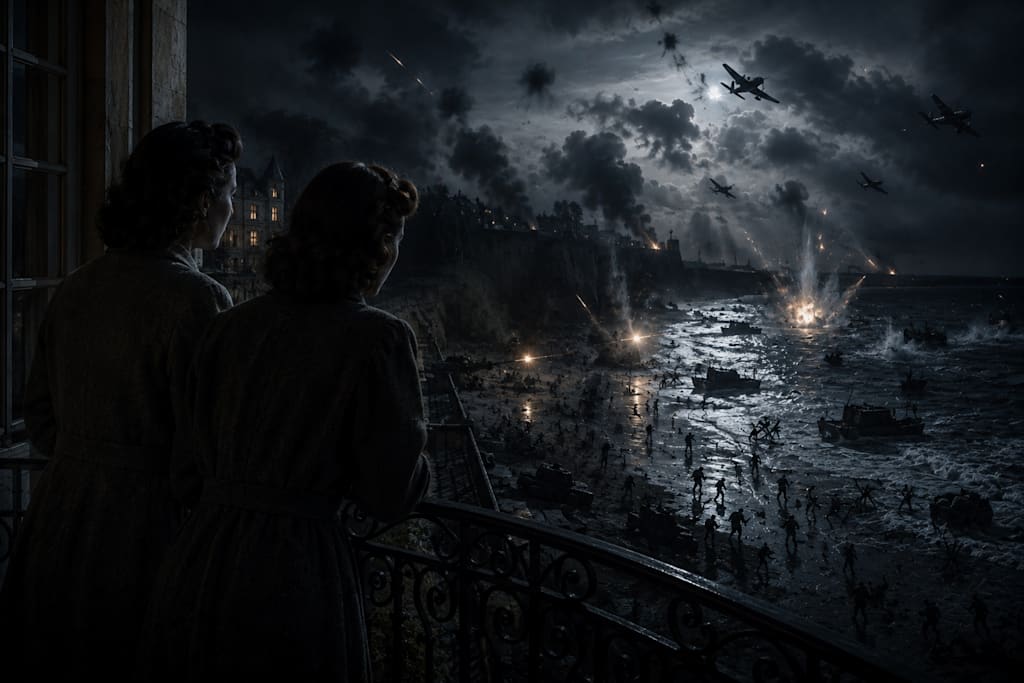
At first, it sounded like thunder...
It was shortly after four o’clock in the morning on August 4, 1951, near the French coastal town of Dieppe. The beach below lay in darkness. The English Channel stretched beyond it. Nine years had passed since one of the most disastrous Allied operations of the Second World War had exploded across this coastline.
That war was over. The soldiers were gone. The guns were silent. But two British women staying near the beach were about to claim that, for one extraordinary morning, the silence ended.
One of the women awakened to a tremendous noise outside. She listened. This was no ordinary storm. There were explosions. Gunfire. Aircraft engines. Men shouting. The second woman was awakened. Together they listened as the impossible battle continued somewhere beyond their room.
Eventually they went onto the balcony and looked toward the coast. There was no battle. No attacking army. No soldiers running across the beach. No aircraft plunging toward German positions. Nothing that could possibly explain the scale of what they believed they were hearing.
And so, while the noises continued, the women did something remarkably important. They watched the clock. They recorded the times. Only later would those notes be compared with the chronology of a real battle fought on those beaches nine years earlier. And that is where the mystery of the Phantom Raid of Dieppe begins.
But to understand what the women believed they heard in 1951, we first have to return to a morning when the guns were real.
August 19, 1942
The operation was called Jubilee. The objective was Dieppe, a German-occupied port on the northern coast of France. Nearly 5,000 Canadian troops formed the bulk of the assault force, accompanied by British commandos and a small number of American Rangers. Tanks would be landed. Aircraft would battle overhead. Naval vessels would support the attack.
The Allies hoped to seize the port temporarily, destroy important installations, gather intelligence, and learn lessons about launching a major amphibious assault against occupied Europe. Instead, Dieppe became a catastrophe.
Before dawn on August 19, landing craft approached several beaches along the coast. At Puys, immediately east of Dieppe, men of the Royal Regiment of Canada were supposed to land under cover of darkness. They arrived late. The sky was brightening. German defenders occupied commanding positions overlooking a narrow beach trapped between the sea and a high seawall.
At approximately 5:06 in the morning, the Canadians began coming ashore. They were met by devastating fire. Machine guns swept the beach. Mortars and artillery struck the landing area. Men desperately attempted to cross open ground and reach the seawall. Some never made it. Those who did found themselves pinned beneath German positions with few options for escape.
Elsewhere around Dieppe, the situation deteriorated with terrifying speed. Aircraft screamed overhead. Naval guns fired from offshore. Landing craft moved toward beaches already covered by enemy fire. Tanks struggled across the shingle. Communications failed. Units became trapped. Orders were confused. Men were killed, wounded, or captured.
Within hours, Operation Jubilee was effectively finished. Of the 4,963 Canadians who embarked for Dieppe, only 2,210 returned to England. More than 900 Canadians died, and nearly 2,000 were taken prisoner. At Puys alone, the Royal Regiment of Canada suffered horrifying losses.
Then the survivors left. The dead were buried. The war continued. Three years later, Germany surrendered. Life returned to the French coast. The beaches became beaches again. And nine years after Operation Jubilee, two women came to stay near Puys.
August 4, 1951
Accounts of the incident identify the women under names used in later psychical research literature, commonly Dorothy and Agnes. They were not completely ignorant of what had happened at Dieppe. That is important. They knew a wartime raid had taken place there, and during their experience they apparently consulted a guidebook containing information about it.
Anyone presenting this story as two unsuspecting tourists who had never heard of the Dieppe Raid until after their strange encounter is giving the mystery an unnecessary coat of paranormal paint. The real story does not need it. Because shortly before dawn on August 4, the women reported hearing something they could not explain.
The first major noises were recorded at approximately 4:20 a.m. They described sounds suggesting distant military activity, explosions, gunfire, and aircraft. Then came voices. Shouting. Cries apparently coming from men somewhere beyond the house. Yet when the women looked outside, there was no visible battle to match what they had heard.
Around 4:50, the sounds diminished. Then, at approximately 5:05 or shortly afterward, the activity reportedly intensified again. More gunfire. More explosions. More aircraft. Another lull came around 5:40. At approximately 5:50, the sounds resumed, with aircraft becoming especially noticeable. By around 6:20, the apparent battle seemed to be moving farther away. Shortly before seven... it stopped.
The morning became ordinary again. No ruined army lay on the beach. No bombers disappeared across the Channel. No soldiers emerged from the darkness. Whatever the women had heard was gone. And strangely, other people staying in the house apparently had not been awakened by it.
That alone might have left the incident as nothing more than a peculiar vacation story. But the women had recorded the progression. Those notes eventually attracted the attention of investigators associated with the Society for Psychical Research.
In 1952, G. W. Lambert and Kathleen Gray published an examination of the experience in the Society for Psychical Research’s journal under a deliberately cautious title: “The Dieppe Raid Case: A Collective Auditory Hallucination.” The investigators compared aspects of the women’s chronology with records of the 1942 operation, and they found correspondences they considered intriguing.
One is particularly difficult to ignore when first encountered. The women recorded renewed activity between approximately 5:05 and 5:07. Nine years earlier, the Royal Regiment of Canada’s landing at Puys had begun at approximately 5:06. Other reported changes in the sounds were compared with phases of the historical operation, including periods of aircraft activity and shifts in the fighting.
Over the decades, paranormal retellings sharpened this into a much more dramatic claim: the women’s notes supposedly matched the official military record exactly, minute by minute. That goes further than the evidence justifies. There were interesting correspondences. That is not the same as demonstrating a perfect chronological replay of Operation Jubilee. And the distinction matters.
Because there are substantial reasons for skepticism. The women already knew about the Dieppe Raid. They had access to information about it. They were staying beside the battlefield. Ordinary sounds could have been interpreted through that knowledge. The Channel coast is not silent. Aircraft pass overhead. Ships operate offshore. Waves strike the beach. Machinery carries across water. Under unusual atmospheric conditions, distant noises can travel surprisingly far.
Add darkness, fatigue, and the peculiar state between sleep and complete wakefulness, and ordinary sounds can become remarkably difficult to identify. Once one person says, “That sounds like gunfire,” another sound may be mistaken for an aircraft. A crash becomes artillery. Distant voices become soldiers. Expectation begins constructing a narrative. There was even discussion of possible dredging or maritime activity that may have contributed to what the women heard.
And there is another complication. One of the women reportedly experienced a weaker episode several days earlier, hearing sounds resembling distant gunfire, shelling, aircraft, and cries. The other woman slept through it. She apparently wasn’t told about the first experience before the larger event on August 4. If accurately reported, that makes simple mutual suggestion less satisfying as a complete explanation. But it does not establish anything supernatural. Perhaps one woman misidentified ordinary noises twice. Perhaps the second woman was influenced during the later episode without realizing it. Perhaps atmospheric conditions produced genuinely unusual sounds from distant human activity. Perhaps memory and later investigation sharpened coincidences that originally were much less precise.
There is also a deeper problem common to almost every historical paranormal case. We are examining the experience through layers: the event, the women’s recollections and notes, the investigators, the published paper, subsequent analysis, and, finally, decades of retelling. Every layer provides another opportunity for uncertainty to become certainty and coincidence to become correspondence.
So what happened at Puys? The paranormal interpretation is extraordinary. According to that possibility, the women somehow experienced an auditory fragment of the past—a battle replaying itself without visible participants. Modern paranormal folklore sometimes calls such phenomena “residual hauntings”: events supposedly impressed upon a location and later replayed without conscious spirits being involved. A related idea, sometimes called the “stone tape” theory, posits that environments somehow record emotionally intense events. There is no established scientific mechanism demonstrating that buildings, landscapes, or beaches can record human experiences and replay them years later.
But the Dieppe case remains associated with the idea because of one profoundly unsettling characteristic: nothing seemed to be communicating with the women. No ghost appeared. No dead soldier asked for help. No apparition crossed the beach. The women claimed only that they could hear something that should no longer have existed. Their eyes were in 1951. Their ears seemed to be somewhere else.
Perhaps the explanation was entirely ordinary. Maybe aircraft, surf, and distant machinery combined into an extraordinary acoustic illusion. Perhaps knowledge of the battle supplied the missing pieces. Maybe two tired minds standing in darkness transformed unrelated sounds into a war that had ended years earlier. Human perception is capable of astonishing mistakes.
But that explanation leaves us with an image almost as strange as the paranormal one. Two women standing on a balcony before sunrise, listening intently to an invisible battle while recording the time. Below them lay Puys. Quiet. Empty. Nine years earlier, it had been anything but quiet. Men had screamed there. Machine guns had fired. Aircraft had roared overhead. Explosions had shaken the ground. Young soldiers had desperately searched for shelter while friends fell beside them. Hundreds had wished for only one thing: for the guns to stop.
Eventually they did. Years passed. The war ended. And Puys became peaceful again. Then, on one August morning in 1951, two women claimed that the silence had broken.
Perhaps the past did not return. Perhaps nothing supernatural happened at all. But for roughly two and a half hours, Dorothy and Agnes believed they were listening to something no longer there. They wrote down the times. Investigators studied them. Historians could identify curious correspondences. And more than seventy years later, we still cannot stand beside those women on the balcony and hear what they heard.
Today, the Channel continues rolling toward the same shore. Wind crosses the beach. Aircraft still pass overhead. And the battlefield is silent. As it should be. But somewhere between 4:20 and seven o’clock on the morning of August 4, 1951, two witnesses insisted that the sounds of war returned to Puys. Maybe ordinary noises became extraordinary in the darkness. Maybe memory completed a pattern that coincidence began. Or maybe, for reasons we do not understand, two women briefly heard an echo from one terrible morning that history had already buried.
Whatever happened, when the sun rose over Dieppe, the beach was empty. The guns were silent. And whatever the women had heard had vanished once again... behind the Veil of Shadows.
About the Creator
Veil of Shadows
Ghost towns, lost agents, unsolved vanishings, and whispers from the dark. New anomalies every Monday and Friday. The veil is thinner than you think....
Enjoyed the story? Support the Creator.
Subscribe for free to receive all their stories in your feed.
Comments
There are no comments for this story
Be the first to respond and start the conversation.