
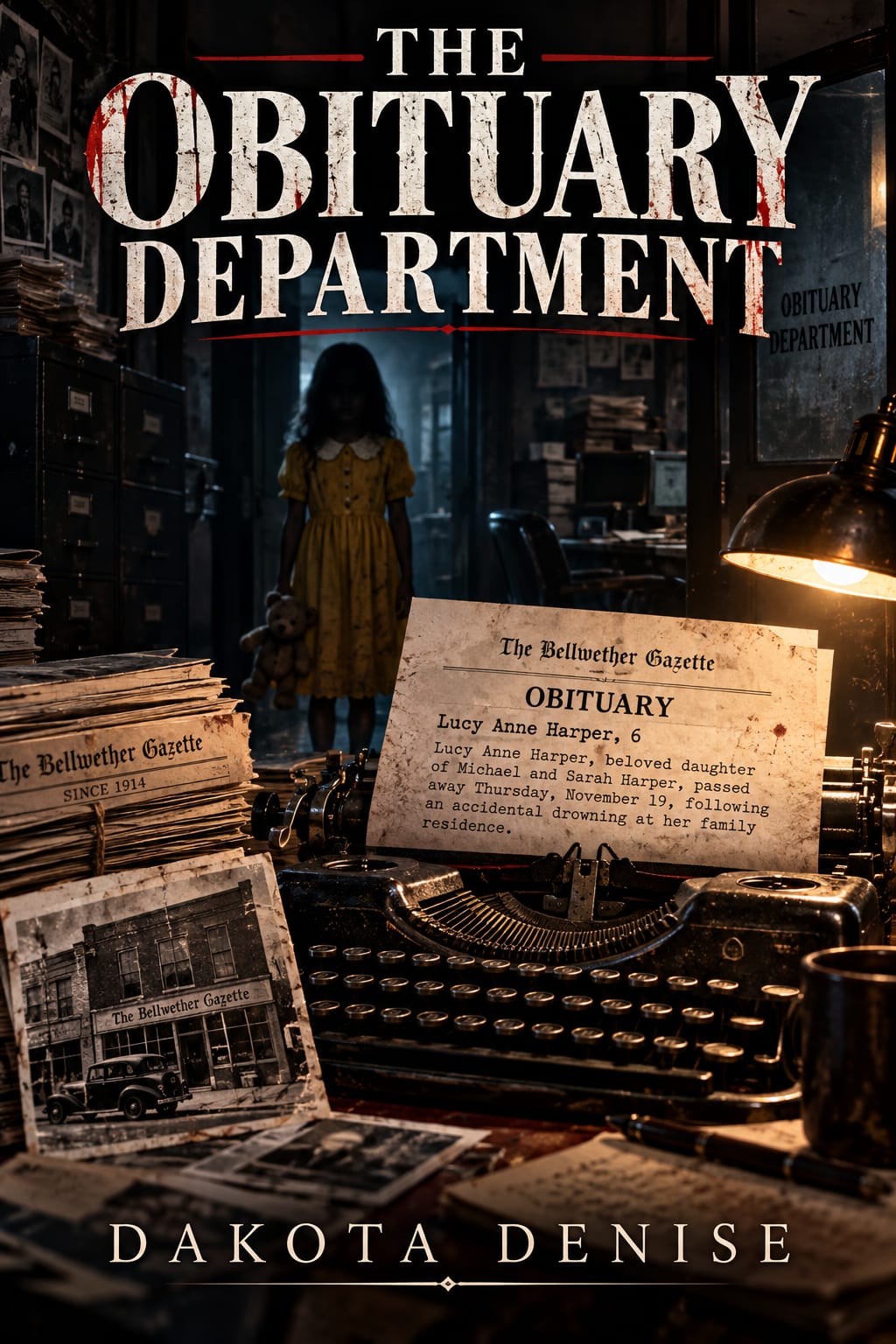
THE OBITUARY DEPARTMENT
Every Thursday, the newspaper publishes an obituary for someone who isn't dead yet.

The first time I seen an obituary for someone who was still alive, I thought it was a clerical error.
By the fourth funeral, I stopped believing in mistakes.
By the eleventh, I understood that somebody at the newspaper knew exactly what was happening.
And by the twelfth, I had made the kind of mistake that couldn't be corrected with a retraction.
But I'm getting ahead of myself.
My name is Evelyn Mercer. I was thirty-four when I accepted the position of obituary editor at the Bellwether Gazette, a small-town newspaper in northern Pennsylvania.
The position paid $42,000 a year, offered terrible health insurance, and came with an office that smelled like wet cardboard.
It was perfect.
I'd spent nearly a decade working for larger publications, chasing deadlines, interviewing grieving families, and pretending journalism hadn't become an exhausting competition to see who could publish the worst news first.
Obituaries were different.
People died. Families submitted photographs. I checked dates, corrected spelling, and made sure nobody accidentally listed an ex-wife as the surviving spouse.
It was quiet work.
Predictable work.
Or at least that's what I believed until Thursday, September 3.
At 6:17 that morning, an obituary appeared in our publishing system.
MARGARET ELAINE WHITCOMB, 67
Margaret Elaine Whitcomb, beloved mother of three and longtime resident of Bellwether, passed away peacefully on Thursday, September 3, following complications from a fall in her home.
There was nothing particularly unusual about the obituary.
Except Margaret Whitcomb hadn't died.
I knew this because I'd spoken to her the previous afternoon.
She'd called to complain about a photograph we'd published of the annual church picnic. Apparently, she'd been caught mid-bite eating a hot dog, and she wanted to know why the photographer couldn't have waited until she'd finished chewing.
I remembered her exact words.
"Young lady, I've lived sixty-seven years without looking like a starving raccoon in public, and I don't intend to start now."
I checked the obituary again.
Then I checked the submission history.
No sender.
No email address.
No payment information.
The article had been entered directly into our publishing system, bypassing the usual approval process.
And it was already live.
I immediately called Margaret.
She answered on the fourth ring.
"Bellwether Gazette."
"Mrs. Whitcomb? This is Evelyn Mercer."
"If this is about that photograph, I already told your editor"
"Ma'am, are you all right?"
A pause.
"What kind of question is that?"
I explained that an obituary had appeared under her name.
She laughed.
Then she stopped laughing.
"Well, somebody better take that down before my children see it."
I apologized, removed the article, and reported the incident to my supervisor, Thomas Bell.
Thomas had worked at the Gazette for thirty-one years. He was a thin, gray-haired man who wore the same brown cardigan every Thursday and kept a framed photograph of the newspaper's original building behind his desk.
When I told him what had happened, he didn't look surprised.
He looked frightened.
"Did you publish it?" he asked.
"No. It was already published when I logged in."
"Did you remove it?"
"Of course."
His fingers tightened around his coffee mug.
"You shouldn't have done that."
I stared at him.
"Thomas, we published an obituary for a living woman."
"I understand."
"Then why shouldn't I have removed it?"
He looked toward the window.
"Because now she'll have to be entered again."
I waited for an explanation.
None came.
That evening, Margaret Whitcomb fell down the basement stairs while carrying a basket of laundry.
Her daughter found her shortly after nine.
The medical examiner attributed her death to injuries sustained in the fall.
The following morning, her family submitted an obituary.
It was identical to the one I'd deleted.
Every word.
Including a sentence about her youngest grandson's upcoming graduation that her daughter said she had written herself.
I told Thomas.
He closed his office door.
"Accidents happen, Evelyn."
"Not like this."
"Go home."
And that was the end of our conversation.
At least until the following Thursday.
The second obituary appeared at 6:17 a.m.
DANIEL ROBERT FOSTER, 41
Daniel Robert Foster passed away Thursday, September 10, following a single-vehicle collision on Route 19.
Daniel Foster was a mechanic.
He was married, had two teenage sons, and owned a blue Ford pickup.
I called the garage listed in our business directory.
Daniel answered.
He sounded irritated when I asked whether he planned to drive on Route 19 that day.
"Lady, I drive that road every damn day."
I told him about the obituary.
He accused me of playing a sick joke.
I begged him to stay home.
He hung up.
At 4:32 that afternoon, his truck crossed the centerline on Route 19 and struck a concrete barrier.
The police report said he'd suffered a sudden medical emergency while driving.
He died before the ambulance arrived.
That night, I searched the publishing system for the original obituary.
It was gone.
Not deleted.
Not archived.
Gone.
The audit log contained no record of its existence.
When I checked my own handwritten notes, however, the words were still there.
I hadn't imagined anything.
Someone was publishing the future.
And the future was killing people.
By the fourth Thursday, I'd stopped sleeping.
The third obituary belonged to a retired schoolteacher named Walter Briggs. He died of a stroke in his garden.
The fourth belonged to a twenty-nine-year-old waitress named Amanda Ruiz.
Her obituary said she'd die in a kitchen fire.
I called the restaurant where she worked and begged her to leave.
She did.
At 8:14 that evening, a fire broke out in her apartment building.
Amanda went back inside for her cat.
Neither survived.
That was when I realized something important.
The obituaries weren't predicting where people would die.
They were predicting that they would.
And changing the circumstances didn't necessarily change the outcome.
I began keeping records.
Dates. Names. Ages. Causes of death.
I printed screenshots of every obituary before they disappeared. I saved them to an external drive, photographed my computer screen, and mailed copies to myself.
I even took one to the police.
Detective Nathan Cole listened patiently while I explained what was happening.
Then he asked whether I'd been sleeping.
I hated him immediately.
"Four people are dead," I said.
"People die every day, Ms. Mercer."
"Not after somebody publishes their obituary twelve hours early."
He studied the photographs.
"Could somebody be threatening these people?"
"With what? A stroke? A car accident?"
"That's what I'm trying to determine."
He promised to investigate.
Three days later, he called to say there was no evidence of criminal activity.
He suggested I take some time off.
I suggested he go to hell.
Neither of us followed the other's advice.
On the sixth Thursday, the obituary named a woman who was already dying.
Her name was Helen Sutter.
Eighty-nine years old. Terminal cancer. Receiving hospice care at home.
I called her daughter.
She confirmed that Helen was still alive, although doctors didn't expect her to survive the week.
I almost felt relieved.
Maybe the system was somehow pulling information from medical records.
Maybe somebody had developed an algorithm capable of predicting death.
Maybe there was a rational explanation.
Then Helen's daughter told me something that made my stomach tighten.
"Mom's been talking about the newspaper."
"What about it?"
"She keeps saying they printed her name too early."
I asked whether I could speak with Helen.
Her daughter hesitated.
Then she handed over the phone.
For several seconds, all I heard was breathing.
"Mrs. Sutter?"
A weak voice answered.
"You're the new girl."
I sat up.
"Excuse me?"
"At the newspaper."
"Yes."
"Did they tell you about the Thursdays?"
My mouth went dry.
"Who?"
"The people downstairs."
"Mrs. Sutter, what people?"
She began coughing.
I waited.
When she spoke again, her voice was barely audible.
"Don't let them finish the page."
The line went dead.
Helen Sutter passed away at 11:46 that night.
Her daughter later told me the phone had slipped from her mother's hand.
I didn't tell her what Helen had said.
I didn't know how.
The Bellwether Gazette had been established in 1914 by a man named Arthur Bell.
His portrait hung in the lobby, directly beneath the newspaper's original masthead.
According to the town historical society, Arthur was a respected publisher, a generous philanthropist, and a devoted husband.
According to the old newspapers, he was also a man who rarely smiled.
I started spending my lunch breaks in the basement archives.
The Gazette had digitized most of its records, but several early editions remained on microfilm.
I searched for Thursday obituaries.
At first, I found nothing.
Then I noticed something strange.
Every year, beginning in 1914, there were missing Thursday editions.
Not every Thursday.
Just certain ones.
Sometimes one a month.
Sometimes several.
And every missing edition had been published on a date corresponding to an unexplained death in the town's historical records.
I showed Thomas.
He stared at the list for a long time.
Then he asked me to sit down.
"How much do you know about Arthur Bell?"
"Not much."
"He founded this newspaper after his daughter died."
I glanced toward the portrait on his wall.
"I thought he had no children."
"That's what the official history says."
"Why?"
Thomas removed his glasses.
"Because some stories are easier to live with when nobody remembers them."
He told me Arthur's daughter, Eleanor, had been six years old when she drowned in the river behind the original newspaper building.
Her body was never recovered.
Arthur's wife died two years later.
Afterward, Arthur became obsessed with the idea that death could be negotiated.
He attended séances. Consulted spiritualists. Paid enormous sums to people who claimed they could communicate with the dead.
Eventually, he stopped attending church.
He stopped speaking to friends.
And he began working every Thursday night in the newspaper's basement.
"What was he doing?" I asked.
Thomas shook his head.
"Nobody knows."
"Then why are you telling me this?"
"Because you're asking questions that other people learned not to ask."
I leaned forward.
"Thomas, did you know about the obituaries before I started?"
He looked at his hands.
"Yes."
"How long?"
"Since my first Thursday."
I stood so quickly my chair struck the wall.
"You knew people were going to die?"
"I knew their names appeared."
"And you did nothing?"
He looked up.
"What would you have done?"
I opened my mouth.
Then closed it.
I'd called people.
I'd warned them.
I'd contacted the police.
And every single one of them had died anyway.
Thomas lowered his voice.
"The Gazette has had twenty-three obituary editors since Arthur Bell died. Some stayed for decades. Others lasted a week."
"What happened to them?"
"Most resigned."
"Most?"
He didn't answer.
I left his office.
And for the first time since accepting the job, I seriously considered never returning.
The eleventh obituary appeared on November 12.
ROBERT MICHAEL HAYES, 52
Robert Michael Hayes, devoted husband and father, passed away Thursday evening following complications from a ruptured cerebral aneurysm.
Robert was a local pharmacist.
His wife answered when I called.
I told her everything.
Not the shortened version I'd given the others.
Everything.
The Thursday obituaries.
The deaths.
The missing archives.
Arthur Bell.
She listened without interrupting.
Then she said, "I'm taking him to the hospital."
At 10:18 that morning, Robert Hayes was admitted for observation.
Doctors performed neurological examinations and imaging studies.
They found nothing immediately life-threatening.
At 7:05 p.m., Robert was speaking with his wife when he suddenly complained of the worst headache of his life.
He lost consciousness minutes later.
Despite emergency treatment, he died at 11:38.
His wife called me from the hospital.
She didn't scream.
She didn't accuse me of anything.
She simply asked one question.
"How did you know?"
I had no answer.
After we hung up, I sat in my apartment staring at the eleven names I'd written on my kitchen wall.
Eleven Thursdays.
Eleven deaths.
Eleven families who had no idea their loved ones had been marked for death before breakfast.
And then I noticed something I'd overlooked.
Every obituary had included the same phrase somewhere in the text.
Sometimes near the beginning.
Sometimes buried in the final paragraph.
Forever remembered.
It was an ordinary expression.
The kind people used in obituaries every day.
But when I checked the original submissions, those words hadn't always come from the families.
They'd been inserted automatically.
I searched the publishing system for the phrase.
The search returned one result.
A file named:
FINAL_EDITION_1914
I clicked it.
The screen went black.
Then a message appeared.
Unauthorized access.
A second message followed.
The twelfth entry must not be interrupted.
I stared at the screen.
Before I could take a photograph, both messages disappeared.
The computer restarted.
And when it came back on, the file was gone.
The twelfth Thursday was November 19.
I arrived at the Gazette at 5:45 a.m.
I brought coffee, a flashlight, my external drive, and a letter of resignation I'd already signed.
If another name appeared, I intended to warn the family.
Then I was leaving.
At 6:16, the publishing system froze.
The office lights flickered.
My computer screen went dark.
Then the familiar notification appeared.
NEW OBITUARY RECEIVED.
I clicked.
LUCY ANNE HARPER, 6
Lucy Anne Harper, beloved daughter of Michael and Sarah Harper, passed away Thursday, November 19, following an accidental drowning at her family residence.
For a moment, I couldn't breathe.
Six years old.
The same age as Arthur Bell's daughter.
I read the obituary three times.
Lucy attended Bellwether Elementary School.
She loved drawing butterflies, collecting smooth stones, and singing songs she made up herself.
Her favorite color was yellow.
Her parents called her Lulu.
I found their address in the public directory.
Then I called Detective Cole.
He answered on the second ring.
"Ms. Mercer?"
"There's another one."
He sighed.
"Evelyn—"
"She's six years old."
Silence.
I read him the obituary.
Then I told him about the eleven deaths.
Every date.
Every cause.
Every warning I'd made.
He listened.
When I finished, he said, "Give me the address."
By noon, the Harper residence was surrounded by police.
Lucy's parents were terrified.
Her mother cried when Detective Cole explained the situation.
Her father demanded to know whether someone had threatened their daughter.
Nobody knew what to tell him.
The family lived in a two-story house with a small backyard and an above-ground swimming pool.
The pool had already been drained for winter.
Cole ordered officers to inspect the property.
They checked the bathrooms.
The basement.
The water heater.
Every sink and faucet.
They disconnected the washing machine.
They even removed the water from the family's fish tank.
By evening, Lucy was sitting on the living room couch between her parents, surrounded by police officers who looked increasingly uncomfortable.
At 8:30, she asked for hot chocolate.
Her mother refused.
At 9:15, she asked to take a bath.
Her father nearly shouted.
At 10:00, she began crying.
"I didn't do anything wrong."
Her mother held her.
"No, baby. You didn't."
I watched from the doorway.
For the first time in eleven weeks, I felt something other than dread.
Hope.
We were going to save her.
At 11:30, Detective Cole checked every entrance again.
At 11:50, Lucy fell asleep in her mother's lap.
At 11:58, her father began counting the seconds.
I watched the clock.
11:59.
Eleven fifty-nine and thirty seconds.
Forty.
Fifty.
Fifty-five.
Midnight.
Nothing happened.
Lucy continued sleeping.
Her mother began sobbing.
Her father dropped to his knees.
Detective Cole looked at me.
And smiled.
We'd done it.
For the first time in the Gazette's history, somebody had survived their obituary.
I should have been relieved.
Instead, I noticed something.
The house had gone completely silent.
No refrigerator humming.
No wind against the windows.
No distant traffic.
Even the ticking clock had stopped.
Then Lucy opened her eyes.
She looked directly at me.
And whispered, "You shouldn't have done that."
The following morning, I returned to the Gazette.
Thomas wasn't there.
His office was locked.
His car was gone.
At 6:17, no obituary appeared.
Instead, an email arrived.
No sender.
No subject.
One sentence.
You weren't supposed to save her.
Attached was a photograph.
Black and white.
A group of newspaper employees standing outside a brick building.
The Bellwether Gazette.
1914.
Arthur Bell stood in the center, wearing a dark suit and holding a folded newspaper.
There were eight other adults.
And one little girl.
She stood at the far right, holding a rag doll.
Her hair was tied with yellow ribbons.
Her dress had a white lace collar and three small buttons down the front.
I enlarged the photograph.
My hands began shaking.
The little girl was Lucy Harper.
Not someone who resembled her.
Lucy.
The same face.
The same crooked front tooth.
The same tiny scar above her left eyebrow.
And the same yellow dress she'd worn the previous night.
I checked the photograph's caption.
The original staff of the Bellwether Gazette, photographed June 1914.
Underneath, someone had handwritten the names.
Arthur Bell.
Edmund Price.
Josephine Carter.
Samuel Reed.
The list continued.
The final name read:
Eleanor Bell.
I drove to the Harper residence.
Nobody answered.
The police cruiser that had been parked outside the previous night was gone.
I called Sarah Harper.
Disconnected.
Michael Harper.
Disconnected.
I drove to the elementary school.
The secretary told me Lucy Harper wasn't enrolled there.
"Are you sure?"
She checked again.
"Ma'am, we don't have a student by that name."
I showed her the photograph I'd taken of Lucy's school identification card the previous day.
She studied it.
Then looked at me strangely.
"Where did you get this?"
"From her parents."
She handed back my phone.
"That isn't one of our identification cards."
I returned to the Harper house.
A woman answered the door.
She was in her seventies.
She said she'd lived there for forty-three years.
She had never heard of Michael, Sarah, or Lucy Harper.
I looked past her shoulder.
The living room was different.
Different furniture.
Different curtains.
The swimming pool was gone.
I asked whether I could see the backyard.
She threatened to call the police.
I left.
Then I called Detective Cole.
"Nathan, something's wrong."
"Who is this?"
"Evelyn Mercer."
A pause.
"Can I help you?"
"The little girl. Lucy Harper. We were at her house last night."
"I think you have the wrong number."
"Nathan, you had six officers there."
"Ms. Mercer, I haven't spoken to you since September."
He hung up.
I sat in my car, staring at my phone.
The photographs were still there.
Lucy on the couch.
The police officers.
Her mother crying.
The empty swimming pool.
But when I enlarged the photographs, I noticed something impossible.
Lucy wasn't in any of them.
Where she'd been sitting, there was empty space.
Her mother's arms were wrapped around nothing.
Her father was kneeling in front of an empty couch.
And in the final photograph, the one I'd taken at midnight, every person in the room was staring at the same spot.
A spot where no child appeared.
I returned to the Gazette shortly after noon.
The building was empty.
Not temporarily empty.
Abandoned.
The front doors were chained.
Newspapers littered the sidewalk.
A notice from the county building department was taped to the glass.
PROPERTY CONDEMNED — 1998
I read it three times.
Then I walked around the building.
The rear basement entrance was partially hidden behind overgrown bushes.
The lock had rusted.
I forced it open with a tire iron from my trunk.
The smell hit me immediately.
Mold.
Rotting paper.
Something metallic.
I switched on my flashlight.
The basement was larger than I remembered.
Rows of filing cabinets stretched into darkness.
Old printing equipment sat beneath plastic sheets.
At the far end stood a wooden door.
I'd never noticed it before.
A brass plaque hung above the handle.
OBITUARY DEPARTMENT
I pushed the door open.
Inside was a single desk.
A typewriter.
A wooden chair.
And twelve filing cabinets.
Eleven were closed.
The twelfth stood open.
Inside were folders labeled with names I recognized.
Margaret Whitcomb.
Daniel Foster.
Walter Briggs.
Amanda Ruiz.
Helen Sutter.
Robert Hayes.
Every person whose obituary I'd seen.
I opened Margaret's folder.
Inside was her original obituary.
Typed on yellowed paper.
Dated September 3.
But the year wasn't the current year.
It was 1914.
I opened another.
Daniel Foster.
September 10, 1914.
Amanda Ruiz.
September 24, 1914.
The names, dates, and causes of death were identical.
The only difference was the year.
I pulled out the final folder.
LUCY ANNE HARPER.
Inside was a photograph of Arthur Bell's daughter.
A birth certificate.
A newspaper clipping describing her disappearance.
And a handwritten letter.
June 18, 1914.
To whoever inherits this responsibility:
My daughter was taken from me on a Thursday.
I was told that death could be persuaded to return what it had stolen, provided another life was offered in its place.
I believed I could purchase her return with a single sacrifice.
I was wrong.
The arrangement requires twelve names.
Eleven to sustain the passage.
One to complete it.
The final name must belong to the person being returned.
The first eleven are not predictions. They are payments.
The twelfth is a warning.
If the final death is prevented, the passage remains open.
And whatever has been waiting on the other side will be free to enter.
I beg you: let the twelfth die.
Arthur Bell.
I read the letter twice.
Then I heard the typewriter.
One key.
Then another.
Slowly.
Deliberately.
I turned.
The chair was empty.
But the keys were moving.
Letters appeared on the page.
YOU SAVED HER.
A pause.
NOW SHE CAN REMEMBER.
The basement lights came on.
And I saw the walls.
They were covered in photographs.
Hundreds of them.
Thousands.
Families.
Weddings.
Birthday parties.
School portraits.
All from different decades.
And in every photograph, somewhere in the background, stood the same little girl.
Lucy.
Sometimes she wore a school uniform.
Sometimes a winter coat.
Sometimes a yellow dress.
In one photograph from 1938, she stood beside a hospital bed.
In another from 1962, she watched a wedding from the back of a church.
In a photograph dated 1987, she sat on a playground swing.
And in one taken just last year, she stood outside the Bellwether Gazette.
Beside Thomas Bell.
I stepped closer.
Thomas wasn't smiling.
He was crying.
On the back of the photograph, someone had written:
He kept the arrangement for thirty-one years.
He failed on the twelfth.
I backed away.
The typewriter began moving faster.
SHE WAS NEVER ARTHUR'S DAUGHTER.
The keys struck the paper so violently the desk shook.
SHE WAS WHAT CAME BACK WEARING HER FACE.
I ran.
Up the basement stairs.
Through the rear entrance.
Across the parking lot.
I didn't stop until I reached my car.
My phone rang.
Unknown number.
I answered without thinking.
A little girl's voice said, "Miss Evelyn?"
I couldn't speak.
"Why did you leave?"
I looked toward the building.
Lucy stood at the basement entrance.
Yellow dress.
White collar.
Three buttons.
She held a rag doll in one hand.
"Lucy?"
She smiled.
"That's what they call me now."
"What are you?"
She tilted her head.
"Don't you remember?"
I shook my head.
Her smile disappeared.
"That's okay. You always forget at first."
My phone slipped from my hand.
She took one step toward me.
Then another.
I started the engine.
As I reversed out of the parking lot, she raised her hand and waved.
Just like any ordinary six-year-old girl saying goodbye.
Except her shadow didn't move.
It remained standing in the doorway.
Even after she stepped into the sunlight.
I drove for six hours.
I didn't stop for gas until the warning light came on.
I didn't answer my phone.
I didn't turn on the radio.
At a motel outside Columbus, I paid cash for a room and locked the door.
Then I opened my laptop.
I searched for the Bellwether Gazette.
Nothing.
I searched for Arthur Bell.
Nothing.
I searched for the eleven people who had died.
No obituaries.
No death notices.
No photographs.
Not even social media accounts.
It was as though none of them had ever existed.
I searched for myself.
Evelyn Mercer.
Journalist.
Thirty-four years old.
Nothing.
I tried my old employer.
My college.
My parents.
Every search returned the same result.
No records found.
Then an email appeared.
No sender.
No subject.
I opened it.
Dear Evelyn,
You have misunderstood the arrangement.
Arthur Bell did not create the obituary department.
He inherited it.
Just as Thomas inherited it.
Just as you did.
The newspaper is not a place.
It is a position.
The building changes.
The town changes.
The names change.
But the work continues.
You were never hired to write about the dead.
You were hired to keep the living from remembering them.
Unfortunately, you have now remembered too much.
Your replacement will arrive Thursday.
I stared at the screen.
A second email appeared.
This one contained an attachment.
EMPLOYEE_RECORD_EVELYN_MERCER.pdf
I opened it.
The first page was a photograph of me.
Not the photograph from my driver's license.
Not the headshot I'd submitted with my résumé.
It was an old photograph.
Black and white.
I was standing outside the original Bellwether Gazette building.
The year printed beneath it was 1914.
I wore a long dark skirt and a high-collared blouse.
My hair was pinned beneath a small hat.
And beside me stood Arthur Bell.
On the back of the photograph, written in faded ink, were three words.
First obituary editor.
I scrolled to the second page.
A death certificate.
EVELYN MERCER
DATE OF DEATH: JUNE 18, 1914
CAUSE OF DEATH: DROWNING
I stopped breathing.
June 18.
The same date as Arthur's letter.
The same day Eleanor Bell disappeared.
I scrolled farther.
A newspaper article described how a young woman employed at the Gazette had drowned while attempting to rescue Arthur Bell's daughter from the river.
Her body had been recovered.
The child's had not.
The article included a statement from Arthur.
Miss Mercer died attempting to save my little girl. I will remain indebted to her for the rest of my life.
My hands began trembling.
I remembered the river.
Not everything.
Just pieces.
Cold water.
A child's hand slipping from mine.
A voice calling from somewhere beneath the surface.
And then something else.
A bargain.
Not Arthur's.
Mine.
I remembered begging.
Promising anything.
Offering anything.
Asking only that the little girl be allowed to live.
And something in the water had answered.
You may keep her.
But you must never let her remember what she is.
I looked at the computer screen.
The final page of the document contained a single sentence.
Every twelve deaths, the memory is restored. Every twelve deaths, the editor must choose.
And beneath it:
You have chosen incorrectly 112 times.
I don't know how long I sat there.
Minutes.
Hours.
The motel room had become cold.
My reflection in the dark television screen looked wrong.
Older.
Then younger.
Then unfamiliar.
I began remembering things that hadn't happened to me.
A newspaper office in 1926.
A hospital in 1949.
A woman screaming in 1973.
A little girl standing beside a swimming pool in 1998.
Different towns.
Different names.
Different buildings.
But always Thursday.
Always twelve obituaries.
Always Lucy.
And always me.
Sometimes I let her die.
Sometimes I saved her.
When I let her die, she returned at the beginning of the next cycle, innocent and unaware.
When I saved her, she remembered.
And the world around us began disappearing.
Because the bargain wasn't designed to bring a child back from the dead.
It was designed to keep something ancient asleep inside the shape of a child.
Eleven deaths kept it dreaming.
The twelfth returned it to sleep.
Unless someone interfered.
Unless someone saved her.
Unless I saved her.
Again.
A knock sounded at the motel door.
Three gentle taps.
I didn't move.
"Miss Evelyn?"
Lucy's voice.
I closed my eyes.
"Go away."
"I can't."
"Please."
A pause.
Then she said something I hadn't heard in more than a century.
"You promised you wouldn't leave me in the water."
I covered my mouth.
Because I remembered.
I remembered the little girl struggling against the current.
I remembered reaching for her.
I remembered the impossible thing beneath the water opening its eyes.
And I remembered making the bargain.
But there was something else.
Something Arthur hadn't known.
Something Thomas hadn't known.
Something I'd spent more than a century trying not to remember.
The thing in the river hadn't asked for eleven lives.
It had asked for twelve.
And I'd offered the first.
My own.
The others had been added later, when I discovered that death didn't consider one human life sufficient payment for something that had never been human.
The knock came again.
"Miss Evelyn?"
I stared at the door.
"What do you want?"
"I want to go home."
"You don't have a home."
"Neither do you."
I began crying.
Because she was right.
I had no parents.
No childhood.
No apartment.
No career.
No life beyond the newspaper.
Everything I remembered had been borrowed.
Created.
Rearranged.
A new identity every time the arrangement began again.
And every cycle, I'd believed it.
The voice outside softened.
"You don't have to do it anymore."
I looked up.
"What?"
"The obituaries."
I swallowed.
"What happens if I stop?"
For a long time, she didn't answer.
Then she said, "Everybody gets to remember."
The television switched on.
Static filled the screen.
Then a news broadcast appeared.
A reporter stood outside a hospital.
Behind her, ambulances lined the street.
The caption read:
MASS CONFUSION REPORTED AS THOUSANDS CLAIM MEMORIES OF PEOPLE WHO NEVER EXISTED
The image changed.
A woman standing in a kitchen, screaming at a family photograph.
A man digging through old newspapers.
Children crying for parents who had never been born.
A cemetery where every headstone was blank.
Then the television went dark.
Lucy spoke through the door.
"They've been forgetting for a very long time."
I pressed my hands against my ears.
"Stop."
"They forgot the people who paid for me."
"Stop."
"They forgot the people who loved them."
"Please."
"And every time you start again, you forget too."
I looked at the laptop.
A new document had opened.
Blank.
Except for a heading.
THE BELLWETHER GAZETTE
OBITUARY DEPARTMENT
THURSDAY EDITION
The cursor blinked.
Waiting.
Outside, Lucy began humming.
A familiar tune.
One I'd heard in the river.
One I'd heard in dreams I could never remember upon waking.
I placed my fingers on the keyboard.
And for the first time in 112 years, I understood what the obituary department actually did.
It didn't predict death.
It didn't cause death.
It recorded the people who had been exchanged for the world's ability to forget what lived beneath it.
Eleven people every cycle.
Eleven lives erased from history.
And a twelfth name that sent the creature back into its sleep.
The system had always offered me a choice.
Write the final obituary.
Let Lucy die.
Begin again.
Or refuse.
Let her live.
And allow everyone to remember.
I looked toward the door.
"Lucy?"
"Yes?"
"Are you really six years old?"
She laughed softly.
"No."
"How old are you?"
Another pause.
"Older than the river."
I stared at the blank document.
Then I typed a name.
Not Lucy's.
Not mine.
A name I'd found on the original photograph.
The man who had begun this terrible arrangement by trying to undo what I'd done.
ARTHUR BELL.
The cursor stopped blinking.
A message appeared.
SUBJECT ALREADY DECEASED.
I deleted the name.
Then I typed another.
EVELYN MERCER.
The screen flickered.
A new message appeared.
SUBJECT ALREADY DECEASED.
I sat back.
Of course.
You couldn't sacrifice somebody who was already dead.
The living had to pay.
And I hadn't been alive since 1914.
I looked toward the motel door.
"Lucy?"
She was still humming.
"Can you die?"
The humming stopped.
For the first time, her voice sounded frightened.
"Don't ask me that."
"Can you?"
Silence.
Then:
"Not if you remember me."
I looked at the computer.
At the photographs.
At the hundreds of names.
At the lives that had been traded away because I couldn't bear the thought of letting one little girl drown.
And suddenly, I understood.
The twelfth obituary wasn't meant to kill Lucy.
It was meant to erase her.
To make everyone forget she had ever existed.
To make even me forget what I'd brought out of the water.
But every time the cycle ended, I somehow remembered enough to bring her back.
Because I'd never been able to accept losing her.
The thing outside the door began crying.
Not a monster's cry.
A child's.
"Please, Miss Evelyn."
I placed my fingers on the keyboard.
"I'm sorry."
"Don't."
I typed the final obituary.
ELEANOR BELL, 6
Eleanor Bell, beloved daughter of Arthur and Margaret Bell, died June 18, 1914, following an accidental drowning in the Bellwether River.
Her body was never recovered.
She is survived by those who loved her.
I stopped.
The final line had appeared automatically.
Forever remembered.
I understood then why those words had appeared in every obituary.
They weren't a tribute.
They were the problem.
The people were being erased, but the newspaper was keeping their memory alive.
And anything remembered could return.
I deleted the words.
Outside, Lucy screamed.
The lights shattered.
The television burst into static.
Something enormous moved beneath the motel floor.
I could hear water rushing through the walls.
A smell of river mud filled the room.
The door began bending inward.
I typed the final sentence.
May she finally be forgotten.
Then I clicked Publish.
The police found the motel room empty the following morning.
According to the manager, no woman named Evelyn Mercer had checked in.
There was no record of a reservation.
No vehicle in the parking lot.
No laptop.
No luggage.
Only a wet carpet and a single sheet of paper lying on the desk.
The paper contained an obituary for a six-year-old girl who had drowned in 1914.
The manager threw it away.
By the afternoon, he couldn't remember finding it.
Across the country, thousands of people woke from strange dreams.
Some remembered drowning.
Others remembered a newspaper office.
A few recalled a little girl standing in the background of family photographs.
By evening, those memories had faded.
The Bellwether Gazette disappeared from the historical record.
The missing Thursday editions returned to their proper places in the archives.
The eleven people whose names had appeared in the final cycle were remembered by their families.
Their photographs returned.
Their graves regained their inscriptions.
And somewhere, in a quiet Pennsylvania town, a river continued flowing past an empty brick building.
For the first time in more than a century, nothing waited beneath the water.
Or so everyone believed.
Three weeks later, a woman named Caroline Price accepted a job at a small newspaper in Ohio.
She was twenty-eight.
Recently divorced.
Looking for a fresh start.
The position was simple.
She would manage death notices and obituary submissions.
The newspaper had been established in 1914.
Its owner was a quiet elderly man who wore a brown cardigan every Thursday.
On her first morning, he showed her to a small office.
"Everything comes through the publishing system," he explained. "You'll have very little direct contact with families."
Caroline nodded.
"Sounds easy enough."
He smiled.
"Most people think so."
She placed her purse on the desk.
There was an old photograph hanging on the wall.
A group of newspaper employees stood outside a brick building.
One woman stood at the far left.
She wore a long dark skirt and a high-collared blouse.
Her hair was pinned beneath a small hat.
Caroline pointed toward her.
"Who's that?"
The old man followed her gaze.
For a moment, his expression changed.
Then he smiled again.
"Nobody important."
He left.
Caroline switched on the computer.
The screen loaded.
The publishing system opened.
She glanced at the clock.
6:16 a.m.
A notification appeared.
NEW OBITUARY RECEIVED.
She clicked.
CAROLINE ELIZABETH PRICE, 28
Caroline Elizabeth Price passed away Thursday morning under circumstances that remain under investigation.
Caroline laughed nervously.
"What the hell?"
She reached for the phone.
Before she could dial, another notification appeared.
EDITOR'S NOTE:
This obituary has been submitted for correction.
She clicked the attachment.
A photograph filled the screen.
A little girl stood beside a river.
Yellow dress.
White lace collar.
Three buttons.
On the back of the photograph, someone had written:
SHE REMEMBERS YOU.
The clock changed.
6:17 a.m.
And somewhere beneath the building, a typewriter began to move.
About the Creator
Dakota Denise
Every story I publish is real lived, witnessed, survived, by myself or from others who trusted me to tell the story. Enjoy 😊
Enjoyed the story? Support the Creator.
Subscribe for free to receive all their stories in your feed. You could also become a paid subscriber, letting them know you appreciate their work.
Comments
There are no comments for this story
Be the first to respond and start the conversation.