
The Nuckelavee: The Terrifying Sea Demon of Orkney Folklore
A closer look at Scotland's skinless nightmare and how it compares to the Kelpie

The Nuckelavee: The Terrifying Sea Demon of Orkney Folklore
A closer look at Scotland's skinless nightmare and how it compares to the Kelpie
There are some creatures in folklore that seem almost beautiful when you first hear their stories. Others are frightening because of what they might do. And then there are creatures like the Nuckelavee, which make you wonder what on earth people were imagining when they first started telling stories about them.
I came across this particular creature while exploring the darker corners of Scottish folklore, and I have to admit, it stayed with me.
The Nuckelavee is an old legend from the Orkney Islands, a group of islands off the northern coast of Scotland. It is often described as a creature of the sea, but unlike the familiar mermaids and water spirits that sometimes appear in folklore, this one has very little charm about it.
In fact, its appearance is so disturbing that even the written descriptions are difficult to forget.
What makes the story particularly interesting is its connection to the natural world. The Nuckelavee wasn't simply a monster that frightened people traveling near the water. It was associated with sickness, failing crops, dying livestock, and the kinds of disasters that could threaten an entire island community.
And while we're exploring this creature, I thought it would be interesting to compare it with another familiar figure from Scottish folklore: the Kelpie.
Both have connections to water and horses, but their stories reveal two very different kinds of supernatural danger.
So, grab your coffee. This one is worth taking our time with.
An Island With a Long Memory
To understand the Nuckelavee, we need to spend a little time in Orkney.
The Orkney Islands have a fascinating history. Their traditions were shaped by centuries of contact between Norse settlers and the wider Scottish and Gaelic world. The landscape itself is dramatic, with rugged coastlines, open farmland, unpredictable weather, and an ocean that has never been particularly forgiving.
For generations, island communities depended on fishing, farming, and livestock. A storm could destroy a boat. Disease could wipe out animals. A poor harvest could leave families struggling through the winter.
Without modern scientific explanations, people often turned to the stories and beliefs passed down through their communities to make sense of frightening events.
This is where folklore becomes particularly interesting to me.
Monsters weren't always created simply to frighten children. Sometimes they represented genuine fears about survival, nature, and the things people couldn't control.
The Nuckelavee seems to embody many of those fears.
Although its exact origins are uncertain, its story is firmly associated with Orkney. One of the most detailed surviving accounts comes from Walter Traill Dennison, an Orcadian folklorist who recorded local traditions during the nineteenth century.
His description, published in 1891, gives us much of what modern readers recognize as the Nuckelavee.
And goodness, what a description it is.
A Creature Without Skin
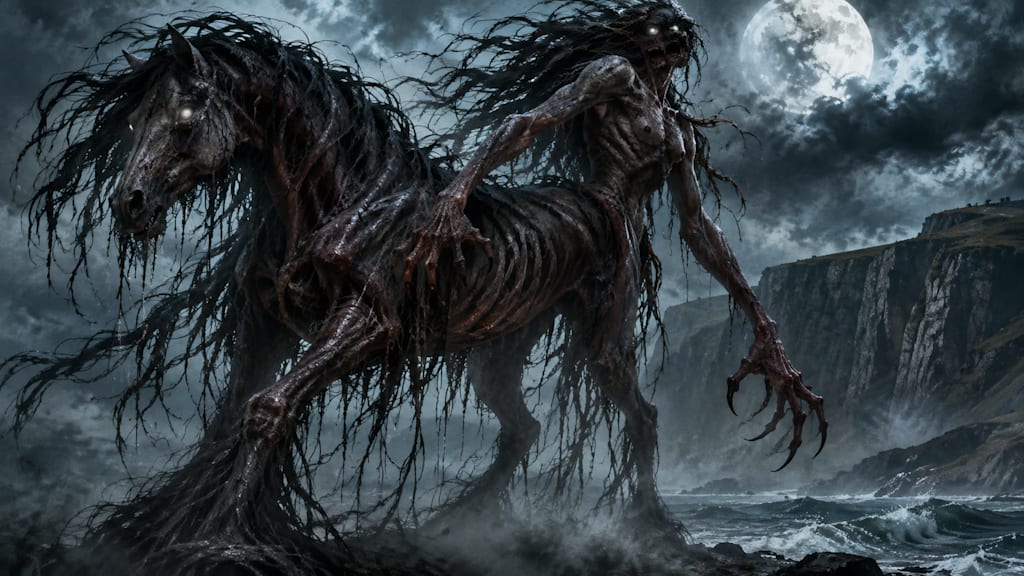
The Nuckelavee is generally described as an enormous combination of horse and human.
The lower portion resembles a powerful horse, while a human-like torso rises directly from its back. It isn't a rider sitting on an animal. The two forms are fused together into one unnatural creature.
Its arms are extraordinarily long, hanging almost to the ground. Its head is large and grotesque, and traditional descriptions include a single enormous eye.
But perhaps the most disturbing feature is its skin.
There is none.
The creature is described as having exposed flesh, with muscles, veins, and sinews visible across its body. Its appearance is often portrayed as something that belongs neither to the living world nor to anything we would comfortably recognize as an animal.
Some modern illustrations make it look almost like a horse carrying a monstrous rider. That misses an important detail of the traditional description. The human figure and horse are part of the same creature.
I find that distinction important because it makes the Nuckelavee considerably stranger than an ordinary supernatural horse.
It also separates it from the Kelpie, whose appearance is often much more familiar and sometimes even attractive.
The Nuckelavee doesn't seem interested in disguises.
More Than a Monster That Hunts
One of the most unsettling parts of the Nuckelavee legend is what it was believed to do to the surrounding countryside.
Its breath was associated with disease and destruction. Crops could fail, livestock could become sick, and the land itself could suffer.
In a farming community, those weren't minor inconveniences. They could mean losing an entire year's income or struggling to feed a family.
There is also an interesting historical connection between the creature and the burning of seaweed.
During the eighteenth century, seaweed was burned in Orkney to produce kelp ash, which was used in the production of soda ash. The industry became an important part of the local economy.
According to the folklore recorded by Dennison, the Nuckelavee despised the smoke from these fires.
The story connects the creature's anger with sickness among horses on the island of Stronsay. The disease was known locally as mortasheen.
Whether the tale developed around actual livestock illnesses or emerged from older supernatural beliefs is difficult to establish. What we can say is that the legend reflects the importance of horses and farming to island life.
There is something rather revealing about that.
The Nuckelavee wasn't simply imagined as a creature that attacked an unfortunate traveler. Its presence threatened the things people depended on every day.
It represented a world where nature could turn against you, and there might be no obvious explanation for why.
The Encounter With Tammas
One of the best-known accounts of the Nuckelavee involves a man named Tammas.
The story was recorded by Walter Traill Dennison, who reportedly knew the man personally.
According to the account, Tammas was traveling home one evening along a road between the shore and a freshwater loch.
As he continued along the road, he encountered something approaching him.
At first, the shape was difficult to understand. But as it came closer, its appearance became unmistakable.
It was the Nuckelavee.
The creature's enormous horse-like body carried a human torso rising from its back. Its exposed flesh and unnatural proportions made it unlike anything Tammas had ever seen.
He understood that he was in terrible danger.
Fortunately, he also remembered something important about the creature.
The Nuckelavee could not cross fresh water.
Tammas made his way toward the loch and used the water as protection. In the traditional account, the creature recoiled when water touched it.
He continued toward safety, eventually reaching a stream that helped put further distance between himself and the monster.
The creature reportedly made a final attempt to reach him, even catching his bonnet, before being forced to retreat.
Tammas escaped.
I particularly enjoy this detail of the legend, although I suspect Tammas himself would have preferred never to have experienced it.
There is something fascinating about the idea that a creature associated with the sea could be defeated by fresh water.
The very element that sustained the island's people became the barrier that protected them.
It also gives the Nuckelavee a very specific place in the folklore of Orkney. Its power was terrifying, but it wasn't unlimited.
The Mither o' the Sea
Another interesting character in this story is the Mither o' the Sea.
In Orcadian tradition, she is associated with the sea and its changing seasons. According to the account recorded by Dennison, she was responsible for restraining the Nuckelavee during the summer months.
As the seasons changed, the creature was able to return.
I find this particularly interesting because it places the Nuckelavee within a wider supernatural world rather than presenting it as an isolated monster.
There are other forces at work in the story, and the changing seasons influence when the creature can threaten the islands.
It also raises an interesting question.
If the Nuckelavee was held back during the summer, what did people believe happened when that protection disappeared?
Perhaps the approaching winter brought more than bad weather in the imagination of those who told these stories.
The Kelpie: Scotland's Other Dangerous Horse
Now, let's turn our attention to the Kelpie.
If you've explored Scottish folklore before, chances are you've encountered this particular water spirit.
Unlike the Nuckelavee, the Kelpie is often described as a beautiful horse, usually appearing near rivers, lochs, or other bodies of water.
Its appearance can be deceptive.
A traveler might discover a magnificent horse standing alone near the water. It may appear calm and approachable, perhaps even inviting someone to climb onto its back.
That is where the trouble begins.
In many traditional stories, the Kelpie has an adhesive hide. Once someone touches it, they become trapped and cannot easily escape.
The creature then carries its victim into the water, where drowning is often the intended outcome.
Some versions of the legend also describe the Kelpie taking human form, sometimes appearing as an attractive stranger who lures people toward the water.
There are variations across Scotland, but the central warning remains remarkably consistent.
Don't trust everything that looks harmless.
The Kelpie is a creature that uses appearances to its advantage. It doesn't need to announce its intentions because its victims often approach willingly.
And that is quite a contrast to the Nuckelavee.
One hides its danger behind an inviting appearance. The other is described as something so unnatural that anyone who saw it would likely turn and run.
At least, I hope I would.
Two Creatures, Two Different Fears
Although the Nuckelavee and Kelpie share connections to horses and water, their folklore serves different purposes.
The Kelpie is primarily associated with the dangers of rivers and lochs. Its stories warn against approaching unfamiliar animals and wandering too close to dangerous water.
The Nuckelavee represents a much broader threat.
Its association with disease, livestock deaths, and failing crops connects it to the vulnerability of entire communities.
Their appearances are equally different.
The Kelpie can be beautiful, familiar, and convincing. Its danger lies in the deception.
The Nuckelavee is grotesque and unnatural. Its danger is immediately apparent.
Even their weaknesses differ. Traditional Kelpie stories sometimes involve an enchanted bridle that can control or subdue the creature. The Nuckelavee, in the Orcadian account, is kept at bay by fresh water.
I think these differences tell us something about the communities that preserved their stories.
The Kelpie reflects the dangers of the waterways that people encountered during everyday life.
The Nuckelavee reflects the fear of forces that could destroy a livelihood without warning.
Both creatures may have been supernatural explanations for very real dangers, but they developed into distinctly different legends.
Norse, Gaelic, and the Folklore of the North
It is tempting to place the Nuckelavee into one large category of Norse or Celtic monsters, especially because Orkney has such a strong history of Norse settlement and Scottish cultural influence.
However, the history deserves a little more care.
The Nuckelavee is specifically associated with Orkney. Its closest relatives in folklore are sometimes discussed alongside other northern European water spirits, including the Norse nøkk.
The nøkk appears in several Scandinavian traditions and is associated with dangerous waters. Depending on the region and story, it may take the form of a horse or another supernatural figure.
The Shetland Islands also have a related folkloric figure known as the Mukkelevi.
The Kelpie belongs to the wider Scottish water-horse tradition, while the Gaelic each-uisge is another supernatural water horse with its own collection of frightening stories.
There are similarities between these beings, but similarities do not necessarily establish a direct connection or common origin.
Folklore changes as people move, trade, settle, and share stories. Sometimes a creature's name survives while its appearance changes. Sometimes two traditions develop similar monsters independently because people in different places share similar fears.
I think that uncertainty is part of what makes folklore so rewarding to explore.
We aren't always handed a neat explanation. Sometimes we're left with fragments of stories, descriptions recorded generations later, and questions that may never have definite answers.
Why the Nuckelavee Still Deserves a Place in Our Folklore
When I first started looking into the Nuckelavee, its appearance was what caught my attention.
A skinless horse-human creature roaming the shoreline is certainly memorable.
But the more I explored its history, the more I realized that its appearance was only one small part of the story.
The creature was tied to the everyday struggles of people living on remote islands. It reflected concerns about animal sickness, failed crops, industrial changes, and the unpredictable power of the natural world.
That gives the legend a different kind of depth.
Folklore is often treated as entertainment, and there is nothing wrong with enjoying a good monster story. But these traditions also preserve pieces of the communities that created them.
They tell us what people feared, what they valued, and how they tried to understand the world around them.
The Kelpie warns us about the dangers of trusting appearances.
The Nuckelavee reminds us that sometimes the greatest fear isn't being singled out by a monster. It is watching everything you depend upon become threatened by something you cannot understand.
And perhaps that is why the old stories remain interesting centuries later.
We may no longer explain livestock disease or crop failure through supernatural creatures, but the human fear behind those stories is still recognizable.
As for me, I think I'll admire the Orkney coastline from a comfortable distance.
Preferably with a warm cup of coffee in my hands.
A Little More Tea Before We Go
I would love to know which of these creatures you find more unsettling.
Is it the Kelpie, with its beautiful disguise and deadly intentions, or the Nuckelavee, whose very appearance seems to belong in a nightmare?
And if you have encountered other versions of these legends, particularly from Scotland, Orkney, or the surrounding islands, I'd genuinely enjoy hearing about them.
Folklore is one of those subjects where there is always another story hiding just beneath the surface.
Thank you for spending a little time at my tea table today. If you enjoyed this exploration of the darker side of folklore, you're welcome to follow my work here on Vocal and join me on Facebook at Lily Writes, where the conversations continue between articles.
Until next time, keep your curiosity alive and your coffee close.
Miss Lil ☕
About the Creator
Lilithea Adasia
I dig where others look away. 🖤 True crime, paranormal mysteries, uncomfortable truths, and the beautifully broken human experience. I chase the stories others bury and ask the questions others avoid. Come curious. Leave questioning.
Enjoyed the story? Support the Creator.
Subscribe for free to receive all their stories in your feed. You could also become a paid subscriber, letting them know you appreciate their work.
Comments (1)
i really enjoyed how you explored the nuckelavee beyond its terrifying appearance and connected the legend to the everyday fears of people living in orkney. the contrast between its destructive presence and the kelpie's deceptive beauty was especially interesting, and tammas escaping through fresh water was such a memorable detail. if you could explore another creature from scottish folklore in a future article, would you choose the each-uisge or the mysterious mukkelevi ?