
The Noppera-bō: Japan’s Faceless Nightmare
The ghost with no eyes. No mouth. No mercy for the human mind.

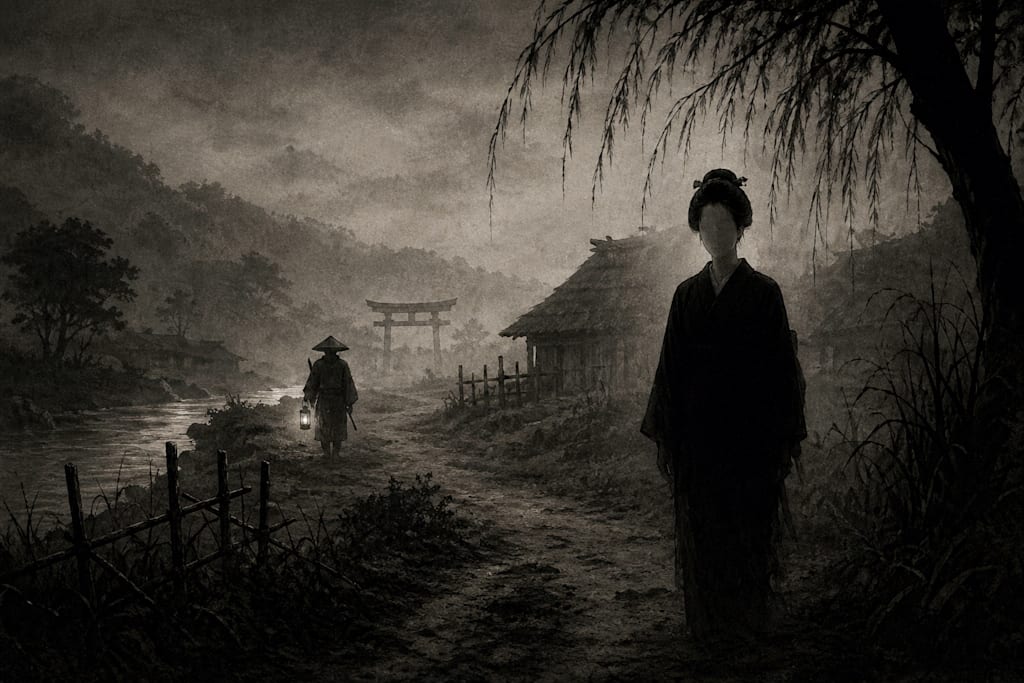
There are monsters that kill with claws.
There are demons that hunt with teeth.
And then there are horrors so unnatural that they don’t need violence at all.
They simply look at you.
And your sanity collapses.
In the shadowed corners of Japanese folklore lives one of the most psychologically disturbing entities ever conceived — the Noppera-bō, the faceless ghost.
At first glance, it appears human.
A woman crying beside a river.
A lonely traveler under a lantern.
A familiar face standing in your doorway at night.
Then the face disappears.
No eyes.
No nose.
No mouth.
Only smooth flesh stretched across a blank skull like wet paper.
And according to generations of whispered accounts, once you see a Noppera-bō, you never truly forget it.
The Ghost Without a Face
The Noppera-bō is one of Japan’s oldest and most feared yōkai — supernatural entities woven into the country’s folklore for centuries. The creature is often described as a spirit capable of disguising itself as an ordinary human before revealing its true appearance: a completely featureless face.
Unlike many spirits in folklore, the terror of the Noppera-bō is deeply psychological.
It does not usually tear flesh apart.
It does not leave bodies hanging from trees.
Instead, it destroys something more fragile: the human mind.
Witnesses in old legends describe overwhelming panic, nausea, paralysis, and even long-lasting trauma after encounters with faceless apparitions. The horror comes from the impossible sight itself — the human brain rejecting what it sees.
Because a face is identity.
Without one, the thing standing before you becomes something fundamentally wrong.
Something that should not exist.
The Woman by the Moat
One of the oldest recorded legends comes from old Edo-era Japan.
A traveler was walking along the lonely Akasaka Road late at night when he spotted a woman sitting beside the moat, softly crying into her sleeves.
Concerned, he approached her carefully.
“Miss,” he reportedly asked, “what troubles you?”
The woman continued weeping.
The man stepped closer.
Slowly, she lifted her head.
Then she wiped her hand across her face.
And everything vanished.
Her eyes melted away first.
Then her mouth.
Then her nose.
The traveler stumbled backward in horror as the smooth skin spread across her head like wax melting under heat.
The man ran screaming through the streets until he found a soba vendor under a lantern.
Breathless, he tried explaining what he had seen.
The vendor listened quietly.
Then asked:
“Did she look… like this?”
The vendor’s face vanished too.
The traveler’s screams echoed through the road long after he disappeared into the night.
The Sacred Pond Incident
Another famous account involves a fisherman warned not to visit a haunted pond near a graveyard.
Ignoring local superstition, he went anyway.
As the sun began setting, a beautiful woman approached him and politely begged him to leave the sacred waters alone.
He mocked her.
That was his mistake.
The woman slowly raised her hands to her face.
Then wiped away every feature.
No eyes remained to blink.
No lips remained to speak.
Only smooth skin under the dying orange light.
Terrified, the fisherman fled home to his wife.
Shaking violently, he told her what he had witnessed.
His wife stared silently.
Then her own face dissolved into blank flesh.
The story ends there.
Most versions never explain what happened to the fisherman afterward.
Perhaps because listeners already know.
Some terrors are worse than death.
Are There “Real” Encounters?
Modern paranormal communities still share stories eerily similar to the ancient legends.
A chilling post on Reddit described two boys spotting a faceless child crouched beside a creek in the 1980s. The witness recalled the child turning toward them with a perfectly smooth white face “like an egg.” Years later, another friend reportedly described seeing the exact same entity near the same river.
Another story described a woman in a restaurant bathroom seeing a giggling figure reflected in the mirror beside her — only to realize the woman had no face at all.
Of course, skeptics dismiss such stories as urban legends, hallucinations, or sleep-deprived imagination.
But legends survive because they evolve.
The Noppera-bō has endured for centuries because the fear it represents is universal.
Humans are biologically wired to recognize faces.
Psychologists even have a term for our instinctive discomfort when facial features appear distorted or absent: the “uncanny valley.”
The faceless ghost exploits that fear perfectly.
It is humanity stripped of humanity.
The Cruelty of the Noppera-bō
Many descriptions claim the Noppera-bō is “harmless.”
That depends entirely on your definition of harm.
Imagine seeing your mother enter your bedroom at night.
She stands silently beside your bed.
You ask what’s wrong.
She leans closer.
And her face is gone.
No scream can prepare the mind for that.
No logic can process it.
The cruelty of the Noppera-bō lies in its manipulation.
It chooses familiar forms.
It gains trust.
Then it reveals the impossible.
Some legends even claim the creature enjoys watching victims descend into hysteria. Others suggest repeated encounters drive people toward isolation, paranoia, madness and self harm.
A claw wound heals.
A broken bone mends.
But the image of a faceless human standing inches away from you?
That remains forever.
Why Japan Feared It
Japanese folklore often treats spirits not merely as monsters, but as warnings.
The Noppera-bō may have originally served as a cautionary tale about wandering alone at night, disrespecting sacred places, or trusting strangers too easily.
But over time, the legend became something darker.
A symbol of identity erased.
Emotion erased.
Humanity erased.
And perhaps that is why the creature still terrifies modern audiences more effectively than many violent monsters.
Because deep down, everyone fears losing themselves.
The Noppera-bō simply wears that fear like a mask.
Or rather—
the absence of one.
Final Thoughts
The legend of the Noppera-bō remains one of the most unsettling ghost stories ever created.
Not because it drenches walls in blood.
Not because it tears victims apart.
But because it forces the human brain to confront something it cannot understand.
A human face is comfort.
Recognition.
Safety.
The Noppera-bō takes that away in an instant.
And if old Japanese legends are to be believed, the last thing many victims ever see…
is smooth, empty flesh staring back at them from the darkness.
Author's Note:
I've been writing horror articles for over a year now. I use several online forums, other articles, horror stories and AI for research. I should state that this one really was the scariest one I've come across.
like everyone else, I do not wish to see an entity without a face.
About the Creator
E. hasan
An aspiring engineer who once wanted to be a writer .
Enjoyed the story? Support the Creator.
Subscribe for free to receive all their stories in your feed.
Comments
There are no comments for this story
Be the first to respond and start the conversation.