
The Murder of Julia Wallace: Checkmate at Menlove Gardens
Fearful Friday Edition

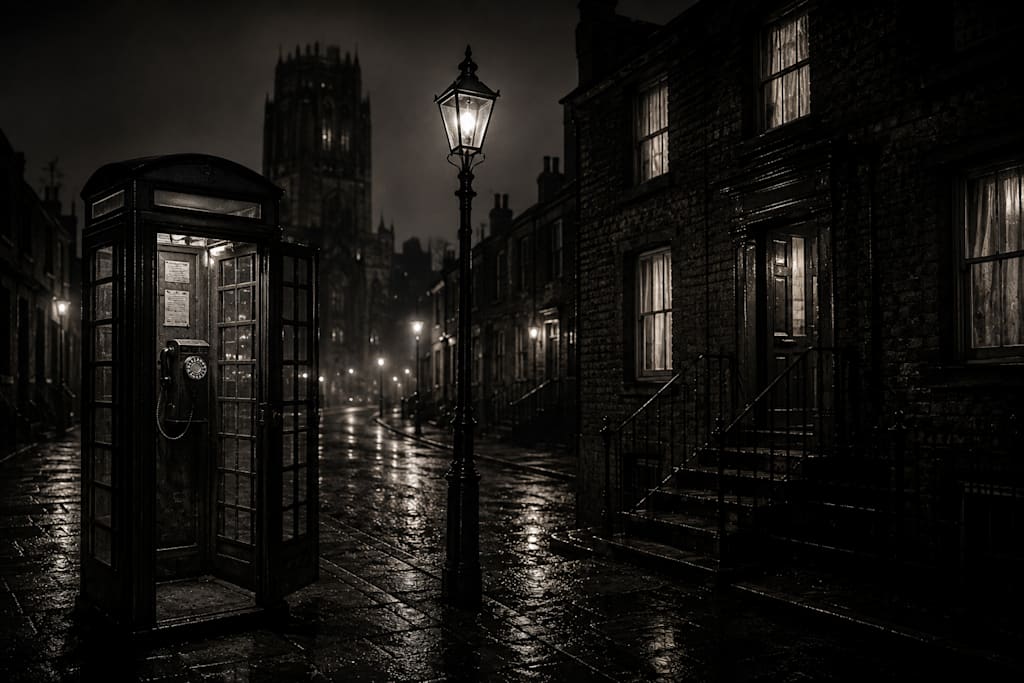
Liverpool, January 1931. Night came early. Streetlamps glowed through the winter darkness as trams rattled along wet streets and people hurried home against the cold. Somewhere in the city, a telephone rang at a chess club. The man who answered could not possibly have known that the voice on the other end was making the opening move in one of Britain's most baffling murder mysteries.
The caller gave his name as R. M. Qualtrough. He wanted to speak with an insurance agent named William Herbert Wallace. Wallace was not yet at the club, so a message was left. Simple enough, except no one has ever established who R. M. Qualtrough was. And before the following night was over, Wallace's wife would be dead.
William Wallace was an insurance agent living with his wife, Julia, at 29 Wolverton Street in Liverpool's Anfield district. Reserved and intellectual, Wallace enjoyed chemistry, music, and chess. He regularly attended the Liverpool Central Chess Club, where on the evening of January 19 he arrived expecting to play an ordinary match. Instead, he received the peculiar telephone message. Qualtrough supposedly wished to discuss insurance and asked Wallace to visit him the following evening at 25 Menlove Gardens East. Nothing about the request seemed particularly sinister. Insurance agents met prospective clients; addresses were written down, appointments were made. Wallace apparently had no reason to suspect that he had just been handed directions to somewhere that did not exist.
The following evening, January 20, Wallace left Julia at home and began the journey across Liverpool. And this is where the story begins feeling less like a murder investigation and more like an elaborate puzzle. Wallace traveled by tram toward the Menlove Avenue district. Once there, he searched for Menlove Gardens East. There was a Menlove Gardens North. There was a Menlove Gardens South. There was a Menlove Gardens West. But Wallace could not find East. He asked conductors, questioned pedestrians, and sought directions from anyone who might know the neighborhood. Again and again, the answer remained elusive. Eventually the uncomfortable truth became apparent: Menlove Gardens East did not exist. Wallace had been sent across Liverpool to find an imaginary address. He eventually abandoned the search and returned home.
When he reached Wolverton Street, however, another problem awaited him. He had difficulty entering his house. Wallace later said the doors would not open normally at first. Eventually he gained entry and began searching for Julia. He found her in the front parlor. She had been murdered.
The quiet chess player who had spent his evening searching Liverpool for a nonexistent client suddenly became the central figure in a homicide investigation. And detectives immediately confronted an extraordinary question: Had someone deliberately sent Wallace away so that Julia would be alone? At first, that interpretation seemed obvious. The mysterious caller apparently knew Wallace's name, knew enough about Wallace's routine to telephone the chess club, apparently knew that an insurance inquiry would attract Wallace's attention, and provided an address plausible enough to keep Wallace wandering across the city while someone visited his home. If that was the plan, it was remarkably clever.
But investigators soon considered another possibility. What if the telephone call wasn't intended to remove Wallace? What if it was intended to protect him? What if... William Wallace himself had created R. M. Qualtrough? Suddenly the entire evening looked different.
Wallace's fruitless search for Menlove Gardens East had brought him before numerous witnesses. Tram employees remembered him. People remembered giving him directions. He had repeatedly asked about the mysterious address. In effect, Wallace had spent the evening constructing an unusually visible trail proving that he was somewhere else. Was that innocent persistence? Or was it an alibi being deliberately performed?
Police began examining the telephone call. Investigators determined that the call to the chess club had been made from a public telephone box relatively near Wallace's home. That discovery was deeply suspicious. If Qualtrough supposedly lived across Liverpool, why had the call originated close to Wolverton Street? Perhaps the caller merely happened to be there. Or perhaps the caller lived nearby. Or perhaps Wallace himself had made the call before traveling to his chess match. Detectives increasingly favored the last possibility. But favoring a theory and proving it are very different things.
The timeline became the heart of the mystery. To have murdered Julia and still established his movements across Liverpool, Wallace would have needed to commit the crime within an extraordinarily constrained period before beginning his journey. Could he have done it? The prosecution believed so. The defense argued that the available window was dangerously narrow and that the murder itself would have created practical problems difficult to reconcile with Wallace's later appearance.
There was another question: Where was the physical evidence? The attack on Julia had been violent, yet Wallace was not discovered wearing obviously bloodstained clothing when he traveled through Liverpool. If he were the killer, he would have needed to commit the murder, avoid contaminating himself significantly, or clean himself thoroughly and then leave quickly enough to maintain the carefully documented timeline. Possible? Perhaps. Easy? Certainly not.
Then there was the apparent motive. The Wallace marriage was scrutinized as investigators searched for domestic tensions and financial explanations, yet nothing emerged that transformed the prosecution's theory into an obvious certainty. Nevertheless, police arrested William Wallace. His trial began in April 1931. The prosecution argued that the strange telephone call, the impossible address, and Wallace's movements were all pieces of an elaborate plan. Qualtrough had never existed, they suggested, and Wallace had invented him. The jury agreed: William Wallace was convicted of murdering his wife and sentenced to death. It appeared the mystery had been solved.
Then something remarkable happened. Wallace appealed. The Court of Criminal Appeal examined the case and concluded that the verdict was not supported by the weight of the evidence. His conviction was overturned, and Wallace walked free. The legal system had effectively produced two incompatible images of the same man. To one jury, he was a calculating murderer who had engineered an extraordinary alibi. To the appeal court, the evidence simply did not justify that conclusion. And Julia Wallace's killer remained unidentified.
Over the decades, another name became increasingly prominent in discussions of the case: Richard Gordon Parry. Parry was a younger man who had previously worked with Wallace and knew aspects of his insurance business. Later researchers argued that he deserved greater scrutiny, and various theories placed him, or someone associated with him, behind the mysterious Qualtrough call. Some versions proposed robbery; others suggested that someone familiar with Wallace's collection work believed money would be inside the house and devised a telephone call to lure him out. The theory has attractive features: it potentially explains why the caller knew Wallace's routine, provides an alternative reason for sending him across Liverpool, and removes the problem of Wallace having to perform a murder within such a narrow timeframe.
But like nearly every solution to the Wallace mystery, it eventually encounters the same obstacle: proof. There isn't enough. That is what makes this case so maddening. If Wallace murdered Julia, the Qualtrough call makes extraordinary sense as the foundation of an alibi, but then the timeline and physical circumstances become troublesome. If someone else murdered Julia, sending Wallace away makes perfect sense, but then we must explain who knew enough about his life to construct such an elaborate diversion, and why the crime unfolded as it did. Every solution moves one piece neatly into position while knocking another off the board.
Perhaps that is appropriate. William Wallace was, after all, a chess player. And his wife's murder resembles a chess problem in which every surviving move can be reconstructed, but the identity of the player remains hidden.
Someone picked up a telephone on January 19, 1931. Someone spoke the name R. M. Qualtrough. Someone invented an address that did not exist. The following evening, William Wallace moved across Liverpool exactly as the caller seemingly intended. While he searched for an imaginary house, Julia remained behind at 29 Wolverton Street. And somewhere between those movements, someone entered, or was already inside, the Wallace home.
Nearly a century has passed. The telephone exchange is gone. The witnesses are gone. William and Julia Wallace are gone. Liverpool itself has changed almost beyond recognition. But the moves remain: a telephone call, a chess club, a false name, a nonexistent address, a husband wandering through winter streets, a wife waiting at home, and a murderer who somehow disappeared between them.
Perhaps William Wallace constructed the entire puzzle. Perhaps another person moved him across Liverpool like a chess piece. Perhaps investigators once stood face-to-face with R. M. Qualtrough without ever realizing it. We may never know. The board remains exactly where history left it. The pieces are still visible. The moves can still be reconstructed. But after nearly a century of investigators, historians, and armchair detectives attempting to solve the position, one piece remains forever hidden: the hand that made the opening move.
Somewhere in Liverpool on a cold January night in 1931, someone lifted a telephone receiver and spoke a name that may never have belonged to anyone. R. M. Qualtrough... And with those three words, the game began. Nearly a century later, we are still waiting for checkmate...
About the Creator
Veil of Shadows
Ghost towns, lost agents, unsolved vanishings, and whispers from the dark. New anomalies every Monday and Friday. The veil is thinner than you think....
Enjoyed the story? Support the Creator.
Subscribe for free to receive all their stories in your feed.
Comments
There are no comments for this story
Be the first to respond and start the conversation.