
The Murder of Charles Walton: England's Most Chilling Witchcraft Mystery
Veil of Shadows Monday Edition

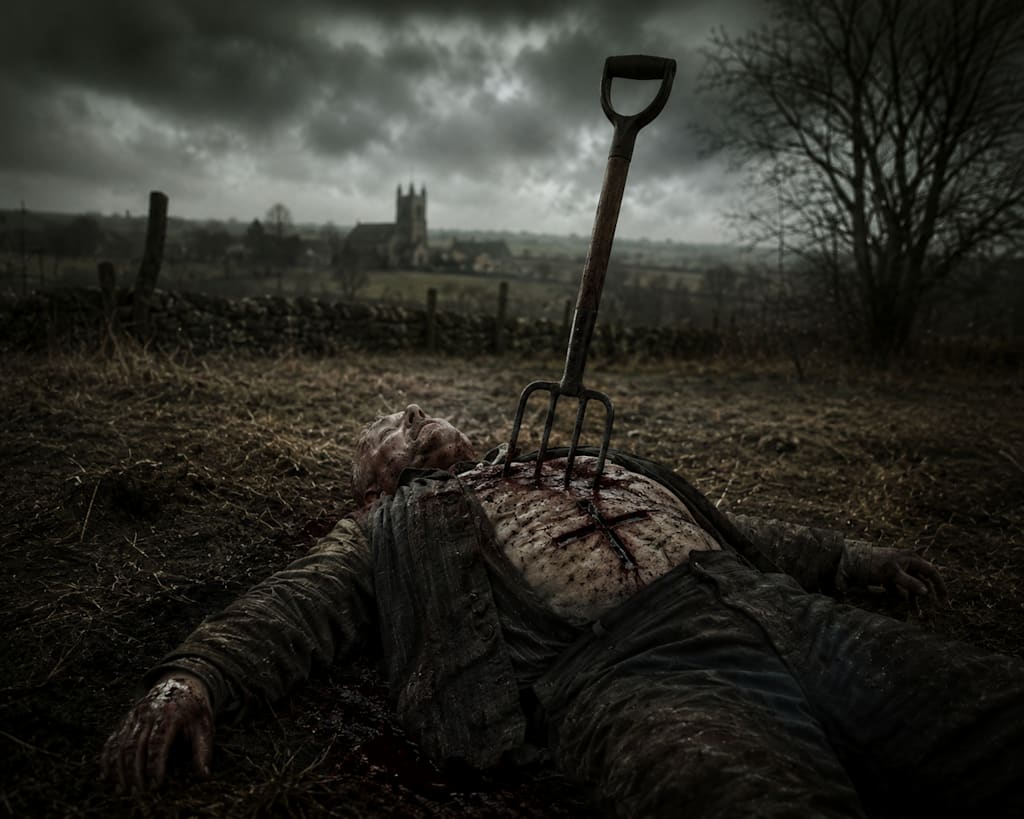
There are murder cases that remain unsolved because evidence is scarce. There are cases that remain unsolved because witnesses refuse to speak. And then there are cases that linger for decades because the answers seem to lie somewhere between reality and folklore. The murder of Charles Walton belongs firmly in that final category.
Even today, more than eighty years after his death, investigators, historians, and paranormal researchers continue to debate what really happened on a lonely English hillside in 1945. The facts themselves are disturbing enough.
A seventy-four-year-old farm laborer was found brutally murdered in a field near the village of Lower Quinton in Warwickshire, England. He had been pinned to the ground with his own pitchfork. A large cross had been carved into his chest. The scene was so bizarre that it attracted national attention and eventually drew the interest of Scotland Yard.
What makes the case extraordinary, however, is not merely the crime's violence. It is the possibility that the murder may have been connected to ancient rural superstitions that had survived for centuries in the English countryside. And that possibility has haunted the case ever since.
The story begins on Valentine's Day, February 14, 1945. While much of Europe remained consumed by the final months of World War II, life in Lower Quinton continued much as it always had. Nestled among rolling hills and farmland, the village seemed largely untouched by the chaos that had engulfed the continent.
Charles Walton was a familiar figure in the area. He had spent most of his life working the land and was known as a quiet, reserved man. Neighbors described him as hardworking and unremarkable. There was nothing about him that suggested he would become the center of one of Britain's most infamous unsolved murders.
That morning, Walton set out to perform routine agricultural work on Meon Hill, a prominent rise overlooking the surrounding countryside. It would be the last time anyone saw him alive. As daylight faded and Walton failed to return home, concern grew. Friends and neighbors began searching the area.
What they discovered was horrifying. Walton's body lay in a field. His throat had been slashed. His body had been pinned to the ground by a pitchfork driven through his neck. And carved into his chest was a crude cross. The sheer brutality of the scene shocked even experienced investigators. This was not a robbery. Nothing appeared to have been stolen. Nor did the murder resemble an act of random violence.
The killer seemed to have gone out of their way to stage the body in a highly symbolic manner. The question was obvious. Why?
Local police immediately launched an investigation, but the unusual nature of the crime quickly attracted wider attention. Soon, Scotland Yard became involved. Leading the inquiry was Detective Chief Inspector Robert Fabian, one of Britain's most respected investigators.
Fabian was no stranger to unusual crimes. Throughout his career, he had encountered murderers, thieves, fraudsters, and countless forms of human depravity. Yet even he found the Walton case deeply unsettling.
As investigators examined Walton's life, they discovered something intriguing. The victim had long been associated with local folklore. Not because he practiced witchcraft. But because stories and rumors had attached themselves to him over the years.
Some villagers claimed Walton possessed unusual knowledge of farming traditions. Others whispered that he had connections to old customs passed down through generations. Most of these claims were impossible to verify. But they pointed investigators toward a larger truth.
Lower Quinton was a place where ancient beliefs had never entirely disappeared. To outsiders, rural England often appears picturesque.
- Rolling fields.
- Stone cottages.
- Ancient churches.
Yet beneath that peaceful image lies a rich history of folklore stretching back hundreds of years. Stories of witches. Cunning folk. Protective charms. Harvest rituals. Superstitions tied to the land itself. In many isolated communities, such traditions survived well into the twentieth century. And some believed they still existed in 1945.
The murder's location only fueled speculation. Meon Hill had long possessed a reputation for strange stories. Local legends connected the area to supernatural events, mysterious sightings, and tales of witchcraft dating back centuries.
Whether those stories held any truth is impossible to say. But their existence created an atmosphere unlike any ordinary murder investigation.
As Fabian interviewed villagers, he encountered something unexpected. Silence. Not the silence of ignorance, but the silence of reluctance. Many residents seemed unwilling to discuss local traditions. Others spoke only in vague terms. Some refused to talk altogether.
To Fabian, it felt as though an invisible wall surrounded the case. Years later, he would write about his experience in his memoirs. Remarkably, Fabian openly acknowledged that he believed the murder may have been connected to rural witchcraft beliefs.
He did not claim supernatural forces killed Charles Walton. Rather, he suspected that ancient superstitions may have motivated a human killer. That distinction is important. Yet it remains deeply unsettling. Because if Fabian was correct, then Walton's murder may have represented the collision of modern society with beliefs rooted centuries in the past.
As the investigation continued, numerous theories emerged. Some suggested personal revenge. Others proposed that longstanding feuds were hidden beneath the surface of village life. Still others pointed toward ritual motives.
None could be proven. No suspect was ever successfully prosecuted. No definitive explanation emerged. And despite extensive efforts, the investigation gradually stalled. The mystery remained.
Over the decades, the case evolved. It ceased being merely a murder investigation. It became folklore. Books were written and documentaries were produced. Researchers revisited the evidence repeatedly. Each generation brought fresh theories. Yet no theory ever fully explained the crime. That lingering uncertainty is what keeps the case alive.
Because there is something uniquely disturbing about crimes that occur in places steeped in ancient traditions. The human mind naturally seeks patterns. We look at the carved cross. The pitchfork. The isolated hillside. The village legends. And we instinctively wonder whether they are connected. Perhaps they are. Perhaps they are not. The truth may be far simpler than the legends suggest. But simplicity struggles to survive in the shadow of Meon Hill.
Today, visitors can still stand in the countryside near Lower Quinton. The landscape appears peaceful. Birds move across open fields. Farmers tend the land. The wind drifts across the hills much as it did in 1945. Nothing about the scenery hints at violence. Nothing suggests one of Britain's strangest unsolved murders unfolded there. And yet the mystery remains.
Somewhere on that hillside, Charles Walton met his killer. Someone knew why. Someone understood the meaning behind the symbols left at the scene. Someone carried the truth away from Meon Hill. But that truth has never surfaced. Perhaps it never will.
More than eighty years later, the murder of Charles Walton continues to occupy a unique place in British criminal history. It is not simply an unsolved murder. It is a mystery suspended between fact and folklore. A crime that occurred in the modern age but seems to belong to a much older world.
A world of whispered traditions, ancient fears, and secrets buried deep beneath the soil of rural England. And somewhere among those rolling green hills, the answer still waits. Hidden... Silent... And perhaps destined to remain that way forever.
About the Creator
Veil of Shadows
Ghost towns, lost agents, unsolved vanishings, and whispers from the dark. New anomalies every Monday and Friday. The veil is thinner than you think....
Enjoyed the story? Support the Creator.
Subscribe for free to receive all their stories in your feed.
Comments
There are no comments for this story
Be the first to respond and start the conversation.