
The Mount Vernon Monster: Nine Months of Screams in Washington's Shadow
Veil of Shadows with Historical Mysteries

The Sound in the Darkness
On a May morning in 1979, Fairfax County game warden Ralph Stickman was leaving the woods near Mount Vernon, Virginia. He had been waiting for something. For months, residents of the surrounding neighborhoods had complained about an unsettling sound that emerged after dark. It came from the trees, sometimes seeming close enough to the houses that people could hear it through their windows. The descriptions varied. Some called it screaming. Others described a long, mournful wail. Whatever produced it had remained remarkably difficult to locate.
Stickman had spent another night searching. He was heading back toward his vehicle when the sound came again. It was precisely the sort of noise he had been trying to identify. And once again, its source remained hidden.
Journalist Blaine Harden documented the incident in a May 1979 report for The Washington Post. By then, the mystery had troubled the area for about nine months. It had also acquired a name. The Mount Vernon Monster. The name suggested something extraordinary. The evidence established something far more frustrating: people were hearing a noise, authorities had investigated, and nobody had produced a convincing explanation.
A Quiet Neighborhood With an Uninvited Guest
The disturbances centered on a wooded, swampy tract between the Union Farm Estates and Southwood neighborhoods, roughly a mile from George Washington’s historic Mount Vernon estate. These were established residential communities, with houses bordering approximately 100 acres of woodland. During the day, the landscape offered the familiar contrast of suburban homes and undeveloped trees. At night, it became an increasingly unwelcome mystery.
The sounds were not confined to one isolated evening. According to the contemporary newspaper account, residents had endured them through changing seasons. Summer nights gave way to colder weather. Rain and snow came and went. The wailing continued. Children were frightened. Dogs barked. Neighbors compared experiences and argued over possible explanations. The mystery became a regular topic at neighborhood gatherings. For residents trying to sleep, however, the situation was considerably less entertaining.
Joan Flore, who lived across from the woods, told the newspaper that the mysterious noise had become an exhausting subject of conversation. With warmer weather approaching, she wanted to open her windows at night. That ordinary desire says something about the situation. This was no longer merely a curious sound heard during an evening walk. It had become an intrusion into daily life. The longer it continued, the harder it became for residents to dismiss.
What Did It Sound Like?
One of the strangest aspects of the Mount Vernon mystery was how hard witnesses had time describing what they heard. Some compared it to an animal. Others thought it resembled a human voice. Theories ranged from wild pigs and owls to unusual frogs, a malfunctioning radio, or someone deliberately producing the noise. More imaginative suggestions included the ghost of George Washington, or even the ghosts of pigs once raised on the surrounding land.
The variety of explanations reflected a real problem: an unfamiliar sound heard at night with no visible source can be remarkably difficult to identify. Michael Berger, a wildlife-management specialist working for the National Wildlife Federation, had heard the noises himself. He did not believe they sounded human. But he also couldn't definitively identify the animal. He described a series of sounds resembling wails more than conventional screams. That distinction matters. A sound can resemble human distress without originating from a person. Certain birds and mammals produce calls that can sound startlingly like crying, shrieking, or screaming. Distance, trees, wind, and darkness can further distort what listeners perceive. Yet these possibilities did not settle the matter. Investigators of the Mount Vernon disturbances still had no confirmed source. Then came a claim that turned a mysterious noise into something far more unsettling.
The Woman Who Reported Seeing Something
Thelma Crisp lived on Union Farm Road, near where the sounds were reported. According to Harden’s newspaper account, Crisp had told several neighbors that she had seen an unusual creature in her backyard. She described it as approximately six feet tall. She said it walked upright. That was the central visual claim behind the Mount Vernon Monster legend. But it is essential to understand what the historical record actually contains. The newspaper did not independently establish that such a creature existed. It reported what Crisp had allegedly told other residents. The article did not provide a detailed, independently corroborated description of the figure, nor did it document physical evidence connecting her reported sighting to the nighttime sounds. We cannot establish from that account what she saw. A person? An animal? A misidentified shape in poor lighting? Something else? There is insufficient evidence to decide. Nevertheless, the report understandably shaped the developing legend. An unexplained sound is disturbing. An unexplained sound accompanied by a reported upright figure in someone’s backyard becomes an entirely different kind of story. It gives the darkness a possible occupant. And once that possibility enters a neighborhood’s imagination, every subsequent noise can seem more ominous.
The Search Begins
The authorities did not simply dismiss the complaints. Game warden Ralph Stickman and other county animal-control personnel had spent months examining the swampy woodland. They searched the trees and undergrowth. They conducted overnight watches. They considered the possibility that someone had hidden loudspeakers in the woods to frighten residents. That was not an unreasonable theory. A concealed audio device could have produced repeated noises while letting a prankster stay safely elsewhere. But the searches reportedly uncovered no such equipment. They also found no identifiable animal responsible for the disturbances. Stickman had heard the sound himself. His difficulty was not deciding whether the residents had imagined hearing something. It was determining what had made the noise. The situation had reached the point where police organized a larger operation. And the methods used were considerably more elaborate than an officer walking through the woods with a flashlight.
The Night the Helicopter Came
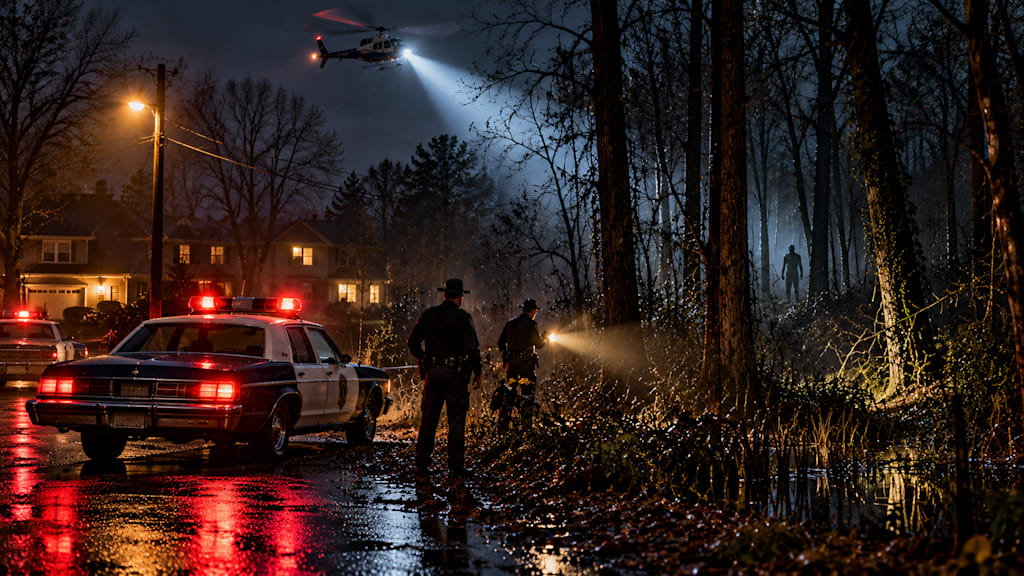
In May 1979, Fairfax County police enlisted assistance from the United States Park Police. They brought in a helicopter equipped with searchlights to examine the woodland from above. Six officers with portable radios took positions among the trees. The team also assembled two infrared cameras for the operation. The plan was straightforward. If the mysterious sound began, officers on the ground could help identify its location while the helicopter searched overhead. The effort was organized to locate whatever was disrupting the neighborhood. The search involved real personnel, real equipment, and a genuine commitment of police resources. But the night did not unfold as investigators hoped. The sound never occurred during the coordinated search. The helicopter’s operation was cut short. Nothing responsible for the wailing was identified. Maj. Harry S. Sommers later explained that authorities had hoped to locate the source from the air once it began making noise. Without the sound, that approach produced no result.
There was another complication. The mysterious presence had not been shown to have injured anyone. Authorities were responding to an ongoing disturbance, not investigating a verified attack. For residents, however, the absence of physical harm offered limited comfort. The screaming remained unexplained. And the woods remained silent whenever investigators most needed them to make noise.
The Warden’s Most Unsettling Observation
Of all the details recorded in the contemporary reporting, one stands out. Stickman believed the timing of the noise was peculiar. On occasions when he searched the woods, the sound seemed to occur after he had given up and started leaving. That impression understandably encouraged speculation. Was something deliberately avoiding him? Could the source detect approaching people? Was someone operating a concealed device and waiting until investigators departed? Or was the timing simply coincidence? The newspaper account does not answer these questions. Animals frequently stop calling when disturbed. A prankster might wait until the area appeared empty. Sound can also travel unpredictably through wooded terrain. There is no need to assume that the source possessed unusual intelligence. Still, consider the situation from the warden’s perspective. He had searched the trees. He had looked for hidden equipment. He had waited through the night. And just when the search seemed over, the noise returned. It was a deeply unsatisfying outcome. One that left investigators with little more than the knowledge that something kept making itself heard.
The Children Who Recorded the Screams
Perhaps the most intriguing evidence mentioned in the original reporting involved ordinary cassette tapes. Neighborhood children had reportedly positioned portable recorders near their bedroom windows to capture the nighttime sounds. These recordings became fixtures at local social gatherings. Residents played the tapes for visitors, inviting them to guess what could have produced the strange cries. This detail is fascinating for several reasons. First, it suggests the reported sounds weren't confined to private recollections. According to the newspaper, residents possessed recordings they believed captured the phenomenon. Second, the recordings became part of the community’s collective attempt to understand the disturbance. People listened, compared impressions, and proposed explanations. Unfortunately, the surviving newspaper report does not provide a technical analysis of the recordings. It does not establish their acoustic characteristics, identify the source, or provide a publicly accessible recording that can be authenticated today. Without an original tape and reliable information about its recording conditions, modern listeners cannot independently test the claims made about the sound. The tapes remain an intriguing reported element of the story. But they are not, by themselves, proof of an unknown animal or supernatural presence.
When the Mystery Reached Mount Vernon Itself
The controversy did not remain confined to neighborhood conversation. The Mount Vernon Ladies’ Association, the organization responsible for preserving George Washington’s estate, acknowledged the episode in its internal 1979 council minutes. Its records noted that newspaper reports about the alleged monster had circulated beyond the Washington area. They also acknowledged claims from people, including Mount Vernon employees, who said they had heard the unusual sounds. This is a significant historical detail. It confirms the episode became prominent enough to enter the institutional records of one of America’s most recognizable historic sites. It does not confirm a monster's existence. In fact, the association’s account was careful about the distinction between reports of sounds and claims of a creature. But it shows the disturbance wasn't merely a legend invented decades later. People were discussing and investigating something in 1979. The mystery had become part of the local historical record.
An Animal, a Hoax, or Something Else?
Several possible explanations deserve consideration. Wildlife remains one of the most plausible general categories. Owls, foxes, and other animals can produce surprisingly disturbing vocalizations. An escaped exotic bird was another possibility raised in later accounts of the mystery. A peacock, for example, can make a remarkably loud call that sounds unlike anything many suburban residents would expect. But identifying a plausible animal doesn't prove it caused these particular sounds. The contemporary investigation found no verified identification. A deliberate hoax was another possibility. Someone could have used an electronic device or made the sounds personally. Investigators searched for loudspeakers, but the original reporting indicates they found none. That failure does not eliminate every possible prank. It simply means they did not locate the suspected equipment. Misinterpretation is also possible. Different witnesses may have heard different noises, especially over months. As the story spread, people may have attributed unrelated sounds to the same mysterious source. The reported upright figure might likewise have been unrelated to the wailing. These are reasonable possibilities, but the available evidence supports none. And a supernatural explanation? No documented evidence requires one. The area’s proximity to George Washington’s estate naturally encouraged ghostly speculation, but proximity to a historic location does not prove paranormal activity. The story remains unsettling without assigning responsibility to the dead.
The Mystery That Refused to Explain Itself
More than four decades have passed since residents near Mount Vernon listened to those strange nighttime cries. The original newspaper account remains. The police search is documented. Named witnesses described their experiences. The Mount Vernon Ladies’ Association preserved a reference to the controversy in its own records. Yet the sources examined for this article leave the central question unresolved. What made the sounds? Perhaps an ordinary animal was responsible. Perhaps someone discovered that a hidden prank could unsettle an entire neighborhood. Perhaps several unrelated events gradually became one story. The evidence does not permit a confident conclusion. And the six-foot figure reportedly seen in a backyard remains exactly that: an unverified eyewitness claim, preserved through contemporary reporting. There is a temptation, when encountering a mystery like this, to demand a dramatic answer. A creature. A ghost. A secret investigation. Something extraordinary waiting just beyond the reach of a flashlight. But sometimes the most compelling part of a historical mystery is the stubborn absence of an answer.
In 1979, residents heard something they could not explain. Officials searched for it. A helicopter passed over the trees. Officers waited below. And whatever had been making the noise remained unidentified. Somewhere beyond the houses of Union Farm Road, the woods eventually returned to their ordinary place in the landscape. The children grew older. The neighborhood moved on. The cassette tapes disappeared from the newspaper’s account. But one detail remains particularly difficult to forget. A game warden spent hours waiting for the sound. He finally abandoned his search. And as he made his way back toward his car, the wailing began again. Whatever it was, it had not given him an answer. And nearly half a century later, it still hasn’t given us one.
About the Creator
Veil of Shadows
Ghost towns, lost agents, unsolved vanishings, and whispers from the dark. New anomalies every Monday and Friday. The veil is thinner than you think....
Enjoyed the story? Support the Creator.
Subscribe for free to receive all their stories in your feed.
Comments
There are no comments for this story
Be the first to respond and start the conversation.