
The Melon Heads of Kirtland
An Investigative Account of What May Be Watching from the Trees...

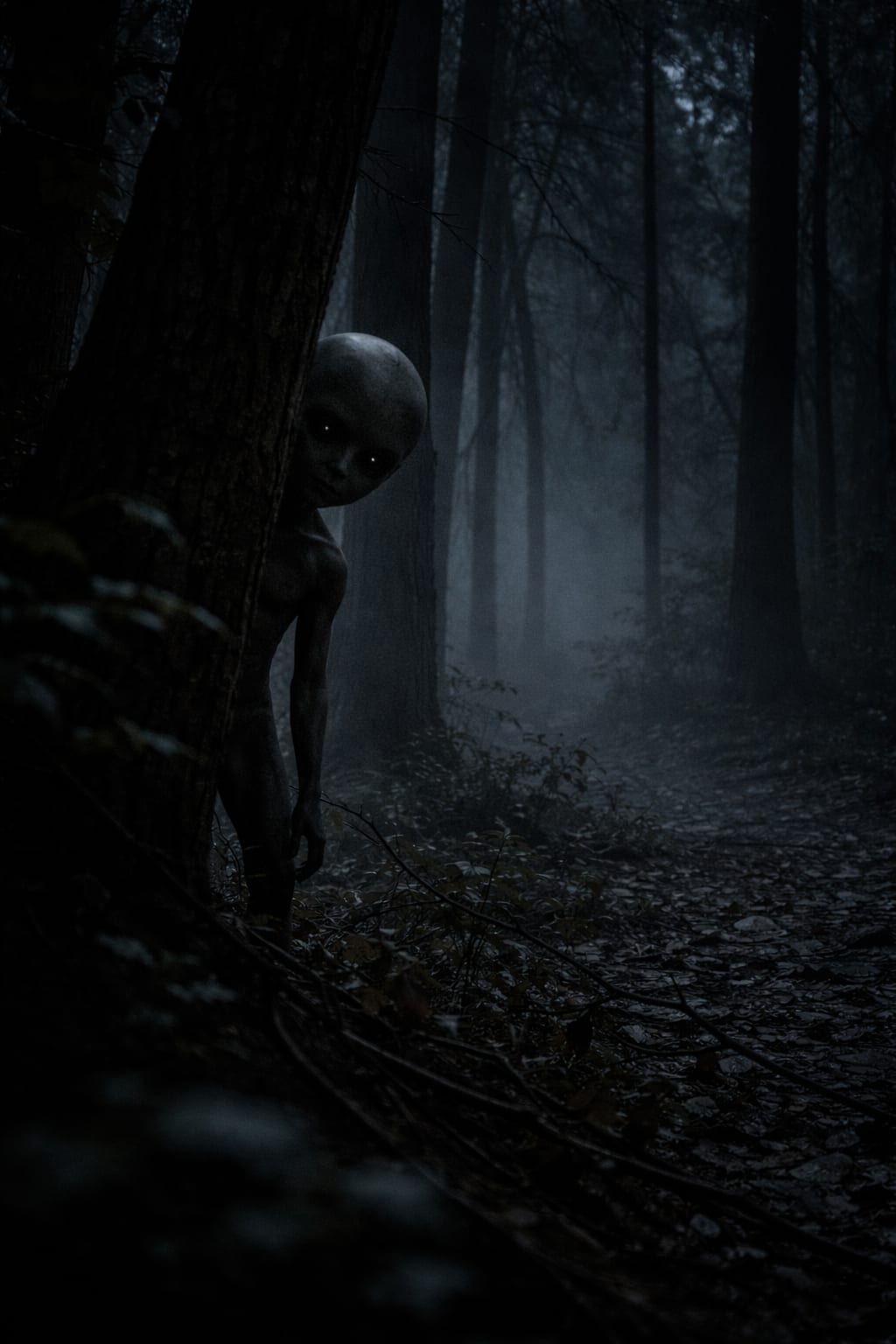
There are places where the woods feel deeper than they should, where the trees seem to close in just a little too tightly, and where the silence carries a weight that is difficult to explain. The outskirts of Kirtland have long been described this way, not because of anything immediately visible, but because of what has been reported there for generations. It is not the kind of story that announces itself loudly. It does not rely on spectacle or dramatic confrontation. Instead, it lingers in the margins, built from quiet encounters, brief glimpses, and a persistent sense that something may be present just beyond the edge of sight.
The legend of the Melon Heads is often dismissed at first, largely because of its name, which carries a tone that feels more absurd than threatening. But the details, when examined more closely, do not resolve into humor. They form a narrative that is both deeply unsettling and difficult to fully dismiss. According to local accounts, the Melon Heads are small, humanoid figures with disproportionately large, bulbous heads, pale skin, and features that are just familiar enough to be recognized as human, yet distorted enough to provoke immediate discomfort.
The origin of the story is tied, in most versions, to a figure known as Dr. Crowe, a name that appears in local folklore but remains elusive in historical record. The story suggests that Dr. Crowe operated an institution for children with severe neurological conditions in the wooded areas outside Kirtland. It is said that these children were subjected to experimental treatments, procedures that were not only ineffective but also damaging. Over time, the story claims, the treatments caused their heads to swell unnaturally, altering both their appearance and their behavior.
Whether Dr. Crowe existed in any verifiable capacity remains uncertain. There are no widely accepted records confirming the operation of such a facility under that name in the region. However, the absence of confirmation does not fully dissolve the narrative. Throughout the nineteenth and early twentieth centuries, institutions for the treatment of mental and neurological conditions were often isolated, underregulated, and, in some cases, poorly documented. It is not impossible that a smaller, lesser-known facility could have existed without leaving a clear historical footprint.
According to the legend, the children eventually escaped, either through neglect, accident, or deliberate action. From that point forward, they are said to have retreated into the surrounding woods, adapting to the environment in ways that allowed them to survive, but not to reintegrate. Over time, they became something else, not entirely human in appearance, not fully understood in behavior, and entirely removed from the structures of society.
The story might have remained contained within folklore if not for the accounts that followed. Reports of encounters with the Melon Heads have persisted for decades, often emerging in similar forms. Individuals traveling along back roads at night describe seeing small figures near the tree line, sometimes stationary, sometimes moving quickly out of view. The descriptions are consistent enough to be notable: short in stature, thin in build, with heads that appear too large for their bodies. In some cases, witnesses report reflective or glowing eyes, though such details are difficult to verify and may be influenced by lighting conditions.
More unsettling are the accounts involving closer proximity. Drivers have reported the sensation of being watched while stopped or slowed along wooded roads, followed by brief glimpses of movement just beyond the reach of their headlights. Some describe shapes crossing the road ahead of them too quickly to be clearly identified, while others hear something moving alongside their vehicle before it disappears into the darkness.
There are also reports, less frequent, but more disturbing, of tapping sounds against car windows, as though something had approached silently and made contact before retreating. These accounts are difficult to substantiate, but they persist in local storytelling, often shared quietly and without embellishment.
Attempts to explain these encounters tend to fall into familiar categories. One possibility is that the sightings result from misidentified wildlife observed under conditions that distort perception. Small animals, when partially obscured by vegetation and illuminated unevenly, can appear larger or more structured than they are. Shadows, reflections, and movement can combine to create impressions that feel more defined than they truly are.
Another explanation centers on the psychological effects of isolation and expectation. Knowledge of a local legend can influence perception, particularly in environments already prone to ambiguity. In such cases, the mind may fill in gaps, constructing forms that align with existing narratives. This does not imply dishonesty on the part of witnesses, but rather highlights the complex interaction between environment and cognition.
However, these explanations, while plausible, do not fully account for the consistency of the descriptions across independent accounts. Nor do they entirely address the persistence of the reports over time. The Melon Heads have neither become a widespread phenomenon nor faded into obscurity. Instead, they occupy a narrow but stable space within local awareness, referenced occasionally, revisited periodically, and never fully resolved.
The physical setting plays a significant role in this persistence. The wooded areas surrounding Kirtland are dense, uneven, and in many places, difficult to navigate. Visibility is limited, particularly at night, and the absence of artificial light allows darkness to settle in fully. Sound behaves unpredictably, carrying over distance in ways that can distort its source. In such an environment, the boundary between observation and interpretation becomes increasingly difficult to define.
It is within this context that the Melon Head legend persists, not as a confirmed reality but as a possibility that cannot be entirely dismissed. The story does not rely on a single defining moment or a piece of evidence that demands acceptance. Instead, it builds gradually through repetition, consistency, and the quiet accumulation of accounts that share more similarities than differences.
What makes the legend particularly effective is its restraint. There are no dramatic confrontations, no definitive proof, no clear resolution. The Melon Heads do not, in most accounts, pursue or attack. They observe. They remain at the edge of perception, present but not engaged, visible only briefly and never long enough to be fully understood.
This restraint creates a different kind of unease, one that is less immediate but more enduring. It invites consideration rather than reaction, encouraging the observer to question not only what was seen, but how it was interpreted. It leaves space for doubt, but not enough to fully dismiss the experience.
In reviewing the available accounts, one detail continues to stand out. The figures, whatever they may be, are almost always described as watching. Not moving randomly, not acting without purpose, but positioned in a way that suggests awareness. This detail, subtle as it is, shifts the narrative from one of misidentification to one of potential interaction, however limited that interaction may be.
Today, the roads and woods of Kirtland remain accessible, unchanged in many respects since the earliest reports began to surface. There are no markers indicating where sightings have occurred, no official acknowledgment of the legend beyond its place in local culture. And yet, the story persists, carried forward not by evidence, but by experience.
For those who pass through the area without knowledge of the legend, it is simply another stretch of wooded landscape, quiet and unremarkable. For those who are aware of it, the experience can be different. The same road, the same trees, the same darkness, but with an added layer of possibility that alters perception in subtle ways.
What was once just a shadow becomes something to consider. What was once just silence becomes something to listen to. And what was once just the edge of the woods becomes a place where something might be standing, unseen but present, observing in the same way it has been described for years.
There is no conclusion to the story of the Melon Heads, no definitive answer that resolves the uncertainty. There are only the accounts, the environment in which they occur, and the lingering question of whether something in those woods exists that has yet to be fully understood.
Because in places like this, where visibility is limited and perception is easily influenced, it is often not what is clearly seen that leaves the strongest impression. It is what might be there, just beyond the trees.
Waiting... Watching... And never quite stepping fully into the light.
About the Creator
Veil of Shadows
Ghost towns, lost agents, unsolved vanishings, and whispers from the dark. New anomalies every Monday and Friday. The veil is thinner than you think....
Enjoyed the story? Support the Creator.
Subscribe for free to receive all their stories in your feed.
Comments
There are no comments for this story
Be the first to respond and start the conversation.