
The Loneliness of Objects: Japan’s Abandoning of the Inanimate
In the ghost villages of rural Japan, the ancient belief in "Tsukumogami" finds a haunting modern reality.

1. The Village Without a Voice
Deep in the mountainous heart of Shikoku and Tohoku, there are places where the clocks have simply stopped. These are Japan’s Genkai Shuraku—"marginal villages" where over half the population is over 65, and eventually, the last breath of the last resident fades into the cedar forests.
Unlike the dramatic ruins of Chernobyl, these Japanese ghost villages (Haikyo) feel different. They are not destroyed; they are merely waiting. As we discussed in our exploration of the school hauntings, the Japanese landscape is deeply intertwined with a sense of "spiritual residue." When humans leave, they leave behind more than just wood and stone.
2. Tsukumogami: The Soul in the Machine
To understand the haunting beauty of an abandoned Japanese home, one must understand Tsukumogami. In Japanese folklore, it is believed that any object—a tea bowl, a lantern, a kimono—that reaches its 100th birthday acquires a soul.
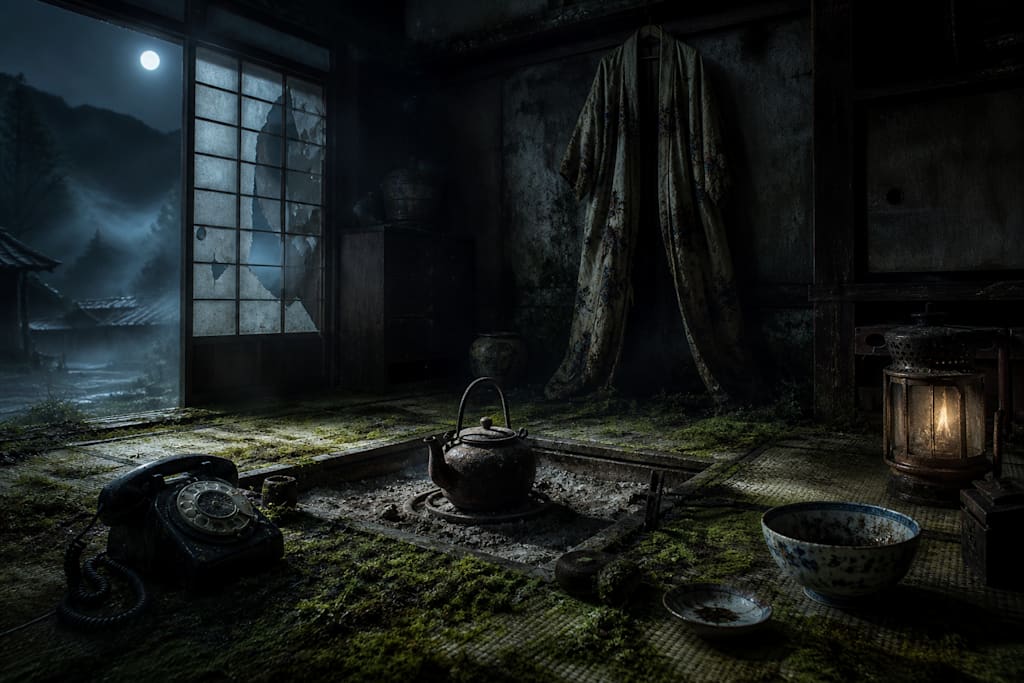
In these abandoned villages, the houses are filled with these silent witnesses. An old rotary phone covered in dust, a rusted kettle on a cold hearth, or a pair of Uwabaki slippers left at a darkened entrance. To the Japanese mind, these aren't just trash; they are grieving entities. They were created to serve, and now, they have been denied their purpose.
3. The Aesthetics of "Mottainai"
There is a term in Japan, Mottainai, which expresses regret when something’s value is wasted. Walking through a village like Nagoro or the decaying hamlets of Okutama, the weight of Mottainai is suffocating.
In one house, you might find a dinner table still set with cracked ceramic bowls. In another, a calendar from 1994 still hangs on the wall, yellowed by decades of mountain mist. This is the "Static Horror" we glimpsed in the Amatsuka Shrine. It is a tragedy not of violence, but of neglect. The objects have outlived their masters, and in their longevity, they have become accidental monuments to a forgotten way of life.
4. The Reclaiming Forest
Nature in Japan is not a passive backdrop; it is an aggressive, living force. Without the daily ritual of sweeping and heating, the wooden bones of these houses succumb rapidly to the dampness.
Moss blankets the tatami mats, turning rooms into soft, green tombs. Vines crawl through shattered windows, wrapping around old television sets like a slow-motion strangulation. It is a visual representation of the boundary (liminal space) between the human world and the mountain's realm—a theme we've seen from the defensive walls of Himeji to the obsidian shadows of Matsumoto.
5. Conclusion: A Lesson in Impermanence
The abandonment of rural Japan is a reflection of Mono no aware—the pathos of things. It is the bittersweet realization that everything, from the mightiest castle to the smallest tea cup, is transient.
When we look at photos of these abandoned places, we aren't just looking at ruins. We are looking at a mirror of our own future. We are reminded that the objects we cherish today will one day sit in a silent room, waiting for a master who will never return. The "ghosts" of Japan aren't always spirits in white kimonos; sometimes, they are just the quiet, heavy sighs of things left behind.
About the Creator
Takashi Nagaya
I want everyone to know about Japanese culture, history, food, anime, manga, etc.
Enjoyed the story? Support the Creator.
Subscribe for free to receive all their stories in your feed.
Comments
There are no comments for this story
Be the first to respond and start the conversation.