
The Legend of Ubasute: The Mountain Where the Elderly Were Abandoned
An ancient Japanese tale of a son, his mother, and the moon that made him regret everything

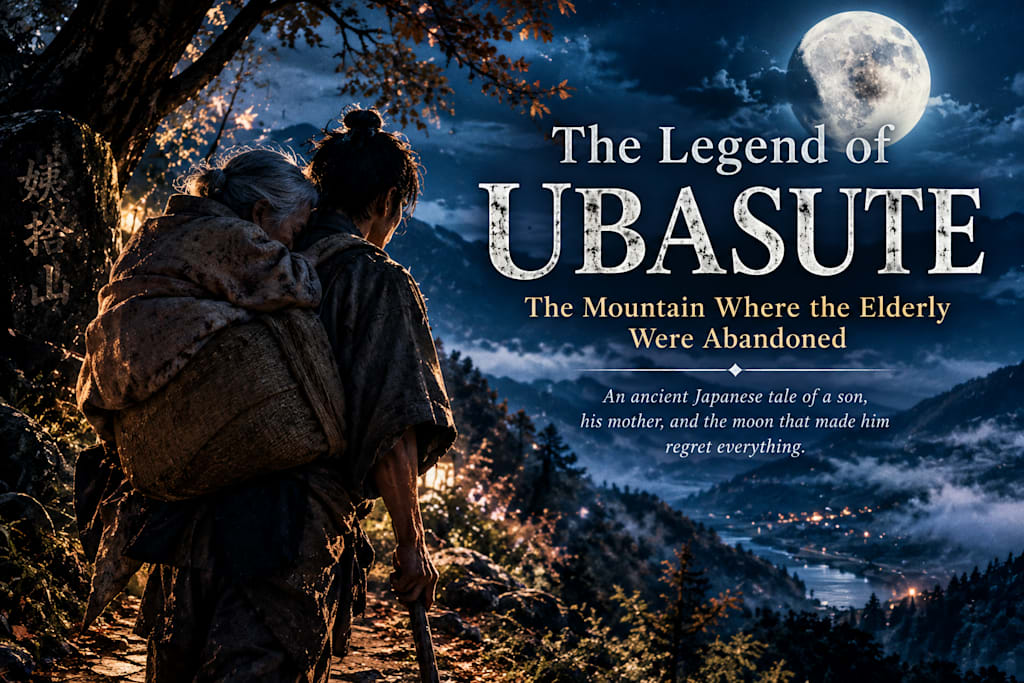
There is a mountain in Japanese legend where a son carried his elderly mother to abandon her.
He believed he had no choice.
But when he returned home alone, he discovered that the hardest part was not leaving her behind.
It was living with what he had done.
This is the haunting story of Ubasute, one of Japan's most heartbreaking legends.
A Son's Impossible Choice
Long ago, in a village in Japan, a man lived with his elderly mother.
She had cared for him when he was helpless. She had fed him, protected him, and watched him grow into a man.
Now, however, she was old and frail.
In some versions of the legend, a cruel ruler had ordered families to abandon their elderly relatives. In others, the story focuses on a son's painful decision to leave his mother behind.
Whatever the reason, the result was the same.
The son decided to take his mother to the mountains.
He knew what the journey meant.
And yet, he could not bring himself to refuse.
The Journey into the Mountains
One evening, the son lifted his mother onto his back and began climbing.
The path was steep. Trees crowded around them, and the village slowly disappeared below.
His mother was light in his arms, but every step seemed to grow heavier.
As they climbed, she quietly broke small branches from the trees and scattered them along the path.
The son noticed, but said nothing.
Perhaps she was frightened.
Perhaps she was confused.
Perhaps she was simply holding on to the last things she could touch.
Eventually, they reached a lonely place deep in the mountains.
The son gently lowered her to the ground.
He could not look at her for long.
Then he turned and began walking home.
Behind him, the mountain grew silent.
The Moon Above the Mountain
On his way down, the son looked up.
The moon shone over the mountains, bathing the trees and the narrow path in pale silver light.
It was beautiful.
Almost unbearably beautiful.
And suddenly, he thought of his mother.
She had spent her life caring for him. Even now, when he was leaving her to face the mountain alone, she had remained gentle.
In one of the best-known versions of the tale, the sight of the moon awakens the son's grief, and he expresses his sorrow in a poem.
He realizes that he cannot bear what he has done.
The mountain is no longer simply a place to leave his mother.
It has become the place where he must face himself.
He turns around.
And he climbs back up.
The Mother Who Still Loved Him
When the son finds his mother, she is still there.
The branches she had broken now mark the way back to her.
She had not scattered them to punish him.
She had left them so he would not lose his way.
Even while being abandoned, she had been thinking of her son's safe return.
That small act changes everything.
The son understands that his mother has given him kindness when he has given her cruelty.
He cannot undo the journey.
He cannot erase the choice he made.
But he can make another choice.
He takes her home.
And in the versions where the story ends with his return, the mountain does not become the place where a mother dies alone. It becomes the place where a son discovers the depth of the love he nearly threw away.
Did Ubasute Really Happen?
The legend is often described as evidence that elderly people were once routinely abandoned in the mountains of Japan.
But that claim needs care.
Ubasute is a traditional legend, not proof of a widespread historical custom. Stories about abandoning the elderly appear in Japanese literature and folklore, and scholars have questioned whether the practice ever existed on a common scale.
The famous versions differ, too. Some emphasize a son's remorse and his mother's love; others involve a ruler's cruel command and the wisdom of older people saving a community.
The details change, but the moral question remains.
What does a society owe the people who once cared for it?
And what happens when the weak are treated as burdens rather than human beings?
The Mountain We Carry Within Us
Perhaps the most frightening part of Ubasute is not the mountain.
It is the possibility that the son could convince himself that abandoning his mother was necessary.
People can find reasons to justify almost anything when fear, hardship, or authority tells them there is no other choice.
But the mother never stops being his mother.
Her age does not erase the years she spent loving him.
And her weakness does not make her life worthless.
That is why this old Japanese legend still matters.
It reminds us that the people who once carried us may one day need us to carry them.
And sometimes, the longest journey is not the road up a mountain.
It is the journey back to the person we should never have left behind.
About the Creator
Takashi Nagaya
I want everyone to know about Japanese culture, history, food, anime, manga, etc.
Enjoyed the story? Support the Creator.
Subscribe for free to receive all their stories in your feed.
Comments
There are no comments for this story
Be the first to respond and start the conversation.