
The legend of the Phi Ta Khon — Thailand
They walked ahead into the shadows first — but once a year, they turn around and walk beside us again.


The Land Where Two Worlds Meet
In the deep, rolling hills and dense forests of Dan Sai, Loei Province, Thailand, there has long been a quiet truth passed down through generations: the world of the living and the world of spirits are not far apart. They are separated only by a thin, unseen veil — a veil that grows thin at certain times of the year, allowing ancestors and spirits of the wild to walk among the living once more. The festival of Phi Ta Khon is not merely a celebration or a performance. It is an ancient ritual, a bridge built by those still living to honour those who have gone before.
The origin of this tradition is deeply tied to the story of Prince Vessantara — the beloved prince whose tale is cherished across the region. Long ago, when the time came for Prince Vessantara to return from his years of exile, the entire kingdom rejoiced. But that joy was woven with a deep, aching longing — a love so vast it could not be contained by the boundaries between life and death. It is said that this love called forth not only the living, but also the spirits of ancestors long departed, and the guardian spirits who dwell deep within the forest. They too had loved the prince. They too came to welcome him home.
The Procession That Walked Between Worlds
When word spread that Prince Vessantara was drawing near, the people of the land began to prepare. They wove flowers, swept their paths clean, and laid out offerings of food and water. But the elders spoke softly, their voices carrying the weight of old knowledge:
"Do not think we are the only ones going to meet him. Our ancestors know this day. They have waited for it just as we have. And in the deep woods, others also watch and wait. They will come too. Do not fear what you cannot recognise — for they love him, just as we do."
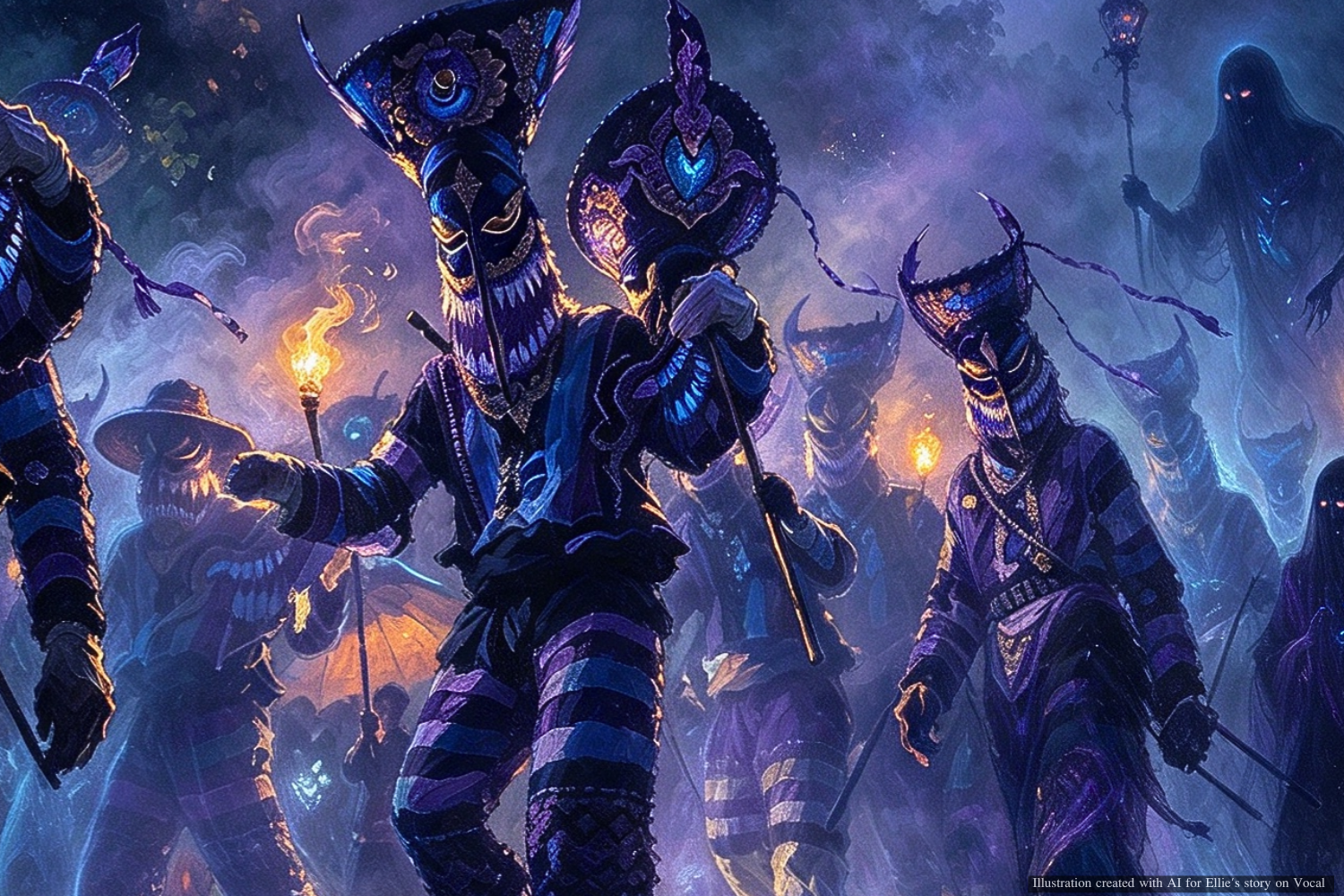
On the night of the full moon, as twilight faded into darkness and the silver glow of moonlight spilled over the treetops, the people gathered along the road leading toward the mountains. Torches flickered against the dark. The air smelled of incense, wild blossoms, and the damp earth of the forest floor. Slowly, the procession began to move forward — walking to meet the returning prince.
But as they drew closer to the edge of the woods, the world began to change. Between the voices of the living, other sounds emerged — faint whispers that seemed to rise from the rustling leaves themselves. Shadows at the edge of the torchlight shifted and lengthened in ways no living person could move. Some among the crowd swore they heard singing drifting from the darkness beyond the trees — a melody that was hauntingly beautiful, yet cold enough to raise gooseflesh upon their arms.
Then they appeared. Figures emerging from the treeline, bathed in pale moonlight. Some were tall and slender, others mist-like and faint. They walked in silence, their faces half-hidden by shadow, yet their eyes held a deep, profound sadness — and a quiet, enduring devotion. They were the ancestors who had passed on, and the wild spirits of the woods. They meant no harm. They simply could not stay away. They too wished to welcome the prince home.
Fear rippled through the crowd at first — for these were shapes that belonged to another realm. But as the people watched, they saw that the spirits walked gently, keeping pace with the living, making no move to frighten or disturb. An elder stepped forward and spoke to the gathering:
"They are part of us still. They have only journeyed ahead. Their love is no less than ours. Shall we turn away those who share our blood and our memories?"
And so the people did not drive them away. They walked together — mortal and spirit side by side — the boundary between the two worlds dissolving in the moonlight. No one could say exactly where the living ended and the spirits began. For one night, all were united by the same longing and the same love.
The Masks That Made Us One
As the procession continued, the elders understood that a delicate balance must be kept. The spirits walked among them because they were called by love — but to linger too long in the mortal realm would bring only sorrow. A way was needed: a way for the living to walk in step with the spirits, without forcing the spirits to reveal themselves too clearly, without binding them to a world they could no longer truly belong to.
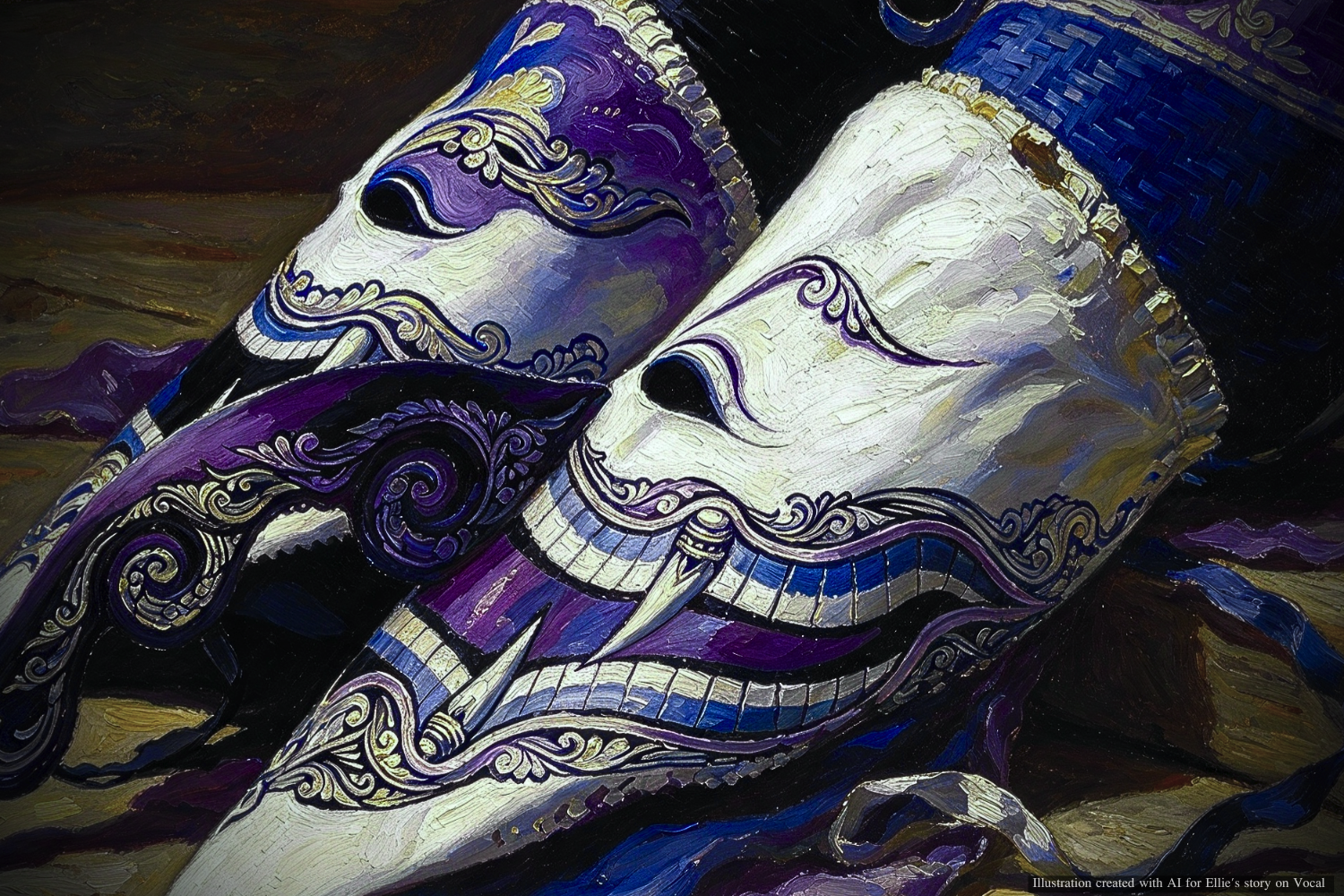
And so a custom was born. The people took woven bamboo steamers — humble, everyday objects familiar to every household — and carved them into faces. They shaped them with wide, deep eyes that seemed to gaze into the darkness itself, broad grins that looked almost menacing yet held no malice — faces that mirrored the strange, awe-inspiring appearance of spirits. These were not made to frighten. They were made to become like the spirits.
"When we wear these masks," the elders explained, "we become like them, for a little while. We step toward their world, so that they may step toward ours without feeling apart. Behind these faces, there is no longer 'living' and 'dead' — there is only us, united in one procession. The masks are not disguises. They are a bridge."
The living danced then — not for entertainment, but in a language understood by both realms. The drums beat deep, vibrating through the soil and echoing into the quiet places where spirits dwelled. Wooden clappers struck in rhythm, a heartbeat of sound that called to the ancestors. Their movements were wild and otherworldly, yet filled with reverence — a silent message: We remember you. We honour you. You are not forgotten.
In that hour, the forest seemed to watch with a thousand unseen eyes. The wind carried faint voices that were no longer quite so distant. Shadows moved along the edges of the torchlight, keeping pace with the dancers. The veil between worlds was woven thin, and for a little while, the living and the lost walked as one.
A Longing Preserved Through Time
When Prince Vessantara finally met the procession, he saw what had come — both mortal and spirit alike — and he understood. He spoke with kindness and gave his blessing: that this tradition should be remembered always, as a reminder that love and memory are stronger than death. That those who leave us do not truly vanish — they walk only a little further into the shadows, waiting for us to remember them.
When dawn broke, the spirits faded back into the mist and the deep woods. They returned to their own realm, content that they had welcomed the prince home. But the people did not let the custom end with that night. Every year, when the moon is full and the veil grows thin once more, they gather again. They carve masks from bamboo steamers. They walk the old paths. They dance the ancient dance.
Even today, elders will tell you in quiet tones: when you look upon the Phi Ta Khon masks, do not see only strangeness or fear. Look deeper. Behind those wide, staring eyes lies the most tender truth of all — these are the faces of our ancestors, walking beside us, watching over us, still loving us across the divide.
Sometimes, when the drums beat loudest and the night is darkest, those walking in the procession say they can hear extra footsteps falling in rhythm with their own. Or catch a glimpse of a shape in the treeline, gone in the blink of an eye. It is not something to fear. It is simply those who have gone before — joining the celebration, as they did that first night, welcomed and remembered.
Phi Ta Khon is not a festival of ghosts. It is a festival of reunion. It tells us that death is not a final goodbye — it is merely a change of scenery. And that love is the only bridge that will ever be strong enough to span the distance between this world and the next.
About the Creator
Ellie
I do not merely tell stories… but invite you to step into a world of feelings — a small realm filled with memories, imagination, and secrets.
[ My words are mine, not a robot’s! ]
_______________
IG: @Ellie.15111
Enjoyed the story? Support the Creator.
Subscribe for free to receive all their stories in your feed. You could also become a paid subscriber, letting them know you appreciate their work.
Comments
There are no comments for this story
Be the first to respond and start the conversation.