
The Legend of Kuchisake‑onna
Beauty hiding cruelty behind a mask

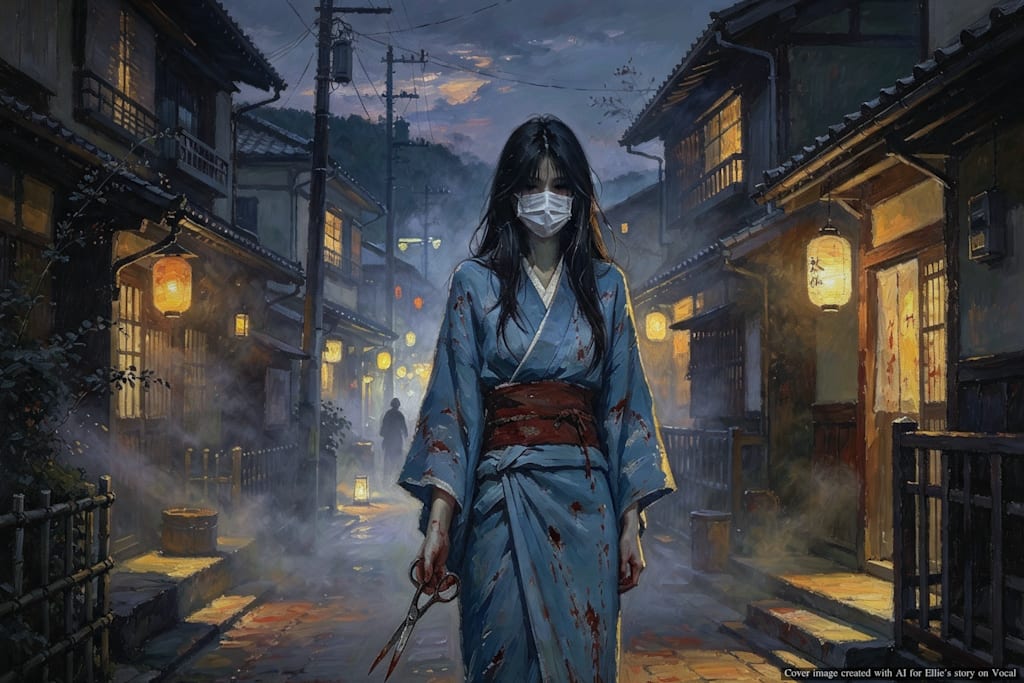
In the late 1970s and early 1980s, Japan was changing rapidly. Cities grew larger, new roads stretched out toward the suburbs. Paths beneath trees and narrow alleys that had once been bright fell into darkness once the sun dipped below the horizon. Prosperity came with something mysterious — whispers passed from one person to the next, turning into a rumor no one could stop.
At first, there were only tales from schoolchildren coming home late. They said that when walking along forest‑side paths or dimly lit alleys, they felt as though someone was watching them. A tall, slender figure lingered behind trees or around corners, never fully visible — only the feeling of eyes staring out from the dark. The first clear description of her came from a young girl returning from evening cram school. She told of a woman in a pale kimono, long black hair falling over her shoulders. But what sent shivers down her spine was a thin white cloth covering part of the woman’s face, leaving only eyes that gazed silently forward.
Before long, the story spread across the whole town. School teachers began warning children not to walk home alone after sunset. Parents told their children to be back before nightfall. Even workers who had to pass through dim alleys started walking in groups. No one knew for certain who this woman was. People called her Kuchisake‑onna — the Slit‑Mouthed Woman.
According to the tales, she could appear anywhere it was dark and quiet: sometimes along paths beside schools, sometimes on small bridges over streams, or even in back alleys of downtown shopping districts. She made no loud noise, no screaming. She only drew slowly closer, until her eyes could be seen clearly. She usually carried a large metal pair of scissors, glinting under moonlight. Some versions say she hid the scissors inside her sleeve, so they could not be seen until it was too late.
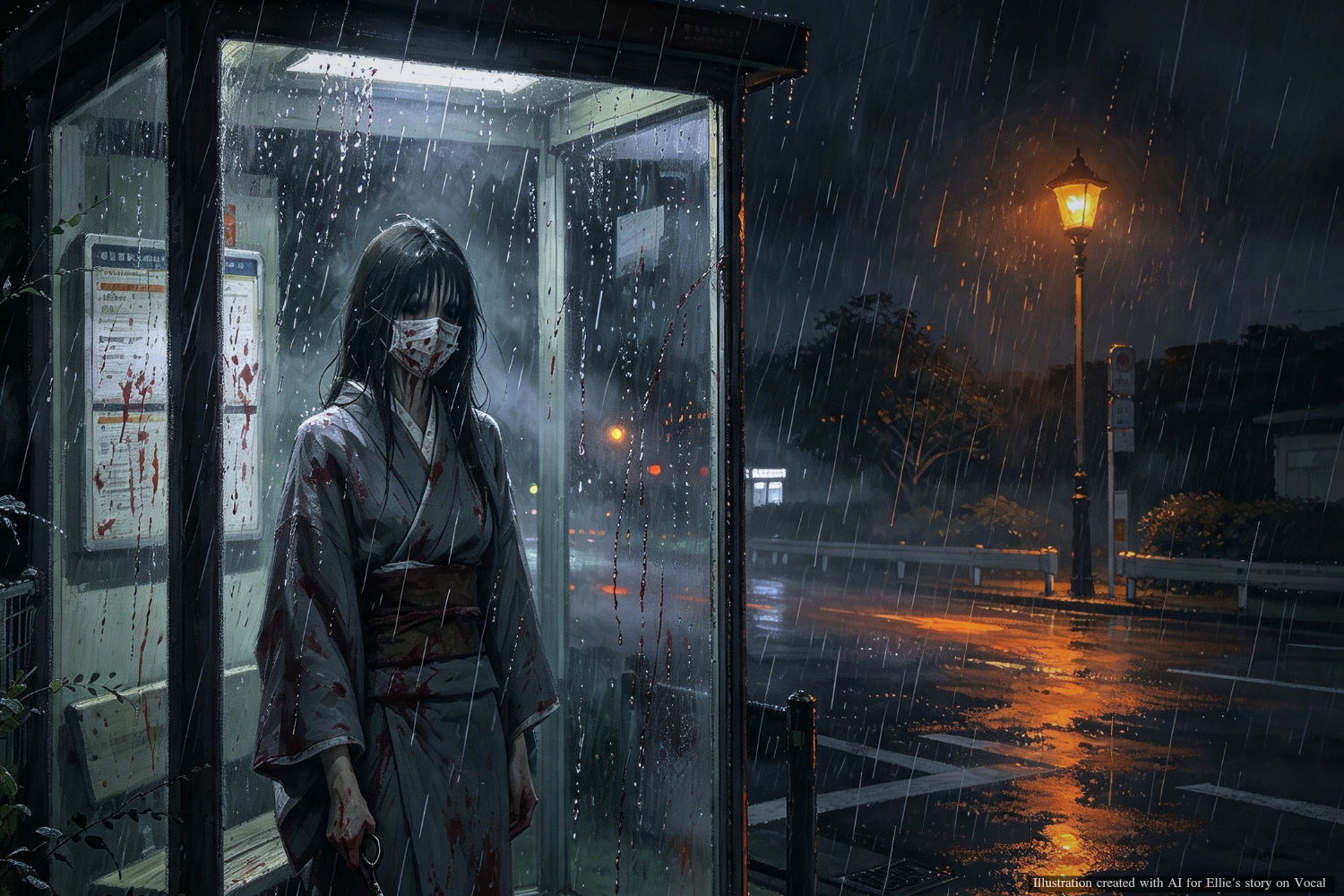
The most feared part of the story was the single question she asked once close enough. She would tilt her head slightly and speak in a soft, hoarse yet clear voice:
“Am I beautiful?”
This was the start of a trap that was not easy to escape.
If the person asked quickly replied “Yes, you are beautiful,” she would slowly lift her hand and remove the cloth covering her face — revealing a terrible wound, a mouth slit wide from one ear to the other. Then she would ask again, her voice seeming to hold hidden anger: “Really?”
If the person answered “No, you are not beautiful,” she would grow furious at once and step forward to attack.
Even those who tried to avoid her by staying silent would find her waiting there, until they spoke some word aloud.
Back then, there were many rumors about those who had met her. Some claimed they had escaped, yet were never the same — frightened of every sound, terrified of the dark, too afraid to walk alone. Others said those who had met the masked woman were never seen again.
Of course, there was no real proof these events had happened. But as the story spread, fear grew along with it. Children would gather to tell the tale after school, then hurry home before dusk fell.
Many tried to believe she was only the imagination of people afraid of the dark — or a story adults had made up to warn children not to stay out late. Yet when evening came, when streetlights began to fade and surroundings grew quiet, some people still swore they felt someone standing at the alley corner — a tall, slender shadow hidden behind trees — as if they were about to hear that soft whisper‑question once more.
No one truly knew who she was, where she came from, or why she kept asking that same question again and again to everyone she met in the night.
As tales of the masked ghost spread across towns in the 1970s, people began to suspect she was more than just a shadow born from darkness. Behind those staring eyes and sharp‑bladed scissors lay a centuries‑old story of pain buried deep in the past — long before it became the terrifying legend that haunts children and adults even today.
The most popular version dates back to the samurai era. In a small village surrounded by forests and mountains lived a young woman named Misae, whose beauty was so striking that a powerful samurai fell in love with her and asked for her hand in marriage. At first their life seemed happy and peaceful; she was a gentle wife who tended their home well. But as time passed, her husband fell prey to unreasonable jealousy. He had heard village rumours that his wife was secretly seeing another man — though there was no proof whatsoever to confirm them.
Obsessed with doubt, the samurai’s mind turned bitter. He began watching her every move, blaming her for small mistakes, and refused to listen to any of her explanations. One day, overcome with rage, he seized Misae firmly and sliced her mouth wide open from one ear to the other with his samurai sword, shouting cruelly: “Now who will call you beautiful?”
She died from the terrible pain and the anger of being falsely accused. Yet her spirit could not pass on to the next world. It was bound to her suffering and the unanswered question — was she truly beautiful? How did others see her? These thoughts became the heart of the Kuchisake‑onna, who wanders dark streets and alleys seeking answers from everyone she meets.
This is not the only story that has been passed down, however. There are other different versions. Some legends say Misae was not harmed by her husband, but suffered a terrible accident that left her face disfigured. In those days, medicine and wound care were far from advanced; the villagers feared her, shunned her, and showed no compassion, until she died all alone. Other tales tell of a woman with a skin condition that split her mouth — something ancient people did not understand, and so they believed it was a curse from a goddess or evil spirit.
Some old story‑tellers explain that she never meant to harm everyone she encountered. She was only driven by the pain of her past. When people said she was beautiful, she knew it did not match her present appearance — and grew angry at what she thought was a lie. If they said she was not beautiful, she was overcome by sorrow and rage, for it reminded her of being rejected long ago. Either way, the question “Am I beautiful?” became a trap with no truly safe answer.
There is an old short tale handed down through generations: one young man met her one evening beside the forest. He saw the woman in her pale kimono with her face covered by white cloth, and heard the familiar question: “Am I beautiful?” The young man was terrified, yet he did not answer yes or no. Instead he looked at her quietly and asked in return: “Why do you ask this?” At once her shadow began to fade, leaving only soft weeping in the dark. Still, this is merely an old fable — no‑one can prove it ever really happened.
As the years went by, Misae’s story was passed down from generation to generation. Parts were added, others left out, until it grew into the well‑known legend we know today. People have come to see her not only as a malicious ghost out to harm others, but as the spirit of someone who was cruelly hurt, falsely accused, and rejected long ago. Yet even now that we know her sad history, no‑one can be certain whether we would truly be able to escape her — if we were to meet her one night after dark.
As Misae’s tale of suffering travelled through time, many people began searching for ways to escape Kuchisake‑onna — if they were unlucky enough to meet her after dark. Ever since the legend first spread across Japan, villagers and schoolchildren had collected tips passed along by others — though none of these methods ever came with a guarantee of safety.
One of the most famous rumours was to answer her question with something other than “beautiful” or “not beautiful” — for instance, “You look quite ordinary” or “So‑so.” People said this kind of reply would confuse her, leaving her too unsure to attack, giving you time to run away. Another trick was to toss sweets or small toys off to one side; her spirit would turn toward the distraction for a moment, for she was always seeking an answer rather than hunting to kill from the start. Still, it was always warned that these were only rumours — no‑one could prove they had ever saved anyone. Some tales even said trying to trick her would only make her far angrier.
As the world moved into the digital age, the legend of Kuchisake‑onna did not disappear — it only changed the way she appeared. Some people claimed to have seen her shadow in underground walkways of large cities; others said they heard faint whispers through mobile phone speakers while watching horror videos late at night. New stories began to appear on message boards and online platforms, sometimes mixed with modern‑day twists, until it became hard to tell which were old tales and which were just modern‑day imaginings.
Folklore scholars explain that this legend has lasted longer than many others because it reflects fears common to people of every era: the fear of being judged only by outward appearance, the fear of giving the wrong answer and facing terrible consequences, or the fear of being misunderstood and rejected with no chance to explain oneself. Since ancient times, people have often been judged by their looks, clothes, or gossip, without others knowing their true story. Kuchisake‑onna has thus become a symbol of the pain of unfair judgment — rather than merely a terrifying ghost that preys on the living.
Of course, there is no scientific proof that she exists today. Most people see this as nothing more than a horror story, made up to warn children not to walk home alone after dark, or told for fun on spooky nights. Even so, many still feel uneasy when walking alone down dim alleys at sunset. Some say that in quiet places, they sometimes feel as though they are being watched — as if they might hear that soft whisper‑question once again.
If you really heard that voice, what would you say?
If a woman in a pale kimono, her face covered with white cloth, stepped out of the dark, tilted her head slightly, and asked you: “Am I beautiful?” — what words would you speak?
There is no perfect right answer, no guaranteed way to survive. Perhaps the true terror is not the sharp scissors or the wide‑slit wound on her face — but the truth that some questions in this world can never be answered to please everyone, no matter what you say. And perhaps Kuchisake‑onna still walks the night‑time streets, searching for the answer she has never found — from hundreds of years ago until the present day.
About the Creator
Ellie
I do not merely tell stories… but invite you to step into a world of feelings — a small realm filled with memories, imagination, and secrets.
[ My words are mine, not a robot’s! ]
_______________
IG: @Ellie.15111
Enjoyed the story? Support the Creator.
Subscribe for free to receive all their stories in your feed. You could also become a paid subscriber, letting them know you appreciate their work.
Comments
There are no comments for this story
Be the first to respond and start the conversation.