
The Last Ferry
Some Doors Stay Close For A Reason
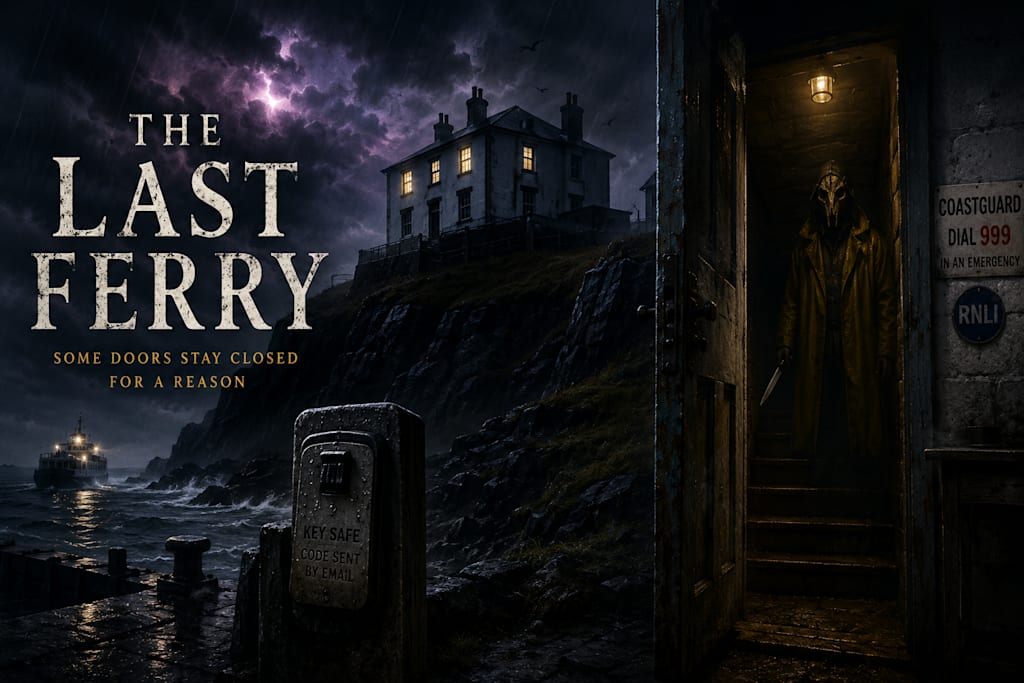
By the time the ferry left, the sky had already begun to bruise.
Not sunset exactly. Sunset suggested warmth, some final generosity of light. This was different. The clouds over Blackmere Island had thickened into a low, purple mass, and the sea had turned the colour of old knives.
“Still time to swim back,” Callum said.
Nobody laughed.
Callum heard silence as an invitation to continue.
“I’m serious. Strong swimmer. Bit cold, maybe. Bit fatal.”
Maya looked past him at the receding ferry. Its lights softened in the mist. “You said this place had Wi-Fi.”
“I said the booking page said it had Wi-Fi.”
“Not the same sentence.”
“It had pictures.”
“Of the Wi-Fi?”
“Of the house.”
Blackmere Island sat three miles off the Northumberland coast, close enough to see on a clear day and far enough to become impossible once the weather turned.
The house stood above the harbour on wet grass and black rock, square and pale against the sky. A former coastguard station, according to the booking page. Renovated. Remote. Ideal for people who did not read reviews properly.
There were six of them.
Maya, who had organised the weekend because friendships died if unattended.
Callum, who paid late and complained early.
Priya and Dan, broken up three months ago and pretending not to perform it.
Elise, with two cameras, three lenses, and no waterproof shoes.
And Tom, Maya’s younger brother, invited last minute because someone had dropped out and he had recently been “going through something,” their mother’s phrase for any period when Tom refused to answer calls.
The ferry gave one low blast as it turned back toward the mainland.
The sound reached them late.
Then it was gone.
“That’s cheerful,” Dan said.
The ferryman had not stayed to greet them. There was a key in a metal key safe beside the pier, the code sent by email while they still had signal. The email also explained that weather could affect crossings, the next return was Sunday afternoon, and guests should bring provisions.
They had brought wine, crisps, pasta, six limes for some reason, and one torch between them.
The walk to the house took twelve minutes and felt longer. The path was steep, slick with rain, bordered by a rusted fence leaning toward the drop. Beyond it, the sea struck the rocks with slow patience.
Halfway up, Elise stopped and raised her camera.
“Seriously?” Priya said.
“It’s atmosphere.”
“It’s hypothermia.”
Elise took the photograph anyway. The flash went off by mistake, lighting the path ahead.
For one white second, the house appeared closer.
In one of the upstairs windows, something moved.
Maya saw it. She was sure she saw it. A pale shift behind the glass. Not a face. Not a figure. Just movement where there should not have been movement.
She waited for someone else to say something.
Nobody did.
The house was colder inside than out.
It smelt of buildings shut up too long: damp wood, old stone, dust under detergent. The hallway was narrow, with hooks and a framed photograph of the station in its original life. Men in oilskins stood outside, their faces blurred by age, weather, or the cheapness of the print.
Callum found the fuse box. Dan found the kitchen. Priya found a dead moth in the downstairs bath and took it as confirmation.
A laminated sheet beside the kettle explained bins, towels, Wi-Fi, and what to do if the immersion heater failed. A damp Ordnance Survey map of the island was pinned by the back door.
“There’s no signal,” Tom said.
He was standing by the front window, phone held up like an offering.
“We’re on an island,” Callum said.
“Islands have signal.”
“Not horror islands.”
“Don’t,” Maya said.
Callum grinned. “What?”
“Don’t make it a thing.”
“I’m not making it a thing. The thing is already a thing. Look at it.”
The lights flickered once.
Everyone went quiet.
Then they steadied.
“Old wiring,” Dan said.
He said it with the confidence of someone who had once changed a plug.
They chose bedrooms with false politeness, pretending not to calculate size, view, and bathroom distance. Maya took the small room at the end of the corridor. Tom took the one beside hers. Priya and Elise shared the front room with twin beds. Dan and Callum took rooms across the landing, though Dan pointed out that he had not asked to be placed opposite Priya.
Dinner was pasta with sauce from a jar. The wine helped the house seem less hostile. Rain began around nine, hard against the windows, blown sideways from the sea.
For a while, it worked.
They talked too loudly. They revived old stories from when everyone had been younger and somehow less tired. Callum made a toast to terrible decisions. Elise photographed their glasses from above. Priya told her not to post anything until they got back.
“Because of privacy?”
“Because of evidence.”
From upstairs came a brief, hard thump.
Everyone looked up.
“What was that?” Tom said.
“House settling,” Callum said, too quickly, and raised his glass. “To structurally unsound memories.”
The joke worked only because they needed it to.
A minute later, something scraped across the ceiling and stopped.
Callum glanced toward the hallway.
Then he smiled again.
The first sound came at 10:17.
A knock.
Not loud. Not theatrical.
Three soft taps from somewhere below them.
They stopped talking.
“Pipes,” Dan said immediately.
“Why are pipes knocking on the front door?” Tom asked.
“It wasn’t the front door.”
“It sounded like downstairs.”
“Everything sounds like downstairs in old houses.”
They listened.
Rain hit the windows. The fridge hummed. Somewhere inside a wall, something settled with a faint wooden click.
Then came the knock again.
Three taps.
This time from beneath the kitchen floor.
Callum looked at Maya. His smile had gone uncertain around the edges. “Cellar?”
“Not on the booking page.”
“That’s how you know it’s good.”
Nobody moved.
Then Elise stood up, because fear had always embarrassed her and she hated giving it room.
“I’m going to look.”
“No, you’re not,” Maya said.
“I am. When we find out it’s heating, pipes, or a trapped branch, remember I was the adult.”
“There is no heating,” Priya said. “That’s why I’m wearing two jumpers and can see my breath.”
They found the cellar door behind a freestanding pantry cupboard, raising the question of why somebody had put it there and why none of them had noticed the draught before.
The door was narrow and painted the same off-white as the wall. Its handle was old iron, cold enough to hurt.
Maya opened it.
A steep set of steps descended into blackness.
The smell came up first: salt, mould, something metallic and stale.
And beneath it, almost covered by the damp, something sharper.
Bleach.
Not old bleach. Not the ghost of cleaning done weeks before. Fresh enough that Maya felt it catch in the back of her throat.
Callum shone the torch down.
The beam reached wet stone steps, a low ceiling, shelves furred with dust. Nothing moved.
Then the light passed over one shelf where the dust had been wiped away in a long, clean stripe. At the end of it, pressed into the remaining grey, was a handprint.
Too large to be any of theirs.
Nobody mentioned it.
That was worse than mentioning it.
“Hello?” Dan called.
Everyone looked at him.
“What?”
“Why would you do that?” Priya whispered.
“I don’t know. It came out.”
No answer came back.
They shut the door.
Maya moved the cupboard back. Nobody joked.
Only when they were halfway through pretending to recover did Priya say, very quietly, “Who bleaches a cellar?”
Nobody answered that either.
At midnight, the power went out.
The house disappeared in pieces. First the kitchen light. Then the hall. Then the oven clock.
Darkness took the rooms so completely that the windows became mirrors, and in them Maya saw six pale faces floating without bodies.
“Fuse box,” Dan said.
“No,” Priya said.
“I can check.”
“No.”
“It’s probably just tripped.”
“Then it can remain tripped until morning.”
The emergency lights did not come on because there were no emergency lights. The one torch was on the kitchen table. Four phone torches appeared, weak and blue-white. Tom’s battery was already at nine percent.
They agreed to stay in the kitchen.
That lasted eleven minutes.
The third knock came from upstairs.
Not beneath them now.
Above.
Three taps.
Then a dragging sound.
Slow.
Measured.
As if something heavy was being pulled across the landing.
Maya felt her body make a decision before her mind did. She reached for Tom’s sleeve. He did not pull away.
“Is everyone here?” she whispered.
“What?”
“Is everyone in the kitchen?”
The phone lights swung around the room.
Maya. Tom. Priya. Elise. Dan.
Callum’s chair was empty.
For two seconds, nobody spoke.
Then Dan said, “He went to the toilet.”
“When?”
“I don’t know.”
“You don’t know?”
“I wasn’t supervising him.”
Maya called his name.
The house returned it to her thinly.
“Callum?”
Rain. Wind. The sea below. No answer.
They found him upstairs.
At first Maya thought he was playing a joke, because that was still possible then. That was still a shape the night could have.
He was lying on the landing outside Priya and Elise’s room, face down, one arm stretched toward the stairs as though reaching for them had been his last useful idea.
The torch rolled from Dan’s hand and struck the floor.
Priya made a sound that did not become a word.
Callum’s back was wet.
Maya understood the wetness before she understood the wound.
There was a long opening through his jumper, dark and clean and terrible, running from shoulder to spine. Not ragged. Not accidental. It looked deliberate. It looked like work.
Tom vomited on the carpet.
Elise kept saying, “No, no, no,” softly, not to anyone else but to the room, to the house, to whatever rule had changed without warning.
Dan reached for Callum’s neck.
“Don’t,” Maya said.
“I have to check.”
“You don’t.”
He checked anyway.
Then he sat back.
Nobody asked.
From somewhere below them came the soft click of the cellar door opening.
That was when panic stopped being atmosphere and became movement.
They ran.
Not together at first. Fear broke them apart and then forced them back into each other. Dan slammed the bedroom door. Priya shoved a chair beneath the handle. Tom was crying openly now, breath hitching, hands pressed to his head. Elise stood by the window, staring down toward the harbour.
“The ferry,” she said.
“It’s gone,” Maya said.
“The radio then. Coastguard station. There has to be a radio.”
“It’s renovated,” Dan said. “It’s a holiday let with decorative oars.”
“Then we go down to the harbour.”
“In this?” Priya pointed at the window.
The rain struck so hard it sounded like thrown gravel.
“We can’t stay in here.”
“We can’t go out there.”
A sound came from the corridor.
Not footsteps.
Something touching the wall.
A light scrape, then pause.
Scrape, then pause.
As if whoever was outside did not need to hurry.
Dan pressed both hands over his mouth. His eyes were enormous in the phone light.
Maya looked around the room. Twin beds. Wardrobe. Dressing table. Elise’s camera bag. Priya’s boots. A framed print of a lighthouse. Nothing that made sense as a weapon.
Then the handle moved.
Slowly down.
The chair held.
The handle rose.
A pause.
Then three soft taps on the door.
Tom whimpered.
Maya felt something inside her go very still.
It was not courage. Courage was too clean a word for it. This was a colder thing. A narrow corridor in the mind where only the next action fitted.
“The window,” she whispered.
“We’re upstairs,” Priya said.
“Roof below. Kitchen extension. Then the ground.”
“You can’t know that.”
“I saw it when we came in.”
“You saw a roof in the dark?”
“I saw enough.”
The door handle moved again.
This time, pressure followed.
The chair creaked.
Dan helped Elise force the window open. Wind burst into the room, wet and violent. Outside, the slates of the lower roof shone black.
Maya made Tom go first.
He climbed badly, slipping once, catching himself on the sill with a cry that made the thing outside the door hit it hard enough to crack the wood around the latch.
“Move,” Maya hissed.
Tom dropped onto the extension roof and slid, grabbing the gutter.
Priya followed. Then Elise.
Dan was halfway through when the door gave.
The chair snapped sideways.
The door opened inward.
For a moment Maya saw only darkness behind it.
Then the darkness separated.
A figure stood in the doorway in a yellow oilskin coat, hood raised, rain-glossy though it had not been outside.
Its face was pale and wrong beneath the hood.
One gloved hand lifted something long and bright.
Dan shoved himself backwards through the window, not climbing now but escaping. His shoulder struck the frame. His foot slipped from the wet outer sill. For half a second he hung there, one hand clawing at empty air.
Then he was gone.
The sound below went through Maya like a hook. Her knees emptied. Her mouth filled with the taste of pennies. She wanted to call his name, but some frightened part of her understood that names were invitations now.
The figure turned toward Maya.
Not rushed.
Interested.
She grabbed Elise’s tripod from the corner and swung it as hard as she could. It struck the doorframe, bent, glanced off the mask. The figure stepped back.
Maya climbed through the window.
The roof was slick beneath her palms. Rain blinded her. Below, Tom was on the grass, pulling at Dan, who was moving but not standing. Priya reached him and grabbed his wrist before he could decide whether he deserved help.
Elise had frozen halfway down.
“Jump!” Maya screamed.
Elise looked back.
The yellow figure appeared at the window behind them.
Elise jumped.
She landed badly, screamed, and rolled.
Maya slid after her, hit the edge of the roof, lost her grip, and fell into cold mud.
For several seconds, the world became rain and breath and pain.
Then Tom was hauling her up.
They ran for the harbour.
Dan could not run. His right leg folded under him and he screamed through clenched teeth.
“I can’t,” he said, looking at Priya as if apologising for more than the leg.
“You can.”
“I left.”
“I know.”
“I’m sorry.”
“Be sorry later.”
Priya put his arm around her shoulders before he could refuse, and Tom took his other side. Maya dragged Elise, who kept saying her ankle was broken, it was broken, she knew it was broken.
Behind them, the house watched with its dark windows.
No one followed.
That was worse.
The path to the harbour had become a stream. Twice they fell. Once Dan begged them to leave him, and Priya slapped him so hard that even in the rain Maya heard it.
“Don’t you dare make that noble,” she said.
They reached the pier at 1:06.
The ferry was gone. The harbour office was locked. The emergency phone inside, beneath a faded COASTGUARD — DIAL 999 sticker, did not work, or they could not make it work, or their hands were too wet and stupid with terror to understand it. An old RNLI collection tin sat beside it, which felt like a joke nobody had meant to make.
Elise found the boat first.
A small motorboat tied behind the harbour wall, half-covered with a tarp.
“No,” Dan said. “No, no, no. In this sea?”
“In that house?” Priya said.
There were keys in it.
That should have stopped them.
It should have seemed too convenient, too arranged, too much like a door held open by someone who wanted them to go through.
But fear is not careful. Fear sees an exit and calls it hope.
They got Dan in first. Then Elise. Tom untied the rope with shaking hands while Maya tried the engine.
It coughed once.
Stopped.
She tried again.
Behind them, from the top of the path, came a light.
A lantern.
Small. Yellow. Steady in the rain.
The figure stood beside the harbour gate.
Watching.
Maya turned the key again.
The engine caught.
Tom shoved them away from the wall and half-fell into the boat. His hands were shaking, but he kept hold of the side and did not look back at the island. For once, Maya thought, he was still moving. The sea took them immediately, lifting the bow, dropping it hard enough to make Elise cry out.
Maya steered toward the black gap between the harbour rocks.
“Do you know how to drive a boat?” Priya shouted.
“No.”
“Of course you don’t.”
The lantern remained on the pier, shrinking behind them.
For one wild minute, escape seemed possible.
Then the engine died.
No cough this time. No struggle. Just absence.
The boat turned sideways.
The sea hit them broadside and threw cold water over everyone. Dan screamed as his leg shifted. Tom grabbed an oar. Priya grabbed the radio clipped beneath the dash and began pressing buttons.
“Mayday,” she said. “Mayday, mayday, we are—”
The radio hissed.
Then a voice answered.
Not coastguard.
Not any of them.
“Nobody opens that door after the last ferry.”
Static swallowed the line.
Then the same voice returned, softer, almost patient.
“You came all the way to the water.”
Priya dropped the radio.
From beneath the tarp at the bow came three soft taps.
Maya looked at Tom.
Tom looked at Maya.
The tarp moved.
Not much.
Just enough.
The boat rocked. Rain fell. The island waited behind them, black and patient, already impossible to reach and impossible to leave.
Maya picked up the oar.
This time, when the noise came again, nobody tried to explain it.
They were done explaining things.
They were done giving the dark better names.
About the Creator
Enjoyed the story? Support the Creator.
Subscribe for free to receive all their stories in your feed.
Comments
There are no comments for this story
Be the first to respond and start the conversation.