
The Lakes That Swallowed Giants: Five Terrifying Disasters Beneath America's Inland Seas
Historical Disasters & Maritime Mysteries

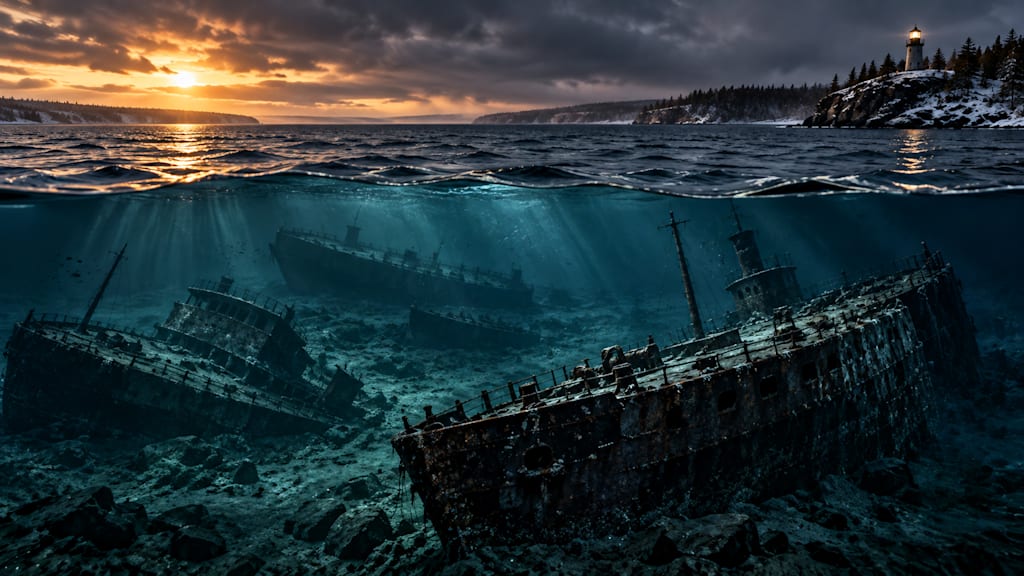
Editor’s note: This article recounts documented maritime disasters using historical records, official investigations, survivor accounts, and established reporting. Atmospheric descriptions evoke known conditions but are not invented eyewitness testimony. Where the final circumstances remain uncertain, the article preserves those uncertainties. No supernatural explanations are presented as fact.
From the shoreline, the Great Lakes can appear almost impossibly peaceful. Sunlight dances across the water. Sailboats drift toward the horizon. Children play along beaches where generations of families have spent their summers.
But far beneath that beautiful surface lie the remains of enormous steel ships, broken apart by forces their crews could neither control nor escape. Some carried coal. Others carried limestone, iron ore, or ordinary household goods. All carried human beings. And the lakes kept them.
There is something uniquely disturbing about a freshwater shipwreck. We expect terrible maritime disasters in the Atlantic or Pacific, where hurricanes and enormous waves have claimed vessels for centuries. But these are lakes. Places with beaches, summer cottages, fishing boats, and vacation resorts. And yet, when the November winds begin to howl, the Great Lakes can become a vast, freezing wilderness where a steel freighter is little more than an obstacle in the water’s path. The lakes do not distinguish between captains and deckhands. They recognize no wealth, experience, religion, or nationality. A man might have spent thirty years navigating their waters. It would not matter.
Here are five disasters that reveal the terrifying reality beneath the beauty of America’s inland seas.
1) The Charles S. Price - The Ship That Floated Upside Down
Lake Huron | November 1913 | 28 lives lost
On November 9, 1913, an extraordinary storm descended upon the Great Lakes. It would become known as the White Hurricane. Winds reached hurricane force. Snow and freezing spray reduced visibility. Waves rose to heights more commonly associated with violent ocean storms. Across the Great Lakes, roughly 250 sailors lost their lives. Lake Huron suffered the greatest destruction.
Among the vessels caught in the catastrophe was the Charles S. Price, a steel freighter more than 500 feet long. The ship carried coal from Toledo, Ohio. Twenty-eight men were aboard. None survived. But the Price would leave behind one of the most unsettling images in Great Lakes history.
After the storm, rescuers found an enormous vessel floating upside down in Lake Huron. Its hull protruded from the water, while the deck and superstructure remained hidden beneath the surface. At first, the overturned ship’s identity was uncertain. Imagine the terrible implications of that discovery. Somewhere beneath the waterline was an entire vessel whose crew could no longer answer a question as simple as its name.
The ship was eventually identified as the Charles S. Price. It remained inverted for a time before finally sinking. Today, its wreck rests upside down in Lake Huron. No verified account exists of the Price's final minutes. We do not know exactly how the vessel capsized or what its crew experienced as the disaster unfolded. The physical evidence tells us the outcome. Twenty-eight men were lost. And for a brief, haunting interval, the ship itself remained above the surface, an enormous overturned monument to a catastrophe that had already occurred.
The haunting detail: After the storm, rescuers found the Charles S. Price floating upside down, initially unidentified, before it too disappeared beneath Lake Huron.
2) The Carl D. Bradley - The Night a Town Lost Its Men
Lake Michigan | November 18, 1958 | 33 lives lost
The Carl D. Bradley was a giant. At approximately 615 feet long, the limestone carrier had spent decades transporting cargo across the Great Lakes. Its home port was Rogers City, Michigan, a small community closely tied to the limestone industry. For many local families, the Bradley was more than a ship. It was employment, stability, and a familiar presence on the lakes.
On November 18, 1958, the freighter was returning toward its home port when a violent storm swept across Lake Michigan. Winds reached approximately 65 miles per hour. Waves climbed to roughly twenty-five feet. Under the storm's tremendous stress, the ship broke apart. The Bradley sent a distress call. But help arrived too late to save most of the crew. Of the thirty-five men aboard, only two survived. They endured approximately sixteen hours on a life raft before rescuers aboard the Coast Guard cutter Sundew found them. Thirty-three others were dead or missing. And the tragedy was about to become even more devastating. Twenty-three of the men who died came from Rogers City. Twenty-three men from one small town. Husbands. Fathers. Brothers. Sons. Neighbors. The loss reached into homes throughout the community. It is difficult to comprehend what that must have meant for a place where so many families depended on the same industry and knew one another personally.
In a large city, a disaster might be reported through names and numbers. In Rogers City, the names belonged to people whose families lived down the street. The storm had destroyed a ship. But the grief settled over an entire town.
The haunting detail: Twenty-three of the thirty-three men lost aboard the Carl D. Bradley came from the same small Michigan community, leaving Rogers City to mourn an extraordinary concentration of loss.
3) The Daniel J. Morrell - The Ship That Broke in Two and Kept Going
Lake Huron | November 29, 1966 | 28 lives lost
Some maritime disasters are frightening because nobody survives to explain them. The sinking of the Daniel J. Morrell is frightening partly because someone survived to tell the story.
In the early morning hours of November 29, 1966, the aging freighter was battling a violent storm on Lake Huron. Winds approached seventy miles per hour. Waves battered its long steel hull. Then the vessel began to fail.
Dennis Hale, a twenty-six-year-old watchman, later described the terrifying breakup. The ship’s structure gave way, and the Morrell split into two enormous sections. The forward portion began sinking. But the stern did something almost unimaginable. It kept moving through the storm on its own power. The separated rear section moved approximately five miles before finally sinking. Picture that. A freighter torn apart in darkness, its bow disappearing beneath the waves, while the stern, still driven by its machinery, continued onward without the front half of the ship. It sounds like a scene invented for a maritime horror film. It happened.
Hale and three other men reached a life raft. They faced freezing conditions on Lake Huron as the storm raged around them. One by one, Hale’s three companions died. He remained alive. For approximately thirty-eight hours, he endured the cold, wind, and waves until rescuers finally reached him. He was the sole survivor of the twenty-nine men aboard. His account preserved details of the disaster that might otherwise have vanished with the vessel. The wreck’s two principal sections now lie miles apart on the lakebed. The ship had been divided in death, just as it had been in its final moments on the surface.
The haunting detail: After the Daniel J. Morrell broke in two, its stern continued under power for approximately five miles. Dennis Hale survived about thirty-eight hours on a life raft; twenty-eight shipmates did not.
4) The Edmund Fitzgerald - The Silence After the Last Report
Lake Superior | November 10, 1975 | 29 lives lost
Of all the shipwrecks in Great Lakes history, few are as widely remembered as the Edmund Fitzgerald. The freighter was approximately 729 feet long and was carrying taconite iron-ore pellets across Lake Superior.
On November 10, 1975, it encountered a powerful autumn storm. Winds and waves battered the vessel as it traveled toward the relative shelter of Whitefish Bay. Another freighter, the Arthur M. Anderson, was operating nearby and maintained radio contact with the Fitzgerald. The crews were navigating conditions that challenged even these enormous vessels.
The Fitzgerald reported problems during the voyage, including damage and equipment issues. Then, at approximately 7:15 that evening, the ship disappeared. There was no confirmed distress call. No crew member survived. All twenty-nine men aboard were lost. The wreck was later located on the bottom of Lake Superior, broken into major sections. Investigators examined the available evidence, but the precise sequence of events that caused the sinking remains disputed.
The National Transportation Safety Board concluded that flooding through cargo hatch closures was the probable cause. Other investigators and researchers have proposed different or contributing mechanisms, including structural damage and the effects of enormous waves. No surviving witness can settle every question. That uncertainty is part of what makes the tragedy so haunting. A ship more than two football fields long was navigating a familiar commercial route. It was communicating with another vessel. Then it was gone. For families waiting ashore, there would be no returning crew to explain what had happened. Only the wreck, the investigation, and the absence of twenty-nine men.
The haunting detail: The Edmund Fitzgerald sank without a confirmed distress call. All twenty-nine crew members died, leaving investigators to reconstruct its final moments from incomplete evidence.
5) The Kamloops - The Ship That Waited Half a Century to Be Found
Lake Superior | December 1927 | 22 lives lost
In December 1927, the Canadian freighter Kamloops was carrying ordinary cargo across Lake Superior. Its cargo included items you might find in any shop or home: shoes, toothpaste, candy, and other packaged goods. Twenty-two people were aboard. As severe winter weather swept across the lake, the Kamloops disappeared near Isle Royale. The vessel carried no wireless radio. No final message explained its predicament. When the ship failed to arrive, searches began. For a time, there was hope that the crew might have reached shore or found shelter somewhere among Isle Royale’s rugged coastline. But winter conditions made the search difficult.
In the spring of 1928, bodies and wreckage were discovered near the island. The evidence confirmed the tragedy, but the vessel itself remained missing. For decades, the Kamloops' location remained a mystery. Then, on August 21, 1977… nearly fifty years after the disappearance, divers located the wreck. It lay deep beneath Lake Superior. Inside and around the vessel, the ordinary cargo remained part of the underwater scene. Shoes. Containers. Equipment. Objects that had once been intended for stores, homes, and everyday life. The wreck also contained human remains. For divers exploring the ship, the discovery was not simply recovering a missing piece of maritime history. It was an encounter with a place where people had died.
The National Park Service preserves the Kamloops as part of Isle Royale’s maritime heritage. Its precise final sequence remains partly uncertain, although physical evidence has allowed researchers to develop possible explanations. One theory involves damage to the smokestack, a loss of engine power, and grounding near the island before the vessel sank. That reconstruction is based on later observations and interpretation, not an eyewitness account of the sinking. The certainty lies in what was lost. Twenty-two people departed aboard the Kamloops. None returned.
The haunting detail: The Kamloops lay undiscovered for nearly half a century. When divers finally located it in 1977, its everyday cargo and human remains were still part of the wreck site.
What the Water Does Not Remember
Five ships. Five disasters separated by more than sixty years. The circumstances differed. One vessel was found floating upside down. Another left a small town devastated. A third broke apart, yet its stern kept traveling through the darkness. A fourth vanished without a distress call. And the fifth lay undiscovered for almost fifty years.
Yet beneath those differences lies a common truth. The people aboard these vessels were not characters in a horror story. They were working. They transported cargo, maintained machinery, stood watch, prepared meals, and carried out the routines that keep commercial ships moving. Some were experienced mariners. Others were younger men beginning their careers. The Kamloops also carried two women serving as stewardesses. Each person had a life beyond the ship. A home. People who knew them. A future that did not include dying in freezing water.
The Great Lakes knew none of that. And perhaps that is what makes these disasters so difficult to contemplate. There is no villain to confront. No malicious intelligence hiding beneath the waves. No supernatural force that must be appeased. There is only weather, water, cold, steel, and the limits of what human beings can withstand.
The enormous waves that broke these vessels were not acts of vengeance. They were physical forces. The freezing water did not choose its victims. They simply took away the chance to survive from those who could not escape. And once the storms passed, the lakes grew calm again. That may be the most unsettling part of all. The same waters that had torn ships apart eventually returned to their familiar beauty. Sunlight touched the surface. Waves rolled gently against the shore. Boats ventured out again. Life continued above.
But beneath the water, the wrecks remained. Some rest upright. Others lie overturned or broken into separate sections. Some are accessible to divers. Others are too deep, too dangerous, or too fragile to disturb. They are historical sites, but they are also places of death and remembrance. Every vessel represents a human story that ended long before its journey was supposed to end.
So the next time you stand beside one of the Great Lakes on a beautiful afternoon, look toward the horizon. You may see nothing unusual. Only water stretching toward the sky. But somewhere beneath that peaceful surface are the remains of ships that once seemed too large, too strong, and too familiar to disappear. The lakes don't need ghosts to be frightening. Their history is already resting on the bottom. And the water above it is perfectly calm…
Exploring the mysteries, tragedies, and unsettling truths that linger beyond the reach of ordinary history. - Veil of Shadows
About the Creator
Veil of Shadows
Ghost towns, lost agents, unsolved vanishings, and whispers from the dark. New anomalies every Monday and Friday. The veil is thinner than you think....
Enjoyed the story? Support the Creator.
Subscribe for free to receive all their stories in your feed.
Comments
There are no comments for this story
Be the first to respond and start the conversation.