
The Lake Bodom Murders: The Night, Terror Came to Finland's Most Beautiful Lake.
Behind the Veil Exclusive

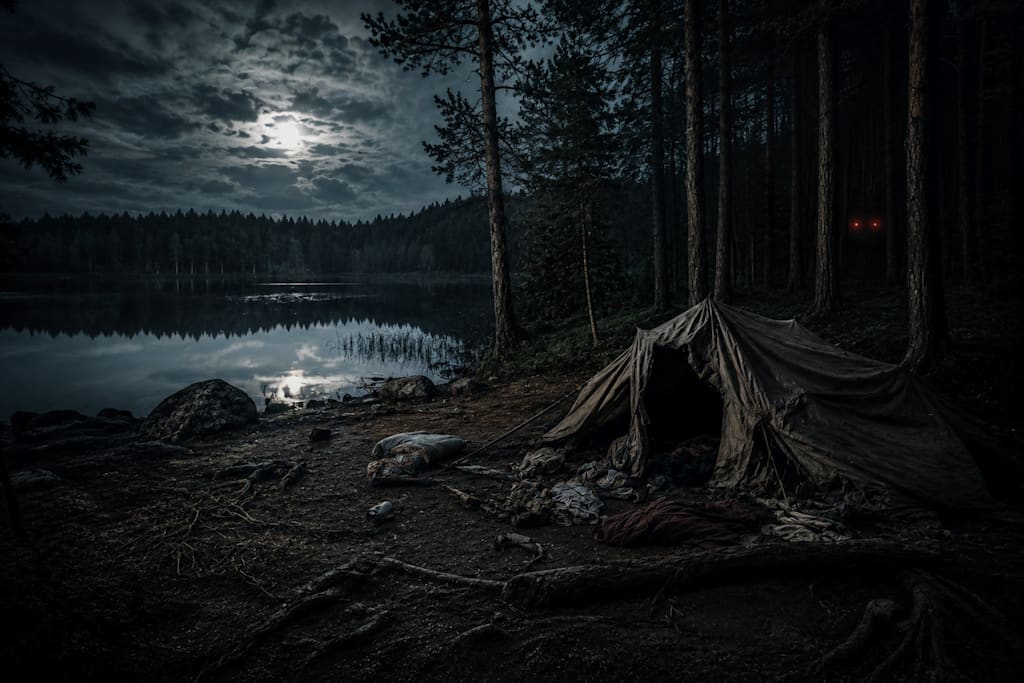
On summer nights in southern Finland, the sun barely disappears. Even after midnight, a pale glow lingers on the horizon, casting the forests and lakes in an eerie twilight. Pine trees stand motionless along the shoreline, their reflections stretching across dark water that seems to go on forever. It is a landscape of remarkable beauty… peaceful, quiet, and timeless.
In June of 1960, four teenagers arrived at one such lake hoping to enjoy exactly that. By the following morning, three of them would be dead. The fourth would survive with terrible injuries and a fragmented memory of what had happened.
More than six decades later, the Lake Bodom murders remain one of Finland's most haunting unsolved mysteries. Part crime story, part survival tale, and part modern folklore, the case occupies a strange place in the public imagination. Police files offer one version of events, rumors offer another, and somewhere between them lies the truth. A truth that may have vanished into the forest forever.
Lake Bodom sits just outside Helsinki, surrounded by thick woods and rolling countryside. In 1960, it was already a popular destination for young campers seeking a few days of freedom during the long Nordic summer. On June 4, four teenagers made the trip: fifteen-year-old Nils Gustafsson and his girlfriend, Tuulikki Mäki, along with their friends Seppo Boisman and Maila Björklund, both also fifteen. Like countless teenagers before them, they packed food, supplies, and a tent and headed for the lakeshore. Nothing about the outing appeared unusual. Friends and family expected them home soon. Instead, the campsite would become the scene of one of the most infamous crimes in Scandinavian history.
Sometime during the night, or perhaps in the earliest hours of June 5, something happened beside Lake Bodom. The exact sequence of events has never been established. When morning came, passersby noticed something deeply wrong: the tent had collapsed, belongings were scattered around the campsite, and inside and around the torn canvas lay three of the teenagers… dead. Nils Gustafsson, though severely injured, was still alive.
The scene baffled investigators from the very beginning. The attack appeared to have occurred from outside the tent. The canvas itself bore signs of violence, items belonging to the campers had been thrown about the area, and some possessions vanished entirely. Gustafsson suffered significant injuries, including facial fractures and a concussion so severe that his memory of the event would remain fragmented.
For police, the immediate task was straightforward in theory but impossible in practice: who had attacked the teenagers, and why? The surviving camper became the key witness, yet Gustafsson's recollections were incomplete and changed over time, as traumatic memories often do. In the days following the attack, he reportedly described seeing a figure near the tent. Later accounts, retellings, and rumors would add increasingly unsettling details, most famously stories that Gustafsson had spoken of a strange presence with glowing, or "red," eyes. Whether those descriptions originated with Gustafsson himself, grew through decades of embellishment, or emerged from the public's fertile imagination remains fiercely debated. But once such stories enter a mystery, they rarely leave.
Almost immediately, Lake Bodom ceased to be merely a murder investigation; it became something larger. The police launched one of the largest investigations in Finnish history. Suspects appeared quickly. One of the earliest was a local kiosk owner known for his erratic behavior and hostility toward campers; rumors swirled around him for years, fueled by stories that he despised visitors to the lake and had displayed violent tendencies. Yet no conclusive evidence ever connected him to the crime.
Other theories followed. Some investigators wondered whether the attacker had been a drifter moving through the area; others speculated that the crime had been committed by someone known to the victims. Still others suggested that crucial evidence had been mishandled during the chaotic early hours of the investigation. And there were certainly mistakes: the crime scene was not secured to modern standards, curious onlookers reportedly wandered through the area before investigators had completed their work, and potential evidence may have been disturbed or lost.
For decades, the case languished. Then, in 2004, forty-four years after the murders, Finnish authorities made a stunning announcement: they arrested Nils Gustafsson. The sole survivor had become the prime suspect. Prosecutors argued that Gustafsson himself had killed his friends during an argument that spiraled into violence, and advances in forensic analysis, they claimed, supported the theory. The revelation shocked Finland. For generations, Gustafsson had been viewed as the victim of a horrifying attack; now, in his sixties, he found himself accused of orchestrating one of the nation's most notorious crimes. The trial captivated the country. And then, almost as suddenly as the theory had emerged, it collapsed. In 2005, Gustafsson was acquitted; the court concluded that the evidence was insufficient, and the prosecution's case relied heavily on interpretation and speculation rather than definitive proof. Once again, the mystery returned to where it had begun: no suspect, no confession, no answers.
That alone would be enough to secure Lake Bodom's place among history's great unsolved crimes. But the story possesses another quality, one far more difficult to explain. Over the decades, the murders have accumulated legends. The forests around the lake became fertile ground for ghost stories and whispered warnings: campers exchanged tales of strange sounds after dark, locals spoke of shadowy figures glimpsed among the trees, and some claimed that the shoreline itself felt different after sunset. And always, the rumors returned to that unsettling image. A figure standing outside the tent, watching, red eyes glowing in the darkness.
Whether that image has any connection to reality is impossible to know. Trauma reshapes memory, stories grow with repetition, and human beings have an extraordinary talent for weaving myths around events they cannot explain. Yet myths do not emerge from nowhere; they grow in the spaces left behind by uncertainty. Lake Bodom offered uncertainty in abundance, and the setting itself seems designed to encourage it.
Unlike urban mysteries, where streetlights and crowds soften the edges of fear, Lake Bodom unfolds in wilderness. There are no witnesses hidden behind apartment windows, no passing traffic, only water, trees, and darkness. And darkness behaves differently in the forest: every sound carries farther, every movement feels closer, and the imagination, deprived of certainty, begins filling in gaps. What did the teenagers hear that night? Did they wake suddenly? Did they understand what was happening? Did the attacker speak? Or was the entire assault carried out in terrible silence? No one knows. The surviving witness could never provide a complete account, and the dead, of course, offered none.
Perhaps that is why the mystery continues to fascinate people so many years later. Most unsolved crimes eventually settle into familiar categories, greed, jealousy, revenge, or random violence, and the details become clearer as time passes. Lake Bodom resisted that process. Instead, the mystery expanded. It became not only a question of who committed the crime but of how memory, rumor, and fear transform history.
Because there are, in truth, two Lake Bodoms. There is the Lake Bodom preserved in police records and courtroom transcripts: a brutal, unsolved crime that claimed three young lives and left investigators grasping for answers. And then there is the Lake Bodom that exists in the imagination: the one inhabited by campfire stories, shadowy figures, and the suggestion that something incomprehensible stepped out of the woods in the pale Finnish night. Those two versions coexist uneasily. Neither fully erases the other.
Today, visitors still come to the lake. Children swim in its waters. Families picnic along its shores. Hikers wander the surrounding trails. In daylight, it appears exactly as it always has: peaceful and beautiful. But beauty and tragedy often occupy the same places. As evening falls and the last colors fade from the sky, it is not difficult to understand why the story endures. The forests remain dense. The lake remains quiet. The silence feels ancient. And somewhere, hidden within that silence, lies the answer to what happened in the early hours of June 5, 1960.
Perhaps the truth is painfully ordinary, a crime committed by a human hand, obscured by mistakes and lost evidence. Or perhaps the mystery has survived because people instinctively feel that some events resist ordinary explanations. After all, sixty-five years have passed. Suspects have come and gone. Trials have begun and ended. Witnesses have aged or passed. Investigators have retired. And yet the essential question remains exactly where it started.
Four teenagers went camping beside a beautiful lake. Only one came home alive. And on quiet nights, when the wind moves through the pines and the water turns black beneath the northern sky, people still wonder what stepped out of the darkness at Lake Bodom… and whether anyone will ever truly know.
About the Creator
Veil of Shadows
Ghost towns, lost agents, unsolved vanishings, and whispers from the dark. New anomalies every Monday and Friday. The veil is thinner than you think....
Enjoyed the story? Support the Creator.
Subscribe for free to receive all their stories in your feed.
Comments
There are no comments for this story
Be the first to respond and start the conversation.