
The Isdal Woman: The Spy Who Never Existed?
Behind the Veil Exclusive

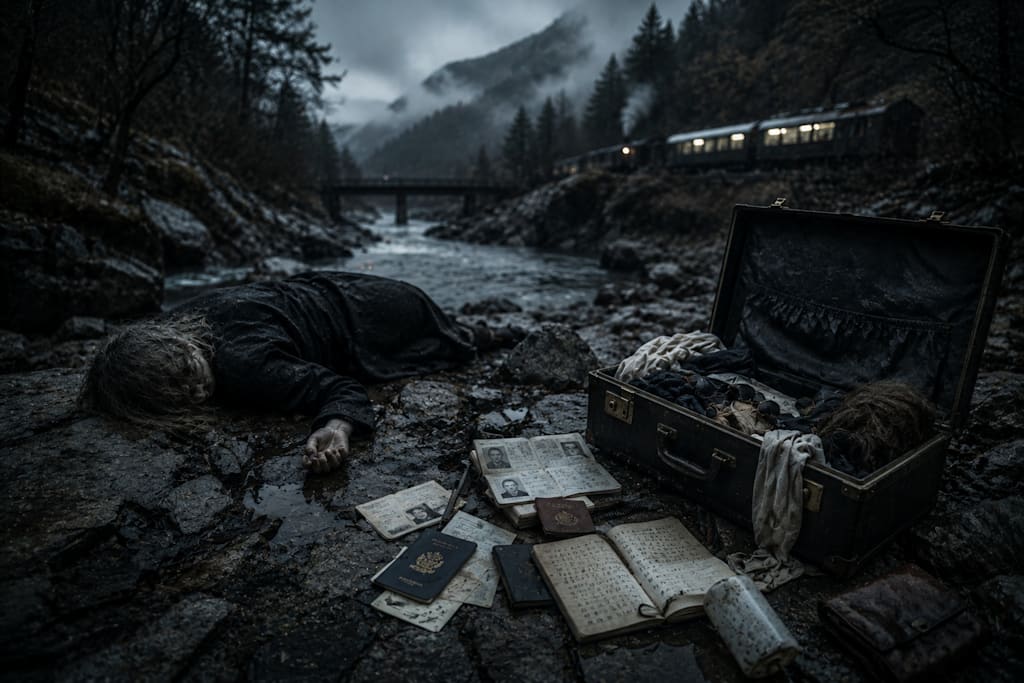
On November 29, 1970, a father and his two daughters were hiking through a remote, rugged valley near Bergen, Norway. Locals knew the area by an unsettling nickname: Death Valley. Though the name wasn't official, it had been earned over the years due to a number of accidents and suicides that occurred there. The valley was beautiful, but also lonely.
As the hikers moved through the rocky terrain, they noticed something unusual among the stones. At first, it appeared to be a pile of debris. Then they realized they were looking at a body, a woman, badly burned, lying among the rocks. The scene immediately struck investigators as strange, and it would only become stranger.
Over the following weeks, authorities uncovered a trail of clues so bizarre that the case would become one of Europe's most enduring mysteries. The woman had no identification, no obvious records, no known family, and no name. Yet she appeared to have spent months traveling across Europe under multiple identities. She carried coded notebooks, used aliases, changed appearances, and seemed determined to erase every trace of her true self. More than half a century later, nobody can say with certainty who she was. The world knows her only by the place where she died: the Isdal Woman. And her mystery remains one of the most baffling unsolved cases in modern history.
When Norwegian police examined the body, several details immediately raised questions. The woman had suffered severe burns. Nearby, investigators discovered personal items, including jewelry, an umbrella, and partially burned objects. Most unusual of all, the labels had been removed from her clothing, not torn accidentally or worn away by time, but deliberately removed. Every label, every identifying mark… gone.
At first, police assumed they were dealing with an unusual suicide. Then the investigation expanded, and the mystery exploded. Several days after the discovery, authorities located two suitcases linked to the woman at Bergen's railway station. The contents of the case transformed the investigation: inside were wigs, clothing, maps, sunglasses, cosmetics, foreign currency, and evidence suggesting the woman had traveled extensively throughout Europe. But there was something even stranger, just as with the clothing found on her body, identifying information had been meticulously removed. Labels had been cut away, names erased, ownership marks destroyed. Investigators also discovered a prescription lotion bottle with the prescribing doctor's name carefully scraped from the container. Someone had gone to extraordinary lengths to ensure that no trail could be followed. This wasn't random. This wasn't careless. It was systematic, professional, almost obsessive.
Then police found the notebooks. At first glance, they appeared ordinary, but the pages contained a series of cryptic entries, letters, numbers, dates, and seemingly meaningless combinations arranged in patterns. Investigators eventually concluded that the entries represented coded travel records, documenting a complex series of journeys as the woman moved frequently between cities and countries. But the notebooks revealed little about who she actually was; instead, they raised even more questions. Who keeps coded travel records? Why hide them? And what exactly was she doing?
As police continued digging, they discovered that the woman had checked into hotels throughout Europe using numerous false identities. Witnesses described a well-dressed woman who often appeared reserved and cautious. She spoke several languages, seemed educated, and frequently changed her appearance. Some hotel staff remembered her wearing different wigs, others recalled unusual behavior, and several reported that she appeared to be watching people around her. One witness claimed she seemed particularly interested in military activities, while another recalled her asking questions about local defense installations. These details would eventually fuel one of the most popular theories surrounding the case: the spy theory. And honestly, it's not difficult to see why.
The timing alone is suspicious: the year was 1970, the Cold War was in full swing, and Europe had become a battleground of secrets. East and West watched one another constantly, intelligence agencies operated across borders, and spies moved through cities under false identities. Dead drops, coded messages, and covert meetings were all very real parts of daily intelligence work. The Isdal Woman appeared to fit the profile: multiple aliases, extensive travel, secretive behavior, coded notebooks, and erased identities. To many observers, she looked exactly like an intelligence operative. There was another intriguing detail; several of the locations she visited were near military facilities and sensitive installations. This may have been a coincidence. Over the decades, speculation has linked her to numerous intelligence agencies: some believe she worked for the Soviet Union, others suspect a Western service, and a few researchers have proposed she acted as a courier carrying information between contacts. The problem is that no evidence has ever conclusively supported any particular theory. No intelligence agency has claimed her, no classified files have surfaced identifying her, and no former operatives have stepped forward with answers. As compelling as the spy theory is, it remains exactly that, a theory.
Yet if she wasn't a spy, who was she? Some investigators believe she may have been fleeing something. Perhaps running from an abusive relationship, involved in criminal activity, or simply had reasons to disappear that had nothing to do with espionage. The false identities and removed labels could have been attempts at self-protection rather than tradecraft.
But this explanation encounters a troubling problem: nobody appears to have been looking for her. Think about that for a moment. A woman travels across Europe, stays in hotels, interacts with dozens of people, crosses borders, leaves behind luggage, and dies under mysterious circumstances. And yet, no family member successfully identifies her, no missing-person report definitively matches her, no childhood friend comes forward, and no former employer recognizes her. No one can conclusively say, "That is who she was." That level of disappearance is extraordinarily rare, even today.
Then there is the question of how she died. Officially, authorities concluded that the Isdal Woman took her own life. Yet controversy erupted almost immediately. Some investigators felt aspects of the scene did not fit neatly with suicide, and questions arose regarding the positioning of the body, witness accounts, and the circumstances leading up to her death. Some believed she had been murdered. Others believed the scene may have been staged. The debate continues to this day.
Every theory seems to explain part of the puzzle while creating new mysteries elsewhere. If she was murdered, who killed her? If she was a spy, who was she working for? If she was hiding, what was she hiding from? And perhaps most importantly: why was every trace of her identity removed?
Years passed, then decades. The mystery refused to die. New forensic techniques emerged, investigators revisited the evidence, journalists dug through archives, and researchers retraced her movements. DNA analysis provided new clues regarding her ancestry, and forensic facial reconstructions attempted to show what she may have looked like in life. Each development generated headlines and raised hopes, yet none produced a definitive answer. The Isdal Woman remained unidentified. The deeper investigators looked, the stranger the case became.
Perhaps that is why the mystery continues to fascinate people around the world. Most unsolved cases eventually narrow, possibilities shrink, and evidence accumulates. This one does the opposite: the more information emerges, the larger the mystery becomes. Because the central question has never changed, who was she? Not merely how did she die, but who was she? Where was she born? What language did she speak at home? Did she have parents, brothers, sisters, children? Did anyone love her? Did anyone miss her? Was she living a double life, or ten different lives? Those questions remain unanswered, and they may never be answered.
Somewhere in Europe, there may once have been a woman who carefully erased herself from the world. She traveled under false names, hid her tracks, and left behind coded notes and scattered clues. Then she died in a remote valley known as Death Valley. Half a century later, investigators still follow her trail, and it always ends in the same place: a burned body among the rocks, a suitcase filled with secrets, a handful of aliases, and a mystery so complete that even now, after all these years, the Isdal Woman remains exactly what she appears to have wanted to be… a ghost. Not because she haunted the living, but because she somehow managed to vanish while standing in plain sight. And perhaps the most unsettling possibility of all is this: somewhere, someone once knew exactly who she was, and they took that secret to the grave.
About the Creator
Veil of Shadows
Ghost towns, lost agents, unsolved vanishings, and whispers from the dark. New anomalies every Monday and Friday. The veil is thinner than you think....
Enjoyed the story? Support the Creator.
Subscribe for free to receive all their stories in your feed.
Comments
There are no comments for this story
Be the first to respond and start the conversation.