
The Infinite Platform
A salaryman’s midnight commute turns into a logicless nightmare of wet rust, shifting anatomy, and a destination that doesn't exist on any map.

The digital clock inside the train car didn’t show the time. It showed three blinking horizontal lines: --:--.
Kenji sat alone on the damp, green fabric of the commuter train. He was exhausted. The structural audit of the abandoned mountain tunnel had taken fourteen hours, and his brain felt like old paper soaked in rainwater. He remembered boarding the last train back to Tokyo. He remembered the hum of the tracks.
But trains in Japan run with terrifying, mathematical precision. They do not run in complete silence.
Kenji looked out the window. There was no neon, no concrete, no reflection of his own face. Only a thick, suffocating blue fog pressing against the glass. The train was moving, but he couldn't feel the vibration in his boots. The physical reality of the commute had unraveled while he slept.
“Next station… Shinjuku,” the automated voice chimed. But it wasn’t a recorded woman's voice. It sounded like his own voice, pitch-shifted, speaking with a mechanical delay.
The train slowed down, the brakes producing a wet, organic screech rather than the grind of iron. The doors slid open.
Outside was not Shinjuku. It was an abandoned rural platform, decaying and swallowed by the mountain night. The air smelled of rusted iron and old coins left in a well. Kenji’s instincts screamed at him to stay on the train, but a sudden, heavy pressure in his chest forced him to step forward. The moment his leather shoes touched the cracked concrete, the train doors snapped shut behind him.
The train didn’t pull away. It simply dissolved into the fog, leaving only the smell of burnt electricity.
The station had no exit signs. The only structure was a wooden waiting room with broken sliding screens. On the wall hung a standard anatomy poster, like the ones from his middle school science lab. But as Kenji stared at it under the flickering fluorescent light, the muscle fibers on the diagram began to twitch. The painted eyes of the skinless figure shifted, tracking his movement.
Kenji staggered backward. Panic, cold and sharp, flooded his veins. This was the logic of a fever dream—the terrifying distortion of familiar things.
He ran down the platform, looking for the stairs. Instead, he found a rusty red railroad crossing barrier sitting directly on the concrete, blocking nothing but the empty air. Clang. Clang. Clang. The alarm began to wail, vibrating inside his teeth.
From the fog on the tracks below, things began to crawl.
They weren't monsters from folklore. They were flat, human silhouettes made of thick, black sludge, their shapes mimicking people he knew—his boss, his mother, the old woman he had seen buying rice that morning. They didn't have faces, but they were weeping. The sound of their crying was the sound of a train horn, distorted and echoing in the mountain air.
"This is a dream," Kenji whispered, squeezing his eyes shut. "Wake up. Wake up."
He turned and bolted down the dark asphalt path leading away from the platform. The fog grew denser, freezing his lungs. The geometry of the space was broken; the faster he ran forward, the closer the waiting room seemed to get behind him. The flickering light from the science poster cast a long, jagged shadow that stretched toward his heels like a claw.
He could hear footsteps behind him. Not the squelch of the sludge creatures, but the sharp, rhythmic click-clack of wooden sandals (geta) on the asphalt. They were perfectly synchronized with his heartbeat.
The air turned thick, smelling heavily of sandalwood incense—the scent of a Japanese funeral.
Kenji tripped, his hands scraping against rough, mossy stone. He looked up. The asphalt path had vanished. He was kneeling in a vast, empty courtyard centered around a colossal, dead cedar tree. Wrapped around its rotting trunk was a thick straw rope (shimenawa) dripping with dark, black water.
The clicking of the sandals stopped right behind him. A heavy, freezing hand pressed down on his shoulder. The weight of it was immense, crushing his collarbone.
"You shouldn't have audited the tunnel," his own voice whispered into his ear, but it was wet, filled with the sound of rushing water. "We were sleeping inside the stone."
Kenji screamed, a sound that tore at his throat, and the world went entirely black.
Kenji opened his eyes with a violent gasp.
His heart was hammering against his ribs, his chest heaving as he drank in the cool, climate-controlled air. He sat up quickly, his hands shaking.
He wasn't on the dark platform. He wasn't by the dead tree.
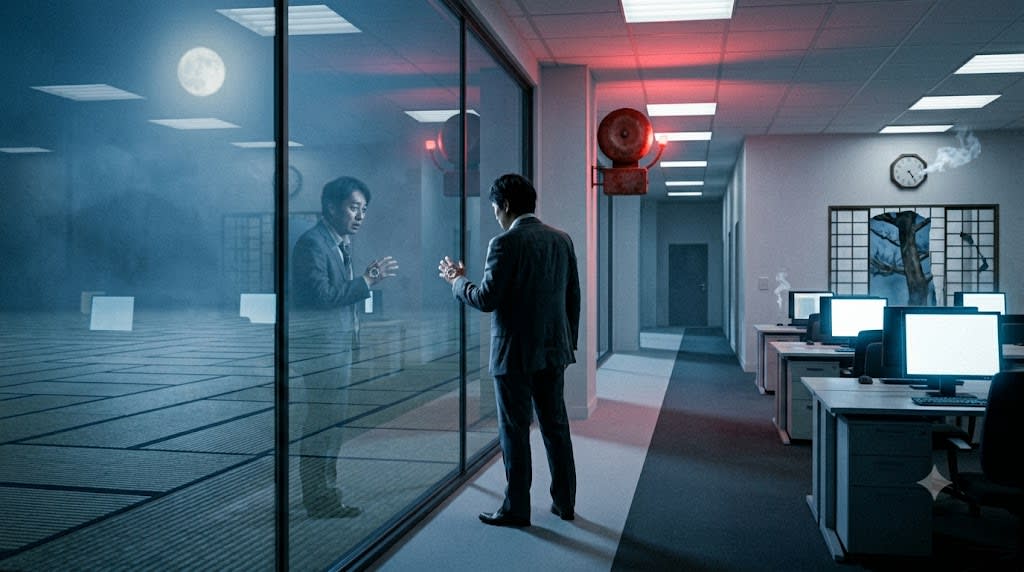
He was in an office. A perfectly modern, brightly lit Tokyo office. The fluorescent lights overhead hummed with a comforting, mundane buzz. Around him, dozens of desks were neatly arranged, computer monitors glowing with spreadsheets and architectural blueprints.
"Just a dream," Kenji breathed, pressing his palms against his face. "A horrific, stress-induced nightmare."
He let out a weak, trembling laugh and reached down to pick up his smartphone from the desk to check the time. But his hand froze.
The office was completely silent. There were no sounds of typing, no murmurs of colleagues, no traffic from the street outside. He stood up and looked across the room. The desks were entirely empty. There was no one here.
Kenji walked toward the massive glass windows that overlooked the Tokyo skyline. He expected to see the sea of neon, the Tokyo Tower, the crowded streets of Roppongi.
Instead, outside the glass, there was only an infinite, flat expanse of woven tatami mats stretching out into a horizon of thick, blue fog under a pale, motionless moon.
He looked down at his hands. Embedded beneath the skin of his knuckles, tiny grains of uncooked white rice were neatly arranged in a perfect, geometric circle.
And then, from the hallway behind him, he heard the distinct, rhythmic sound of a train alarm beginning to ring. Clang. Clang. Clang.
About the Creator
Takashi Nagaya
I want everyone to know about Japanese culture, history, food, anime, manga, etc.
Enjoyed the story? Support the Creator.
Subscribe for free to receive all their stories in your feed.
Comments
There are no comments for this story
Be the first to respond and start the conversation.