
THE HOUSE THAT HID MORE THAN SECRETS
Prospect Place: Underground Railroad, Forgotten Lives, and the Haunting History of an Ohio Mansion

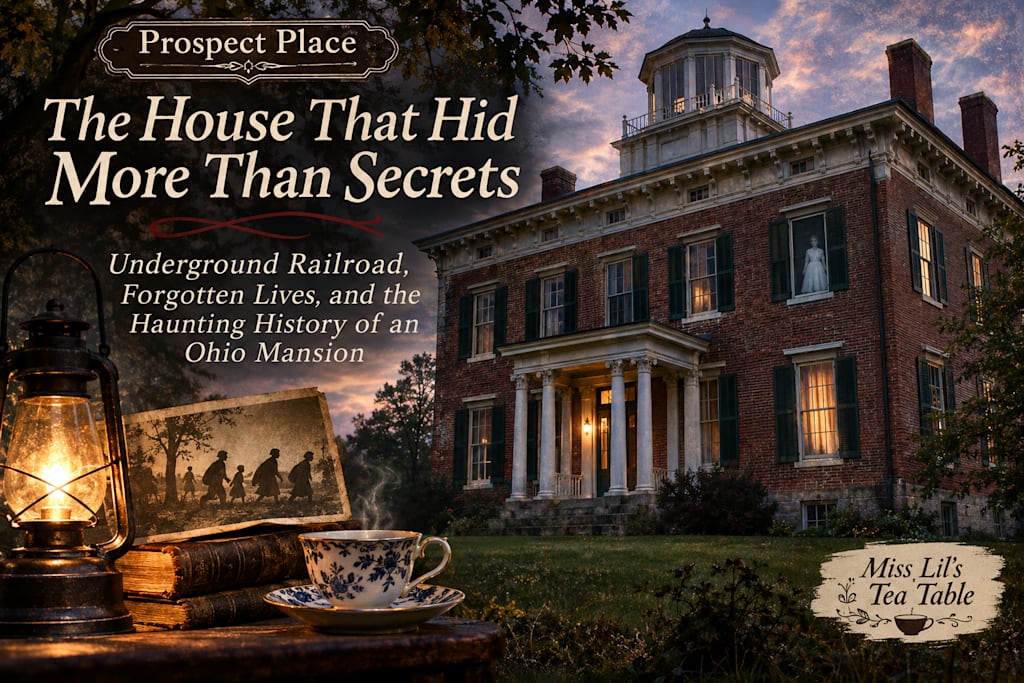
THE HOUSE THAT HID MORE THAN SECRETS
Prospect Place: Underground Railroad, Forgotten Lives, and the Haunting History of an Ohio Mansion
MISS LIL'S TEA TABLE | HAUNTED HISTORY & FORGOTTEN PLACES
There are houses that hold memories. There are houses that hold secrets. And then there are houses whose histories seem to have accumulated so many unanswered questions that even the walls appear reluctant to give them up.
Tucked into the Ohio countryside, between Dresden and Trinway, stands a remarkable nineteenth-century mansion known as Prospect Place. Its imposing brick exterior, sprawling rooms, and distinctive cupola make it difficult to overlook. But the real story of this property isn't simply about its architecture or the wealthy family who called it home.
It is about freedom.
It is about the people who risked everything to help others escape slavery. It is about a family whose convictions were shaped by the very institution they rejected. It is about a mansion that witnessed changing generations, unexpected tragedy, and a disappearance that left a family searching for answers.
And, naturally, there are the ghost stories.
So settle in, grab your favorite cup, and let's take a closer look at a house that may have hidden considerably more than its original owners ever intended.
A HOUSE BUILT ON CONVICTION
Prospect Place, also known as the George Willison Adams House or the Adams-Cox House, is located in Trinway, Muskingum County, Ohio.
The mansion was constructed in 1856 by George Willison Adams, a prosperous businessman, community leader, and abolitionist. It contained 29 rooms and was designed to reflect the wealth and standing of the Adams family.
But the family's story began long before the mansion's impressive brick walls were raised.
The Adams family originally came from Fauquier County, Virginia. George Beal Adams, George Willison's father, had lived in a slaveholding state, but he opposed the institution of slavery. According to a historical account published in the Zanesville Times Signal in 1948, he freed the people he enslaved and moved his family to Ohio in 1808, seeking a future in a state where slavery was prohibited.
That decision would shape the next generation.
George Willison Adams inherited his father's opposition to slavery. Alongside his brother Edward, he built a successful milling and shipping business, eventually becoming a man of considerable influence in the region.
He was also willing to put his convictions into action.
This was not simply a matter of disagreeing with slavery from the comfort of a wealthy home. Adams became involved in the dangerous work of helping enslaved people escape bondage.
The family had money, property, commercial connections, and influence. Those resources could be used for more than business.
They could be used to help people find freedom.
And that is where the story of Prospect Place becomes considerably more important than its grand architecture.
BEFORE THE MANSION, THERE WAS A FIRE
There is something rather unsettling about a house that never quite got its first beginning.
The original Prospect Place was completed in 1856. The family had watched its construction, a substantial brick structure rising above the surrounding countryside. It featured three stories, a two-story servants' wing, ornate architectural details, and a cupola crowning the roof.
It was meant to be the family's new home.
But the night before the Adams family was scheduled to move in, disaster struck.
The mansion caught fire and burned to the ground.
Imagine that for a moment. Years of planning, considerable expense, and the anticipation of moving into a beautiful new home, all reduced to smoke and rubble before the family could even unpack.
The fire became the beginning of one of Prospect Place's earliest mysteries.
Local stories offered competing explanations. One particularly colorful legend blamed an elderly Native American woman known as Old Satan, who was supposedly angered because the mansion had been built over a Shawnee burial ground.
Another account accused a bricklayer named George Blackburn of deliberately setting the fire to create more work for himself.
According to the estate's historical account, Blackburn was arrested and sent to prison after Adams learned of the allegation. He later escaped.
The story of Blackburn is itself an unusual piece of local lore, although the precise circumstances of the fire and the accusation deserve careful historical scrutiny.
What we do know is that Adams refused to abandon his plans.
The mansion was rebuilt on the same foundation, following the original design.
The second Prospect Place would become the home remembered today.
One has to wonder whether the family ever looked at those walls and thought about what had happened to the first house.
THE HOUSE THAT HELPED PEOPLE ESCAPE
The phrase Underground Railroad has a way of conjuring images of secret tunnels, underground chambers, concealed doors, and elaborate escape routes.
The reality was often much less theatrical and considerably more dangerous.
The Underground Railroad was a network of people, homes, businesses, churches, and other locations that helped enslaved people escape to freedom. It was not an actual railroad, and the word underground referred to the secrecy surrounding its operations.
Those involved risked imprisonment, financial ruin, violence, and even death.
For someone escaping slavery, the journey north was not a romantic adventure. It was a desperate attempt to reclaim a life that had been stolen.
And Prospect Place became part of that struggle.
George Willison Adams and his brother Edward had previously used their milling operation as a station. As tensions surrounding slavery intensified during the 1850s, the brothers reportedly shifted the operation to George's new home.
There was a practical reason for this.
A busy commercial operation could be placed at risk if its connection to abolitionist activity became known. A private residence offered a different kind of cover.
The mansion's history identifies its gentlemen's parlor as a likely location for abolitionist meetings. The home also became associated with the activities of local Underground Railroad conductor Nelson T. Gant.
Gant's story deserves particular attention.
He was formerly enslaved in Virginia, having gained his freedom following the death of his enslaver. He moved to Ohio, where he established an orchard and a coal-mining operation in Zanesville. Through his business ventures, he became wealthy and an important figure in the local Underground Railroad network.
Think about the significance of that.
A man who had once been enslaved became a successful businessman and then helped others pursue the freedom he had obtained.
He was not merely a name passing through someone else's history. He was an active participant in the work of liberation.
The possibility that Gant regularly visited Prospect Place adds another important dimension to the mansion's history.
THE TUNNEL THAT MAY NEVER HAVE EXISTED
Now, we need to address one of the most persistent stories attached to Prospect Place.
The underground tunnel.
For years, stories have circulated about a hidden passage beneath the mansion, supposedly used to conceal freedom seekers or provide an escape route if slave catchers came searching.
It is a wonderfully atmospheric image. A hidden doorway, a dark passage beneath the floorboards, and people quietly disappearing into the earth while danger waits outside.
But there is a problem.
During restoration work, no confirmed Underground Railroad tunnel has been discovered beneath Prospect Place.
The estate's own historical account explains that a subfloor refrigeration pit exists in the basement. This unusual feature could easily have contributed to the tunnel legend. It may also have offered an emergency escape opportunity, although that use has not been established.
And here is something worth remembering: the Underground Railroad did not require underground passages to operate.
A concealed room, an ordinary cellar, a carriage, a mill, or a sympathetic neighbor could be every bit as important.
We should not confuse the absence of a tunnel with the absence of history.
The people who sought freedom did not need a cinematic underground railway. They needed somewhere safe to hide, someone willing to help, and a chance to survive the journey.
That is frightening enough without adding a secret passage.
THE PEOPLE WHO MADE PROSPECT PLACE A HOME
It is easy to become so fascinated by the Underground Railroad and the paranormal stories surrounding Prospect Place that we forget something rather important.
People actually lived here.
They raised children, entertained guests, celebrated milestones, experienced heartbreak, and went about their daily lives in a house that would eventually become the subject of ghost stories.
George Willison Adams and his wife Mary raised their family at Prospect Place. Their children included John Jay and Sophia, born after the family moved into the rebuilt mansion.
The house was also home to other members of the Adams family, including children from George's earlier marriage.
A particularly interesting historical account appeared in the Zanesville Times Signal on August 29, 1948. The article, written by Norris F. Schneider, included information provided by a descendant of the Adams family.
It described a house that was considerably more elaborate than the average nineteenth-century residence.
There was a library furnished with black furniture and red leather seats. There were three stairways, marble fireplaces, bedrooms finished in green paint, and a servants' wing with smaller rooms.
The third floor served as a ballroom.
Let that sink in for a moment.
A ballroom occupying an entire floor of a private mansion in rural Ohio!
The observatory at the top of the house was another unusual feature. Surrounded by glass windows and opening French-style doors, it was used for preparing food during large celebrations.
The mansion was built for entertaining, and entertaining it certainly did.
One particularly memorable celebration involved a reception for an Episcopal bishop. More than 200 people reportedly attended from around the state.
According to the property's historical account, specially refrigerated railway transportation even brought ice cream to the celebration, making it an early milestone in the county's culinary history.
Prospect Place wasn't simply a secluded hiding place for people escaping slavery. It was also a center of wealth, family life, business, and community activity.
And those lives would eventually become part of the house's complicated legacy.
A SON WHO MADE HIS OWN HISTORY
One of the most notable people born at Prospect Place was John Jay Adams.
Born on November 18, 1860, John Jay grew up to become a respected Ohio attorney and judge.
He attended Kenyon College, studied law in Zanesville, and eventually served as a judge on Ohio's Fifth Circuit Court.
His accomplishments extended beyond the courtroom. He later became associated with Ohio State University, serving as dean of its law school and acting president.
It is rather remarkable to think that a child born in a house associated with the Underground Railroad would go on to become a prominent figure in Ohio's legal and educational history.
The mansion's significance was never limited to the people who passed through it seeking freedom. It was also the birthplace of people who would go on to shape their communities.
And yet, as the generations passed, the family's fortunes and circumstances changed.
The house that had once been filled with celebrations and activity would eventually become associated with a much more troubling family mystery.
THE MAN WHO WALKED AWAY AND NEVER CAME HOME
If Prospect Place were a fictional setting, this would be the moment when someone would lower their voice and suggest that perhaps the house had never been quite right.
But this particular mystery doesn't need embellishment.
It has its own newspaper trail.
By the late nineteenth century, Prospect Place had passed into the hands of George Adams's descendants. His daughter Anna married William Evans Cox, and the couple became associated with the mansion.
William Cox was a wealthy man who enjoyed entertaining. In 1886, he invested considerable money in improvements to the property, including a new floor in the main hall and a replacement slate roof for the barn.
The family continued to entertain guests, and the mansion remained a place of considerable social activity.
Then William disappeared.
According to an account preserved by Historic Prospect Place, William left home on November 15, telling his family he was going to Zanesville on business.
He never returned.
His disappearance became a subject of considerable local attention. A detective was reportedly employed to search for him, but no immediate trace could be found.
Then came an extraordinary development.
A woman named Jennie Adams, who had formerly lived in Dresden, reported seeing William on the streets of San Francisco.
She recognized him and approached him, calling his name.
Instead of greeting her, William allegedly hurried away.
When she followed him into a cigar store, he moved through another exit and disappeared from her sight.
The woman subsequently wrote to his wife, Anna, explaining what she had witnessed.
There was another curious detail. William had reportedly been seen traveling with a mysterious companion, a man whose description matched the individual Jennie Adams claimed to have seen with him in California.
Why had William left?
Was he in financial trouble? Had he deliberately abandoned his family? Was there something happening in his personal affairs that nobody at home understood?
The surviving account doesn't establish his motive.
What it does establish is that Anna was left behind, and her family spent years trying to determine what had happened.
Their son, George Cox, reportedly devoted a considerable portion of his life and money to finding his father.
For a long time, the mystery remained unresolved.
THE SAN FRANCISCO CONNECTION
The Historic Prospect Place website now provides a likely explanation for William's fate.
A Cox family genealogist reportedly identified evidence suggesting that William settled in California. The family believes he may have been staying in a San Francisco hotel when the devastating earthquake and fires of April 1906 destroyed much of the city.
He may have been among those killed.
This remains a proposed resolution rather than a conclusively documented identification of his death. Nevertheless, it offers a possible ending to a disappearance that had haunted the family for generations.
And there is something particularly sad about that.
A man walked away from a home where his family expected him to return. His wife never received a proper explanation, and his son spent much of his life looking for him.
The mansion had witnessed celebrations, family milestones, and the quiet business of everyday life.
Now it also carried the memory of a family left with unanswered questions.
THE GHOSTS OF PROSPECT PLACE
And now, dear readers, we arrive at the portion of our tea that may require a little extra sugar.
Prospect Place has developed a considerable paranormal reputation. It has attracted ghost hunters, paranormal investigators, and television crews interested in the possibility that something other than history remains within its walls.
The property itself offers flashlight tours and paranormal investigation events, inviting visitors to explore the mansion's legends and decide what they believe.
Among the stories associated with the estate are reports of unexplained footsteps, shadowy figures, strange sounds, and alleged electronic voice phenomena.
But several particular stories stand out.
THE LITTLE GIRL IN THE HOUSE
One of the most frequently repeated tales involves a young girl who supposedly died after falling from an upper balcony during the winter.
According to the story, the ground was frozen, preventing her burial. Her body was allegedly kept in the basement on ice until the earth thawed.
Her mother supposedly visited her there every day.
The girl's spirit is said to appear throughout the mansion, with some accounts describing a small figure near the windows.
It is a heartbreaking story, and it is easy to understand why it has become one of the property's most enduring ghost legends.
However, there is an important distinction here: the paranormal account has not been substantiated by the historical documentation we've examined. We should not present the girl's identity, death, or alleged burial arrangements as established fact.
THE MAN IN THE BARN
Another story concerns a supposed encounter between George Adams and a bounty hunter who came to the property demanding the return of an enslaved person.
The paranormal version describes an armed confrontation, followed by the bounty hunter being captured, tried in the barn, and hanged.
Some visitors and investigators have subsequently reported unusual experiences in the barn, including sensations of being touched and sightings of a male figure.
It is an especially dramatic story, but the account comes from paranormal reporting rather than independently established historical evidence.
The broader historical context is certainly believable: bounty hunters and slave catchers posed a genuine threat to those assisting freedom seekers. The specific incident at Prospect Place, however, requires corroboration before we can treat it as fact.
ANNA'S LINGERING PRESENCE
And then there is Anna Adams Cox.
Remember the woman whose husband disappeared?
Paranormal accounts claim that Anna spent her later years lonely and heartbroken after William vanished. Some stories suggest that she never truly left the mansion and that her spirit continues to wander its rooms.
There is an undeniable human sadness in Anna's documented story. She was left to raise her family without knowing what had happened to her husband.
But whether she remains at Prospect Place in any supernatural sense is another question entirely.
I would rather give Anna her proper place in history than turn her into nothing more than a ghost story.
WHAT INVESTIGATORS HAVE REPORTED
A paranormal investigation conducted by the North Ohio Paranormal Scientific Society in May 2010 documented several experiences at the property.
Investigators reported unusual sounds, unexplained movement of light, physical sensations, and what they interpreted as possible apparitions.
The team also discussed recordings that they believed contained unexplained voices.
These are investigator-reported experiences, not independently verified proof of paranormal activity.
Still, they help explain why Prospect Place continues to attract people interested in the unexplained.
A MANSION THAT ALMOST DISAPPEARED
For all its history, Prospect Place nearly became a forgotten ruin.
By the twentieth century, the property had passed through several generations of the family. Eventually, ownership changed hands, maintenance declined, and the mansion began suffering the consequences of neglect.
In 1969, George Cox sold the property to Cox Gravel Company.
During the 1970s and 1980s, the mansion deteriorated. Water damage, vandalism, and structural problems took their toll. Floors became unsafe, portions of the building collapsed, and the roof was in danger of failing.
In 1988, the property was facing demolition.
Fortunately, someone recognized what would be lost.
Local businessman and preservationist Dave Longaberger, who was related to the Adams family, became involved in an effort to save the mansion. His company purchased the property and began restoration work, including installing a new roof.
Unfortunately, Longaberger's declining health interrupted those plans.
In September 2001, George Jeffrey Adams, a descendant of the original owner, purchased the property. Restoration efforts continued, and the G. W. Adams Educational Center eventually took ownership.
Today, the nonprofit organization works to preserve the mansion and its grounds, offering educational programs, historical tours, and paranormal events.
Prospect Place was also added to the National Register of Historic Places on May 10, 1979.
It survived fire, neglect, vandalism, and the threat of demolition.
Perhaps its most important survival, however, is that its history has not been entirely forgotten.
WHAT THE HOUSE REALLY HID
There is something I keep coming back to when researching Prospect Place.
We spend so much time looking for ghosts that we sometimes overlook the people who were actually there.
We talk about mysterious figures in windows, unexplained footsteps, and strange voices caught on recording equipment.
But imagine the people who once stood inside those rooms.
Imagine a family willing to risk its fortune and reputation to help enslaved people escape. Imagine someone arriving at that property after traveling through dangerous territory, exhausted, frightened, and uncertain whether the next person they encountered would offer assistance or betray them.
Imagine the quiet tension of an abolitionist meeting, the knowledge that the wrong visitor could expose everyone involved, and the terrible consequences that could follow.
Imagine the children growing up in that mansion, the celebrations held in its ballroom, and the families who eventually experienced loss and heartbreak within those same walls.
And imagine Anna Cox, waiting for a husband who never came home.
These are not ghost stories. These are pieces of human history.
The mansion may have hidden people from those who wanted to return them to slavery. It may have concealed conversations that could not safely be spoken aloud. It may have sheltered people whose names were never recorded and whose stories were never fully told.
That is the part of Prospect Place that deserves our attention.
As for the paranormal stories?
Well, I am not going to tell you that every shadow is a spirit or every unexplained noise is someone trying to communicate from the other side.
Miss Lil has standards, after all.
But I will say this: Prospect Place has more than enough history to make a person pause before walking through its doors.
And if something happens to whisper your name while you're standing in that old mansion, perhaps you should take a moment before deciding whether to answer.
Just saying.
THE FINAL POUR ☕
Prospect Place is a reminder that historic buildings are more than collections of bricks, beautiful woodwork, and old photographs.
They are witnesses.
They stand through generations of human triumph, suffering, courage, mistakes, and mysteries. Sometimes their stories are carefully recorded. Sometimes they survive through family memories and local legends. And sometimes, the truth gets lost somewhere between what happened and what people believe happened.
The story of Prospect Place contains all three.
Its connection to the Underground Railroad gives it a significance that reaches far beyond Ohio. Its family history offers glimpses into a changing America. Its mysteries remind us how easily a person's story can become fragmented with time.
And its haunting reputation ensures that people continue to ask questions.
Perhaps the most important question isn't whether Prospect Place is haunted.
Perhaps it is whether we have truly listened to everything its history has been trying to tell us.
Until next time, keep your tea warm, your curiosity alive, and remember:
Sometimes the most haunting things about an old house aren't the ghosts. They're the stories of the people who once called it home.
Miss Lil has finished her tea. The house, however, still has a few stories left to tell.
About the Creator
Lilithea Adasia
I dig where others look away. 🖤 True crime, paranormal mysteries, uncomfortable truths, and the beautifully broken human experience. I chase the stories others bury and ask the questions others avoid. Come curious. Leave questioning.
Enjoyed the story? Support the Creator.
Subscribe for free to receive all their stories in your feed. You could also become a paid subscriber, letting them know you appreciate their work.
Comments
There are no comments for this story
Be the first to respond and start the conversation.