
The House That Drove Its Owners Away: The Haunting of Hinton Ampner
Freakery Friday Edition

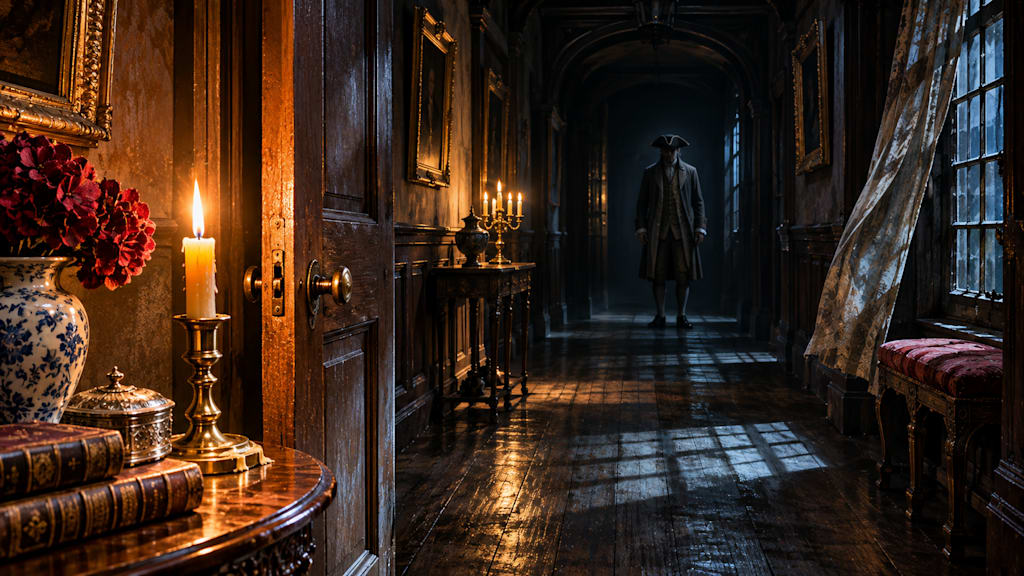
Editor’s Note: This article examines reported disturbances at Hinton Ampner, Hampshire, between 1765 and 1771, drawing on the surviving writings of Mary Ricketts, historical correspondence, and later research. These records exist; the supernatural interpretation of the events does not. Atmospheric descriptions are literary reconstructions, not invented eyewitness evidence. Disputed details are identified as such.
The Footsteps in the Empty Room
Hampshire, England. 1771. The house has settled into darkness. Beyond its walls, the English countryside lies beneath the night sky. Inside, the corridors of Hinton Ampner are quiet, their heavy doors closed against the chill.
Mary Ricketts is in her bedchamber. She knows the sounds of this house. The ordinary creaking of old timber. The occasional movement of servants. The subtle noises that accompany any building standing through the changing seasons. But something has begun happening that she cannot explain.
There are footsteps. Not the distant, uncertain sounds of someone crossing a courtyard. These seem close. Then comes another noise. The unmistakable rustling of clothing. As though a woman wearing a long silk dress has entered the room and is moving somewhere nearby.
Mary listens. There should be nobody there. The sound continues. And then, just as mysteriously, it stops. For a moment, the house is quiet again. But Mary has learned something deeply unsettling during her years at Hinton Ampner. Silence doesn't necessarily mean whatever is making the noises has gone away.
This was the atmosphere described in one of England’s most remarkable eighteenth-century haunting accounts.
Unlike many ghost stories that have accumulated anonymous witnesses and increasingly elaborate legends over the centuries, a woman who lived in the house recorded the disturbances at Hinton Ampner. Her account survives. So does correspondence concerning attempts to discover what was happening. And what those documents describe is not a single frightening night. It is a household gradually worn down by years of experiences its occupants could not satisfactorily explain.
An Old House in Hampshire
The original Hinton Ampner manor stood near Alresford in the Hampshire countryside. It was an old Tudor house, situated near the village church and surrounded by the landscape of a substantial country estate. In 1765, William Henry Ricketts and his wife, Mary, took up residence there with their family and household servants. The property belonged to Mary Bilson-Legge, Baroness Stawell, who would later marry Wills Hill, Earl of Hillsborough.
The Ricketts family occupied a comfortable position in Georgian society, though that comfort rested on a darker economic foundation. William’s business interests included plantation property in Jamaica and the exploitation of enslaved people. His commercial affairs would eventually require him to be away overseas for an extended period. Mary, meanwhile, would remain in Hampshire with the children and servants.
The house initially seemed like an ordinary country residence. But according to Mary’s later account, the disturbances began soon after the family settled there.
The earliest incidents were comparatively simple. Doors opened and closed. Footsteps sounded where no one was expected. And sometimes the doors did not merely close. They slammed with extraordinary force.
Mary described hearing doors being struck shut so violently that the noise seemed entirely disproportionate to ordinary household activity. At first, there were obvious explanations. Perhaps a servant had been careless. Perhaps someone was playing a practical joke. Perhaps villagers had obtained keys and were entering the building without permission.
New locks were installed. But the noises reportedly continued. Whatever explanation the household sought, it did not seem to end the problem.
And before long, the servants began reporting something more disturbing than sounds. They claimed to have seen people who did not belong in the house.
The Gentleman in the Drab Coat
Among the figures the servants described was a gentleman in drab-colored clothing. Another reported apparition was a woman wearing silk. The details were unsettling, particularly in a house already troubled by mysterious footsteps and slamming doors. But Mary did not immediately accept that these appearances represented anything supernatural. She appears to have treated the servants’ claims with considerable skepticism.
That is an important feature of her testimony. The story does not begin with a woman enthusiastically declaring that her home is haunted. Instead, it describes someone attempting to understand a succession of events through ordinary explanations. Servants might exaggerate. People might mistake shadows for figures. A strange noise might take on a frightening meaning after repeated discussion. And an old house could produce sounds that were difficult to locate. All of these possibilities deserve consideration.
Yet according to the surviving account, the disturbances persisted. The household staff changed over time. Some servants became frightened, and Mary eventually found herself with an entirely different group from those who had originally arrived with the family. She considered that turnover significant. If the noises had been organized by a conspiracy among the original servants, why should they continue after those servants had departed?
It was a reasonable question. Although it did not eliminate every possibility of human interference, it made the simplest explanation less satisfying to those experiencing the events. And the worst was still to come.
The Year the House Became Unbearable
William Ricketts traveled to Jamaica in 1769, leaving Mary to manage the household during his absence. By 1771, the reported disturbances had become considerably more severe. The noises were no longer limited to footsteps and slamming doors. Mary described sounds resembling groaning, murmuring, and shrieking. Some seemed to occur near her bedroom. Others appeared to come from different parts of the building.
The rustling of silk became a particularly memorable feature of the account. That detail is deeply unsettling. A crash can be blamed on a falling object. A bang might be caused by a door caught in a draft. But the sound of someone moving through a room, clothing brushing against itself, suggests a human presence. It encourages the listener to imagine a person standing somewhere in the darkness. And if no person can be found, the mind is left with an uncomfortable question. What, exactly, was heard?
The incidents became sufficiently distressing that Mary sought help from her brother. His name was John Jervis. At the time, he was a captain in the Royal Navy. He would later become one of Britain’s most distinguished naval commanders, eventually receiving the title Earl of St Vincent. But in 1771, he faced a problem that had nothing to do with enemy ships or naval warfare. His sister believed something inexplicable was happening inside her home. And she wanted him to investigate.
A Naval Officer Takes the Night Watch
Captain Jervis was not the sort of visitor likely to be impressed by every creaking floorboard. He had spent years in naval service, where discipline, observation, and practical judgment were essential. A fellow officer, James Luttrell, joined him during the investigation.
The men attempted to discover the source of the disturbances. They kept watch. They searched. They considered the possibility that someone was entering the house or deliberately producing the sounds. Some accounts describe the investigators remaining armed while they waited for the supposed intruder. It was an understandable precaution. If a prankster was responsible, catching that person would end the mystery.
But the investigation produced no such culprit. The historical testimony also presents an especially interesting complication. During some of the reported incidents, people standing or sitting near one another did not necessarily hear the same sounds. On certain occasions, Mary heard noises that others did not. That discrepancy is important. It means we cannot treat every reported sound as an independently corroborated event. Human hearing, expectation, attention, and the acoustics of old buildings can produce complicated experiences. But it also means the witnesses were not always simply repeating an identical story. The accounts preserved disagreements and inconsistencies. Jervis initially experienced little that could explain his sister’s alarm. During a later stay, however, he acknowledged hearing disturbances himself. In correspondence written in August 1771, he described hearing noises and failing to identify their cause. The significance of that letter is not that a naval officer proved the existence of ghosts. He did not. It is that a named, historically identifiable investigator left written testimony about sounds he could not satisfactorily explain.
The mystery had moved beyond household gossip. Jervis was concerned enough to urge Mary to leave.
The Decision to Abandon Hinton Ampner
By August 1771, Mary had endured enough. She left the house. The departure was not necessarily one simple, permanent journey. Historical accounts describe her seeking temporary accommodation, making at least one attempt to return, and eventually deciding that remaining at Hinton Ampner was intolerable. One particularly distressing incident reportedly occurred after she tried to resume living there. Mary described hearing an unfamiliar noise close to her, one that frightened her more than the disturbances she had already experienced. Later summaries make the exact nature of the sound hard to establish. But its effect upon her was unmistakable. She no longer believed she could comfortably remain in the house.
When reading an account like this, it's tempting to imagine an elaborate supernatural confrontation. A ghost appearing at the foot of the bed. A door bursting open. A terrifying figure emerging from the shadows. Yet the surviving record requires no such embellishment. Remarkably, Mary and her family had reached a point where they preferred to leave their home rather than continue enduring the reported disturbances.
Whatever was happening, it had become unbearable. And the attempts to identify a human culprit were not over.
A Reward for the Person Responsible
In September 1771, representatives associated with the estate took further action. Armed men reportedly kept watch at Hinton Ampner, hoping to discover who was causing the disturbances. No culprit was found. They offered a £50 reward for information that identified the person or people responsible. The amount was later increased to £100. In eighteenth-century England, this represented a substantial incentive. If someone had been deliberately tormenting the household, the reward gave an accomplice, observer, or informant a reason to come forward. But according to the historical accounts, nobody claimed it.
That failure became part of the haunting’s enduring reputation. Yet it is important not to overstate what the reward proves. An unclaimed reward does not establish that no human culprit existed. A prankster might have remained undiscovered. Potential witnesses might have feared consequences. Or the disturbances might have arisen from causes that were never properly identified. The reward shows that the possibility of deliberate deception was taken seriously enough to prompt an organized attempt to expose it. And still, the matter remained unresolved.
In 1772, Mary’s coachman, Camis, wrote that he regretted their inability to discover the cause of the noises. The household had changed. The family had departed. Investigators had searched. Money had been offered. But no explanation had emerged that satisfied everyone involved.
The Woman Who Left Her Testimony Behind
In July 1772, Mary Ricketts wrote an account of the events. She intended it for her children. She did not write it simply to entertain future generations with a frightening story. She wanted her family to understand what she believed they had experienced and why she had acted as she did.
That document is one of the most important features distinguishing Hinton Ampner from many later haunting legends. The British Library preserves a manuscript account under reference Add MS 30011, together with related papers. Additional correspondence concerning the disturbances survives among the Jervis family records. A version of the narrative appeared in The Gentleman’s Magazine in 1872, and later writers, including Andrew Lang, examined the case.
Of course, the survival of testimony does not guarantee the accuracy of every reported incident. Mary was writing from memory about experiences that had frightened and exhausted her. Other witnesses may have interpreted the same events differently. And later retellings introduced their own emphases. Nevertheless, the documents establish that the haunting was not merely invented by modern paranormal enthusiasts. People in the household discussed and recorded these disturbances in the eighteenth century. That is historically significant. It also gives us an unusually detailed glimpse into how a Georgian family responded when ordinary explanations seemed inadequate.
What Was Really Happening?
More than 250 years later, the cause of the reported disturbances remains uncertain. Several possibilities deserve consideration. The original house was old. Its structure, internal spaces, and acoustics may have contributed to sounds that were difficult to locate. Wind, shifting timbers, animals, and ordinary human activity can sometimes produce noises that appear more mysterious than they are. Deliberate deception is another possibility. Servants, visitors, or outsiders might have had opportunities to create disturbances, although the historical investigations did not establish who, if anyone, was responsible. Psychological factors also matter. When a household becomes convinced that something frightening is occurring, ambiguous sounds can take on increasingly ominous meanings. That does not mean witnesses are lying. It means context influences perception. The reported apparitions require particular caution because Mary did not witness all of them, and the surviving descriptions do not provide the independent evidence needed to establish what was seen.
None of these explanations can be conclusively demonstrated from the available records. But neither can a supernatural cause. The most defensible conclusion is also the least sensational. The Ricketts household reported disturbing experiences, attempts were made to investigate them, and the surviving evidence does not establish their cause. The mystery lies in that unresolved history. Not in pretending the documents prove more than they do.
What Lay Beneath the Floorboards?
The original house did not survive. The National Trust dates its demolition to 1793, although some later accounts give a different year. And after its destruction, another curious detail entered the story. Some retellings claim workers found bones beneath the floorboards during repairs. But reports differ, and no verified examination has established what the supposed remains were, or conclusively confirmed the discovery as popularly described. It is an intriguing footnote, but not reliable evidence explaining the disturbances.
Whatever may or may not have been found beneath the house, the events that troubled Mary Ricketts had occurred decades earlier. The bones story cannot tell us what made her leave. Nor can it establish that anything supernatural had taken place. And perhaps that is where the detail belongs. At the edge of the mystery, rather than its center. Because the truly unsettling part of Hinton Ampner was never what might have been hidden beneath the floors. It was what the occupants believed they could hear moving above them.
The House Is Gone. The Story Remains.
Visitors to Hinton Ampner today encounter a very different property from the building Mary Ricketts knew. The old Tudor manor is gone. The estate has been transformed over generations, and the National Trust now cares for the house and gardens. The corridors where Mary reported hearing footsteps no longer exist. The doors that supposedly slammed with extraordinary force have disappeared. Whatever architectural features might have helped explain the sounds were lost when they demolished the original building.
But the written testimony survived. That's why the story remains compelling. It asks us to imagine living in a place that gradually becomes unfamiliar. A home should offer safety. Its rooms should be predictable. Its ordinary sounds should become reassuring through repetition. But what happens when those familiar sounds begin to suggest something else? When a door slams and nobody admits closing it? When footsteps seem to approach an empty room? When a rustling sound resembles someone standing just beyond the reach of the candlelight?
Mary Ricketts left no proof that ghosts walked the corridors of Hinton Ampner. She left something more historically tangible behind. A record of fear. A record of investigation. And a record of the decision to abandon a home whose disturbances had become intolerable.
Perhaps a human prankster was responsible. Perhaps the old house produced sounds its inhabitants could not understand. Perhaps several ordinary causes combined to create an extraordinary experience. We may never know. But one detail remains difficult to forget. Mary did not simply hear a frightening noise and flee. She stayed for years. She questioned what was happening. She changed locks. She saw servants come and go. She sought help from her brother. And when even his investigations failed to resolve the matter, she finally left.
The original house eventually vanished from the Hampshire landscape. But the question it left behind has survived for more than two centuries. What does a person have to hear, night after night, before the familiar walls of home become more frightening than the darkness outside? At Hinton Ampner, Mary Ricketts believed she had found the answer. And whatever the explanation, she decided she would rather live somewhere else. The house was still standing when she walked away. But to Mary, it had already ceased to be a home.
Veil of Shadows - Where history, mystery, and the unexplained meet.
About the Creator
Veil of Shadows
Ghost towns, lost agents, unsolved vanishings, and whispers from the dark. New anomalies every Monday and Friday. The veil is thinner than you think....
Enjoyed the story? Support the Creator.
Subscribe for free to receive all their stories in your feed.
Comments
There are no comments for this story
Be the first to respond and start the conversation.