
The Hoop Snake: America’s Rolling Serpent of the Wilderness
Mortifying Monday Edition

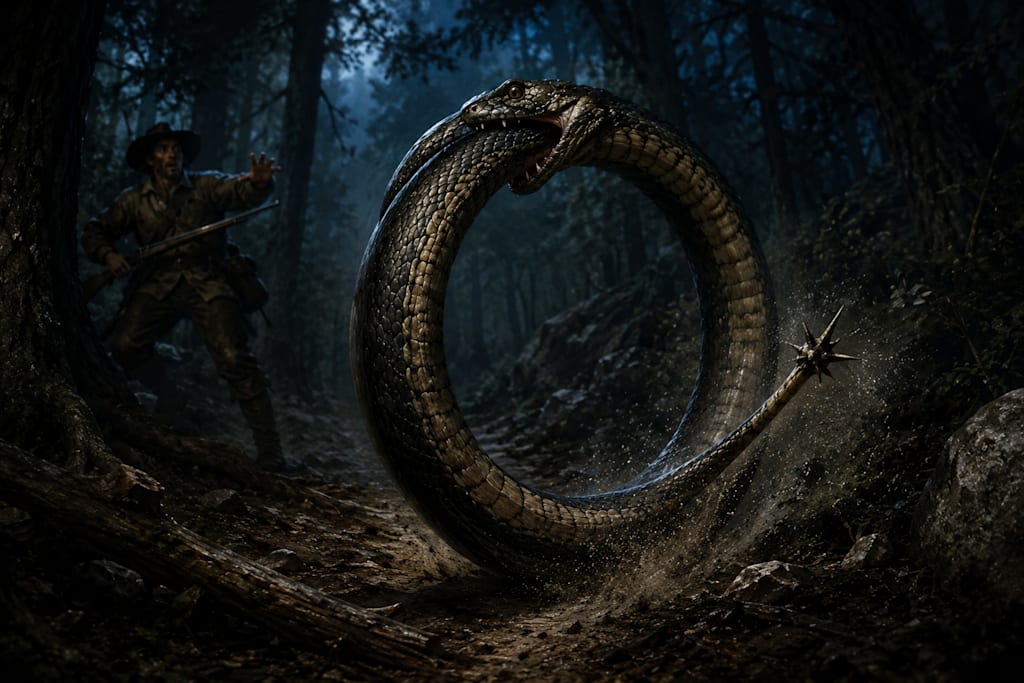
Long before America became a nation… before highways cut through forests and cities swallowed the frontier… there were stories. Stories carried by settlers, trappers, and travelers who vanished into the wilderness for weeks at a time.
Some tales spoke of strange lights in the woods. Others warned of creatures waiting beyond the edge of the firelight. But among the earliest and strangest legends ever recorded in colonial America was something so bizarre… so deeply unnatural… that many dismissed it as pure madness.
A snake that did not slither. A snake that became a wheel. Yeah, you read that right! A serpent that grasped its own tail in its mouth… rolled at terrifying speed through the forests… and struck its victims with a venomous stinger hidden at the end of its tail.
They called it… the Hoop Snake. And for generations, people swore it was real.
Act I – The Wilderness Beyond the Colonies
To understand the legend of the Hoop Snake, you first have to understand 18th-century America. This was not the mapped and civilized landscape we know today. Much of the eastern wilderness remained untamed:
- endless forests
- swampy lowlands
- rocky hills
- and miles of darkness untouched by settlement
For early colonists, the woods were both opportunity and terror. Every unfamiliar sound carried danger. Predators moved through the trees unseen. Venomous snakes lurked beneath fallen leaves. Disease spreads easily. Travelers disappeared.
And in that atmosphere of uncertainty, stories flourished. Some were obvious exaggerations. Others may have grown from genuine encounters with misunderstood animals into something ridiculous. But a few legends became so strange… so persistent… that they refused to die. The Hoop Snake was one of them.
Act II – The Rolling Serpent
Descriptions of the creature varied slightly from region to region, but the core details remained astonishingly consistent. Witnesses claimed the Hoop Snake possessed an extraordinary method of movement. Rather than slithering like an ordinary serpent, it would:
- grasp its tail in its mouth
- bend its body into a circular hoop
- and propel itself forward by rolling rapidly across the ground
Some reports described it moving downhill at terrifying speed, crashing through brush and trees with unnatural momentum. Others claimed it could pursue victims relentlessly over long distances. And then came the detail that elevated the creature from bizarre curiosity into nightmare fuel. The tail...
According to legend, the Hoop Snake’s tail ended not merely in a point... but in a deadly venomous stinger. Rather than biting prey as is traditional, the snake allegedly struck by uncoiling at the last moment and driving its venomous tail into the victim with tremendous force.
It was a horrifying Hollywood image:
- a rolling wheel of muscle and venom
- silently rushing through the woods
- before exploding outward into an attack
Even by frontier standards, the creature sounded impossible. And yet the stories spread anyway.
Act III – Encounters in the Forest
Throughout the 18th and early 19th centuries, reports of Hoop Snake sightings appeared across parts of the American East Coast and frontier territories.
Travelers described hearing strange sounds in wooded areas before glimpsing circular movement between the trees.
Hunters claimed they narrowly escaped encounters by diving behind large obstacles.
One particularly persistent detail recurred in the folklore: the creature was supposedly unable to stop easily once it started rolling at full speed. Because of this, some stories claimed victims survived by placing trees or rocks between themselves and the attacking serpent, causing it to crash violently into the obstacle.
Another bizarre variation suggested the Hoop Snake’s venom was so potent that trees struck by its tail would wither and die shortly afterward.
Whether exaggerated or entirely invented, the imagery became deeply embedded in frontier storytelling.
And perhaps that is because the Hoop Snake represented something larger than itself. Not merely an animal. But the unpredictability of the wilderness itself.
Act IV – Fear, Folklore, and Frontier Psychology
Modern readers often laugh at cryptid stories like the Hoop Snake. And on the surface, it’s understandable. Biologically, the creature makes little sense.
Snakes are not structured to move this way. Rolling locomotion of that kind would be incredibly impractical for a real serpent. So why did so many people repeat the story? Part of the answer lies in the psychological atmosphere of colonial America.
Imagine traveling alone through dense forest in the 1700s:
- exhausted
- sleep deprived
- isolated
- constantly alert for danger
Under those conditions, fear transforms perception. A startled glimpse of an animal moving unusually through the underbrush could easily become something monstrous in memory.
And once stories spread orally between settlements, details grew sharper, stranger, and more terrifying. But even so… the consistency of certain elements remains fascinating. The wheel shape. The odd rolling motion. The venomous tail.
These details recurred across different regions and retellings. Which raises the enduring and more disturbing question: Did the legend evolve from pure imagination? Or from something real that people fundamentally misunderstood?
Act V – Theories Behind the Legend
Over the years, researchers and folklorists have proposed numerous explanations for the Hoop Snake myth.
Some believe the legend emerged from sightings of ordinary snakes contorting themselves defensively. Others point toward hoop-like movement seen in certain caterpillars or reptiles under rare circumstances.
Another possibility is symbolic storytelling. Serpents have long represented danger, chaos, and hidden evil across cultures worldwide. The Hoop Snake may have simply become America’s uniquely frontier-flavored version of ancient serpent mythology.
But there’s another reason the legend endured. The image itself is unforgettable. A wolf attacks predictably. A bear behaves like a bear. But a snake that transforms into a wheel and rolls silently through the forest? That violates instinct and every conceivable interaction with all snakes, regardless of their location.
And the human mind remembers things that violate instinct. Especially in the dark.
Act VI – The Wilderness Remembers
As America expanded westward and scientific understanding improved, reports of the Hoop Snake gradually faded. Roads replaced wilderness trails. Settlements became towns. The deep forests retreated beneath axes and railroads. But the legend never disappeared completely.
Even today, stories occasionally surface in rural folklore collections and regional ghost tales. Usually half-jokingly. Usually told around campfires or during long nights in isolated cabins. Yet the image still carries power.
Because something about the Hoop Snake taps into an ancient fear: the fear that nature may still hide forms of life we do not fully understand. And perhaps more importantly… the fear that some legends survive because they are too strange to forget.
In Closing
The Hoop Snake may never have existed. Perhaps it was merely a frontier myth born from exhaustion, fear, and imagination. But legends do not endure for centuries without reason. Something about the story captured people’s minds so completely that it rolled through American folklore generation after generation… refusing to die.
And somewhere in the oldest forests of the East Coast… when the wind moves strangely through the trees… it is still possible to imagine hearing something impossible approaching through the darkness.
Not slithering... but rolling.
About the Creator
Veil of Shadows
Ghost towns, lost agents, unsolved vanishings, and whispers from the dark. New anomalies every Monday and Friday. The veil is thinner than you think....
Enjoyed the story? Support the Creator.
Subscribe for free to receive all their stories in your feed.
Comments
There are no comments for this story
Be the first to respond and start the conversation.