

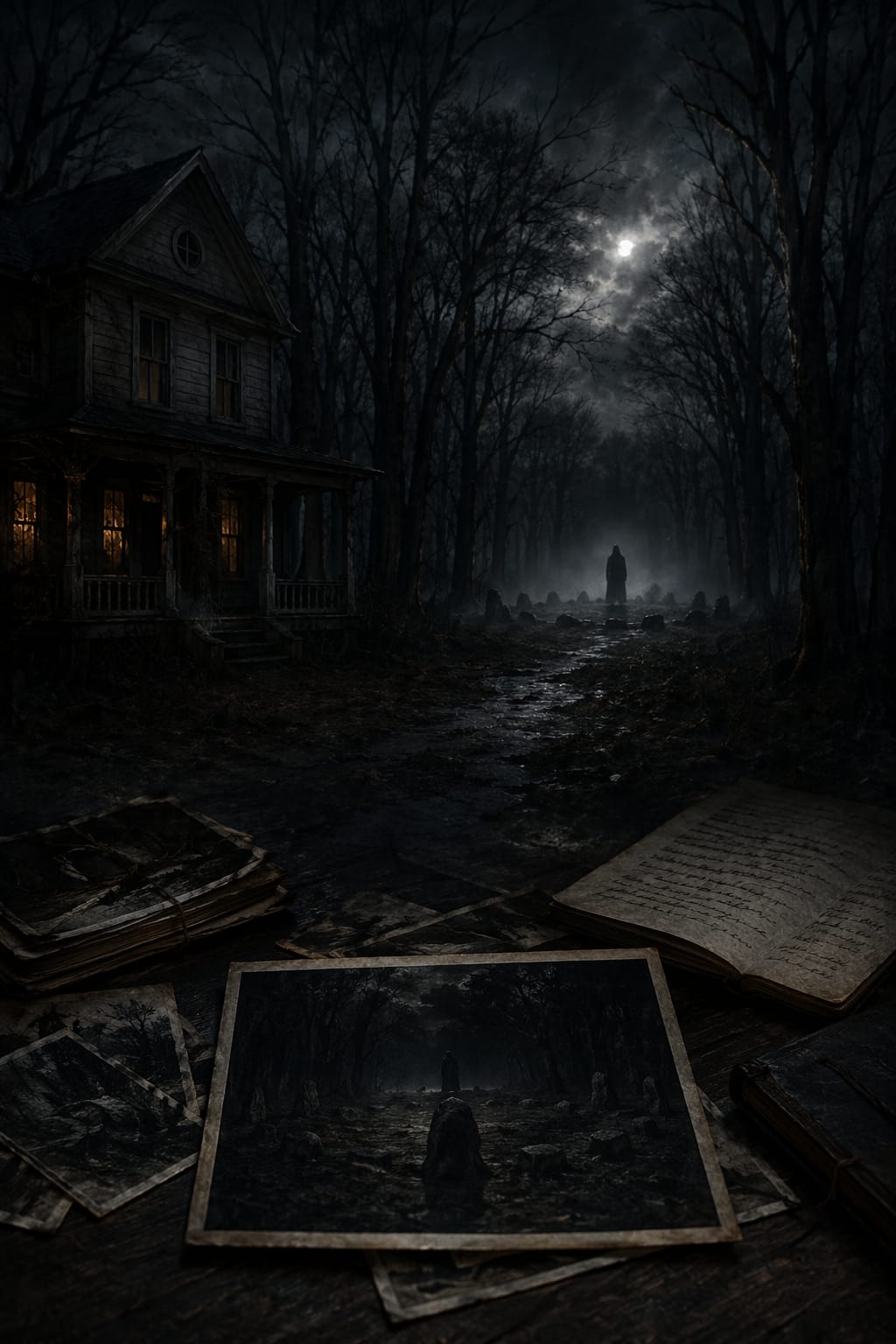
The town of Greyhollow had always felt older than its records suggested. Maps drawn before the turn of the century showed no settlement where the town now stood — only a blankness, a cartographer's hesitation, as though the land itself had refused to be named. The locals never spoke of this. They had learned, the way all small communities learn such things, through silence passed from parent to child like a cold hand in the dark.
Margaret Voss arrived in Greyhollow on the first day of October, pulling her secondhand station wagon off the interstate onto a road that the GPS said did not exist. The signal had flickered out somewhere past mile marker forty-four, and she had driven by instinct — or something that felt like instinct, though later she would question whether it had truly been her own.
She was a restoration archivist, hired by a private collector to catalogue the contents of a house left untouched for thirty-one years. The contract had been vague. The money had not been. She had asked no further questions.
* * *
The house was called Ashfield. It sat on the eastern edge of town, separated from its neighbors by a corridor of dead elms whose bark had turned the color of old bone. The key she had been mailed — a heavy, tarnished thing stamped with a maker's mark she could not identify — fit the front door as though the lock had been waiting for it. As though, perhaps, the lock had been waiting for her specifically.
Inside, everything was exactly as the contract had described: furniture draped in white sheets, bookshelves crowded with volumes whose spines had faded past legibility, filing cabinets sealed with wax. The air tasted of cedar and something else — something she could not name, something just below the threshold of smell, like a word on the tip of the tongue that refuses to arrive.
She set up her equipment in the front parlor and began with the easiest material: printed photographs, boxed by decade. The first box, labeled simply 1940s, contained what she expected — family portraits, outdoor gatherings, the sepia formality of the era. Faces that looked back from the images with the uncomfortable intimacy of the long dead.
The second box was labeled October. Only October. No year.
Inside were forty-seven photographs. All taken at night. All in the same location — a clearing in what appeared to be woodland, ringed by stones whose arrangement was not quite natural, not quite intentional. And in every photograph, at every gathering, standing in the same position at the edge of the clearing, was a figure she could not make out clearly. Not because of photographic degradation. Not because of shadow or distance. The figure was simply — present in a way that the camera seemed reluctant to commit to fully, as though the light itself had agreed not to look directly at it.
Margaret set that box aside. She told herself she would return to it later. She did not return to it that evening. She did not return to it the following morning. On the second night, she dreamed of the clearing, and when she woke the box was open on the floor beside her sleeping bag, though she had locked it herself and placed it on the highest shelf.
* * *
The town, she discovered over the following days, had a specific relationship with October that she had never encountered anywhere else. Not the decorative affection that towns sometimes perform — the hay bales, the carved pumpkins, the manufactured nostalgia. Greyhollow's October was quieter and far more serious. Shop owners would not leave their premises after six in the evening. Children did not play outside after school. At the general store, when she mentioned the photographs and the clearing in the woods, the woman behind the counter looked at her hands and said, very carefully: "We don't go to the Corvin field. Not in October."
"Why not?" Margaret had asked.
The woman had put her change on the counter rather than placing it in her palm, and had not answered.
That night, Margaret could not sleep. She lay in her sleeping bag in the front parlor of Ashfield and listened to the house make its noises — the expected creaks of settling timber, the irregular percussion of the old heating system — and beneath all of it, irregular, intermittent, something that she kept interpreting as footsteps from the floor above even though she had confirmed, on the first day, that the upper staircase was structurally compromised and the second floor inaccessible.
At precisely 2:47 in the morning, she heard something press against the front door from the outside. Not a knock. A pressure. A weight leaning. She lay completely still for eleven minutes. She counted. She would later be unable to explain why she counted, only that it had felt important to keep her mind occupied with something measurable.
At 2:58, the pressure stopped. She did not open the door. In the morning, there were no marks on the steps, no impression in the frost-hardened ground. There was, however, a single dead elm leaf placed precisely in the center of the doormat — a leaf from no tree she could see within thirty feet of the house.
* * *
On the sixth day, she found the journals.
They had been stored in a false-bottomed drawer in the study, beneath a layer of blank ledger paper so carefully arranged that she nearly missed it. There were nine of them — slim, cloth-bound, each labeled with a single year spanning 1961 to 1991. The handwriting was consistent across all nine: small, precise, slanting slightly to the left in the manner of someone who had been taught to write with a hand they did not prefer.
The journals belonged, she eventually determined, to the last resident of Ashfield — a man named Thomas Vane, a county surveyor, who had lived alone in the house from 1958 until 1991, when he had disappeared. Not died. Not moved. Disappeared. The record of his life simply stopped, mid-October, mid-sentence, in the ninth journal. The final entry read:
It has been patient. I thought patience was a virtue I could outlast. I see now that patience, in the right entity, is not a virtue at all. It is a certainty. I have been hearing my name spoken in a voice that has no mouth for thirty years and I have always told myself — tomorrow I will leave. Tomorrow has been very good to me. Tonight is different. Tonight I can hear it at the bottom of the stairs and it is no longer calling. It has stopped calling. It is simply
The sentence ended there. No period. No explanation.
Margaret closed the journal. She sat for a long time in the failing afternoon light of the study. Then she opened her laptop, navigated to her email, and began composing a message to the collector who had hired her, explaining that she would need to terminate the contract.
She stopped typing when she noticed the date displayed in the corner of her screen. She had arrived on October 1st. It was now October 13th. She had planned to stay for two weeks. She had told herself, on day one, that she would leave by the 15th at the latest.
She could not explain, when she tried, why she had not left. Each evening she had intended to. Each morning she had found reasons to stay — one more box uncatalogued, one more file unsealed, one more curiosity that seemed to require resolution before she could leave in good conscience. She had been finding reasons since day one. She had been very good at finding them.
* * *
She packed her car that same afternoon. She did not finish the catalogue. She left the camera equipment. She left a full box of materials she had already processed and labeled. She drove down the dead-elm corridor and onto the main road through town and pointed herself toward the interstate.
At mile marker forty-four, she passed a road she had not noticed on her way in — unpaved, cutting south through dense woodland. On the post at its entrance was a sign so weathered she almost could not read it. She read it at forty miles per hour, in fading light, in the last week of October.
It said: CORVIN FIELD — 1.2 MI
She did not turn down it. She kept driving. The GPS found a signal at mile forty-seven, exactly as it had lost one at mile forty-four. She did not find this suspicious in the moment. Later, back in the city, back in her apartment with its good locks and its noise-canceling walls, she would find it deeply suspicious. She would find many things deeply suspicious, in retrospect. She would lie awake in her apartment — which had, in the first week of November, begun to seem subtly wrong in ways she could not articulate — and think about Thomas Vane, who had told himself tomorrow for thirty years.
She would think about patience as a certainty.
She would think about the figure at the edge of the clearing, present in forty-seven photographs across an unknowable span of time, always at the same position, always in the same attitude — not watching, exactly. Not waiting, exactly. Something between the two. Something for which, she was increasingly certain, no precise word existed in any language she had access to.
On the third of November, a package arrived at her apartment. She had not given her address to anyone in Greyhollow. The package contained no return address. Inside, wrapped in a single sheet of blank ledger paper, was a photograph — taken at night, in a clearing she recognized, at the edge of which stood a figure she recognized.
Beside the figure, slightly blurred but unmistakably present, stood a woman with her back to the camera, looking toward the center of the ring of stones.
The woman was wearing Margaret's coat.
The photograph was dated October 9th. She had been alone in Ashfield on October 9th. She had not left the house.
She turned it over. On the back, in small, precise handwriting that slanted slightly to the left, was a single sentence:
You've been very good at finding reasons.
About the Creator
Alpha Cortex
As Alpha Cortex, I live for the rhythm of language and the magic of story. I chase tales that linger long after the last line, from raw emotion to boundless imagination. Let's get lost in stories worth remembering.
Enjoyed the story? Support the Creator.
Subscribe for free to receive all their stories in your feed.
Comments
There are no comments for this story
Be the first to respond and start the conversation.