
The Hexham Heads: England's Most Disturbing Haunted Artifacts?
Forewarning Friday Edition

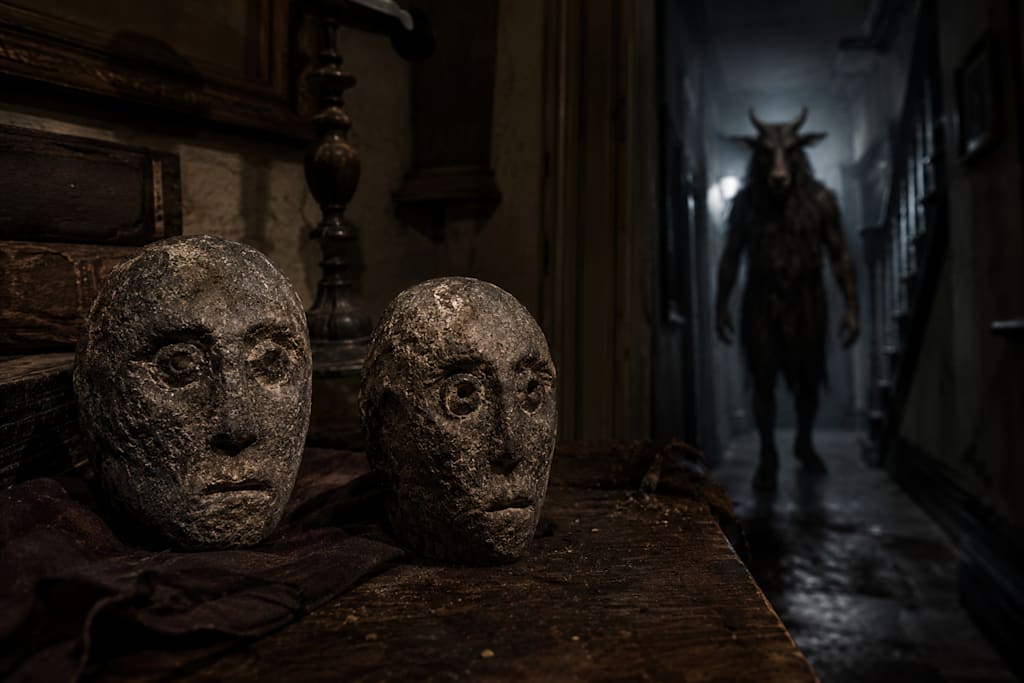
In February 1971, two young boys were digging in their family's garden in the quiet market town of Hexham, Northumberland. At first, their discovery seemed unremarkable; children find strange things in gardens all the time: old bottles, rusty tools, forgotten toys. But what the boys uncovered was something far stranger. Buried beneath the soil were two small stone heads, each only a few inches tall and crudely carved. Their faces were unusual, wide-eyed, expressionless, and unsettling in a way that was difficult to explain. They looked ancient, perhaps even primitive.
No one in the family realized that this find would become one of Britain's strangest paranormal mysteries. Because, according to numerous witnesses, the moment those stone heads entered the house, something entered with them. The artifacts became known as the Hexham Heads, and for years they would be linked to terrifying reports of unexplained phenomena, violent disturbances, and one particularly disturbing visitor. A creature that witnesses described as neither fully human nor fully animal, a thing that seemed to emerge wherever the heads were kept.
The boys brought the stone carvings inside and showed them to their parents. At first, the heads were simply treated as curiosities; no one thought much about them. Then, strange events allegedly began to occur inside the house. The family reported hearing unexplained noises during the night. Heavy objects appeared to move without explanation: furniture shifted, items fell unexpectedly. One incident in particular would become legendary among paranormal researchers: according to family accounts, large objects were heard crashing violently down the staircase, but when family members investigated, they found no obvious explanation. The sounds had been real, the impacts loud, yet nothing could account for them.
As unsettling as these incidents were, they were only the beginning. Soon, the reports became far stranger. Family members claimed they occasionally awoke to find their bedrooms in disarray, blankets disturbed, and objects moved. The atmosphere in the house reportedly felt oppressive, as though something unseen were sharing their space.
Then came the sightings. One family member reported glimpsing a dark figure moving through the hallway at night; another described hearing unusual scratching sounds. The stories escalated until witnesses began describing a creature unlike anything they had ever seen. Reportedly covered in coarse hair, walking on two legs, with a vaguely human shape but a distinctly animal face. Some compared it to a sheep, others saw features resembling a goat. The creature became known as the "half-man, half-sheep" apparition. According to reports, it would appear briefly before vanishing into darkness, sometimes pacing through hallways, sometimes standing motionless in doorways, sometimes watching from shadows. While the descriptions varied slightly, the central image remained remarkably consistent: a human-sized animal figure associated with the mysterious stone heads.
Word of the strange events soon spread beyond the family. Local researchers and historians became interested, among them a scholar with expertise in Celtic artifacts and ancient traditions. She was intrigued by the possibility that the heads might be genuine relics; the carvings were unusual, and some researchers suggested connections to ancient Celtic practices, while others believed they were more recent creations.
To study them more carefully, the scholar took possession of the heads. At that point, one might expect the haunting stories to end, after all, if the phenomena were simply the result of imagination, suggestion, or family anxiety, removing the objects from the house should have solved the problem. Instead, the reports allegedly followed the heads. According to later accounts, the scholar began experiencing disturbances of her own: noises, unusual sensations, and eventually, sightings. Most disturbing of all, she reportedly described encountering the same animal-like entity that had terrified the original family. The details differed slightly, yet the similarities were difficult to ignore. Again, there appeared to be a large, hairy creature; again, it seemed connected to the presence of the stone heads; and again, it manifested at night.
For believers, this was powerful evidence; the phenomenon appeared to be attached to the objects themselves rather than to the original witnesses. For skeptics, however, another explanation existed: once stories enter public awareness, expectations can influence perception, and someone who knows a haunting story may become more likely to interpret ordinary events as extraordinary. This remains one of the most common skeptical interpretations today. But even skeptics admit the case contains some unusual details.
One of the most fascinating aspects of the Hexham Heads mystery concerns their possible origins. Several researchers examined the artifacts over the years, and opinions varied dramatically. Some believed the carvings might have been modern creations, others suspected they could be much older, and a few drew comparisons to Celtic stone heads discovered elsewhere in Britain. Ancient Celtic cultures often attributed spiritual significance to human heads; some historians believe severed heads were viewed as repositories of power or the soul, and stone head carvings appear throughout Celtic archaeological sites. Could the Hexham Heads have belonged to that tradition? Perhaps, yet no definitive evidence ever confirmed such a connection, and the mystery only deepened as investigations continued.
Then came another twist: the heads disappeared. At some point after changing hands among researchers and investigators, the artifacts simply vanished. No one can say with certainty where they are today; no museum possesses them; no university collection contains them; and no laboratory has ever conducted modern scientific testing. The most important physical evidence in the entire case was lost.
For paranormal enthusiasts, this disappearance only added another layer of mystery. For skeptics, it represented a frustrating dead end. Without the objects themselves, many questions can never be answered: were they genuinely ancient or modern carvings? Could traces of their origin still have been identified through modern analysis? Nobody knows. The evidence is gone, and that absence has become part of the legend.
Over the decades, explanations for the Hexham Heads have ranged from the mundane to the extraordinary. Some researchers believe the events were a classic case of suggestion and folklore. The discovery of unusual objects sparked imagination, which then influenced how ordinary events were interpreted. Others point toward environmental factors: old houses make strange noises, shadows distort perception, and stories grow with repeated retelling. Yet believers argue that the consistency of certain reports remains difficult to dismiss entirely, particularly the recurring descriptions of the animal-like figure. The so-called sheep-man remains one of the strangest aspects of the entire story, and its appearance also echoes something far older than the events of 1971. Throughout Britain, ancient folklore is filled with horned spirits, animal-headed entities, and hybrid creatures that blur the line between man and beast. Whether coincidence or cultural memory, the resemblance is impossible to ignore.
Today, the Hexham Heads occupy a peculiar place in paranormal history. Unlike many famous hauntings, there is no haunted house to visit, no preserved artifact behind museum glass, and no final explanation. Only stories, witness accounts, and a mystery that has stubbornly resisted resolution.
Perhaps the heads were nothing more than oddly carved stones. Perhaps the strange events were misunderstandings amplified by fear. Or perhaps something else occurred, something attached itself to two forgotten objects buried beneath the soil of Northumberland, something that followed them wherever they went. The truth may never be known, because the most important evidence disappeared long ago. And somewhere in that uncertainty, the legend continues to grow.
The Hexham Heads remain one of Britain's most bizarre paranormal mysteries. A case where strange artifacts emerged from the earth, unsettling reports followed in their wake, and the answers vanished almost as completely as the stones themselves. Leaving behind only a question: What exactly did those boys uncover in that garden in 1971? And why did so many people wish they hadn't?
About the Creator
Veil of Shadows
Ghost towns, lost agents, unsolved vanishings, and whispers from the dark. New anomalies every Monday and Friday. The veil is thinner than you think....
Enjoyed the story? Support the Creator.
Subscribe for free to receive all their stories in your feed.
Comments
There are no comments for this story
Be the first to respond and start the conversation.