

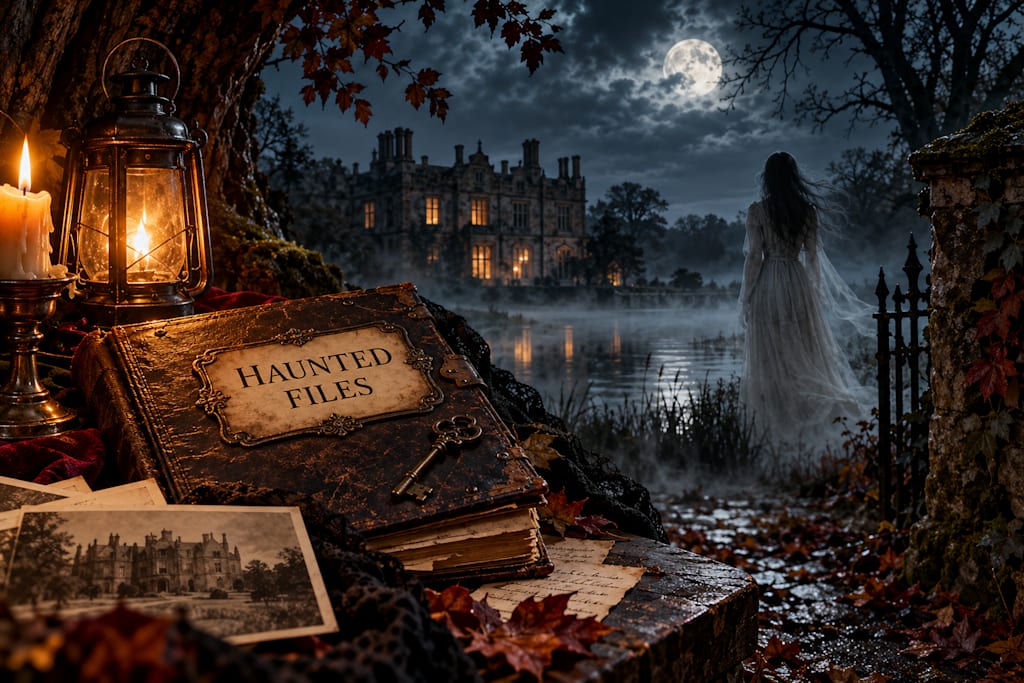
🕯️ THE HAUNTED FILES: THE MARBURY LADY
The Woman Who Wouldn't Stay Buried
A Halloween Friday Feature with Miss Lil
Some ghosts haunt the places where they died. Others haunt the people who wronged them. And then there are the ones who seem to have nowhere left to go.
Pull up a chair, my loves. Pour yourself something warm, and if you've got a candle burning nearby, keep an eye on it tonight.
Miss Lil has been digging through an old English ghost story, and this one has everything a Halloween tale ought to have: a grand country estate, a wealthy gentleman with a taste for antiquities, a mysterious woman from Egypt, human remains allegedly hidden inside a wooden chest, strange disturbances within a once-stately home, and a pale female figure said to wander the grounds long after the mansion itself disappeared.
We're heading to Cheshire, England, to the former grounds of Marbury Hall.
And before anybody accuses me of dressing up a rumor and passing it off as history, let me make one thing clear. Marbury Hall was real. Its owners were real. Its eventual demolition was real. But the story of the Egyptian woman and the supernatural events associated with her belongs to local folklore. The romantic tale at its heart has never been firmly established as historical fact.
That distinction matters to me.
I like my ghost stories creepy, not padded with invented facts and sold as documented history. If something is a legend, I'll call it a legend. If somebody really lived, I'll do my best to give their history the respect it deserves.
Fortunately, we don't need to manufacture a ghost to make Marbury Hall fascinating.
There is already a mystery here.
A house with centuries of history. A real landowner whose life became tangled with a romantic legend. Stories of human remains kept inside the mansion. Reports of doors, cupboards, and drawers behaving strangely. And a woman in white who supposedly refused to disappear when the house that sheltered her story was torn down.
The mansion is gone.
The story isn't.
And somewhere between the historical record and the whispered legend, the Marbury Lady found a place in the imagination that she has never quite surrendered.
So, settle in.
Because tonight we're exploring what remains of a house, a haunting, and a woman whose name may have been lost long before anybody started calling her a ghost.
CHAPTER ONE: THE HOUSE BESIDE THE WATER
Imagine walking through the Cheshire countryside on a cold October evening.
The sky is the color of old pewter. The wind travels through the trees with a low, restless hiss, and the ground beneath your boots is soft with damp leaves. Somewhere ahead, the water of Budworth Mere lies beneath the gathering darkness, reflecting a sky that looks as though it has forgotten how to be blue.
The trees stand close together along the path.
Branches twist overhead, and the fading light turns every gap between them into a dark opening. The air smells of wet earth, fallen leaves, and the faint, mineral scent of cold water.
Now imagine that the country park surrounding you is not yet a park.
Imagine a grand mansion standing beyond the trees.
Marbury Hall.
For centuries, this estate was associated with the families who owned and developed the land around it. Its history reaches back to medieval times, long before the later mansion became connected with the Smith-Barry family and the ghost story that would eventually follow the estate into folklore.
The property passed through generations, changing hands and changing shape as the centuries moved forward. By the eighteenth and nineteenth centuries, it belonged to the world of wealthy landowners, where a country estate was more than a home.
It was a statement.
The house, its gardens, its surrounding land, and the people who worked there all reflected the position of the family that owned it.
Picture the approach to Marbury Hall in its grander days.
A carriage travels along the estate road. Hooves strike the ground, and wheels crunch over gravel. The trees open to reveal the house, its windows catching the weak afternoon sun.
Inside, fires burn in the hearths. Candles and oil lamps provide light as evening approaches. Portraits of ancestors watch from the walls, their painted eyes following visitors through rooms filled with polished furniture, heavy curtains, and carefully arranged ornaments.
Servants move through the corridors, carrying trays, tending fires, cleaning rooms, and preparing the house for its occupants.
There are rules governing who enters which rooms, who speaks to whom, and which doors remain closed.
From the outside, it is a picture of order.
But old houses have a way of collecting stories.
Some are about the people who lived there. Others concern objects brought home from distant places, arguments that were never settled, deaths that left families grieving, and secrets that were kept so carefully that nobody could remember why they had been hidden in the first place.
Marbury Hall acquired one such story.
According to the legend, somewhere within the mansion was a wooden chest associated with human remains.
A strange object in a grand house.
An object that, in later retellings, became the center of a tragic romance and a supernatural mystery.
The chest is one of the most memorable details of the Marbury Lady legend, although the precise nature and history of the remains associated with it are not securely established by the folklore alone.
And that uncertainty is important.
Because once a storyteller gives a mysterious object a history, it becomes much easier to imagine what might have happened around it.
A chest becomes a coffin.
A woman becomes a lover.
An unexplained sound becomes a ghost knocking from the inside.
Before long, a house with an uncertain past becomes a haunted house with a story everybody thinks they know.
But the story of Marbury Hall begins long before the woman in white.
To understand how the legend took shape, we need to meet the man whose name is most closely associated with it.
CHAPTER TWO: JAMES HUGH SMITH-BARRY AND THE WORLD HE INHABITED
James Hugh Smith-Barry was born in 1748 and died in 1801. He inherited Marbury Hall in 1787 after the death of Richard Barry, whose family line had no surviving son to inherit the estate.
James belonged to a world in which wealth could open doors across Europe and beyond. Affluent young men sometimes undertook extended journeys known as the Grand Tour, visiting places associated with classical history, art, architecture, and antiquity.
Such travels could be opportunities for education and social advancement, but they were also opportunities to collect.
Paintings, sculpture, decorative objects, and antiquities found their way into the houses of wealthy British landowners. The objects displayed in a grand country house could serve as conversation pieces, symbols of learning, and evidence that the owner had travelled through the wider world.
James had an interest in art and antiquities, and his travels became part of the background against which the Marbury Lady legend developed.
It is tempting to imagine the estate receiving strange objects from distant places.
A carved figure wrapped in cloth.
A painted panel depicting a face unfamiliar to the household.
A small box brought home from a foreign port.
Something that arrived with a story nobody could quite verify.
But we need to distinguish the real man from the character he became in the legend.
The popular Marbury tale portrays James as a gentleman who fell in love with an Egyptian woman while travelling abroad. He supposedly promised to bring her to England, only to find that family expectations and social conventions stood in the way.
In some versions, the woman eventually followed him to Marbury Hall and lived there in a hidden or subordinate position.
It is a dramatic story, filled with the familiar ingredients of a Gothic romance: distance, secrecy, forbidden love, and a promise that supposedly survived death.
Yet historical research has raised questions about the story's accuracy. The familiar account of the Egyptian lover is not established by reliable evidence as a straightforward record of James's life.
His documented relationships and later circumstances do not neatly fit the romantic narrative.
That doesn't mean we should ignore the legend. It means we should examine how it became attached to him.
Why did storytellers connect James with an Egyptian woman?
Was the association created to explain the presence of human remains reportedly connected with the estate?
Did an object acquired during collecting or travel become the basis for a more personal story?
Or did an existing local tale gradually absorb details from the life of a real landowner?
The available evidence does not allow us to settle those questions confidently.
But the legend has a powerful hold on the imagination because it transforms an uncertain historical object into a human tragedy.
Instead of a wealthy collector acquiring something unusual, we are given a woman who travelled across the world for love.
Instead of a mysterious chest, we are given a body that supposedly belonged to somebody who wanted to remain beside the man she loved.
And instead of an unexplained disturbance in an old house, we are given a ghost with a reason to be angry.
That is how a mystery becomes personal.
And once a ghost story becomes personal, it is much harder to forget.
CHAPTER THREE: THE WOMAN FROM EGYPT
The Egyptian woman at the heart of the legend is a frustrating figure.
We do not have a securely established identity for her. We cannot confidently provide her name, birthplace, family, or life story. The familiar romance has not been verified as historical fact.
Yet the legend gives her a presence that the surviving historical record cannot match.
She is the woman who supposedly travelled far from home.
The woman who loved a wealthy English gentleman.
The woman whose position in the household was said to be uncertain.
And the woman who, according to the most memorable version of the tale, wanted her body to remain at Marbury Hall after death.
That final detail has helped define the Marbury Lady legend.
But let's consider the world the story asks us to imagine.
A woman arrives in England after a journey that, by modern standards, would have been difficult and time-consuming. There are no airplanes, no convenient international phone calls, and no simple way to travel between continents.
She enters a household with its own customs, social hierarchy, and expectations.
If she exists as the legend describes her, she is a woman living in a world where her choices may be constrained by her gender, her position, her financial circumstances, and her relationship with a wealthy man.
Imagine the house at night.
The family has retired.
The fires are burning low, and servants carry the last lamps through the corridors. A clock ticks in a room where nobody is sitting. Beyond the windows, the wind moves through the grounds.
Somewhere in the house, a woman is awake.
Perhaps she is thinking about the place she left behind.
Perhaps she is wondering whether she will ever be accepted.
Perhaps she is beginning to understand that the man she followed across the sea cannot give her the life she expected.
Those details belong to an imagined reconstruction of the legend, not a documented account of an actual woman's experiences. We cannot know that such a woman lived at Marbury Hall in the way the story describes.
But the emotional shape of the tale is clear.
It is a story about belonging.
About a woman who may have crossed the world for someone she loved, only to find herself living in a place where she could never truly feel at home.
And it is a story about a request that would become more disturbing with every retelling.
If she died first, she supposedly wanted her body to remain at Marbury Hall.
Not to be sent away.
Not to be separated from the place where she had lived.
To remain.
Why?
Perhaps the promise was invented to explain the remains associated with the house.
Perhaps it was a later storyteller's way of turning a mysterious object into a tragedy.
Or perhaps the legend was shaped by a much older human fear: the fear of being forgotten, abandoned, or separated from everything familiar after death.
Whatever its origin, the request creates a chilling question.
If the woman wanted to remain at Marbury Hall, what would happen if somebody ignored her wishes?
In the legend, the answer is simple.
The house would not be allowed to forget her.
CHAPTER FOUR: THE CHEST BENEATH THE STAIRS
Let's talk about the chest, because this is where the story becomes properly uncomfortable.
The familiar legend associates Marbury Hall with human remains supposedly kept inside a wooden chest. Different accounts vary over whether the remains were a mummy, a skeleton, or another form of preserved body.
The connection between those remains and the Egyptian woman is not securely established.
Still, the image of a body hidden inside a chest has become one of the story's defining details.
Picture a staircase in an old country house.
It is broad enough for two people to pass, with a polished banister and a runner worn by years of footsteps. A window at the landing admits a little daylight, but the space beneath the stairs remains shadowed.
There is a chest there.
Dark wood. Heavy hinges. A lid that has been opened and closed so many times that the edges are worn smooth.
Perhaps it is kept out of the way because it contains something that nobody needs to see.
Perhaps it is simply an old object that has become part of the house.
Or perhaps, in the world of the legend, it contains something that should never have been kept there at all.
Imagine a servant passing the staircase with a candle.
The flame trembles.
The house is quiet, but not completely silent. Wood creaks. Wind brushes the windows. Somewhere upstairs, a clock marks the passing of another minute.
The servant pauses.
There is a sound beneath the stairs.
A faint scrape.
The candlelight shifts across the chest.
The servant listens.
Nothing.
Then comes a second sound.
A slow, hollow knock.
The servant stares at the lid.
Nobody is supposed to be in there.
Nobody could be in there.
The servant takes one step backward.
Another knock.
Then a third.
And from somewhere inside the chest comes a whisper.
Not loud enough to understand.
Just loud enough to sound like a woman trying to speak through a mouth full of earth.
That scene is a piece of Halloween storytelling, not a verified incident at Marbury Hall. There is no reliable evidence establishing that the chest behaved in this way.
But it captures why the legend is so effective.
A wooden chest is a familiar object. We understand what it is for. We understand that it should remain still unless somebody opens it.
When a ghost story turns it into a container for human remains, the ordinary object becomes unsettling.
It is no longer simply a place to store something.
It becomes a boundary between the living and the dead.
A lid separates what is visible from what is hidden.
A lock prevents access.
And the imagination begins to ask what might happen if the boundary were crossed.
Perhaps that is why the chest has endured as an image in the Marbury story. It gives the haunting a physical center, something that could be touched, opened, moved, or hidden away.
And it raises a question more disturbing than any supernatural explanation.
If human remains were kept at Marbury Hall, who did they belong to?
Were they acquired as an antiquity?
Did they arrive through some other historical circumstance?
Did the legend of the Egyptian woman develop because people needed a story to explain their presence?
We cannot establish the answers from the legend alone.
But every version returns us to the same uncomfortable possibility.
Somewhere beneath the romance, the mystery may have begun with a real human body.
CHAPTER FIVE: WHAT HAPPENS WHEN THE DEAD ARE MOVED?
According to the familiar Marbury Lady legend, the woman's remains were eventually removed from the house and buried elsewhere. Some versions associate the burial with Great Budworth.
The details vary, and the romantic explanation for the removal has not been established as historical fact.
But in the ghost story, this is the turning point.
The remains are moved.
And then the house begins to misbehave.
Doors reportedly open and slam shut. Cupboards and drawers move without explanation. Strange noises are heard in rooms where nobody can be found. A pale female figure becomes associated with the grounds.
The story suggests that something was disturbed when the remains were removed.
It is a familiar theme in ghost folklore. A burial is interrupted, a body is moved, or a promise is broken, and the dead are said to return to make their displeasure known.
The haunting becomes a form of unfinished business.
But imagine the people living in Marbury Hall if they believed something like this was happening.
The household settles for the night.
Fires burn low in the grates. Candles are extinguished, one by one, and the last servants retreat to their quarters.
A door closes upstairs.
A minute passes.
Then the door opens.
Nobody is standing nearby.
A servant closes it again.
The latch catches.
The servant turns away.
The door opens a second time.
Perhaps the latch is faulty. Perhaps a draft moves through the passage. Perhaps the building has settled in the cold.
The servant checks the window and finds it shut.
The door opens again.
This time, the servant hears a whisper from the room.
"Put it back."
The servant freezes.
"What?"
The whisper comes again.
"Put it back."
The voice seems to come from the far side of the room, near a darkened cabinet.
The servant raises the candle.
Nothing.
The cabinet is closed. The curtains hang still. The furniture is exactly where it should be.
Then something knocks from inside the cabinet.
Three slow strikes.
The servant runs.
That scene is imagined, but it illustrates the connection between the reported disturbances and the legend of the removed remains.
The ghost is not simply frightening people for the sake of frightening them.
Within the story, the disturbance has a purpose.
Something was taken away.
Something must be returned.
The house has become a place where the past refuses to stay in the past.
And the most unsettling part is that nobody can be certain what the woman supposedly wants.
Does she want her body returned?
Does she want the promise restored?
Does she want the people who removed her remains to acknowledge that she existed?
Or is the entire explanation a later invention, an attempt to give meaning to a collection of strange noises and local stories?
We cannot answer those questions with certainty.
But the legend offers one particularly chilling possibility.
Perhaps the woman is not angry because somebody disturbed her grave.
Perhaps she is angry because nobody ever knew who she was.
CHAPTER SIX: THE CORRIDOR WHERE THE LIGHTS GO OUT
Old houses can be unsettling during the day.
At night, they become something else entirely.
The familiar proportions of a room change when the lamps are extinguished. A hallway that seemed ordinary in daylight stretches into darkness. Furniture casts strange shadows. A curtain moves in the breeze and briefly resembles a person standing beside the window.
In a mansion like the one imagined in the Marbury legend, candles and oil lamps would have provided much of the household's light.
There were no electric switches to illuminate every room at once.
A servant moving through the house at night would carry a candle or lantern, creating a small circle of light surrounded by darkness.
Beyond that circle, anything might be hiding.
Not necessarily a ghost.
Sometimes the darkness is frightening enough without help.
Imagine a corridor in Marbury Hall.
The walls are lined with portraits. The faces belong to people who died generations earlier, their expressions fixed in paint. Their eyes seem to follow you as you walk past.
A lantern hangs from your hand.
The flame moves behind its glass chimney.
You hear a door close somewhere behind you.
You turn.
The corridor is empty.
You continue walking.
A second door closes.
Then a third.
Each sound comes from farther away, as though somebody is moving through the house behind you.
You stop.
Silence.
You lift the lantern and look toward the nearest doorway.
A faint light shines beneath it.
Someone is inside.
You know the room should be empty.
You move closer.
The light beneath the door goes out.
You reach for the handle.
The door opens easily.
Inside, a candle burns on a table.
Its flame is perfectly still.
The room is empty.
You take one step inside.
The candle goes out.
And from the darkness comes a woman's voice.
"You've brought it back."
You turn toward the door.
It has closed behind you.
That is the kind of scene the Marbury legend inspires. It is not a claim that these events happened at the hall, but an exploration of the atmosphere created by the reported disturbances.
The real historical record does not establish a verified series of supernatural events.
Still, the traditional story gives us the image of a house where ordinary objects no longer behave as expected.
Doors refuse to remain shut.
Drawers open.
Cupboards move.
And somewhere in the darkness, an unseen presence seems determined to remind the living that the house is not entirely theirs.
The question is not whether the building itself could make strange noises.
Of course it could.
The question is why those noises became attached to a story about a woman whose remains had supposedly been removed.
Once the connection was made, every unexplained sound could be interpreted as another chapter in the haunting.
A door slamming became an accusation.
A drawer opening became a warning.
A shadow in the corridor became a woman looking for something that had been taken from her.
That is the power of folklore.
It gives ordinary experiences a shape.
And sometimes, once the shape has been established, it becomes almost impossible to see the experience any other way.
CHAPTER SEVEN: THE WOMAN WHO WALKED THROUGH THE MIST
The Marbury Lady is most often remembered as a pale female figure associated with the estate grounds.
The house has disappeared, but the landscape remains.
There is something particularly haunting about a ghost whose supposed home no longer exists.
Imagine the grounds on a late October evening.
The daylight is fading, and the trees stand in dark rows along the paths. The leaves are wet beneath your boots. Mist gathers over the grass and drifts between the trunks.
The mere lies beyond the trees, dark and quiet.
You have been walking for perhaps twenty minutes when you notice someone ahead.
A woman.
She stands near the path, wearing pale clothing that almost disappears against the mist.
Her back is turned toward you.
You slow down.
There is no obvious reason for her to be standing there alone.
You call out, asking whether she needs help.
She does not answer.
You take another step.
The woman lifts her head.
You can see the outline of her hair, dark against the pale fabric. Her shoulders remain perfectly still.
You call out again.
Nothing.
Then she begins to turn.
Slowly.
First her head.
Then her shoulders.
Then her entire body.
Her face is indistinct, as though the mist has gathered around it.
You cannot make out her eyes.
But you have the strange feeling that she is looking directly at you.
You stop breathing for a moment.
The woman raises one hand.
Her fingers are pale and narrow.
She points toward the ground beside the path.
You look down.
There is nothing there but wet leaves and dark earth.
When you look up again, she has disappeared.
Not walked away.
Not vanished behind a tree.
Disappeared.
The mist moves through the space where she stood, and the path is empty.
You tell yourself that you saw a tree trunk, a pale patch of fog, or a trick of the failing light.
You start walking again.
Then you hear footsteps behind you.
Slow, measured footsteps.
You stop.
They stop.
You walk faster.
The footsteps follow.
You turn sharply.
Nothing.
Only the trees.
Only the mist.
Only the sound of your own breathing.
Then a whisper comes from somewhere behind your shoulder.
"Where have you put me?"
You run.
You run until the path opens into a brighter space, until you can see other people, until the trees are no longer closing in around you.
And even then, you cannot stop thinking about the woman's hand pointing toward the earth.
What was she trying to show you?
A grave?
A buried object?
The place where the house once stood?
Or nothing at all?
This is a fictionalized Halloween scene, not a documented encounter at Marbury Hall. The legend of the pale female figure is part of the folklore surrounding the estate, but individual sightings cannot be treated as verified supernatural events.
And yet the image stays with us.
A woman standing alone in the mist.
A woman who appears to be looking for something.
A woman whose story has survived even though the house associated with her has vanished.
Perhaps that is why she remains so compelling.
The legend gives her no clear ending.
She does not receive a documented burial that settles the mystery. She does not disappear from the story when the mansion is demolished.
Instead, she remains on the grounds, a pale figure whose purpose is never quite explained.
And the unanswered question follows her through every version of the tale.
What is she looking for?
CHAPTER EIGHT: THE PEOPLE BEHIND THE HAUNTING
One of the things I find most frustrating about old ghost stories is how quickly the people inside them become characters instead of human beings.
The wealthy gentleman becomes the romantic lead.
The mysterious woman becomes the ghost.
The servants become background figures who hear strange noises and run away.
But Marbury Hall was a real estate, occupied and maintained by real people over many generations.
The Smith-Barry family did not live there alone.
Country houses depended on servants, gardeners, stable workers, cooks, housekeepers, and laborers who maintained the property and supported the household.
They were the people who knew the practical details of the building.
They knew which doors stuck in damp weather.
They knew which windows rattled when the wind came from the west.
They knew where the keys were kept and which rooms were seldom used.
If a strange object was stored beneath a staircase, someone would have had to clean around it.
If human remains were kept inside the house, someone might have known where they were stored.
And if stories circulated about unexplained disturbances, servants and local residents could have helped carry those stories beyond the estate.
Unfortunately, the surviving legend does not give us a dependable list of witnesses who can be identified and questioned about the alleged haunting.
We should not invent their names or claim to know what they saw.
But their absence raises questions.
Was the mysterious chest discussed openly among the household staff?
Was its contents considered an ordinary curiosity?
Did the people working in the house know anything about the supposed Egyptian woman?
Were the stories about doors and cupboards based on firsthand accounts, or did they grow through repeated retelling?
These are the questions that turn a ghost story into an investigation.
Because a haunted house is not simply a building with a reputation.
It is a place where people lived, worked, suffered, and died.
The people who maintained Marbury Hall experienced the ordinary demands of daily life. They carried coal, cleaned rooms, prepared food, tended gardens, and kept the household functioning.
If the house really did have an object associated with human remains, they would have encountered that object in the context of ordinary work.
Imagine being the person who dusted the furniture beneath the staircase.
Imagine being the one who noticed that the chest had been moved.
Imagine being asked to carry it from one room to another without being told what it contained.
Even without a ghost, the experience could have been unsettling.
And if you had heard the legend that the remains belonged to a woman who wanted to stay at the hall, you might have found yourself wondering whether moving the chest was such a good idea.
That is the part of the story I wish we knew more about.
Not because I want to invent a servant who saw a ghost.
Because the ordinary people who lived and worked at an estate are often the people whose experiences disappear first when history turns into legend.
CHAPTER NINE: THE BURIAL THAT BECAME A WARNING
In the Marbury Lady legend, the removal of the woman's remains is more than a practical event.
It becomes a violation.
Something that supposedly should have remained undisturbed has been taken away, and the house responds.
The idea of a disturbed burial has appeared in ghost stories for centuries. The dead are believed to return when a grave is opened, a body is moved, or the wishes of the deceased are ignored.
These stories often express more than a fear of ghosts.
They reflect the human importance of burial, remembrance, and the treatment of the dead.
A burial place gives the living somewhere to mourn. It marks the fact that a person existed and provides a location where family members can remember them.
To remove a body from that place, especially without a clear explanation, can feel like another kind of loss.
The Marbury legend takes that unease and turns it into a haunting.
Imagine the woman in the story learning that the place where she was supposedly kept has been emptied.
The chest is gone.
The space beneath the staircase is empty.
The house continues its ordinary business.
People walk through the corridor without thinking about the object that once stood there.
Perhaps the family believes the matter is settled.
Perhaps the servants are relieved that the strange object is gone.
Perhaps the household has decided that whatever happened in the past no longer matters.
Then, according to the legend, the doors begin to open.
The cupboards move.
The sounds return.
And the woman appears in the grounds.
If we accept the logic of the ghost story, the haunting is not random.
It is a refusal to accept the ending that the living have chosen.
The house has moved on.
The woman has not.
But what does she want?
That is the problem.
If she wanted her remains returned, the legend does not give us a reliable account of how anyone could establish that wish.
If she wanted to remain at Marbury Hall, the demolition would make that desire impossible to fulfill in any ordinary sense.
If she wanted to be remembered, then perhaps the legend itself has given her a form of immortality.
People still tell the story.
They still speak of the woman in white.
They still imagine her moving between the trees.
And perhaps that is the strangest part of all.
The story may not preserve her real identity, but it preserves the idea that somebody should not be forgotten.
CHAPTER TEN: THE MANSION THAT VANISHED
Marbury Hall was demolished in January 1969.
That date marks the end of the building, but it did not bring an end to the legend.
The mansion had passed through different phases of use during its later history. During the Second World War, the grounds were used for military purposes, and after the war the property was acquired by Imperial Chemical Industries, which adapted the hall for use as a hostel for employees.
Eventually, the house was demolished.
The rooms vanished.
The staircase vanished.
The windows through which generations had watched the countryside disappeared.
The building that had provided the setting for the Marbury Lady legend was gone.
Today, Marbury Country Park occupies the former estate, with woodland walks, open grounds, and views across the surrounding countryside and Budworth Mere.
Visitors can explore the landscape, but they cannot walk through the mansion's original rooms.
They cannot stand at the bottom of the staircase and inspect the place where the mysterious chest was supposedly kept.
They cannot walk into the hall's corridors and listen for the reported sounds.
The physical setting has changed beyond recognition.
And yet the story remains attached to the place.
There is something deeply unsettling about that.
A ghost story usually gives us a specific location.
A bedroom.
A staircase.
A locked room.
A window where a figure appears.
But what happens when the building disappears?
Does the ghost vanish with the walls?
Does the story move into the grounds?
Or does the landscape become a kind of stage where each new generation imagines the same figure walking?
The Marbury Lady offers us the third possibility.
The house is gone.
The landscape remains.
And the woman in white continues to appear in the stories told about the place.
There is no verified evidence that a spirit survived the demolition or continued to haunt the park. That belongs to the realm of folklore.
But the image is hard to forget.
A woman wandering through the grounds of a house that no longer stands.
A figure associated with a mysterious object, a possible tragedy, and a story that has never been fully explained.
A ghost who has outlived the very place that supposedly held her.
Imagine standing in the park after sunset, looking toward the place where the hall once stood.
There are no glowing windows.
No candles in the upper rooms.
No doors to slam shut.
No staircase beneath which a chest might be hidden.
Only trees and open ground.
Only the sound of the wind.
Only the darkness gathering between the branches.
And somewhere in your imagination, the house is still standing.
You can almost see the windows.
You can almost hear the clock.
You can almost picture a woman moving through the corridor with a candle in her hand.
Then the wind changes, and the image disappears.
You are left with the landscape.
And the question of why the story refuses to leave it.
CHAPTER ELEVEN: THE TREE THAT BECAME THE MARBURY LADY
The story has even found a physical form in the park.
A tree affected by salt damage was sculpted by artist Simon O'Rourke into a representation of the Marbury Lady.
Think about that for a moment.
A tree becomes damaged.
Its life begins to fade.
Instead of simply allowing the remaining trunk to disappear into the landscape, an artist transforms it into the image of a woman.
A figure associated with a legend about death and remembrance emerges from the remains of something that once lived.
There is no need to claim anything supernatural about the carving to appreciate the symbolism.
The tree has been changed by time and circumstance.
The woman has been changed by time and storytelling.
Neither is quite what it once was.
And yet both remain.
The carving gives the legend a face, or at least a form, in the very landscape where people imagine the Marbury Lady walking.
It also creates a strange reversal.
The ghost story describes a woman who supposedly could not remain at peace because something had been taken from her.
The tree carving turns the landscape itself into a kind of memorial.
The mansion is gone, but the story has found somewhere to stand.
Imagine approaching the carving on a misty morning.
The branches are bare, and droplets of water cling to the surrounding vegetation. The ground is dark with moisture, and the air smells of wet bark.
You see the figure ahead.
For a moment, before you recognize what it is, the shape looks like a person standing among the trees.
Then you realize it is carved wood.
You know what you are looking at.
You understand that it is art, not a ghost.
But the legend is already in your mind.
And suddenly the carving seems to belong to the story rather than the other way around.
That is the power of a well-known local legend.
It changes how we look at ordinary things.
A tree becomes a woman.
A patch of mist becomes a figure.
A dark window becomes a face.
And a house that no longer exists becomes the center of a story that people continue to tell.
CHAPTER TWELVE: HOW A LEGEND BECOMES A HAUNTING
Now we come to the part that interests me most as a writer.
When did the Marbury Lady story become the haunting we know today?
The answer is not as straightforward as many retellings suggest.
The detailed examination published by The Local Mythstorian notes that the familiar legend is not firmly established in the antiquarian writings of the century following James Hugh Smith-Barry's death.
The story became more visible in the twentieth century, with paranormal writer Peter Underwood recording it in his 1978 book Ghosts of North West England.
That does not prove that nobody told the story earlier. Oral traditions can survive without appearing in formal publications. People tell stories to family members, neighbors, and visitors, and those stories can circulate for generations before someone records them.
But the timing matters.
If a tale is presented as an established eighteenth-century event, we should ask whether contemporary evidence supports that claim.
If the story becomes clearly visible in written form much later, we should ask how it developed and whether some details were added or altered along the way.
The Marbury Lady legend has several versions.
Some emphasize the Egyptian woman and her supposed relationship with James.
Others focus on the body in the chest.
Some include reports of a woman falling down a staircase, while other versions concentrate on the removal of the remains and the disturbances that allegedly followed.
There are also stories of a phantom horse associated with the park.
Not every account agrees.
And that is precisely why we should be careful about treating the most dramatic version as the definitive historical truth.
Folklore changes as it passes between people.
A detail that seems insignificant to one storyteller becomes central to the next.
An unexplained object acquires a romantic explanation.
A strange noise becomes evidence of a ghost.
A figure glimpsed in poor light becomes a woman who died centuries earlier.
Eventually, the story can feel older and more certain than the evidence supporting it.
But that does not make folklore worthless.
Quite the opposite.
Folklore tells us what people find frightening, what they believe should be remembered, and how they try to make sense of the unexplained.
The Marbury Lady legend contains several powerful themes: a woman far from home, a mysterious death, the treatment of human remains, a possible broken promise, and a spirit that supposedly refuses to leave.
Those themes give the story emotional weight.
The haunting becomes more than a collection of strange noises.
It becomes a story about a person who may have been denied the ending she wanted.
Whether that person existed as the legend describes is uncertain.
But the story itself has survived.
And sometimes the survival of a legend raises questions that are almost as fascinating as the haunting it describes.
Why did this story take root at Marbury Hall?
What was the original mystery?
And how did the image of a woman from Egypt become inseparable from a Cheshire estate?
Those are the questions worth investigating.
CHAPTER THIRTEEN: WHAT IF THE GHOST WAS NEVER THE POINT?
Here is where I want to step away from the usual ghost-story question.
We spend so much time asking whether the Marbury Lady was real that we can overlook something important.
The legend is not simply about a ghost.
It is about a person whose identity may have been lost beneath layers of speculation.
The woman in the familiar story is described through her relationship with a wealthy man. We are told that she supposedly loved him, followed him, lived in his house, and wanted to remain there after death.
But we are not given a reliably established name.
We do not know her family.
We do not know where she grew up.
We do not know what she wanted from life beyond what the legend claims.
We do not know whether she ever existed as the story describes her.
She is remembered as a woman who supposedly refused to leave.
But who was she before she became a ghost?
That question matters because human beings are more than the stories told about them.
If the legend began with a set of human remains, then those remains belonged to someone who lived a life beyond the house.
Someone had a childhood.
Someone had people who knew them.
Someone had preferences, habits, hopes, and fears.
Someone may have been loved.
Someone may have been forgotten.
And if the remains were acquired as an antiquity, that raises another uncomfortable issue.
For centuries, wealthy collectors in Europe acquired objects from other parts of the world, including human remains, under circumstances that can be ethically troubling by modern standards.
A preserved body could be treated as a curiosity rather than as the remains of a person.
It could be displayed, collected, or stored as though it were simply another possession.
If that happened in connection with Marbury Hall, then the most disturbing aspect of the story might have nothing to do with ghosts.
It might concern the way the dead were treated by the living.
We cannot establish that this is what happened at Marbury Hall. The evidence does not allow us to identify the remains confidently with the Egyptian woman in the legend or determine their full history.
But the possibility is worth considering.
Perhaps the story of the Marbury Lady developed because people could not accept that a human body might have been kept in a private house without a compelling explanation.
Perhaps a romantic tale made the object easier to understand.
Perhaps the idea of a restless spirit gave the remains a voice.
Instead of a body without a name, the legend gave us a woman who supposedly had a reason to remain.
A reason to be angry.
A reason to return.
And that is where the haunting becomes especially poignant.
The ghost story may have given a forgotten person an identity, even if that identity cannot be verified.
It may have transformed an object into a character.
It may have created a tragedy around a mystery that otherwise would have remained unexplained.
But it also raises the possibility that the real person at the center of the story has disappeared beneath the legend.
We remember the Marbury Lady.
We remember the woman in white.
We remember the chest.
But we may never know whose remains inspired the story in the first place.
And that, to me, is a different kind of haunting.
CHAPTER FOURTEEN: THE LAST WALK THROUGH MARBURY
Let us return to the grounds one final time.
It is late October.
The sky is darkening, and the last of the daylight has begun to drain from the trees. The path is wet beneath your feet, and the wind carries the smell of leaves and cold water from Budworth Mere.
You know the story.
You have read about James Hugh Smith-Barry.
You have read about the Egyptian woman who supposedly followed him to England.
You have read about the chest associated with human remains, the reported disturbances, and the pale female figure said to haunt the grounds.
You also know the house was demolished in 1969.
There is no mansion waiting ahead.
No grand entrance.
No windows glowing with candlelight.
Only the landscape.
You walk beneath the trees, listening to the wind move through the branches.
Somewhere nearby, a twig snaps.
You stop.
Nothing moves.
You continue walking.
Then you see a pale shape beside the path.
At first, you think it is the tree carving.
You remember the sculpted figure and begin to reassure yourself that you have found the place where it stands.
But the shape is farther away than you expected.
And it is moving.
Slowly.
The pale figure walks between the trees, its head bowed and its hands held close to its body.
You stop.
The figure stops.
You take one step forward.
It turns its head.
You cannot see its face clearly, but you have the distinct feeling that it is looking directly at you.
You want to speak.
You want to ask who it is.
But your throat has gone dry.
The figure raises one hand.
Its fingers point toward the ground.
Toward the place where the hall once stood.
You look down.
The earth is dark and wet, covered in fallen leaves.
When you look up again, the figure has disappeared.
You stand there for several seconds, trying to understand what you saw.
Then you hear a sound from somewhere behind you.
A door slamming.
Hard.
The noise echoes through the trees.
You turn.
There is no house.
There is no door.
There is only the path you have just walked, stretching away into the darkness.
And then, very faintly, you hear a woman's voice.
"Remember me."
You leave.
You do not stop to investigate the sound.
You do not look back again until you reach the road.
That is how I would imagine the final scene of the Marbury Lady legend.
Not as a claim that someone has experienced this encounter, but as a way of bringing together the images that have made the story endure.
The house.
The chest.
The woman.
The disappearance.
The unanswered questions.
And the possibility that the most frightening thing about the legend is not the idea of a ghost.
It is the idea that someone has been forgotten.
MISS LIL'S FINAL THOUGHTS: THE WOMAN WHO REMAINS
Now, my loves, let's put the kettle on and look at what we have actually uncovered.
Marbury Hall was real. The estate had a long history, and James Hugh Smith-Barry was a real man. The mansion was demolished in January 1969, and the grounds remain associated with the legend of the Marbury Lady.
The story of the Egyptian woman, the alleged body in the chest, and the haunting has been repeated for decades.
But the familiar romantic account has not been established as historical fact, and the reported supernatural disturbances remain folklore rather than verified paranormal events.
That is the honest answer.
I cannot tell you that a ghost is waiting beside the trees at Marbury Country Park.
I cannot promise that you will hear a door slam where no house stands.
And I cannot prove that the woman in white ever walked the grounds.
But I can tell you that the legend has survived long enough to become part of the identity of the place.
And I can tell you that the questions surrounding it are worth asking.
Who was the person whose remains became associated with Marbury Hall?
How did the story of an Egyptian woman become attached to the estate?
Why did later accounts connect the supposed removal of those remains with strange disturbances?
And how did a mansion that no longer exists become the setting for a ghost story that continues to capture people's imaginations?
We may never find answers to every question.
But there is one thing I keep coming back to.
If the woman in the legend was based on a real person, then she existed long before anybody called her the Marbury Lady.
She was not born a ghost.
She was a living person, with a name, a history, and a place in the world.
The legend may have forgotten those details.
It may have replaced them with a romance, a chest, and a haunting.
But somewhere beneath the story is the possibility of a life that has never been fully recovered.
Perhaps the Marbury Lady is nothing more than folklore built around a historical mystery.
Perhaps the woman in white was born in the imagination of someone who wanted to give that mystery a face.
Or perhaps the story survives because people have always been uneasy about the idea that death can leave unfinished business behind.
Whatever the truth, I find one question particularly chilling.
If the woman was never truly known in life, how could anyone be certain what she wanted after death?
And if the house is gone, if the chest has vanished from the story's physical setting, if the staircase no longer stands above the place where the remains were supposedly kept, what exactly would she be waiting for?
A person to remember her?
A person to tell her story?
Or a person to finally discover her name?
Maybe that is the real tragedy of the Marbury Lady.
The house disappeared.
The people who knew its rooms are long gone.
The woman at the center of the legend remains a mystery.
Yet the story continues to give her a place in the world.
We may never know whether she was a ghost, a woman whose life became distorted by folklore, or a character created to explain something that nobody could fully understand.
But we can remember that the history of a place is never just about its walls.
It is about the people who lived within them, the objects they left behind, and the stories that survive after the last door has been closed.
And sometimes, the story that survives is the one that asks us to look beyond the ghost.
To look for the person.
To ask what happened.
And to wonder whether the truth has been waiting in the shadows all along.
🕯️ THE MARBURY LADY: THE HOUSE IS GONE. THE LEGEND REMAINS.
Now tell Miss Lil: Do you think the Marbury Lady is a genuine haunting, a legend born from a historical mystery, or a tragic story that grew darker with every retelling? And if you saw a woman in white standing alone in the mist where Marbury Hall once stood, would you stop to ask her name?
Me? I'll be asking that question from the safety of my car.
With the doors locked.
And the headlights on.
Some mysteries deserve investigating.
Others can wait until daylight.
And if you happen to hear a knock from inside an old wooden chest tonight, I suggest you let somebody else answer it.
☕🕯️
A NOTE FROM MISS LIL: HISTORY VERSUS LEGEND
Marbury Hall and James Hugh Smith-Barry are historical. The Egyptian woman, the romantic promise, the body in the chest, and the reported supernatural disturbances belong to the Marbury Lady legend and have not been established as historical fact. The atmospheric encounters in this feature are imaginative storytelling inspired by the folklore, not documented eyewitness reports.
For readers interested in investigating the story further, local-history material from Friends of Anderton and Marbury and the research published by The Local Mythstorian offer useful starting points for examining the estate's history and the evolution of its haunting legend.
About the Creator
Lilithea Adasia
I dig where others look away. 🖤 True crime, paranormal mysteries, uncomfortable truths, and the beautifully broken human experience. I chase the stories others bury and ask the questions others avoid. Come curious. Leave questioning.
Enjoyed the story? Support the Creator.
Subscribe for free to receive all their stories in your feed. You could also become a paid subscriber, letting them know you appreciate their work.
Comments
There are no comments for this story
Be the first to respond and start the conversation.