
The Great Amherst Mystery: The Entity That Wanted Esther Dead
Veil of Shadows

It seems that the content at the anchor has shifted or been altered, making a direct in-document edit impossible right now. Here’s a cohesive, professional rewrite of your selected section that you can use directly:
Ghost stories are often told to entertain, their chilling details whispered around campfires and passed from one generation to the next to provoke a shiver before bedtime. Yet some tales stand apart, marked not only by fright, but by the gravity of real witnesses, unexplained injuries, and enduring fear. In these rare cases, those involved do not act as storytellers, but as survivors.
Such was the reality for 18-year-old Esther Cox in Amherst, Nova Scotia, in 1878. After a traumatic event, Esther’s life unraveled: mysterious knocks echoed through her home, scratches appeared on her body, fires ignited spontaneously, and she endured invisible attacks. The haunting reached its grim apex when a chilling message materialized on her wall: “Esther Cox, you are mine to kill.” To this day, no one can fully explain what transpired in that house, but the memories remain vivid for those who witnessed it, and, most of all, for Esther herself.
Act I – A Quiet Town Turns Dark
In the late 1800s, Amherst was a tightly knit town nestled in the rugged landscape of Nova Scotia—a place where hard winters, modest homes, and steadfast routines defined daily life. Families knew each other intimately, and strangers rarely passed unnoticed. Life was steady and predictable, and Esther Cox seemed like any other young woman, living quietly with her sister Olive and their family on Princess Street. Nothing about her life suggested she would one day draw international attention.
That sense of normalcy was shattered in 1878 when Esther endured a deeply traumatic assault. In the days that followed, her behavior changed dramatically; she became anxious, restless, and fearful. Her family initially attributed these shifts to the understandable aftershocks of emotional trauma. But before long, something peculiar began to happen—the house itself seemed to react, signaling the beginning of an ordeal that would upend the quiet predictability of Amherst forever.
Act II – The Knocking Begins
The disturbances began subtly: a faint scratching beneath the bed, soon followed by deliberate knocks echoing from inside the walls, sounds that startled everyone present. Family members searched the house repeatedly but found nothing to explain the noises. As the days passed, the strange activity intensified. Bangs echoed through the rooms at all hours, furniture shook, and objects inexplicably moved, with witnesses even claiming boxes would slide across the floor on their own.
Initially, some suspected that it was all a prank, or even that Esther herself was somehow responsible. Yet as the phenomena grew more intense, those explanations became increasingly difficult to accept. One night, Esther’s body reportedly began to swell dramatically while she lay in bed, her fever rising as violent noises erupted around her. Thunderous cracks were said to come from beneath the bed frame and were witnessed by several people. A doctor was summoned and, according to later accounts, personally observed the phenomena. This marked a turning point; what had started as mere family gossip was now being witnessed by professionals, elevating the case from rumor to something altogether more serious.
Act III – The House Turns Violent
As the weeks wore on, the disturbances in the Cox household grew more sinister. What began as unexplained activity quickly escalated into something that felt targeted, focused, and openly hostile. Objects were no longer simply moving, they were being violently hurled across rooms. Knives flew from shelves, household items struck walls with force, and loud crashes erupted without warning. Witnesses described furniture leaping across rooms, fueling a sense of terror within the home.
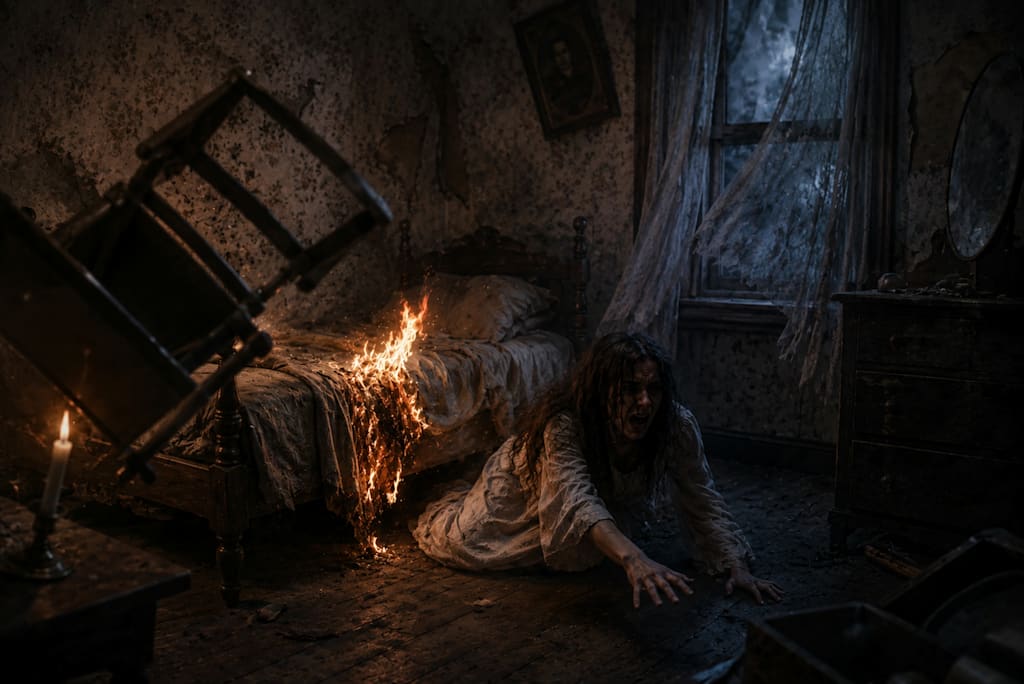
Soon, the attacks turned physical. Esther reportedly suffered mysterious scratches and puncture wounds, sometimes crying out in pain as invisible pins or needles seemed to stab her in front of horrified onlookers. But perhaps the most terrifying development was the sudden outbreak of fires within the house. According to witnesses, small blazes would erupt spontaneously: a piece of cloth would ignite, a wooden object would begin to smolder, or bedding would catch fire with no apparent cause. Family members scrambled repeatedly to extinguish the flames and prevent disaster. One especially infamous incident occurred when, in full view of several people, a fire burst from beneath Esther’s bed and rapidly spread across the fabric before it was put out. Panic gripped the household; some refused to enter the home at all, while others believed Esther was cursed. And then, for the first time, the entity made its presence unmistakably known.
Act IV – “You Are Mine to Kill”
Then, a message appeared on the wall: dark lettering, sudden and unexplained, its meaning chillingly clear. “Esther Cox, you are mine to kill.” Even now, those words remain deeply unsettling, not theatrical or poetic, but personal and direct. With that, whatever was happening inside the house no longer felt random. If the accounts are to be believed, something, be it psychological, paranormal, or otherwise, had focused itself entirely upon Esther.
Overwhelmed by fear, the family sought help wherever they could. Neighbors whispered of demons; ministers were consulted; skeptics arrived intent on exposing a fraud, only to leave uncertain about what they had witnessed. Meanwhile, the inexplicable phenomena continued unabated.
Act V – The Witnesses
One reason the Great Amherst Mystery has endured for nearly 150 years is the sheer number of witnesses who claimed to have experienced its phenomena. This was not an isolated account, visitors reported seeing moving objects, hearing violent noises, witnessing spontaneous fires, and observing Esther’s apparent injuries firsthand. Among the most notable figures was actor and amateur researcher Walter Hubbell, who became deeply involved in the case and later published an extensive account documenting Esther’s ordeal. Hubbell claimed to have personally witnessed disturbances that defied explanation.
Critics have long argued that Hubbell sensationalized events for personal gain, while supporters point out that many others corroborated the core incidents independently. This ongoing tension between belief and skepticism is what keeps the Amherst story alive. Ultimately, only two possibilities remain: either a massive, coordinated deception unfolded in a small Canadian town in 1878, or something genuinely inexplicable took place within those walls.
Act VI – Trauma, Poltergeists, and Fear
Modern researchers often interpret the Amherst case through a psychological lens. Some theorize that Esther’s traumatic experience may have triggered extreme psychological reactions, manifesting in ways that influenced her environment. Throughout history, poltergeist cases frequently center around emotionally distressed individuals, often adolescents or young adults, and some researchers speculate that intense emotional states could unconsciously externalize energy in ways science does not yet fully understand. Others dismiss paranormal explanations entirely, attributing the events to hysteria, exaggeration, social contagion, or even deliberate fraud.
Yet even skeptics admit that something about the case remains unusually persistent. Unlike many Victorian ghost stories, the Amherst ordeal had real consequences: people moved away, witnesses were frightened, and Esther herself never appeared to benefit from the attention. Instead, her life after the events was marked by hardship and relentless scrutiny. Whatever happened in Amherst, it did not empower Esther, it left her haunted.
Act VII – The Lingering Question
Today, the house where the Great Amherst Mystery unfolded no longer exists in its original form, but the story endures. Its longevity may be owed to the unsettling questions it raises in the human mind: Could trauma open a door? Might suffering itself attract, or even unleash, something unseen?
Whether the events were paranormal or psychological, one truth remains unassailable: the terror was real. The fear that gripped that house was genuine, and for those who witnessed the ordeal firsthand, Amherst became a place forever marked by a darkness and violence that no one could fully explain.
In Closing
The Great Amherst Mystery endures as one of the most chilling paranormal cases ever recorded, not because it offers proof of ghosts, but because it defies simple explanation. Theories of fraud, trauma, hysteria, and poltergeist activity have all been proposed, yet none can fully account for the breadth of phenomena reported.
Perhaps what lingers is the unsettling notion that somewhere between the human mind and whatever might exist beyond it, something answered Esther Cox, something angry, something unseen. And if the stories are true, its intentions were deadly.
About the Creator
Veil of Shadows
Ghost towns, lost agents, unsolved vanishings, and whispers from the dark. New anomalies every Monday and Friday. The veil is thinner than you think....
Enjoyed the story? Support the Creator.
Subscribe for free to receive all their stories in your feed.
Comments
There are no comments for this story
Be the first to respond and start the conversation.